
⚡ TL;DR
- The Framework: TFSD (Title, Features, Search Terms, Description) matches how Amazon’s A10 algorithm weights your listing data.
- The Silent Killer: Amazon counts BYTES not characters—249 byte limit for backend search terms. Most tools get this wrong.
- Mobile First: 70% of shoppers are on mobile. Your title gets cut at 80 characters—put core keywords early.
- Don’t Repeat Keywords: If it’s in your Title, don’t waste Bullet space. Use synonyms instead.
- Go Global Smart: Direct translation kills rankings. Use intent-aware localization for international markets.
- Skip Generic AI: ChatGPT doesn’t know Amazon’s style guides. Use policy-aware tools like Amber AI.
📋 Table of Contents
- The Physics of Amazon Listing Optimization (A10 & COSMO)
- The TFSD Framework: Your Data Architecture
- The “Silent Killer”: Bytes vs. Characters
- Intent-Aware Optimization: Beyond Direct Translation
- The 2026 Tool Landscape: A Specialist’s View
- Common Mistakes: The “Kill Your Rank” List
- FAQ: Deep-Dive Optimization
- Conclusion: Start Engineering Your Rank
Look, let’s be honest. You can have a “game-changing” product and beautiful 3D renders, but if you don’t show up on page one, you’re invisible. On Amazon, “organic discovery” is a myth for anyone who doesn’t understand the math of search.
Most sellers—and I see this every day—treat Amazon listing optimization like they’re writing a college essay. They focus on being “persuasive.” They fill every text box until it’s overflowing with adjectives.
We call this Chaos Optimization. It’s the fastest way to confuse the algorithm and kill your ranking.
Amazon’s A10 Algorithm and its newer COSMO layer aren’t looking for great prose. They are looking for specific signals. If your data structure is a mess, the machine won’t know where to put you.
This is the blueprint for 2026. No fluff, no “growth hacks.” Just the engineering physics of proper Amazon listing optimization.
The Physics of Amazon Listing Optimization (A10 & COSMO)
Amazon is a search engine that happens to have a warehouse. Its only goal? Revenue Per Search (RPS).
Why Your Keyword Stuffing Isn’t Working
In the old days of the A9 Algorithm, you could rank just by keyword frequency. Repeat “Garlic Press” enough times and you’d climb the ranks. That era ended years ago.
The A10 algorithm and COSMO (Common Sense Model) prioritize Behavioral Relevance.
* A10 tracks sales velocity relative to specific keywords. It’s all about conversion.
* COSMO adds a layer of “common sense.” It knows that a user searching for a “camping chair” probably cares about “portability” and “weight limits,” even if they didn’t type those words.
If your Amazon listing optimization strategy doesn’t align with these behavioral signals, the math will work against you. Period.
The Weighting Hierarchy
Amazon weights different fields differently. It’s a waterfall:
1. Title: Your primary signal. High-weight indexing.
2. Features (Bullets): Secondary. Great for long-tail phrases.
3. Search Terms (Backend): Crucial for indexing, invisible to the customer.
4. Description: Low indexing weight, high conversion power.
If you treat your bullets with the same keyword priority as your title, you’re making a massive technical error. You’re diluting your strongest relevance signals.
The TFSD Framework: Your Data Architecture
We developed the TFSD Framework to force sellers into a rigid data hierarchy: Title, Features, Search Terms, Description. This is the core of effective Amazon listing optimization.
1. Title: The 200-Character Constraint
Your title is your H1 tag. It is your strongest signal to the machine.
* The Engineering: Brand + Core Keyword + Variant + Top Differentiator.
* The Trap: Avoid “Best” or “Premium.” Amazon ignores them, and you’re just burning character count.
* Mobile First: 70% of shoppers are on mobile. Your title gets cut off at 80 characters. If your core keyword is at character 120, you’ve already lost the click.
2. Features: The Benefit-First Model
Stop repeating keywords from your title in your bullets. It doesn’t give you “extra points.”
* The Goal: Use secondary keywords and focus on conversion.
* Formatting: Start every bullet with a capitalized benefit (e.g., DISHWASHER SAFE) followed by the technical proof.
3. Search Terms: The Backend Janitor
This is the catchment area for keywords that are high-volume but “ugly” for readability. Misspellings. Spanish translations. Synonyms.
* Pro Tip: Don’t use commas. They consume bytes. Spaces are all you need.
4. Description: Brand Storytelling
Use this for A+ Content. While it doesn’t index heavily, it keeps people on the page. Longer dwell time and higher conversion feed the sales velocity signal that A10 loves.
The “Silent Killer”: Bytes vs. Characters
If there’s one thing that keeps me up at night for our clients, it’s this:
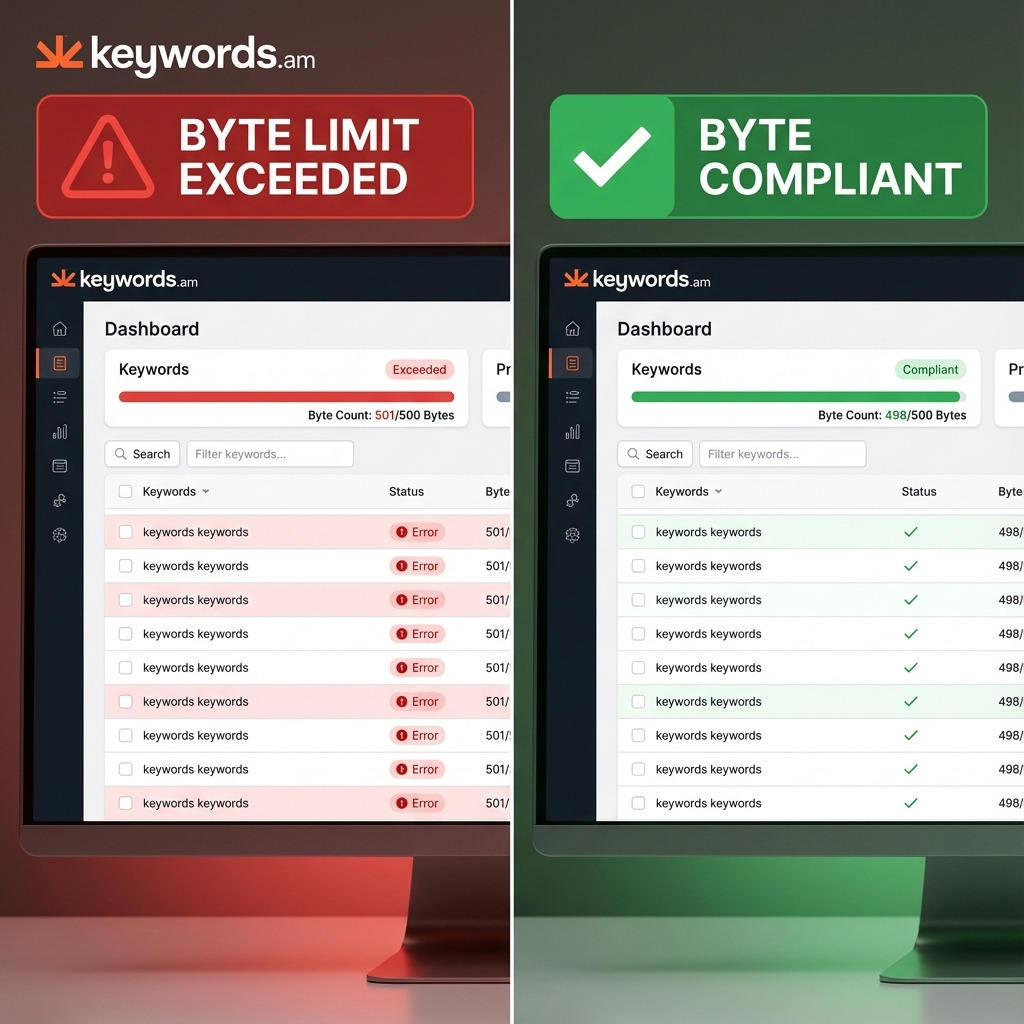
Amazon counts BYTES, not characters.
Amazon’s documentation is very clear—backend search terms are limited to 249 bytes.
The Math of De-Indexing
In standard English, 1 character is 1 byte. But when you sell internationally, things get messy:
* A Spanish ñ = 2 bytes.
* A Japanese 猫 = 3 bytes.
* An Emoji 🔥 = 4 bytes.
If you’re using a “all-in-one” tool like Helium 10 that counts characters, you’re playing a dangerous game. You might write 249 characters, but if you have a few special symbols or foreign characters, you’re at 260 bytes.
The result? Amazon doesn’t just truncate the extra words. They reject the entire field. You won’t get a warning. You’ll just see your traffic flatline and wonder what happened.
Keywords.am is the only tool that uses marketplace-specific byte counters. We stop you at 249 bytes, whether you’re listing in the US, Mexico, or Japan.
Intent-Aware Optimization: Beyond Direct Translation
Selling globally is the easiest way to double your sales, but direct translation is a suicide mission.
You need Intent-Aware Localization.
Take “Sunscreen.” In the US, it’s generic. In Mexico, there’s a massive difference in search volume between “Protector Solar” and “Bloqueador Solar.” If you use the wrong one, you’re invisible to the majority of the market.
We use IntentIQ to find the high-volume terms people actually search for in their native markets. We build listings around local search habits, not a dictionary. This is the future of Amazon listing optimization for global brands.
The 2026 Tool Landscape: A Specialist’s View
Stop paying for bloated tools that get the technical details wrong.
Feature |
Helium 10 |
Keywords.am |
|---|---|---|
Core Strength |
Product Sourcing |
Ranking & Optimization |
Counter Logic |
Characters (High Risk) |
Bytes (Zero Risk) |
Methodology |
Generalist |
TFSD Specialist |
AI Support |
Generic GPT |
Amber AI (Policy Aware) |
Team Access |
$279/mo (Diamond) |
$129/mo (Growth) |
The Bottom Line: Keep Helium 10 for your product research. Black Box is great. But for the actual work of optimization, it’s clunky and technically inaccurate. Keywords.am is the tool for sellers who prioritize technical rank.
Common Mistakes: The “Kill Your Rank” List
Audit your current listings for these three “rank killers”:
- Subjective Fluff: “High quality” or “Best seller.” The algorithm ignores it. Use objective specs instead.
- Repetitive Keywords: If it’s in your Title, don’t waste space in your Bullets. Use that space for a synonym instead.
- Forbidden Trigger Words: Words like “Antibacterial” or “Eco-friendly” can trigger automatic pesticide reviews. Use Amber AI to flag these before you publish and get your listing suppressed.
FAQ: Deep-Dive Optimization
How often should I update?
At least quarterly. Trends change. Competitors move. Use our Keyword Tracker to see exactly when your rank starts to dip so you can fix it before it’s too late.
Does A+ Content text index?
Barely. Use it for conversion. Your Title and backend Search Terms are the heavy lifters for indexing.
Can I just use ChatGPT?
I wouldn’t. Generic AI doesn’t know Amazon’s style guidelines. It will write “Best Selling” in your title and get your listing flagged. Use a policy-aware assistant like Amber AI.
Conclusion: Start Engineering Your Rank
Amazon listing optimization in 2026 is a game of precision. Following the A10 algorithm’s rules isn’t optional; it’s the cost of entry.
Don’t let a character counter destroy your ranking.
Ready to find the holes in your strategy?
Import your listing to Keywords.am now. We’ll show you your real byte count and your optimization score in seconds. It’s time to start engineering your success.