
📑 Table of Contents
- What is the Amazon honeymoon period and why does it determine your keyword strategy?
- What keywords should you target in your first 30 days?
- When should you graduate from long-tail to mid-tail keywords?
- How does the Halo Effect drive keyword progression on Amazon?
- What does Phase 3 look like for short-tail keyword competition?
- What if you missed the Amazon honeymoon period?
- Frequently Asked Questions About Amazon Product Launch Keyword Strategy
- Conclusion
TL;DR
- Most product launches fail because sellers target high-competition keywords too early, wasting the critical 90-day honeymoon period.
- The Keyword Progression Framework structures targeting into three 30-day phases: long-tail foundation, mid-tail expansion, and short-tail competition.
- The “Halo Effect” allows listings to rank for broad terms automatically after proving conversion on specific long-tail phrases.
- TACoS targets should decline from under 60% in Phase 1 to under 25% by Phase 3 as organic rankings stabilize.
- Backend search terms must evolve alongside visible keyword targeting to maintain relevance signals.
- Relaunching products to reset the honeymoon period is risky; applying the progression framework to existing listings is safer and effective.
Most sellers treat keyword strategy the same on day one and day ninety. That is why most launches fail.
According to Nielsen research, 85% of new consumer products fail within 12 months. While Amazon sellers often fare better (64% achieve profitability within their first year), the initial 90 days determine whether a product gains organic traction or stalls indefinitely. The difference typically lies in how sellers approach keyword targeting during the critical launch window.
A common error involves researching keywords before launch, compiling a comprehensive list, and targeting every term simultaneously through PPC and listing optimization. This scattershot approach wastes the algorithmic advantage known as the “honeymoon period.” Spending $50-75 per keyword on exact match PPC before generating a single organic sale depletes budgets rapidly without building the necessary relevance signals.
The solution is the Keyword Progression Framework. This structured approach, analyzed across thousands of product launches, aligns keyword targeting with the natural lifecycle of a new Amazon listing. By phasing targets from long-tail to short-tail over 90 days, sellers can systematically build the authority required to compete for high-volume search terms.
No existing guide provides a concrete model for how keyword targeting should evolve from long-tail to short-tail. This article outlines the progression framework that successful brands use to navigate their first three months on the platform.
What is the Amazon honeymoon period and why does it determine your keyword strategy?
The Amazon honeymoon period is a 30-to-90-day window after launch where Amazon’s algorithm gives new products temporary ranking boosts to evaluate their market fit.
During this window, Amazon evaluates click-through rate (CTR), conversion rate (CVR), and revenue to determine long-term organic positioning. Industry experts like Carbon6 and Brandon Young have documented this phenomenon extensively. The algorithm effectively subsidizes visibility for new items to gather performance data quickly. If a product converts well during this time, it retains its rank; if it fails to convert, it drops to obscurity.
The window is not officially confirmed by Amazon documentation but is a well-documented reality observed by sellers and agencies over years of data. It functions similarly to a probationary period at a new job. Amazon watches how a listing performs on each keyword to decide whether it deserves a permanent position on page one.
This period creates urgency for a precise keyword research methodology. Targeting competitive terms that a new listing cannot convert sends negative signals to the algorithm. Conversely, proving relevance on specific, lower-competition terms builds the trust score required to target broader keywords later. Understanding the honeymoon period explains why a phased approach is necessary.
What keywords should you target in your first 30 days?
During days 1-30, target 15-25 long-tail keywords with lower competition where a new listing can realistically win page-one placement and build initial sales velocity.
Phase 1 of the Keyword Progression Framework focuses entirely on establishing a foothold. Pre-launch research is critical here. Sellers should identify 5-12 initial seed keywords using competitor analysis. Tools like reverse ASIN lookup help identify the specific terms driving sales for established rivals, but the goal is not to copy them directly. Instead, the focus should be on long-tail variations.
Long-tail keywords for this phase should be phrases of three or more words. These terms typically have lower search volume but significantly higher purchase intent and less competition. For example, instead of targeting “yoga mat” immediately, a new seller might target “extra thick yoga mat for bad knees” or “non-slip yoga mat for hot yoga.” These specific queries indicate a buyer who knows exactly what they want, increasing the likelihood of conversion for a new product with few reviews.
PPC strategy during Phase 1 requires aggressive exact-match bidding on these selected long-tails. Bidding 10-20% above the suggested rate ensures visibility. A daily budget of $20-30 is often sufficient because the search volume is lower. Sellers should expect and accept a TACoS (Total Advertising Cost of Sales) under 60% during this phase. The objective is data acquisition and sales velocity, not immediate profitability.
Backend search terms should also align with this strategy. Sellers should fill all 250 bytes with long-tail variations that did not fit naturally into the visible listing copy. Backend keywords provide additional indexing opportunities without cluttering the title or bullet points. By day 30, the goal is to secure 5-10 organic page-one rankings on long-tail terms and accumulate the first 10-15 reviews.
When should you graduate from long-tail to mid-tail keywords?
Between days 31-60, expand to mid-tail keywords with moderate competition as organic rankings and reviews provide the conversion data needed to compete at this level.
Graduating to Phase 2 is not automatic; it is earned. The criteria for moving to mid-tail keywords include having at least 10 reviews, consistent daily sales, and organic rankings on at least 5 long-tail terms. Without these trust signals, mid-tail keywords will likely yield poor conversion rates and wasted ad spend.
Mid-tail keywords typically consist of two to three words and have moderate search volume. The review count for top competitors on these terms should be closer to the seller’s current count. Continuing the previous example, a seller would graduate from “extra thick yoga mat for bad knees” to “thick yoga mat” or “yoga mat non-slip.”
Budget allocation must shift during this phase. Exact match campaigns should account for 40-50% of spend, while phrase match increases to 25-30% to capture variations. Auto and broad match campaigns can utilize the remaining 20-25% to mine for new terms. Sellers should review search term reports weekly to harvest converting terms and add them to manual campaigns.
The TACoS target for Phase 2 drops to 30-45%. As organic sales from Phase 1 rankings begin to supplement paid traffic, the overall efficiency of the account should improve. By day 60, a healthy listing will have 15-40 active keywords and show organic ranking improvements on mid-tail terms.
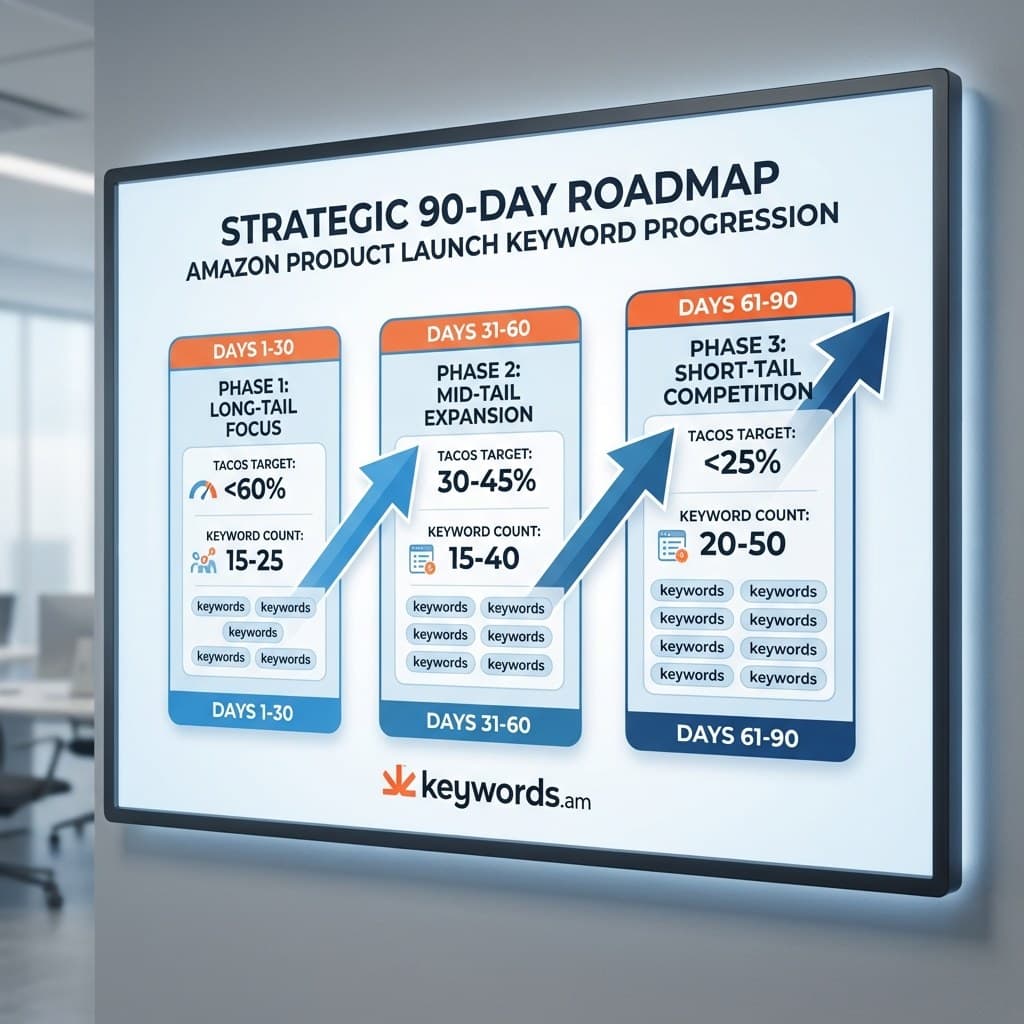
90-Day Keyword Progression Framework
|
Phase |
Days |
Keyword Type |
# Keywords |
Match Types |
TACoS Target |
Milestone |
|---|---|---|---|---|---|---|
|
1 |
1-30 |
Long-tail (3-5 words) |
15-25 |
Exact match focus |
<60% |
5-10 page-one rankings, 10-15 reviews |
|
2 |
31-60 |
Mid-tail (2-3 words) |
15-40 |
Exact 40-50%, Phrase 25-30% |
30-45% |
Organic rank growth, declining TACoS |
|
3 |
61-90 |
Short-tail (1-2 words) |
20-50 |
Exact 50-60%, broad discovery |
<25% |
Stable organic rankings, profitability |
How does the Halo Effect drive keyword progression on Amazon?
The Halo Effect occurs when Amazon’s algorithm tests a product on higher-volume search terms after it demonstrates strong performance on related long-tail keywords.
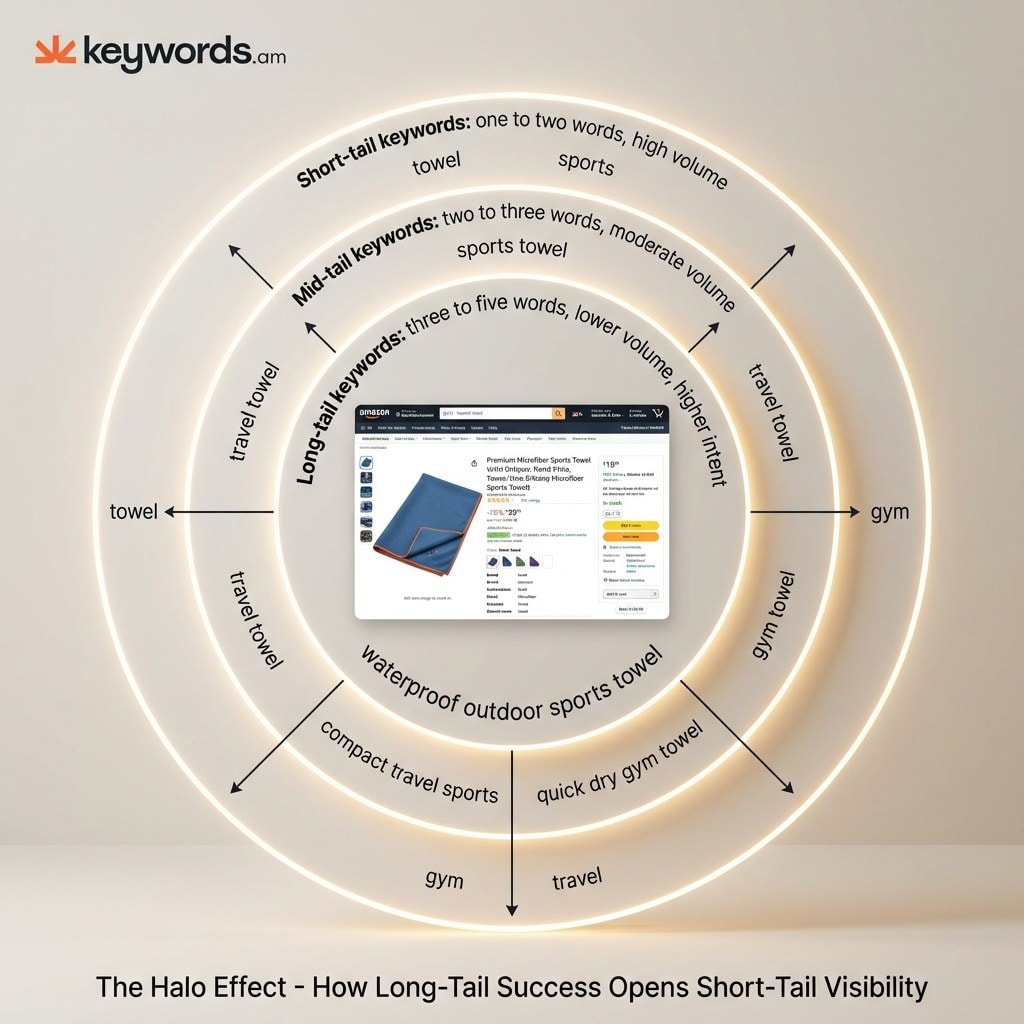
The mechanism behind the progression framework is Amazon’s A10 algorithm, which groups related keywords semantically. When a product achieves a strong conversion rate on a specific term like “extra thick yoga mat for bad knees,” the algorithm interprets this as a signal of relevance for the broader “yoga mat” category. It functions as a trust-building mechanism. The algorithm “promotes” listings that prove themselves on easier terms to more competitive ones.
Sellers who skip the long-tail phase and target short-tail terms immediately often fail because they never build the conversion signal the algorithm needs. Without the foundational data from specific searches, the algorithm has no evidence to justify ranking the product for broad, high-volume terms.
Practical observation shows that sellers who establish five or more page-one long-tail rankings often see their product appear on broader search terms within two to three weeks, even without direct PPC targeting on those broad terms. This organic lift is the Halo Effect in action.
As organic rank shifts, sellers must ensure their backend search terms are updated. Keyword indexing should be monitored to verify that the listing is eligible for the new mid-tail and short-tail variations that become relevant as the product’s authority grows.
What does Phase 3 look like for short-tail keyword competition?
Days 61-90 focus on competing for high-volume short-tail keywords, with exact match representing 50-60% of ad spend and a target TACoS below 25%.
Phase 3 represents the mature stage of a launch. Entry criteria are strict: a listing should have 25+ reviews, a stable conversion rate above 6%, and established organic ranks on mid-tail terms. Rushing to this phase without meeting these benchmarks is a primary cause of profitability issues.
Short-tail PPC strategy involves a significant commitment to exact match targeting, which should represent 50-60% of total ad spend. Discovery spend (broad/auto) should be minimized to 5-10% to maintain efficiency. At this stage, sellers should also introduce Sponsored Brand ads to build recognition.
A critical decision point occurs around day 75. Keywords that have not generated a sale after $50-75 in spend need to be paused. This discipline prevents budget drain on terms that simply do not convert for the specific product. PPC tools can automate these rules, but manual review is equally effective.
The financial goal for Phase 3 is a TACoS below 25%. If TACoS is not declining by day 60, it indicates a problem with listing conversion, keyword relevance, or competitive density. Diagnostic tools and rank tracker tools help identify which of these factors is stalling progress. By day 90, the objective is stable organic rankings on target short-tail terms and a profitable, sustainable advertising cost structure.
What if you missed the Amazon honeymoon period?
Sellers past day 90 can still apply the Keyword Progression Framework by resetting expectations, focusing on long-tail terms where they can realistically compete, and rebuilding organic momentum.
The framework remains valid for older listings, though the timeline extends significantly. Without the artificial boost of the honeymoon period, the progression may take 120-180 days instead of 90. The principles of building authority from the bottom up apply regardless of the listing’s age.
Recovery tactics begin with an audit of current keyword performance. Sellers should identify “close-to-page-one” keywords, meaning terms where the product ranks in positions 15-30. These represent the quickest wins post-honeymoon. Concentrating ad spend on these terms can push them to page one, restarting the Halo Effect.
A listing refresh is often necessary. Titles, bullet points, and backend terms should be updated based on actual search term report data collected since launch. A/B testing these changes ensures that optimization decisions are based on data rather than intuition.
Some sellers ask about “relaunching” (creating a new ASIN to secure a fresh honeymoon period). This strategy is increasingly risky. It requires sacrificing all accumulated reviews and sales history. Amazon has also become more sophisticated in detecting and closing this loophole. A more sustainable path is to apply the progression framework to the existing ASIN, accepting the longer timeline for the sake of stability and asset preservation.
Frequently Asked Questions About Amazon Product Launch Keyword Strategy
These are the most common questions sellers ask about building a keyword strategy for new Amazon product launches.
Conclusion
A structured keyword progression from long-tail to short-tail across 90 days gives Amazon’s algorithm the conversion signals it needs to reward new products with lasting organic rankings.
Successful launches rely on discipline rather than luck. By respecting the three phases of the framework, sellers align their strategy with Amazon’s own evaluation process.
- The honeymoon period is a finite window, and keyword strategy during this time has outsized impact on long-term ranking
- Phase 1 (long-tail) builds the foundation; Phase 2 (mid-tail) expands reach; Phase 3 (short-tail) captures volume
- The Halo Effect connects each phase, where winning on long-tail terms opens visibility on broader keywords
- TACoS benchmarks (<60% → 30-45% → <25%) provide clear guardrails at each phase
- Backend search terms should evolve alongside the progression, not stay static from launch
Sellers should immediately audit their current keyword list and categorize every keyword as long-tail, mid-tail, or short-tail. Aligning PPC budget allocation with the current launch phase prevents wasted spend and accelerates organic growth.
A launch keyword list is only as good as the keyword research behind it. The right data at each phase separates products that gain organic traction from those that stall after the honeymoon ends. Tools like Keywords.am provide the priority scoring and coverage data sellers need to identify opportunities and track their progression through the 90-day window.