
📑 Table of Contents
- What Is the Amazon Buy Box and Why Does It Matter?
- What Are the Buy Box Eligibility Requirements in 2026?
- How Does the Amazon Buy Box Algorithm Rank Sellers?
- How Does Listing Optimization Affect Buy Box Win Rate?
- How Does Buy Box Rotation Work?
- Buy Box Suppression, Hijacking, and the CRaP List
- Which Repricing Strategy Wins the Buy Box?
- Frequently Asked Questions About the Amazon Buy Box
- Conclusion
⚡ TL;DR
- Win rate dominance: The Buy Box captures 80-90% of all Amazon sales, with mobile dominance increasing this share.
- Eligibility criteria: A Professional Seller account, new-condition inventory, and strict performance metrics (ODR < 1%, Late Shipment < 4%) are prerequisites.
- Algorithm hierarchy: Landed price and shipping speed are top factors, but fulfillment method (FBA) and seller metrics heavily influence the calculation.
- The hidden lever: Listing conversion rate is a direct algorithm input; higher-converting listings win more rotation share.
- Rotation mechanics: The Buy Box is not winner-take-all; Amazon rotates the “Add to Cart” button among eligible sellers based on real-time scores.
- Defensive strategy: Monitoring suppression, hijacking, and CRaP (Can’t Realize a Profit) status is essential to protecting market share.
- Repricing approach: Algorithmic repricing outperforms manual rules by balancing competitiveness with margin floors.
Between 80% and 90% of Amazon sales flow through the Buy Box, making that single “Add to Cart” button the most valuable piece of real estate on any product detail page. Yet most sellers treat winning this placement as purely a pricing problem, slashing margins in a relentless race to the bottom. While price is critical, the algorithm evaluates a complex set of variables (including shipping speed, seller metrics, and crucially, listing conversion rates). Sellers who understand the full picture capture disproportionate market share without sacrificing profitability.
This guide covers every eligibility requirement, ranks the algorithm factors by impact, and reveals the overlooked connection between listing optimization and Amazon Buy Box win rate. While competitors focus solely on undercutting prices, sophisticated brands leverage conversion data to secure the Buy Box more frequently.
What Is the Amazon Buy Box and Why Does It Matter?
The Amazon Buy Box is the “Add to Cart” button on a product page, and the seller who wins it captures the majority of that product’s sales.
This featured offer section appears on the right side of product detail pages and determines which seller gets the sale when a customer clicks “Add to Cart.” While multiple sellers may offer the same product, only one occupies this primary position at any moment. For the seller, occupying this position is the difference between high-volume sales and obscurity.
Data from Jungle Scout indicates that 80-90% of Amazon sales go through the Buy Box. Shoppers rarely look for the “Other Sellers on Amazon” link. On mobile devices, where most shopping occurs, this placement is even more dominant because alternative offers are buried below the fold.
Crucially, this placement is not a static prize. Multiple sellers can be eligible, and Amazon rotates between them based on algorithm scoring. A seller might hold the featured offer for 70% of the day, while a competitor captures the remaining 30%. Understanding this rotation is key to refining strategy.
What Are the Buy Box Eligibility Requirements in 2026?
Buy Box eligibility requires a Professional seller account, new-condition inventory, strong performance metrics, and sufficient account history on Amazon.
Before competing for rotation, a seller must meet strict eligibility criteria. The fundamental requirement is a Professional Seller Account; Individual plans are not eligible. Additionally, the product must be in new condition. Used or refurbished items generally do not qualify for the main featured offer.
Beyond account type, Amazon enforces rigorous performance thresholds to ensure the featured seller delivers a positive customer experience.
Seller Performance Thresholds
Metric |
Required Threshold |
|---|---|
Order Defect Rate (ODR) |
< 1% |
Late Shipment Rate |
< 4% |
Pre-Fulfillment Cancel Rate |
< 2.5% |
Valid Tracking Rate |
> 95% |
Account Standing |
Good (no suspensions) |
Meeting these thresholds is the baseline. A seller with an Order Defect Rate of 0.9% is eligible but will likely lose rotation to a competitor with 0.1%. New seller accounts often face a “probationary” period of 2 to 6 months to establish sufficient history.
How Does the Amazon Buy Box Algorithm Rank Sellers?
The Amazon Buy Box algorithm weighs landed price and shipping speed most heavily, followed by fulfillment method, seller metrics, inventory depth, and listing conversion rate.
Once eligible, the algorithm ranks sellers dynamically. Understanding the hierarchy of these factors allows sellers to prioritize effectively.
Algorithm Factor Ranking
Rank |
Factor |
Weight |
Why It Matters |
|---|---|---|---|
1 |
Landed Price (item + shipping) |
Highest |
Must be competitive, not necessarily lowest |
2 |
Shipping Speed |
Very High |
Faster delivery wins tiebreakers |
3 |
Fulfillment Method |
High |
FBA gets algorithmic preference |
4 |
Seller Performance Metrics |
High |
ODR, late shipment, cancellation rates |
5 |
Inventory Depth |
Medium |
Consistent stock signals reliability |
6 |
Listing Quality / Conversion Rate |
Medium |
Higher-converting listings get favored |
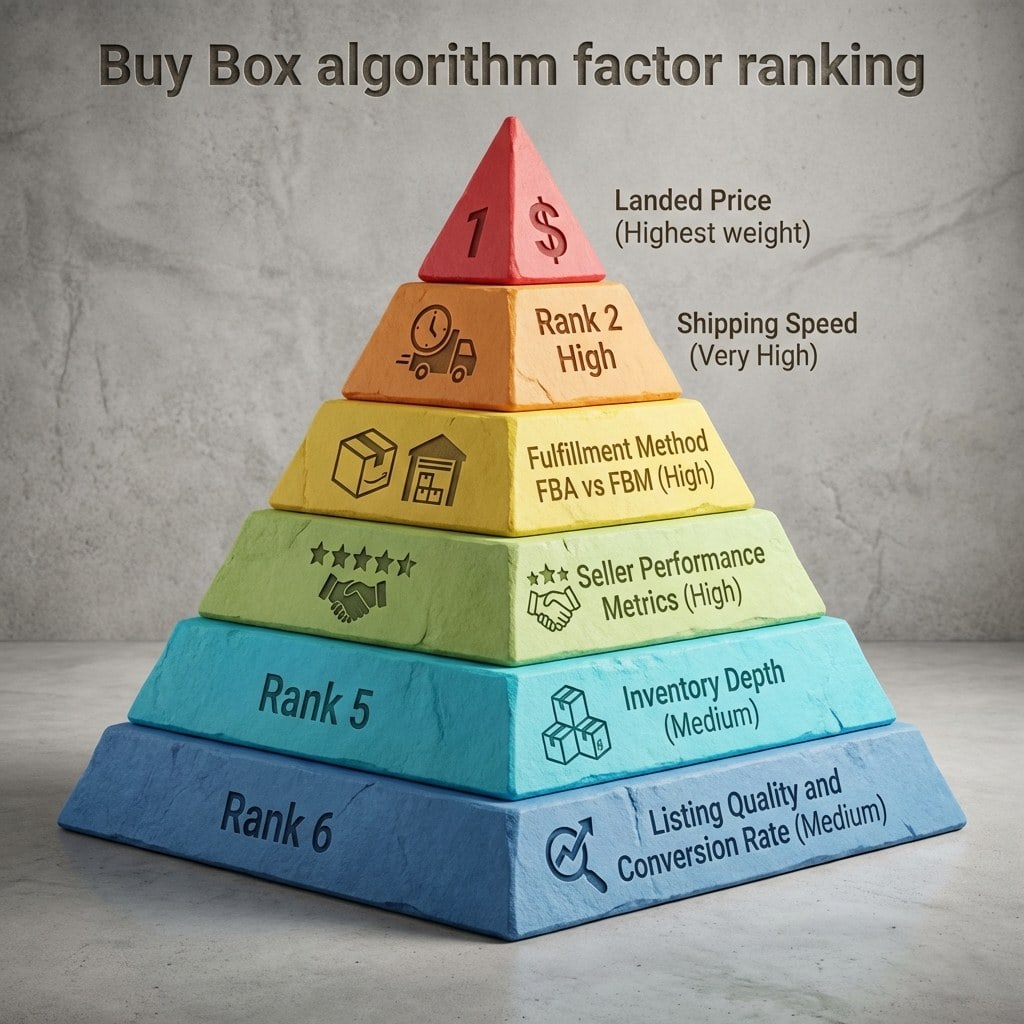
Landed Price (item price + shipping) is the most influential factor. The price must be competitive relative to other offers, not necessarily the absolute lowest. A $25 item with free Prime shipping often beats a $22 item with $5 shipping.
Shipping Speed and Fulfillment Method are closely linked. FBA gives a significant advantage because Amazon trusts its own logistics network. While FBA does not guarantee winning, it acts as a heavy weight. FBM sellers typically need lower prices or exceptional shipping speeds to compete.
Seller metrics act as negative ranking factors; as metrics degrade, the algorithm penalizes the seller. Finally, listing conversion rate is a critical input. The algorithm favors offers that result in completed sales, connecting listing quality directly to featured offer performance.
How Does Listing Optimization Affect Buy Box Win Rate?
Better listing optimization drives higher conversion rates, and Amazon’s Buy Box algorithm favors sellers whose listings convert at higher rates.
The connection between listing quality and the Buy Box is a causal chain many sellers overlook: Keyword-Optimized Listing → More Relevant Traffic → Higher Conversion Rate → Better Buy Box Rotation Share.
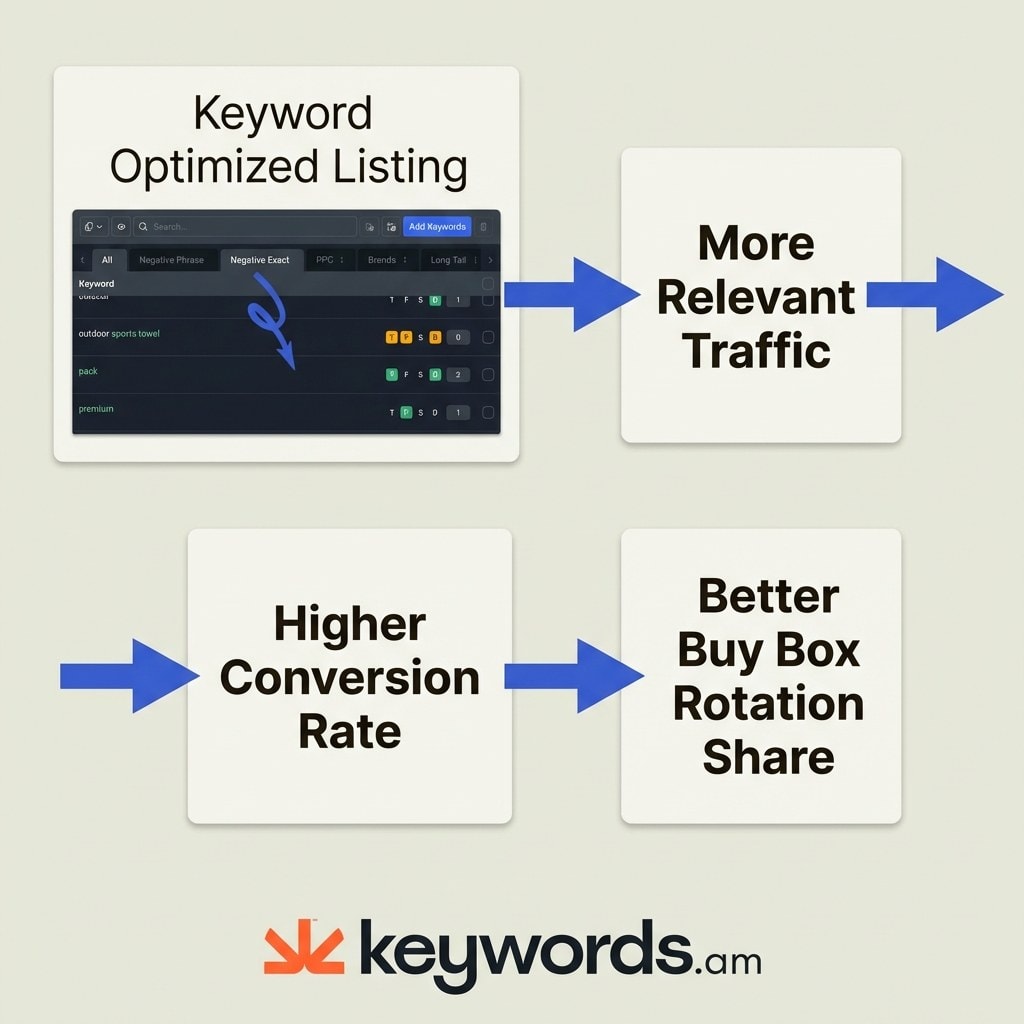
Amazon’s goal is to maximize revenue per session. If Seller A’s listing converts at 15% and Seller B’s at 8%, the algorithm views Seller A as the more efficient option. Therefore, listing optimization is a direct input into the Buy Box calculation.
Key listing elements impacting conversion include:
- Title Optimization: A title matching user intent attracts qualified clicks. Irrelevant keywords drive traffic that bounces, hurting conversion.
- Bullet Points: Concise, benefit-driven bullet points address customer pain points. The Amazon bullet points guide helps structure these effectively.
- A+ Content: Enhanced content allows for visual storytelling, significantly boosting conversion. Implementing Amazon A+ Content optimization strategies can turn browsers into buyers.
- Backend Keywords: Properly indexing for relevant terms ensures discoverability. The Amazon keyword indexing guide explains this alignment.
Sellers should also leverage the feedback loop between PPC and organic performance. Feeding high-converting PPC terms back into organic listings (titles, bullets, backend search terms) improves the overall conversion rate, as detailed in the Amazon PPC keyword strategy guide.
Ultimately, a well-optimized listing signals to Amazon that the product is a high performer. By improving the Amazon product description, sellers effectively increase their “conversion score,” winning the Buy Box more often.
How Does Buy Box Rotation Work?
Amazon rotates the Buy Box among eligible sellers throughout the day, giving top performers 70-90% share while splitting remaining time among other qualified sellers.
The Buy Box utilizes a rotation system to distribute sales based on relative strength. A top-performing seller might capture 80% of the day’s views, while a secondary seller captures 20%. This rotation is dynamic; if a primary seller runs out of stock or metrics dip, the algorithm instantly reallocates their share.
Geography also influences rotation. Amazon may show different winners to customers in different regions based on inventory location. If Seller A has inventory in California and Seller B in New York, a Los Angeles customer is more likely to see Seller A, meaning national Buy Box share is an aggregate of many local victories.
Buy Box Suppression, Hijacking, and the CRaP List
Buy Box suppression removes the Buy Box from a listing entirely, often caused by pricing issues, while hijacking means unauthorized sellers are competing for a listing.
Buy Box Suppression replaces the “Add to Cart” button with “See All Buying Options,” drastically reducing sales. This typically occurs when Amazon detects the price is significantly higher than the list price or other major e-commerce sites. Sellers can detect this by monitoring their “Buy Box Percentage” in Seller Central; a drop to 0% often indicates suppression.
Listing Hijacking involves unauthorized sellers attaching to a brand’s ASIN with counterfeit or lower-quality inventory. They compete on price, stealing Buy Box share and potentially damaging review ratings. Brands should use Amazon Brand Registry to remove unauthorized sellers promptly.
Items may also fall onto the CRaP list (Can’t Realize a Profit) due to low price points combined with high shipping costs. These items may lose Buy Box eligibility or face FBA restrictions. Sellers must maintain healthy margins or bundle products to avoid this classification.
Which Repricing Strategy Wins the Buy Box?
Algorithmic repricing outperforms manual and rule-based methods for most sellers, adjusting prices dynamically based on Buy Box competition and margin floors.
Manual repricing is feasible only for very small catalogs. Rule-based repricing (e.g., “always be $0.01 lower”) often triggers a race to the bottom, eroding margins.
Algorithmic Repricing is the gold standard for catalogs with 50+ SKUs. AI-driven tools analyze competitor behavior and demand to set the optimal price. The goal is to be at the highest possible price that still wins the Buy Box, not just the lowest. Algorithmic repricers understand that if a seller has superior metrics, they can price slightly higher than a competitor and still win. For tool recommendations, review this guide to the best Amazon seller tools.
Frequently Asked Questions About the Amazon Buy Box
> These are the most common questions Amazon sellers ask about winning the Buy Box and maintaining eligibility.
> The Amazon Buy Box is the “Add to Cart” section on a product page that determines which seller gets the sale when a customer clicks to purchase.
It appears on the right side of desktop product pages and prominently on mobile. The featured seller captures the vast majority of sales for that product.
> FBA gives a strong advantage in Buy Box competition but does not guarantee it. Price, seller metrics, and other factors still determine the winner.
FBA sellers typically win the Buy Box more often because Amazon trusts its own fulfillment network for speed and reliability. However, FBM sellers with excellent metrics and competitive shipping can also win.
> Industry data shows that 80-90% of Amazon sales go through the Buy Box, making it the most critical conversion point for third-party sellers.
The exact percentage varies by category and device type. On mobile devices, the Buy Box captures an even higher share because alternative seller offers require extra taps to find.
> Yes, sellers can use both FBA and FBM for different products. Each offer is evaluated independently by the Buy Box algorithm.
Some sellers use FBA for high-velocity products and FBM for oversized or low-margin items. The Buy Box algorithm evaluates each offer on its own merits, and FBA offers typically receive preferential treatment.
> Buy Box suppression occurs when Amazon removes the Buy Box entirely from a product listing, forcing customers to click through to see all available sellers.
Common causes include pricing anomalies, products on the CRaP list, and insufficient seller competition. Sellers should monitor their Buy Box percentage in Seller Central Business Reports to detect suppression early.
> Keywords affect the Buy Box indirectly through conversion rate. Better keyword targeting brings more relevant shoppers, driving higher conversion rates the algorithm rewards.
This is the most overlooked Buy Box factor. Sellers who optimize their listing keywords with tools like [Keywords.am](https://keywords.am/?utm_source=blog&utm_medium=article&utm_campaign=amazon-buy-box) attract higher-intent traffic, improve their conversion metrics, and earn greater Buy Box rotation share as a result.
Conclusion
Winning the Amazon Buy Box requires optimizing price, fulfillment, seller metrics, and listing conversion rate together, not just competing on price alone.
Successful sellers understand these factors are interconnected; a better listing improves conversion, which improves Buy Box share, driving sales volume that further strengthens inventory scores. The sellers who treat the Amazon Buy Box as a full-stack optimization problem consistently outperform those fixated on price alone.
Sellers should immediately audit their Buy Box percentage in Seller Central and cross-reference it with their Unit Session Percentage. If pricing is competitive but share is low, the issue is likely listing quality. Sellers looking to improve their conversion rate factor can use Keywords.am to identify high-intent keywords and optimize their listings for better Buy Box performance.