
📑 Table of Contents
- What Is Amazon FBA and How Does the Fulfillment Cycle Work?
- How Much Does Amazon FBA Cost in 2026?
- What Are the Pros and Cons of Using Amazon FBA?
- When Does FBA Make Sense (and When Does It Not)?
- Why Does Keyword Research Determine FBA Profitability?
- How Do Sellers Get Started with Amazon FBA in 2026?
- Frequently Asked Questions About Amazon FBA
- Conclusion
TL;DR
- FBA basics: Amazon FBA (Fulfillment by Amazon) is a logistics service where Amazon stores, picks, packs, and ships products on behalf of sellers.
- 2026 fees: The fee structure includes fulfillment fees (approx. $3.06+ per unit), storage fees, referral fees (15%), and aged inventory surcharges.
- Prime access: FBA products earn Prime eligibility and Buy Box advantages, but sellers face higher fees and strict inventory limits.
- Sell-through matters: Profitability depends on the sell-through rate, meaning how fast inventory moves to avoid storage penalties.
- Keywords drive velocity: Keyword research is the critical, overlooked factor that drives conversion rates and inventory turnover.
- Research before investing: Successful sellers start with data-driven product research, not random product selection.
Over 60% of Amazon’s physical product sales come from third-party sellers, and the majority of those sellers use Fulfillment by Amazon (FBA) to handle shipping and customer service. While thousands of new merchants join the platform monthly, many fail because they misunderstand the fundamental nature of the program.
Most guides that explain what is Amazon FBA focus on shipping mechanics but completely ignore the factor that determines whether FBA actually makes money: listing quality and keyword strategy. This guide covers how FBA works, what it costs in 2026, when it makes sense, and the overlooked connection between keyword research and FBA profitability that competitors ignore.
What Is Amazon FBA and How Does the Fulfillment Cycle Work?
Amazon FBA (Fulfillment by Amazon) is a service where sellers ship inventory to Amazon warehouses, and Amazon handles storage, picking, packing, shipping, and customer returns.
FBA stands for Fulfillment by Amazon. Sellers send products to Amazon fulfillment centers, and Amazon handles everything from storage to delivery and returns. This program allows small businesses to leverage Amazon’s massive logistics network, ensuring that products reach customers quickly and reliably without the seller needing to rent a warehouse or hire shipping staff.
The fulfillment cycle follows five distinct steps:
1. Shipping to Amazon: The seller prepares and ships inventory to an Amazon warehouse.
2. Storage: Amazon receives the inventory and stores it in fulfillment centers across the country.
3. Order Placement: A customer places an order on Amazon.com.
4. Pick, Pack, and Ship: Amazon locates the item, packs it in Amazon-branded boxes, and ships it to the customer.
5. Customer Service: Amazon handles tracking inquiries, returns, and refunds.
One of the most significant advantages of this system is that FBA products automatically receive Prime eligibility. This badge signals free 1-2 day shipping to over 200 million Prime members worldwide, providing a substantial advantage in winning the Buy Box (the “Add to Cart” button where the vast majority of sales occur).
How Much Does Amazon FBA Cost in 2026?
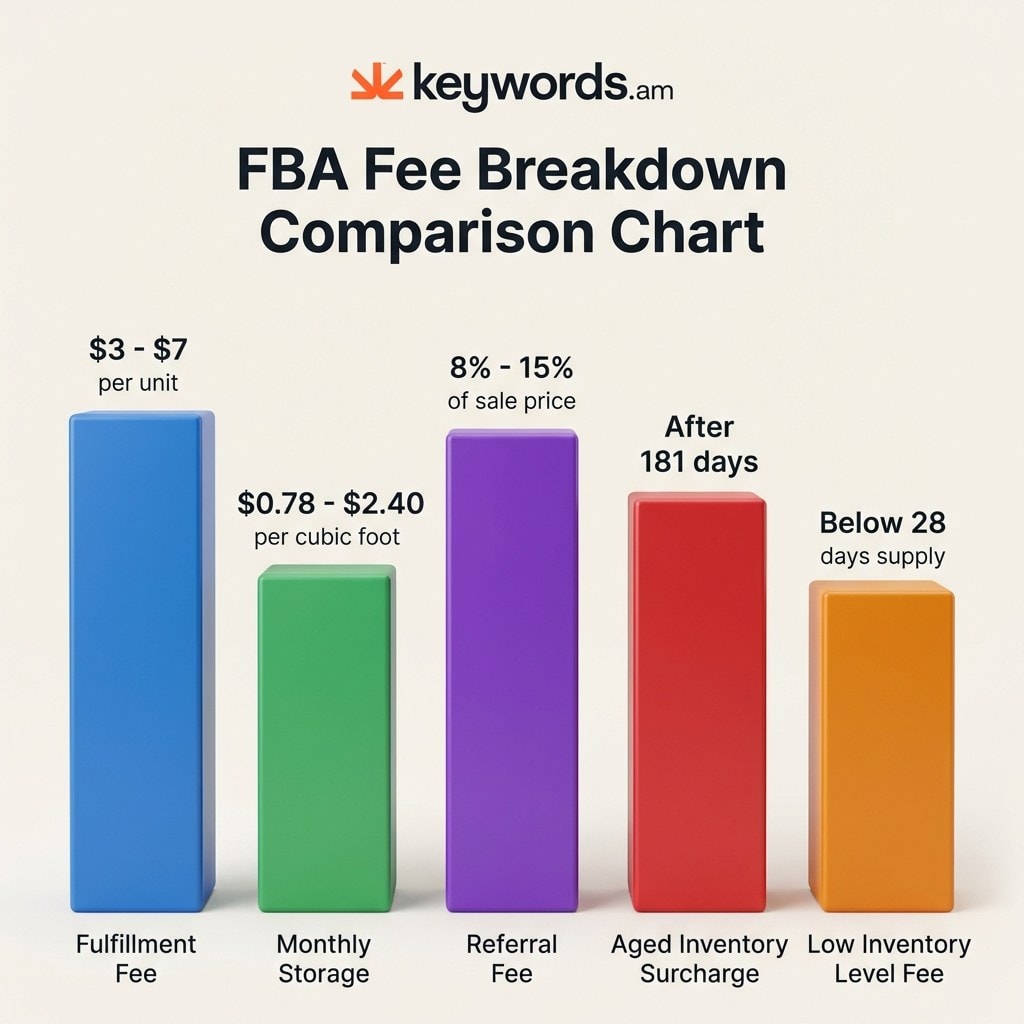
Amazon FBA costs include per-unit fulfillment fees (starting around $3.06 for small items), monthly storage fees, referral fees of 8-15%, and potential surcharges for aged or low inventory.
Understanding what is Amazon FBA from a cost perspective is essential for protecting margins. In 2026, Amazon adjusted its fees to encourage faster inventory turnover and efficient packaging. The costs break down into several key categories that every seller must calculate before sourcing a product.
Fulfillment Fees: These are charged per unit based on size and weight. For 2026, fees for small standard items start around $3.06 to $3.68. Large standard items (1-3 lbs) range from approximately $5.00 to $6.50. Heavier or oversized items see significantly higher rates. On average, fulfillment fees increased by about $0.08 per unit in 2026.
Monthly Storage Fees: Amazon charges for the space your inventory occupies. The standard rate is $0.78 per cubic foot from January through September. However, during the peak holiday season (October through December), this rate nearly triples to $2.40 per cubic foot. Sellers must plan their Q4 inventory carefully to avoid eroding profits through storage costs alone.
Referral Fees: This is the commission Amazon takes for facilitating the sale on their marketplace. It is calculated as a percentage of the total sale price. For most categories, the referral fee is a flat 15%, though some categories like consumer electronics may be lower (around 8%).
Aged Inventory Surcharge: To discourage stale inventory, Amazon imposes surcharges on items stored for long periods. Inventory older than 181 days incurs a surcharge. For items aged 271-365 days, the fee is around $1.50 per cubic foot. Once inventory exceeds 365 days, the fees become punitive: $0.30 per unit or higher cubic foot fees. New for 2026 is an even stricter tier for inventory older than 15 months.
Low-Inventory-Level Fee: Introduced recently, this fee applies when a product’s historical days of supply drop below 28 days. It is assessed at the FNSKU level, meaning sellers must maintain adequate stock levels to avoid this charge. The system penalizes both carrying too much inventory (storage fees) and too little (low-inventory fees), forcing sellers to optimize their supply chain.
FBA Fee Types at a Glance (2026)
Fee Type |
Amount |
When It Applies |
|---|---|---|
Fulfillment (small standard) |
~$3.06-$3.68/unit |
Every unit sold |
Fulfillment (large standard, 1-3 lb) |
~$5.00-$6.50/unit |
Every unit sold |
Monthly storage (Jan-Sep) |
$0.78/cubic foot |
All inventory in FBA |
Monthly storage (Oct-Dec) |
$2.40/cubic foot |
All inventory in FBA |
Referral fee |
8-15% of sale price |
Every unit sold |
Aged inventory (181-270 days) |
$0.50-$1.50/cubic foot |
Slow-selling SKUs |
Aged inventory (12-15 months) |
$0.30/unit or $6.90/ft3 |
Very slow SKUs |
Low-inventory-level fee |
Varies |
Stock below 28 days supply |
What Are the Pros and Cons of Using Amazon FBA?
FBA pros include Prime eligibility, Buy Box advantage, and hands-off logistics. Cons include higher fees, loss of packaging control, commingling risk, and Q4 storage cost spikes.
Deciding between FBA and self-fulfillment requires weighing operational ease against cost and control. For most scalable businesses, the benefits of FBA outweigh the drawbacks, but the risks are real and must be managed.
Pros:
The primary benefit is the Prime badge. With over 200 million Prime members, the trust and speed associated with the Prime logo significantly increase conversion rates. Amazon data suggests that FBA offers shipping rates that are often 70% less expensive than comparable premium shipping options a merchant could negotiate independently. Furthermore, the Buy Box algorithm heavily favors FBA offers, making it the default choice for sellers who want to maximize visibility. The hands-off nature of the program allows entrepreneurs to focus on high-value tasks like product development and marketing rather than taping boxes.
Cons:
The convenience comes at a premium. FBA fees are generally higher than the cost of shipping simple, lightweight items yourself, especially if you have low margins. Sellers also lose control over the unboxing experience; you cannot use custom branded boxes or include marketing inserts as easily as with self-fulfillment. “Commingling” is another risk, where Amazon may mix your inventory with identical products from other sellers to optimize shipping speed, potentially leading to a customer receiving a counterfeit item sold by a competitor but attributed to your account. Finally, the Q4 storage fee spikes can destroy profitability if inventory management is poor.
FBA vs. FBM:
FBM (Fulfilled by Merchant) allows sellers to list products on Amazon but handle shipping themselves. This method offers control over packaging and avoids FBA storage fees but typically sacrifices the Prime badge and Buy Box prominence. Many sophisticated sellers use a hybrid approach, using FBA for high-velocity best-sellers and FBM for heavy, oversized, or slow-moving items.
When Does FBA Make Sense (and When Does It Not)?
FBA makes sense for small, lightweight products with healthy margins and consistent demand. It works poorly for oversized, low-margin, or highly seasonal items with unpredictable sales velocity.
Not every product is suitable for the FBA model. The economics of fulfillment are dictated by physical dimensions and weight, meaning that what works for a smartphone case will fail for a kayak.
The Sweet Spot:
FBA is ideal for products that are small and lightweight (typically under 3 pounds) with a selling price between $15 and $70. Margins should ideally remain above 30% after deducting all FBA fees and landed costs. Products with steady, year-round demand allow for predictable inventory replenishment, minimizing the risk of stockouts or overstock fees.
Poor Fit for FBA:
Items that are oversized or heavy often incur fulfillment fees that exceed $10 per unit, rapidly eating into profit margins. Products selling for under $10 are also difficult to make profitable due to the minimum floor of FBA fees. Highly seasonal items (like holiday-specific decor) can be risky because if they don’t sell out by the end of the season, they attract massive long-term storage fees. Additionally, fragile goods requiring custom packaging to prevent breakage are often better handled via FBM.
The Margin Calculation:
A simple mental framework for FBA profitability is: Sale Price minus (Product Cost + Fulfillment Fee + Referral Fee + Storage Allocation + Inbound Shipping) equals Profit. Many new sellers underestimate the “hidden” costs of returns and storage, often miscalculating their true margin by 15-25%. Before sending a single unit to a warehouse, sellers should use an Amazon sales estimator to validate demand and ensure the volume justifies the fees.
Why Does Keyword Research Determine FBA Profitability?
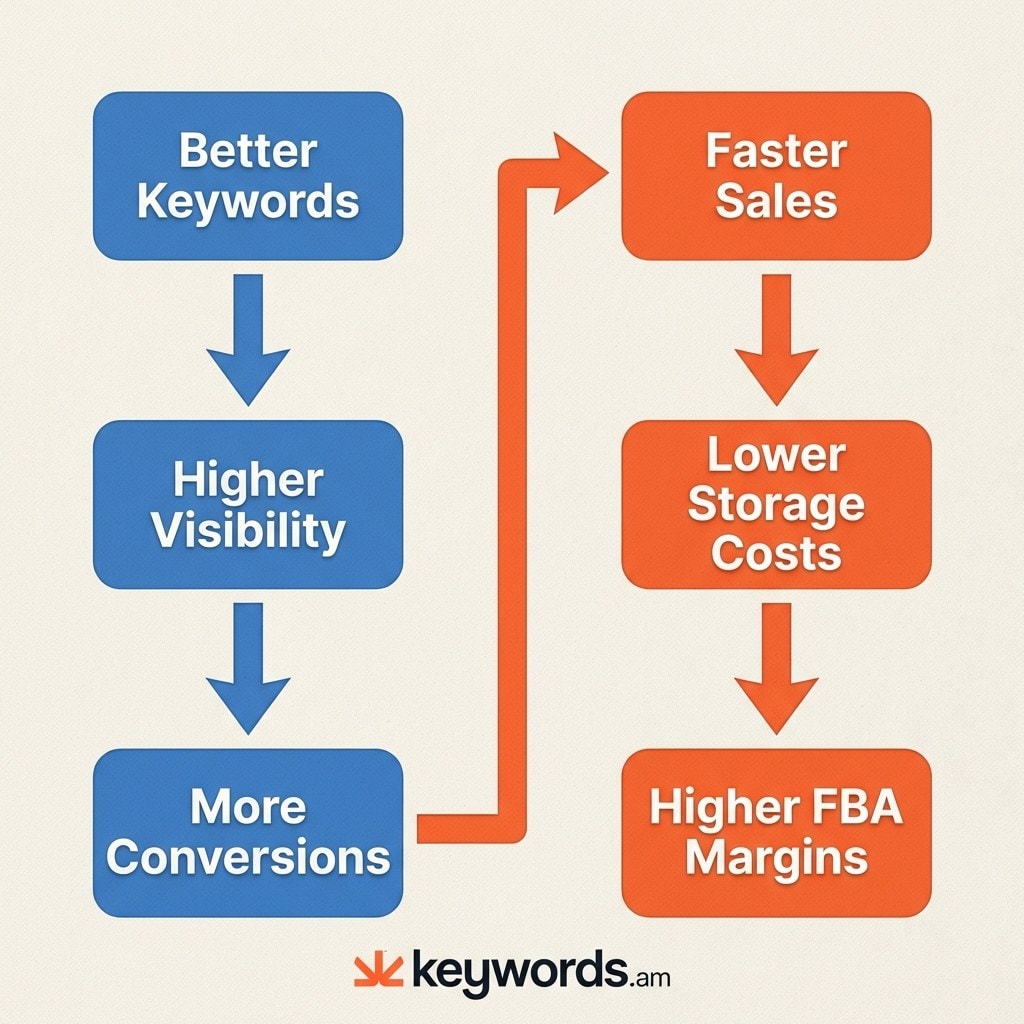
Keyword research directly impacts FBA profitability because better-optimized listings drive higher conversion rates, lower advertising costs, and faster inventory turnover that reduces storage fees.
FBA profitability is not solely a logistics calculation; it is fundamentally a velocity calculation. The fees that kill FBA businesses (monthly storage and aged inventory surcharges) are penalties for slow sales. The only way to avoid them is to sell inventory quickly. The primary driver of sales velocity on Amazon is visibility, which is entirely dependent on keyword strategy.
The Overlooked Connection:
When a listing is optimized with the right keywords, it appears in front of more relevant customers. This relevance leads to higher click-through rates and, crucially, higher conversion rates. A listing that converts at 15% moves inventory nearly twice as fast as one converting at 8%. This difference determines whether a seller turns their inventory over in 30 days (profitable) or 90 days (incurring storage costs).
Advertising Efficiency (ACoS):
Most FBA sellers rely on PPC (Pay-Per-Click) advertising to launch products. Listings with strong, keyword-optimized titles and bullet points achieve higher relevance scores, which lowers the cost per click. A lower Advertising Cost of Sales (ACoS) means higher net margins. If your keyword research is poor, you will pay more to acquire every customer, eroding the margin you tried to protect by using FBA.
Mechanisms of Optimization:
To capitalize on this, sellers must optimize the product title, bullet points, and description with high-volume, relevant search terms. Furthermore, filling out the backend search terms is critical for indexing for keywords that don’t fit naturally in the visible text. This invisible optimization maximizes organic discovery. For a deep dive on this, read the guide on Amazon backend keywords and explore the best Amazon listing optimization tools to automate the process.
Research First:
Successful FBA products are “born” in the research phase. Using tools to estimate search volume allows sellers to validate demand before purchasing inventory. This prevents the common disaster of sending 500 units to FBA only to discover no one is searching for the product. See the best Amazon product research tools guide and the Amazon product launch keyword strategy article to start on the right foot.
How Do Sellers Get Started with Amazon FBA in 2026?
Getting started with Amazon FBA in 2026 requires a Professional seller account ($39.99/month), product research, listing optimization, and shipping the first inventory batch to Amazon warehouses.
The process of launching on FBA has become more standardized, but the requirements for precision have increased.
-
Create a Professional Seller Account: Go to sellercentral.amazon.com to register. The Professional plan costs $39.99 per month and is required to access the Buy Box and advanced reporting tools necessary for FBA.
-
Research and Source Products: Use keyword demand data and competitor analysis to find a viable product opportunity. Never guess; use data to validate that customers are actively searching for what you plan to sell. Check the best Amazon seller tools guide for the right software stack.
-
Create Optimized Listings: Draft your product listing with keyword-rich titles, bullet points, and descriptions. This step is where FBA profitability is built or broken. If the listing does not convert, the FBA fees will drain the account.
-
Prepare and Ship Inventory: Create a shipping plan in Seller Central. You must follow strict FBA prep requirements, including FNSKU labeling and box content information. Note that as of January 2026, Amazon has removed certain prep services in the US, so sellers must ensure units are ready for fulfillment before they leave their hands.
-
Launch and Optimize: Once inventory checks in, launch your product. Use PPC campaigns targeting the keywords you identified in step 2. Monitor your search term reports weekly and refine your listing to improve conversion rates.
Frequently Asked Questions About Amazon FBA
For sellers still researching what is Amazon FBA, these are the most common questions asked before getting started.
Conclusion
Amazon FBA handles logistics so sellers can focus on product selection and listing optimization, the two factors that actually determine whether FBA is profitable.
While the mechanics of shipping and storage are complex, the formula for success is straightforward: precise keyword research leads to high-converting listings, which drives the sales velocity needed to make FBA economics work.
- FBA is a logistics tool, not a business strategy in itself.
- Profitability is determined by how efficiently you turn inventory over.
- Keyword research is the foundation of that efficiency, reducing storage costs and advertising waste.
Now that the question of what is Amazon FBA has been answered, the next step is clear. Sellers should not rush to send inventory to a warehouse until they have validated the market demand. Start with keyword research for potential FBA products before committing any capital to inventory. For a powerful suite of tools to handle that research, explore Keywords.am features to build a data-driven foundation for your Amazon business.