
📑 Table of Contents
- What are Amazon FBA fees and how many types exist in 2026?
- How much do Amazon FBA fulfillment fees cost by size tier?
- What are Amazon referral fees by category?
- How do Amazon FBA storage fees and aged inventory surcharges work?
- What changed in Amazon FBA fees for 2026 (including the April surcharge)?
- How do you calculate true Amazon FBA cost per unit?
- FBA vs FBM cost comparison
- How Amazon FBA fees should inform product research
- 5 strategies to reduce Amazon FBA fees in 2026
- Frequently Asked Questions About Amazon FBA Fees
- Conclusion
⚡ TL;DR
- 8+ fee types — Amazon FBA fees extend far beyond fulfillment and referral. Storage, aged inventory, inbound placement, returns processing, and more add up fast.
- 3.5% fuel surcharge — A new fuel and logistics surcharge hits all FBA fulfillment fees starting April 17, 2026, averaging ~$0.17 per unit.
- 181-day aged inventory rule — Penalties now trigger 90 days earlier than the 2025 schedule. Sellers planning around 270+ days face immediate cost spikes.
- Run the fee waterfall first — Calculate every fee layer before sourcing to ensure a minimum 25% net margin after all costs.
- Size tier optimization saves $1-3/unit — Packaging redesigns and SIPP enrollment can cut per-unit fulfillment costs by $0.90 or more.
Amazon’s FBA fee structure now contains over a dozen cost layers. Most sellers only account for three or four when calculating margins. The April 17, 2026 fuel surcharge adds another 3.5% on top of fulfillment fees, and aged inventory penalties now kick in 90 days earlier than last year.
This guide breaks down every Amazon FBA fee type with 2026 rate tables, a clean 2025-vs-2026 comparison, and three worked profitability examples. For sellers still evaluating FBA, start with What is Amazon FBA for the basics.
What are Amazon FBA fees and how many types exist in 2026?
Amazon FBA fees include fulfillment, referral, storage, aged inventory surcharges, inbound placement, returns processing, low-inventory-level, and removal fees — at least eight distinct cost categories in 2026.
Fulfillment by Amazon means sellers pay per-unit and per-cubic-foot rates while Amazon picks, packs, ships, and handles returns. The fee structure breaks into these categories:
- Fulfillment fees (per unit shipped)
- Referral fees (percentage of the sale price)
- Monthly storage fees (per cubic foot of warehouse space)
- Aged inventory surcharge (penalties for slow-moving stock)
- Inbound placement service fees (distributing inventory across the network)
- Returns processing fees (charged when customers return items)
- Low-inventory-level fee (applied when stock drops too low)
- Removal and disposal fees (extracting or destroying unsold goods)
Plus the new 2026 fuel surcharge. Most sellers factor in fulfillment and referral rates but overlook the other six categories, which add $0.30 to $4.00+ per unit depending on the product and inventory management.
How much do Amazon FBA fulfillment fees cost by size tier?
FBA fulfillment fees range from $3.06 for small standard-size items under 2 oz to over $11.00 for large standard items above 3 lb, with separate rate cards for bulky and extra-large products.
Size and weight dictate the core fulfillment cost. Amazon classifies products into tiers that directly drive unit economics. The 2026 rates took effect January 15.
Size Tier |
Weight Range |
Fee Per Unit (2026) |
|---|---|---|
Small Standard-size |
2 oz or less |
$3.06 |
Small Standard-size |
12 to 16 oz |
$3.98 |
Large Standard-size |
4 oz or less |
$4.08 |
Large Standard-size |
2 to 3 lb |
$7.40+ |
Large Bulky |
Up to 50 lb |
$9.73 (starting) |
Products priced under $10 automatically qualify for Low-Price FBA rates, saving an average of $0.86 per unit compared to standard rates. Above 3 lb in the standard tier, per-unit fees increase by weight increments.
Large Bulky fees decreased by an average of $0.26 per unit versus 2025. Extra-Large fees dropped by an average of $2.08 per unit. However, Amazon introduced a new Overmax surcharge of $17 to $25 per unit for items exceeding 96 inches on the longest side or 130 inches in length plus girth.
Sellers can lower bulky costs through Ships in Product Packaging (SIPP). Enrolled items save $0.90 to $1.00+ per unit. Non-enrolled bulky items pay a $1.51 to $4.04 packaging fee instead.
What are Amazon referral fees by category?
Amazon charges referral fees of 8% to 17% depending on product category, with a $0.30 minimum per unit. These rates have been frozen since 2025.
Every sale incurs a referral fee. The percentage depends on category assignment:
Category |
Referral Fee |
|---|---|
Electronics & Computers |
8% |
Appliances (full-size) |
8% |
Beauty & Personal Care |
8% (under $10) / 15% (over $10) |
Automotive |
12% |
Home & Kitchen |
15% |
Sports & Outdoors |
15% |
Toys & Games |
15% |
Books & Media |
15% + $1.80 closing fee |
Clothing & Accessories |
5% (under $15) / 10% ($15-20) / 17% (over $20) |
The $0.30 minimum referral fee applies when the percentage-based calculation falls below that floor. This mainly impacts very low-priced items. Sellers also pay $39.99/month for a Professional account (or $0.99 per item on the Individual plan). Most FBA sellers use the Professional tier.
How do Amazon FBA storage fees and aged inventory surcharges work?
Monthly storage fees range from $0.56 to $2.40 per cubic foot depending on season, and aged inventory surcharges now start at 181 days with escalating penalties up to $7.90 per cubic foot.
Storage fees apply to inventory every month. Rates spike during Q4 peak season:
Inventory Type |
Jan-Sep Rate |
Oct-Dec Peak Rate |
|---|---|---|
Standard-size |
$0.56 to $0.87 / cu ft |
$2.40 / cu ft |
Dangerous goods |
$0.56 to $0.99 / cu ft |
$4.28 / cu ft |
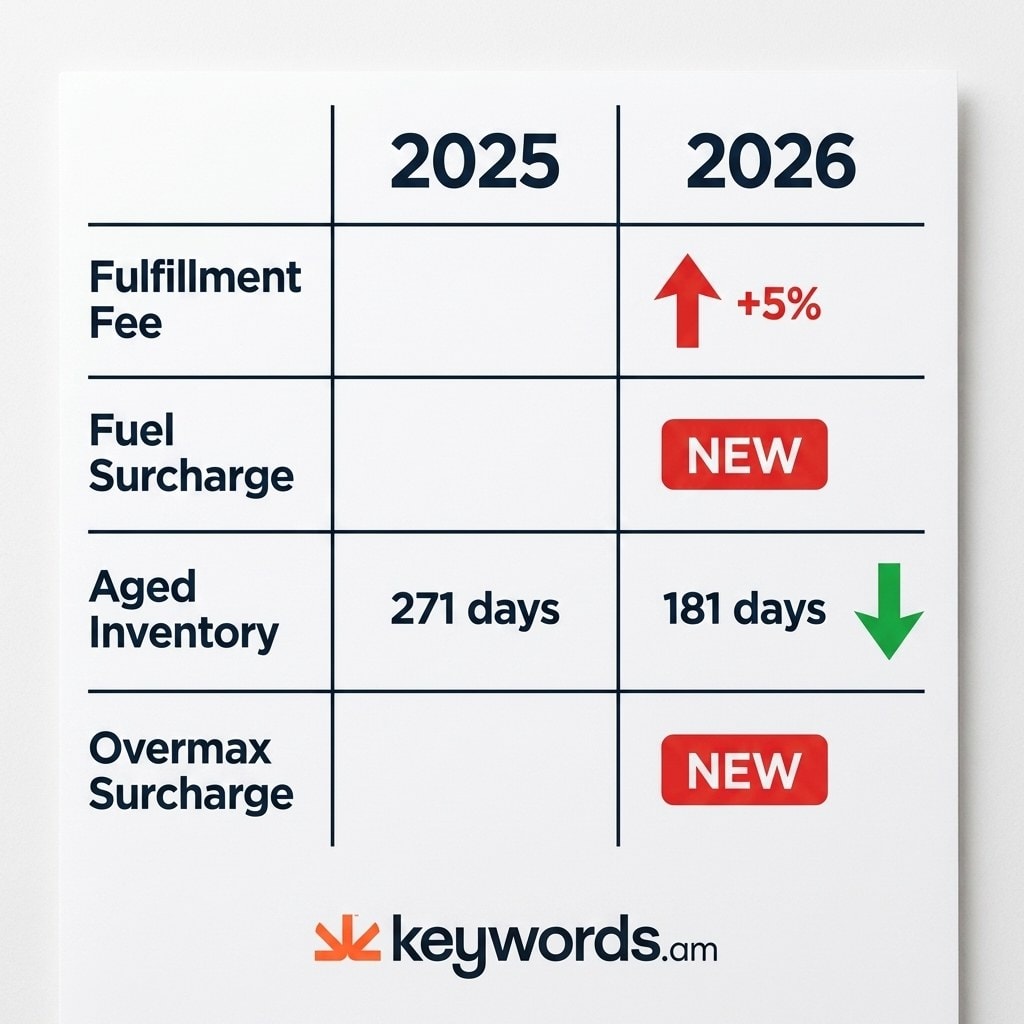
The aged inventory surcharge timeline accelerated in 2026. Penalties previously started at 271 days — now they begin at 181 days, a full 90 days earlier. Sellers who built sourcing models around a 270-day window need to recalculate immediately.
- 181 to 210 days: Surcharge begins
- 211 to 240 days: Penalty escalates
- 241 to 270 days: Penalty escalates further
- 271 to 365 days: Significant penalty applied
- 365+ days: $6.90 per cubic foot or $0.30 per unit
- 15+ months: $7.90 per cubic foot or $0.35 per unit
Removal and disposal fees offer an exit route for slow stock. Removing items under 0.5 lb costs $0.84 per unit (down $0.20 from 2025).
What changed in Amazon FBA fees for 2026 (including the April surcharge)?
Amazon raised fulfillment fees on January 15, accelerated aged inventory penalties to 181 days, and added a 3.5% fuel and logistics surcharge on all fulfillment fees effective April 17, 2026.
January 15 fulfillment fee adjustments
- Small standard ($10-$50): +$0.25/unit
- Large standard ($10-$50): +$0.05/unit
- Small standard (under $10): +$0.12/unit
- Products over $50: +$0.31 to +$0.51/unit
- Extra-large: -$2.08/unit average (decreased)
April 17 fuel and logistics surcharge
A 3.5% surcharge now applies to all FBA fulfillment fees. It does not touch referral, storage, or inbound placement fees. The impact averages $0.17 per unit for standard-size items, ranging from $0.15 to $0.35 depending on size. Amazon cites elevated fuel costs, mirroring similar industry moves like USPS’s 8% surcharge.
Concrete example: A large standard item with a $4.75 fulfillment fee now costs $4.92 after the 3.5% surcharge ($0.17 added).
2025 vs 2026 Amazon FBA fees comparison
Fee Element |
2025 |
2026 |
Change |
|---|---|---|---|
Small Standard fulfillment ($10-50) |
~$3.06 |
~$3.31 |
+$0.25 |
Large Standard fulfillment ($10-50) |
~$5.40 |
~$5.45 |
+$0.05 |
Fuel surcharge |
None |
3.5% on fulfillment |
NEW |
Aged inventory start |
271 days |
181 days |
90 days earlier |
Aged inventory 12-15 months |
Existed |
$0.30/unit ($6.90/ft³) |
Increased |
Aged inventory 15+ months |
Existed |
$0.35/unit ($7.90/ft³) |
NEW tier |
Extra-Large fulfillment |
Higher |
-$2.08/unit avg |
Decreased |
Removal (0-0.5 lb) |
$1.04 |
$0.84 |
-$0.20 |
Overmax surcharge |
N/A |
$17-$25/unit |
NEW |
Inbound placement |
Existed |
+$0.05/unit avg |
Increased |
How do you calculate true Amazon FBA cost per unit?
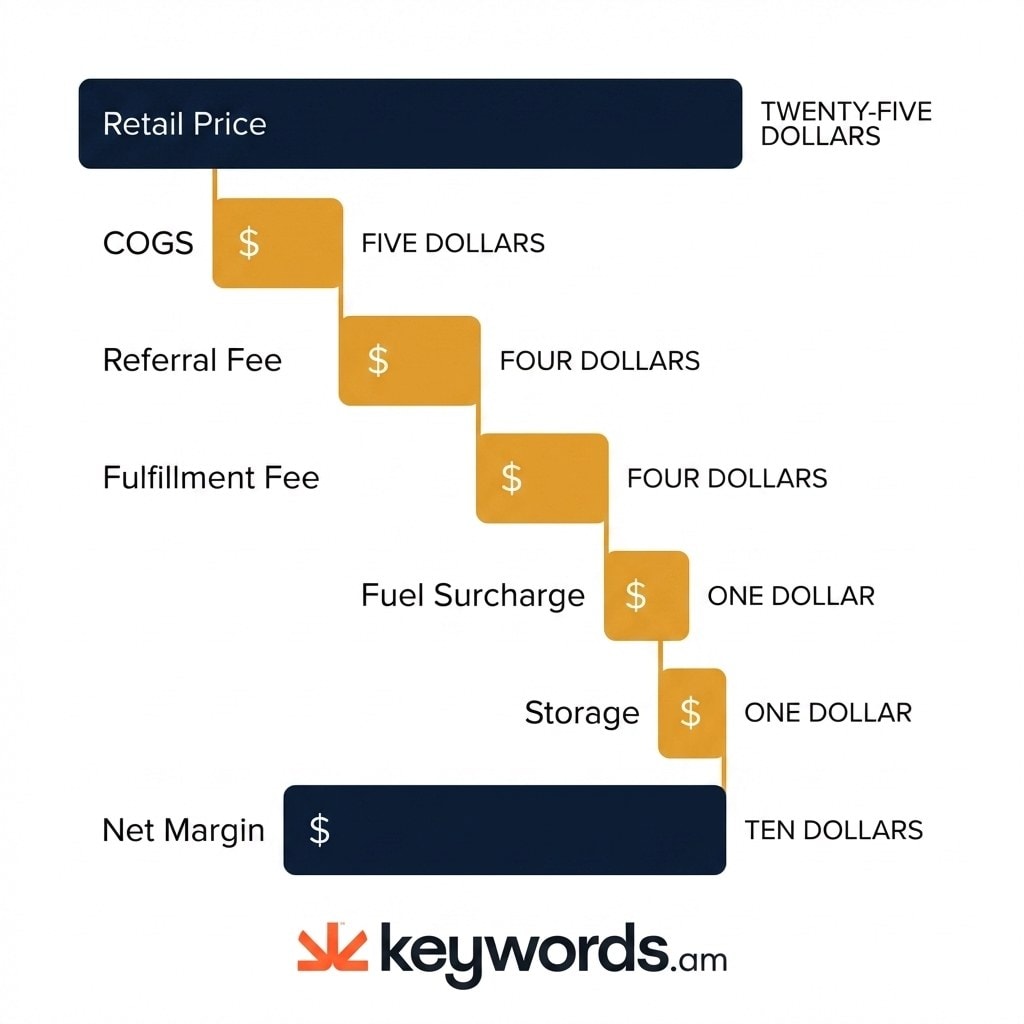
Calculate true FBA cost by stacking every fee layer: retail price minus COGS, referral fee, fulfillment fee, fuel surcharge, and estimated storage. The result is actual net margin per unit.
The fee waterfall formula:
Net Margin = Retail Price – COGS – Referral Fee – Fulfillment Fee – Fuel Surcharge (3.5% of fulfillment) – Storage (prorated)
Here are three worked examples across different price points. Use an FBA calculator tool to model costs for specific ASINs.
Cost Layer |
$9.99 Phone Case (Electronics) |
$24.99 Supplement (Health) |
$49.99 Kitchen Gadget (Home) |
|---|---|---|---|
Retail Price |
$9.99 |
$24.99 |
$49.99 |
COGS |
-$2.50 |
-$6.00 |
-$14.00 |
Referral Fee |
-$0.80 (8%) |
-$3.75 (15%) |
-$7.50 (15%) |
Fulfillment Fee |
-$3.31 |
-$5.45 |
-$7.40 |
Fuel Surcharge (3.5%) |
-$0.12 |
-$0.19 |
-$0.26 |
Storage (est.) |
-$0.05 |
-$0.10 |
-$0.15 |
Net Margin |
$3.21 (32.1%) |
$9.50 (38.0%) |
$20.68 (41.4%) |
The phone case looks profitable at 32%, but leaves just $3.21 per unit for advertising. The supplement at 38% margin gives more room for PPC spend. The kitchen gadget at 41% offers the best cost absorption — higher price points generally survive Amazon FBA fees better because fixed fulfillment costs represent a smaller share of revenue.
FBA vs FBM cost comparison
FBA typically costs more per unit but includes Prime eligibility, customer service, and returns handling. FBM saves on fulfillment fees but requires sellers to manage shipping and customer support directly.
When FBM wins: Low-velocity SKUs that trigger aged inventory surcharges under the 181-day rule. Oversized or heavy items where Amazon’s fulfillment fees destroy margins. Products with thin margins that can’t absorb FBA costs.
When FBA wins: High-velocity standard-size products where fast turnover negates storage risks. Competitive categories where the Prime badge drives conversions. Sellers scaling beyond their own warehouse capacity.
See the full FBA vs FBM analysis for a deeper comparison.
How Amazon FBA fees should inform product research
Smart product research starts with the fee waterfall, not the retail price. Products that survive all FBA fee layers with 25%+ margin are worth validating with keyword demand data.
Run the full fee waterfall for a target price point and category before paying a supplier. A net margin below 20-25% means the product can’t sustain PPC advertising costs — thin profit disappears once marketing begins.
Category selection drives baseline viability. Electronics carries an 8% referral fee while Clothing demands 17%. On a $25 item, that gap alone means $2.25 more margin in Electronics before any other fee applies.
Products passing the fee test still need proven search volume. A free Amazon keyword tool confirms whether buyers actually search for the category. Pair fee analysis with product niche validation and an Amazon sales estimator to project monthly volume. Check conversion rate benchmarks by category to ground expectations.
High-margin products fail if nobody searches for them. High-demand products fail if fees consume the profit. For products that clear both tests, the TFSD Framework guide covers listing optimization.
5 strategies to reduce Amazon FBA fees in 2026
The most effective fee reduction strategies target size tier optimization, SIPP enrollment, inventory velocity, AWD for storage savings, and catalog rationalization — each addresses a different fee layer.
- Optimize packaging to hit a lower size tier. Dropping from Large Standard to Small Standard saves $1-$3 per unit. Redesign box dimensions to fit under tier thresholds.
- Enroll in Ships in Product Packaging (SIPP). Saves $0.90-$1.00+ per unit on bulky items. Non-enrollment triggers a $1.51-$4.04 packaging fee.
- Manage inventory velocity. Aged surcharges now start at 181 days. Enforce sell-through rate targets and initiate removal orders early. Audit fee-inefficient SKUs using SKU rationalization principles.
- Use Amazon Warehousing & Distribution (AWD). Lower storage fees for upstream inventory. Send to FBA in smaller, more frequent batches to avoid standard storage spikes.
- Audit existing SKU profitability. Products with net margins below 15% after all fees often cost more to sell than to discontinue. Run the fee waterfall on every SKU quarterly.
Frequently Asked Questions About Amazon FBA Fees
These are the most common questions sellers ask about Amazon FBA fees in 2026.
Conclusion
Amazon FBA fees in 2026 go well beyond the basic fulfillment and referral rates. Small cost layers compound quickly into real margin losses when left unaccounted for.
- Amazon FBA involves at least eight fee types, and most sellers only track three or four.
- The April 2026 surcharge adds 3.5% to fulfillment fees, averaging $0.17 per unit.
- Aged inventory surcharges now start at 181 days — 90 days earlier than 2025.
- Running the full fee waterfall before sourcing establishes a true cost floor.
Pick a top-selling SKU and run it through the fee waterfall in this guide. Compare the result to previous margin estimates — the gap represents hidden risk. For products that pass the fee test, validate search demand with Keywords.am’s free keyword tool to confirm buyers are searching for that category.