Listing Optimization
Best Amazon Listing Tools International Expansion 2026
Amazon listing tools international expansion guide: compare multi-marketplace keyword research, localization vs translation, and cross-border seller tools ranked.

A whopping 52% of online shoppers now buy from cross-border sites. Plus, 40% of new Amazon FBA sellers are starting businesses outside the US. It’s pretty clear that choosing the right amazon listing tools for international expansion matters a lot if sellers want to play in the global arena. But many still stick to US-centric tools. This honestly leaves serious revenue opportunities untouched in the European Union, United Kingdom, and Japan. The right tools can change this. The most common mistake? Direct translations. Like, a German shopper searching for “Taschenlampe” won’t find a product listed as “flashlight,” even if it’s the top seller in the US.
This guide? It reviews six amazon listing tools for international expansion. It also provides a marketplace coverage matrix. You’ll also find a practical 30-day workflow for a successful EU, UK, and Japan launch. Other articles give you a general overview. But this one? This article zeroes in on international sellers’ needs, comparing the localization features of the top software.
Why Do US Amazon Keywords Fail in International Markets?
US Amazon keywords just don’t work in other countries. Here’s the thing though: shoppers in each market use wildly different search terms. I mean, cultural phrases are different, and product categories? Also different. So, relying on US keywords? It’s pretty much a guaranteed way to vanish. Potential customers abroad won’t see you.
And the core issue? Search behavior is super local. Like, really local. Take flashlights. In the United States, it’s a “flashlight.” But in the United Kingdom, they call it a “torch.” In Germany? It’s a “Taschenlampe.” See? These terms aren’t interchangeable. A keyword with 50,000 monthly searches in the US could have zero in Germany. Zero! That said, this forces you to do keyword research independently for each marketplace. Honestly, it’s the only way. Furthermore, cultural context matters a lot. “Organic” has different meanings in the EU versus the US, plus stricter certification. Worth noting: technical specs change too. In Japan, listing titles are limited by bytes, not characters. So, 200 bytes isn’t the same as 200 characters for Japanese text.
What Is the Difference Between Translation and Localization?
Translation? It converts words. But localization? It adapts your WHOLE listing. Think: keywords, cultural stuff, even units of measurement. It makes it feel local, matching how shoppers actually search and buy. Honestly, this difference matters a lot for selling stuff online.
Translation is just swapping words, one for one. It doesn’t get those local market quirks. And that often means bad Amazon SEO. But localization is different. It’s a big process. You do serious keyword research for each place, adapt to their culture, and get how they search. For example, if you’re selling in the UK, you’ll need “colour” instead of “color,” and use centimeters instead of inches. You’ll want to know local sayings. A study by CSA Research says 76% of people would rather see product info in their own language. And get this: 40% just won’t buy from sites in another language.
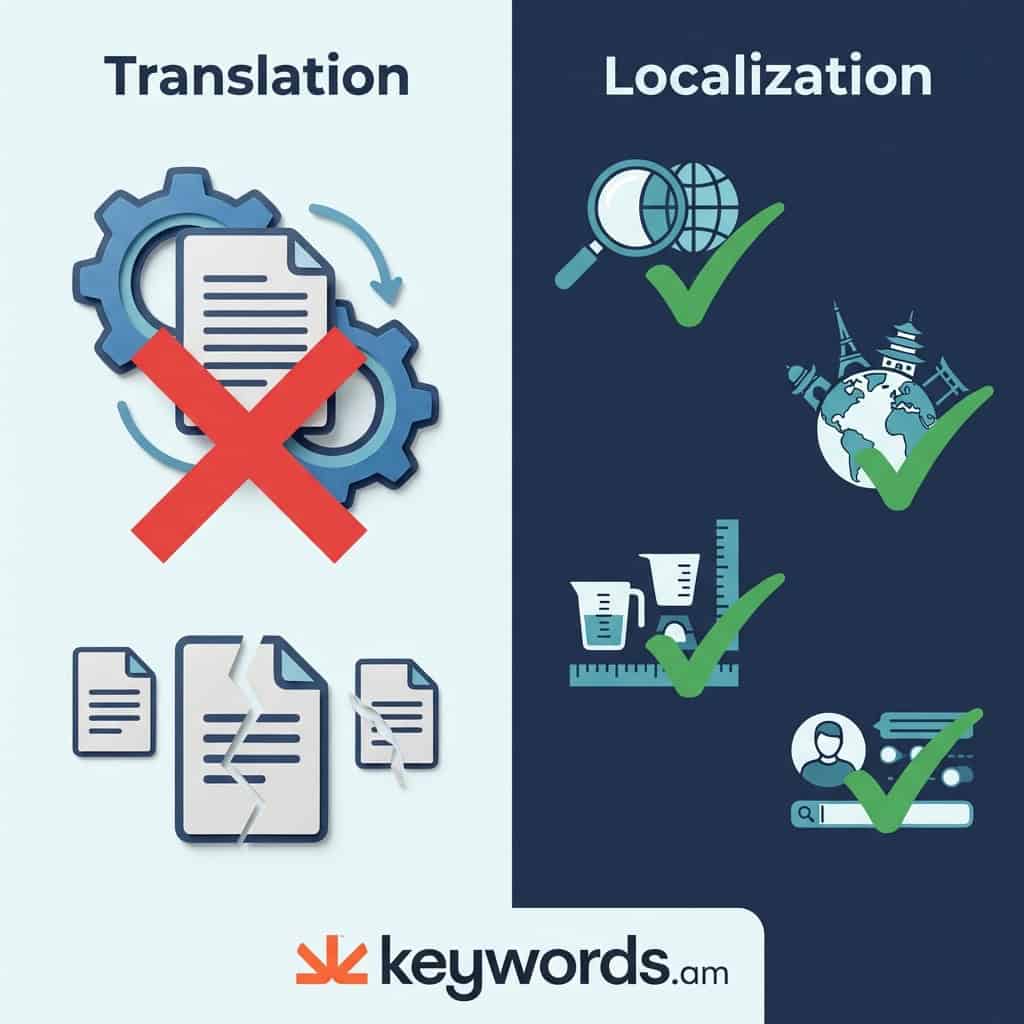
| Aspect | Translation | Localization |
|---|---|---|
| Keywords | Converted literally | Researched per marketplace |
| Measurements | Kept as original | Converted to local (cm, kg) |
| Cultural references | Kept or removed | Adapted to local context |
| Search behavior | Ignored | Primary focus |
| Buyer psychology | Generic | Market-specific |
| SEO impact | Often negative | Positive |
What Are the Best Amazon Listing Tools for International Expansion?
So, you want to sell on Amazon internationally. Makes sense. What tools can really help? There are a few good options.
Keywords.am is great for keyword research; think super-specific to each marketplace. It is awesome for local nuances. Helium 10 has multi-market breadth. It covers a lot of ground. Honestly, that’s a plus for some.
And then there’s YLT Translations. They do human localization of your listing copy. The reality is machine translation often misses the mark.
Each tool has its own advantages, and it really depends on your needs. Here’s the thing though: costs vary a lot. Worth noting: a tool like Helium 10 can be pretty expensive. But it gives you a lot of data. In my experience, good data is worth paying for.
Keywords.am - Best for Marketplace-Specific Keyword Research
Marketplaces: 21 (US, CA, MX, UK, DE, FR, IT, ES, NL, PL, SE, TR, AE, SA, EG, IN, SG, AU, JP, BR)
Here’s the thing though, Keywords.am isn’t just about translations. It’s built around intent-aware localization. That means it understands what people mean when they search in different places. This platform? It’s pretty smart. You get character and byte limits per marketplace directly in the editor. And it uses the TFSD framework (Title, Features, Search Terms, Description) to adapt listings. Check out the TFSD framework if you want to know more.
It’s amazing at figuring out keywords, providing insights into local search behavior. A notable feature? The Swiss Army Knife tool. It’s designed for backend keyword optimization. That said, in my experience, backend keywords are often ignored. Big mistake.
- Best for: Sellers who need keyword data per marketplace that’s actually accurate. Also, sellers who want to optimize listings themselves.
- Limitations: It doesn’t include PPC automation. Its focus is on listing optimization. Worth noting? Keywords.am features are focused.
Helium 10 - Best for Multi-Market Research Breadth
Marketplaces: 21+ (North America, Europe, Asia-Pacific, Middle East)
Helium 10? It’s been around a while. They’ve got tools that work in a lot of different countries. Think Cerebro and Magnet – pretty much functional everywhere they operate. And the Insights Dashboard compares markets, but you’ll need the Diamond+ plan for that. Beyond keywords, there’s product research, PPC stuff, the whole nine yards. They also have a lot of training, which is nice.
- Pricing: Seller plan is $29/mo (limited marketplace access), Platinum is $79/mo (3 marketplace tokens), and Diamond is $229/mo (5 tokens, required for 3+ markets).
- Best for: Sellers seeking a comprehensive suite with multi-market functionality.
- Limitations: Multi-market stuff? It gets pricey. You’re going to need the Diamond plan. Here’s the thing though, the Trustpilot rating? It’s dropped to 2.7/5. Seems like people are complaining about price hikes. The reality is, it’s expensive.
Jungle Scout - Best for Beginners Expanding Internationally
Marketplaces: 17 (US, CA, MX, UK, FR, DE, IT, ES, NL, TR, IN, SA, AE, JP, AU, SG, BR)
Jungle Scout? It really stands out. The keyword accuracy is high – somewhere between 84-86%, according to reports. Plus, the interface is pretty user-friendly. That’s ideal if you’re new to selling in multiple markets. The platform even supports several languages; think Chinese, French, Japanese, and Spanish. For those needing more, there’s Cobalt, their enterprise-level option.
- Pricing: Starter is $49/mo ($29/mo annually). The Growth Accelerator will run you $79/mo. And the Brand Owner plan is $149/mo.
- Best for: New-to-intermediate sellers who want an easier time learning.
- Limitations: Fewer advanced features than Helium 10, the reality is. And you’ll need a higher-tier plan for complete marketplace data.
Worth noting, it’s not perfect though.
DataHawk - Best for International Analytics and BI
Marketplaces: 20+ Amazon markets
DataHawk offers unified analytics. It works across many markets. Honestly, the best part is that it feels built for larger companies. It features keyword ranking monitoring with share of voice calculations. This is per market. Plus, it integrates with Power BI, Tableau, Google Sheets, and Snowflake. Major BI tools, all covered. And its Sales Rank Tracker? It can monitor up to 10,000 ASINs per plan. That’s a lot of ASINs. The platform gets good ratings, 4.5/5 on Trustpilot and 4.3/5 on G2. So it’s not just me saying it’s good.
- Pricing: Custom, based on sales volume and the number of tracked keywords and products.
- Best for: Brands and agencies that require unified BI across numerous marketplaces.
Here’s the thing though: its enterprise-level pricing. It pretty much makes it unsuitable for smaller sellers. Worth noting: DataHawk isn’t for everyone. There are limitations.
YLT Translations - Best for Human Localization Quality
Languages: German, Spanish, Italian, French, Dutch, Swedish, Polish, Czech, Turkish, Japanese, Mexican Spanish, French Canadian, Portuguese, Arabic
Why it stands out: YLT Translations has over 82 native translation experts. These folks really know their stuff, specializing in Amazon listings. I’m talking titles, bullet points, A+ content, even backend search terms. They don’t use machine translation directly. Instead, they focus on localization with, get this, actual cultural context. That’s pretty smart. They also do keyword research. They use Helium 10, which is interesting. Worth noting: YLT is a partner of Thrasio and they were even at the Billion Dollar Seller Summit.
- Pricing: Starts at $0.11/word, and that’s without keyword research.
- Best for: Sellers who want professional human localization above all else.
- Limitations: The cost is higher than using software tools yourself, and honestly, it’s not a real-time thing.
Productsup - Best for Enterprise Feed Management
Scope: 2,500+ channels including Amazon globally
Why it stands out: Productsup? Honestly, it’s a pretty comprehensive platform if you need to manage product data. Think multiple languages, brands, and different geographic regions. It does real-time data validation. Also, it fixes errors. That said, it makes sure you comply with various marketplace rules. Worth noting: it’s a trusted Amazon partner. And it handles both Seller Central and Vendor Central feeds.
- Best for: Large brands and manufacturers with complex global operations.
- Limitations: This is an enterprise-only solution. It’s not suitable for individual sellers, in my experience.
Which Marketplaces Do Amazon Listing Tools for International Expansion Support?
Amazon listing tools and their international expansion coverage? It varies a lot. For example, Keywords.am and Helium 10 support 21+ marketplaces. Jungle Scout covers 17. And YLT? They handle 14 languages.
But evaluating coverage depth matters more than just looking at breadth. Jungle Scout covers 17 marketplaces, right? DataHawk? They do 20+. YLT handles 14 languages. Productsup connects to 2,500+ channels globally. The breadth is important. The depth of data within each marketplace is what really matters, though.
A tool might say it “supports” a market like Japan. Here’s the thing though: it could offer really shallow keyword data compared to its US database. So, when evaluating, you’ll want to assess the info quality. Focus on your target expansion regions.
| Tool | US | UK | DE | FR | IT | ES | JP | AU | CA | MX | Other |
|---|---|---|---|---|---|---|---|---|---|---|---|
| Keywords.am | ✓ | ✓ | ✓ | ✓ | ✓ | ✓ | ✓ | ✓ | ✓ | ✓ | NL, PL, SE, TR, AE, SA, EG, IN, SG, BR (21 total) |
| Helium 10 | ✓ | ✓ | ✓ | ✓ | ✓ | ✓ | ✓ | ✓ | ✓ | ✓ | 21+ total markets |
| Jungle Scout | ✓ | ✓ | ✓ | ✓ | ✓ | ✓ | ✓ | ✓ | ✓ | ✓ | 17 total markets |
| DataHawk | ✓ | ✓ | ✓ | ✓ | ✓ | ✓ | ✓ | ✓ | ✓ | ✓ | 20+ total markets |
| YLT | - | ✓ | ✓ | ✓ | ✓ | ✓ | ✓ | - | - | ✓ | 14 languages |
How Much Do Amazon Listing Tools for International Expansion Cost?
Amazon listing tools for international expansion? They cost anywhere from $49/month (Keywords.am) to $229/month (Helium 10 Diamond). Human localization services? Expect to pay at least $0.11/word. Honestly, the reality is pricing usually depends on how much international data you get.
For example, Helium 10. Their cheaper plans? They don’t let you into a lot of marketplaces. That Diamond plan at $229/month? Pretty much needed if you’re serious about selling in a lot of countries. In contrast, Keywords.am gives you access to all 21 markets they support, no matter what you pay. So, it’s kind of a cheaper deal if you want to expand big time.
| Tool | Entry Price | Full Multi-Market | Notes |
|---|---|---|---|
| Keywords.am | $49/mo | $60-120/mo | All 21 markets included in all plans |
| Helium 10 | $29/mo | $229/mo (Diamond) | Diamond required for 3+ markets |
| Jungle Scout | $49/mo | $149/mo | Higher tiers for full marketplace data |
| DataHawk | Custom | Custom | Enterprise pricing based on volume |
| YLT | $0.11/word | Varies | Per-project pricing |
| Productsup | Custom | Custom | Enterprise only |
How Do You Expand from US to EU in 30 Days?
Expanding from US to EU Amazon marketplaces in just a month? Sounds crazy, right?
Here’s the thing though: it can be done. The reality is that it takes focused effort. Think of it as a four-week sprint. Week 1: Market research. Week 2: Dig into keyword research. After that, week 3 involves listing localization. And finally, week 4: Launch optimization.
This structured approach? Honestly, it can simplify what seems like a really daunting task. Worth noting: going global isn’t always easy.

Week 1: Market Research & Tool Setup
- First, pick your target markets. Honestly, the UK and Germany? Great start. They speak English, and Germany’s the EU’s biggest market.
- Register for VAT. It’s required before you sell stuff in most EU countries. Check out Amazon’s VAT Services for all the details on that. It can be tricky.
- Set up an Amazon Europe Unified Account. You’ll need it!
- Choose a keyword research tool for those EU markets. And then actually configure it.
- Research category-specific stuff for each marketplace. Worth noting: requirements vary a lot. For instance, toys have different rules than phone chargers.
Week 2: Keyword Research Per Market
Keyword research is next. But here’s the thing though: you can’t just translate your US keywords.
You must do it separately for each target market. For example, what works in Germany won’t necessarily resonate in France.
Aim for 20-30 primary keywords per market. It’s a manageable number, honestly. And really focus on quality over quantity.
Pay attention to character and byte limits. Each marketplace has rules.
Negative keywords? They’re really important too. You’ll want lists. Prohibited terms? They can differ market to market. So create separate lists. An example: what’s OK to say about skincare in the US market can be totally off limits in the UK. Worth noting.
Week 3: Listing Localization
- Localize titles, bullet points, and descriptions. Don’t just translate!
- Adapt measurements to the metric system. Think cm, kg, ml.
- Convert currency references. Obvious, but needed.
- Adjust cultural references. Idioms need changing too. Honestly, this is important.
- Fill in backend search terms. Use market-specific keywords.
Week 4: Launch & Monitor
Time to get those listings live! Upload your localized versions to each marketplace. Don’t forget to set your initial prices. You’ll need to include VAT in those prices. And then… launch!
- Monitor indexing with marketplace-specific search tests.
- Track the ranking of your primary keywords in each market.
It’s go-time. Now the real work starts: watching what happens. What’s ranking? What isn’t?
- Iterate on your listings based on early performance data.
In my experience, this is the trickiest part. You have to react fast. And honestly? You’re going to be tweaking things constantly.
Here’s the thing though: using a tool can help. Keywords.am has a clone feature, which is pretty much a lifesaver. It lets you duplicate your US listing structure. Then you localize each field with marketplace-specific keywords. A lot easier than starting from scratch.
For a deeper dive into localization, check out this Amazon listing localization guide.
What Are Common Mistakes When Expanding Amazon Internationally?
Expanding on Amazon internationally? It’s tricky! The most common problems? Direct translation instead of localization. Ignoring VAT requirements is another big one. Using US keyword data abroad? Yep, that’s a mistake. And underestimating character limit differences can also trip you up. Avoiding these things? It can save you serious time and money.
- Direct translation: Machine-translating a US listing? That’ll kill your keyword relevance, honestly.
- Ignoring VAT: Here’s the thing though, you must register for VAT before your first sale. As of August 2024, Amazon UK added a 20% VAT to seller fees. Don’t forget!
- US keyword assumptions: So, your top-performing US keywords? They may have zero search volume in other countries. That’s a problem.
- Character limit confusion: Japan uses bytes, not characters. That significantly affects title length. Crazy, right?
- Single-market tools: Many tools claim to be “international.” But the reality is they provide thin data outside of the US.
- Skipping local compliance: Look, the EU has stricter requirements for organic certifications. Product claims? They can vary by country.
- Identical imagery: Some markets have different image requirements. Cultural expectations? They can vary too. Worth noting.
For a broader comparison of tools, you can also consult this guide to the best Amazon seller tools. There’s a lot of info there.
Amazon Listing Tools International Expansion FAQ
These frequently asked questions address common concerns about choosing and using amazon listing tools international expansion.
Q1: Can I use the same Amazon keywords in different countries?
No, you can’t. Each Amazon marketplace is different. Different search behavior, language, and, of course, the popular search terms vary quite a bit. Keywords must be researched separately for each market, honestly. Even in English-speaking countries, search terms differ a lot. For example, UK shoppers search for “torch” while US shoppers search for “flashlight.”
Q2: What is the cheapest amazon listing tool for international expansion research?
Keywords.am at $49/month includes all 21 marketplaces. That said, Helium 10’s Seller plan is $29/month but limits marketplace access. Here’s the thing though: to get true multi-market capability with Helium 10, you need the Diamond plan at $229/month. Keywords.am provides full 21-marketplace access at every tier, pretty much.
Q3: Do I need to register for VAT before selling in Europe?
Yes. Most EU countries require VAT registration before your first sale. And the UK? It requires registration for all non-UK businesses selling to UK customers. Amazon’s VAT Services can assist with registration in the UK, Germany, France, Italy, Spain, Poland, and the Czech Republic. Worth noting.
Q4: Is machine translation good enough for Amazon listings?
No. Machine translation fails to capture keyword intent. It also misses cultural context, and local search behavior. Use human localization or AI-powered localization tools. With 76% of consumers preferring product info in their own language and 40% refusing to buy from foreign-language sites, professional localization from a service like YLT is a worthwhile investment, in my experience.
Q5: Which Amazon marketplace should I expand to first?
Most US sellers expand to the UK first due to the shared language. Or they go to Germany, which is the largest EU marketplace with $37.6B in revenue. Japan is a high-potential market. But the reality is, it requires more intensive localization efforts due to its unique language and culture.
Q6: How do I handle different character limits per marketplace?
Use tools that enforce per-marketplace limits. Japan uses bytes. 200 bytes is not equal to 200 characters for Japanese text. A Japanese character can use up to 3 bytes. So, a 200-byte title allows for approximately 66 characters. Tools like Keywords.am and Helium 10 track these per-market limits. It’s kind of handy.
Conclusion
So, here’s the thing though, success on Amazon listing tools as you go international really depends on one thing. Localization is key. Don’t just translate your listings. The keywords driving sales in the US? They won’t cut it abroad. You need fresh keyword research, and honestly, do it for each new country. Worth noting: many tools claim to support global expansion. The reality is, their capabilities vary A LOT. Check the data depth. Breadth of coverage isn’t enough.
With a solid 30-day workflow focused on research, keywords, localization, and then launch, expanding your business is, in my experience, achievable. And remember, VAT compliance isn’t optional in EU markets; handle it before your first sale. The best first step? Run your top-selling US ASIN through a multi-marketplace keyword tool. Compare the US data with the UK or Germany. You’ll see immediately why localization matters so much.
Start with Keywords.am’s free Amazon keyword tool to see how keyword data differs across 21 marketplaces. Import your ASIN and compare your US vs. EU keyword coverage in minutes.