
A remarkable 52% of online shoppers now purchase from cross-border sites, and 40% of new Amazon FBA sellers are launching their businesses outside of the US. Choosing the right amazon listing tools for international expansion is critical for sellers who want to compete globally. Despite this global shift, many sellers still rely on US-centric tools, leaving significant revenue opportunities in the European Union, United Kingdom, and Japan untapped. The right amazon listing tools for international expansion can unlock these markets. The most common error in this process is directly translating listings instead of localizing them. A German shopper searching for “Taschenlampe” will never discover a product listed as “flashlight,” regardless of its high ranking in the US market.
This guide reviews six amazon listing tools for international expansion, provides a marketplace coverage matrix, and outlines a practical 30-day workflow to launch successfully in the EU, UK, and Japan. Unlike other listicles that offer a general overview, this article focuses specifically on the needs of international sellers and compares the localization capabilities of leading software.
TLDR: Key Takeaways
- Localization Over Translation: Direct translation of keywords fails. Localization adapts your entire listing to local search behavior, language, and culture.
- Marketplace-Specific Research is Crucial: Keywords that are popular in the US may have zero search volume in other markets like Germany or Japan.
- Tool Coverage and Depth Vary: Not all amazon listing tools for international expansion offer equal data depth outside the US market.
- Character and Byte Limits Differ: Marketplaces have unique requirements; for instance, Japan’s byte-based limits for titles are different from character-based limits in the US.
- VAT and Compliance are Non-Negotiable: Registering for Value Added Tax (VAT) in the EU and UK is a prerequisite for selling.
- A Structured Workflow is Key: A 30-day plan focusing on market research, keyword analysis, localization, and launch can streamline your expansion.
- Keywords.am for Deep Localization: Keywords.am provides full support for 21 marketplaces with features tailored for intent-aware localization.
Why Do US Amazon Keywords Fail in International Markets?
US Amazon keywords fail internationally because shoppers in each market use completely different search terms, cultural phrases, and even different product categories for the same items. Relying on US-centric keywords is a guaranteed way to remain invisible to potential customers abroad.
The core issue is that search behavior is deeply local. For example, a product known as a “flashlight” in the United States is called a “torch” in the United Kingdom and a “Taschenlampe” in Germany. These are not interchangeable terms; a keyword with 50,000 monthly searches in the US may have zero in Germany. This necessitates that keyword research be conducted independently for each marketplace. Furthermore, cultural context shapes buyer intent. The term “organic” carries different connotations and is subject to stricter certification requirements in the EU compared to the US. Technical specifications also vary, such as character limits. In Japan, listing titles are limited by bytes, not characters, meaning 200 bytes is not equivalent to 200 characters for Japanese text.
What Is the Difference Between Translation and Localization?
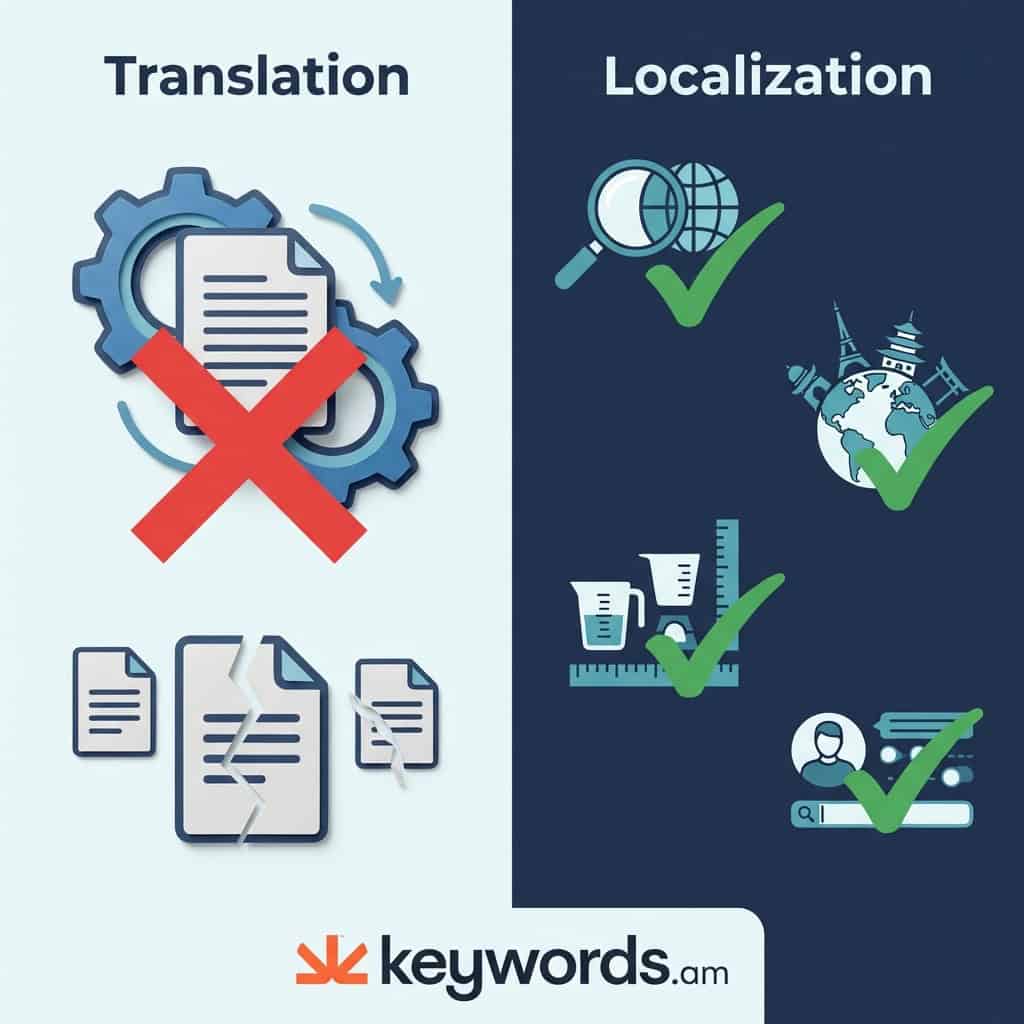
Translation converts words; localization adapts the entire listing—keywords, cultural references, units of measurement, and buyer psychology—to match how local shoppers actually search and buy. The distinction is critical for e-commerce success.
Translation is a literal, word-for-word conversion that fails to account for the nuances of local markets, often leading to poor Amazon SEO. Localization, on the other hand, is a comprehensive process that involves in-depth keyword research for each market, cultural adaptation, and an understanding of local search behavior. For instance, a UK listing requires British spelling (“colour” instead of “color”), metric measurements (centimeters instead of inches), and local idioms. According to a study by CSA Research, 76% of consumers prefer to see product information in their native language, and 40% will not purchase from websites in a foreign language.
Aspect |
Translation |
Localization |
|---|---|---|
Keywords |
Converted literally |
Researched per marketplace |
Measurements |
Kept as original |
Converted to local (cm, kg) |
Cultural references |
Kept or removed |
Adapted to local context |
Search behavior |
Ignored |
Primary focus |
Buyer psychology |
Generic |
Market-specific |
SEO impact |
Often negative |
Positive |
What Are the Best Amazon Listing Tools for International Expansion?
The best tools for international Amazon expansion include Keywords.am for marketplace-specific keyword research, Helium 10 for multi-market breadth, and YLT Translations for human localization of listing copy. Each tool offers distinct advantages depending on your specific needs.
Keywords.am — Best for Marketplace-Specific Keyword Research
Marketplaces: 21 (US, CA, MX, UK, DE, FR, IT, ES, NL, PL, SE, TR, AE, SA, EG, IN, SG, AU, JP, BR)
Why it stands out: Keywords.am is built around the principle of intent-aware localization, not just translation. The platform enforces per-marketplace character and byte limits directly within its editor and utilizes the TFSD framework (Title, Features, Search Terms, Description) to adapt listings for each market. It excels at deep keyword discovery, providing insights into local search behavior. A notable feature is the Swiss Army Knife tool, designed for optimizing backend keywords.
- Best for: Sellers who need accurate keyword data per marketplace and want to optimize listings themselves.
- Limitations: It does not include PPC automation, as its focus is on listing optimization.
- Internal Links: Keywords.am features, TFSD framework
Helium 10 — Best for Multi-Market Research Breadth
Marketplaces: 21+ (North America, Europe, Asia-Pacific, Middle East)
Why it stands out: Helium 10 is a well-established suite of tools with broad multi-market capabilities. Its Cerebro and Magnet tools are functional across all supported markets, and the Insights Dashboard (available on Diamond+ plans) allows for market comparisons. The platform offers a wide range of features beyond keywords, including product research and PPC management, supported by extensive training resources.
- Pricing: Starter plan is $29/mo (limited marketplace access), Platinum is $79/mo (3 marketplace tokens), and Diamond is $229/mo (5 tokens, required for 3+ markets).
- Best for: Sellers seeking a comprehensive suite with multi-market functionality.
- Limitations: Serious multi-market use requires the expensive Diamond plan. The platform’s Trustpilot rating has recently dropped to 2.7/5 amid reports of price increases.
Jungle Scout — Best for Beginners Expanding Internationally
Marketplaces: 17 (US, CA, MX, UK, FR, DE, IT, ES, NL, TR, IN, SA, AE, JP, AU, SG, BR)
Why it stands out: Jungle Scout is known for its high keyword accuracy, reported to be between 84-86%, and its user-friendly interface, which is ideal for sellers new to multi-market expansion. The platform supports multiple languages, including Chinese, French, Japanese, and Spanish, and offers an enterprise-level option, Cobalt, for more advanced users.
- Pricing: The Starter plan is $49/mo ($29/mo annually), the Growth Accelerator is $79/mo, and the Brand Owner plan is $149/mo.
- Best for: New-to-intermediate sellers who value an easier learning curve.
- Limitations: It has fewer advanced features compared to Helium 10, and full marketplace data access requires higher-tier plans.
DataHawk — Best for International Analytics and BI
Marketplaces: 20+ Amazon markets
Why it stands out: DataHawk provides enterprise-grade unified analytics across multiple markets. It features comprehensive keyword ranking monitoring with share of voice calculations per market and integrates with major BI tools like Power BI, Tableau, Google Sheets, and Snowflake. Its Sales Rank Tracker can monitor up to 10,000 ASINs per plan. The platform has strong ratings, with a 4.5/5 on Trustpilot and 4.3/5 on G2.
- Pricing: Custom, based on sales volume and the number of tracked keywords and products.
- Best for: Brands and agencies that require unified BI across numerous marketplaces.
- Limitations: Its enterprise-level pricing makes it unsuitable for smaller sellers.
YLT Translations — Best for Human Localization Quality
Languages: German, Spanish, Italian, French, Dutch, Swedish, Polish, Czech, Turkish, Japanese, Mexican Spanish, French Canadian, Portuguese, Arabic
Why it stands out: YLT Translations employs over 82 native translation experts who specialize in Amazon listings, including titles, bullet points, A+ content, and backend search terms. The service never relies on direct machine translation, instead focusing on localization with cultural context. They also include keyword research as part of their service, using Helium 10. YLT is a partner of Thrasio and was featured at the Billion Dollar Seller Summit.
- Pricing: Starts at $0.11/word, without keyword research.
- Best for: Sellers who prioritize professional human localization.
- Limitations: The cost is higher than DIY software tools, and it is not a real-time solution.
Productsup — Best for Enterprise Feed Management
Scope: 2,500+ channels including Amazon globally
Why it stands out: Productsup is a comprehensive platform for managing product data across multiple languages, brands, and geographic regions. It offers real-time data validation and error correction, ensuring compliance with various marketplace requirements. As a trusted Amazon partner, it handles both Seller Central and Vendor Central feeds.
- Best for: Large brands and manufacturers with complex global operations.
- Limitations: This is an enterprise-only solution and not suitable for individual sellers.
Which Marketplaces Do Amazon Listing Tools for International Expansion Support?
Amazon listing tools international expansion coverage varies widely, with Keywords.am and Helium 10 supporting 21+ marketplaces, Jungle Scout covering 17, and YLT handling 14 languages.
Evaluating coverage depth matters more than breadth alone. Jungle Scout covers 17. DataHawk covers 20+. YLT handles 14 languages. Productsup connects to 2,500+ channels globally. The breadth of coverage is an important factor, but the depth of data within each marketplace is what truly matters.
A tool may claim to “support” a market like Japan but offer shallow keyword data compared to its US database. When evaluating, it is crucial to assess the quality of information for your target expansion regions.
Tool |
US |
UK |
DE |
FR |
IT |
ES |
JP |
AU |
CA |
MX |
Other |
|---|---|---|---|---|---|---|---|---|---|---|---|
Keywords.am |
✓ |
✓ |
✓ |
✓ |
✓ |
✓ |
✓ |
✓ |
✓ |
✓ |
NL, PL, SE, TR, AE, SA, EG, IN, SG, BR (21 total) |
Helium 10 |
✓ |
✓ |
✓ |
✓ |
✓ |
✓ |
✓ |
✓ |
✓ |
✓ |
21+ total markets |
Jungle Scout |
✓ |
✓ |
✓ |
✓ |
✓ |
✓ |
✓ |
✓ |
✓ |
✓ |
17 total markets |
DataHawk |
✓ |
✓ |
✓ |
✓ |
✓ |
✓ |
✓ |
✓ |
✓ |
✓ |
20+ total markets |
YLT |
— |
✓ |
✓ |
✓ |
✓ |
✓ |
✓ |
— |
— |
✓ |
14 languages |
How Much Do Amazon Listing Tools for International Expansion Cost?
Amazon listing tools international expansion pricing ranges from $30/month for Keywords.am to $229/month for Helium 10 Diamond. Human localization services start at $0.11/word. The pricing structures often reflect the level of access to international data.
For example, Helium 10’s lower-priced tiers limit the number of marketplaces you can access, making the Diamond plan at $229/month a necessity for serious multi-market sellers. In contrast, Keywords.am includes access to all 21 of its supported markets at every pricing tier, making it a more cost-effective option for broad international expansion.
Tool |
Entry Price |
Full Multi-Market |
Notes |
|---|---|---|---|
Keywords.am |
$30/mo |
$60-120/mo |
All 21 markets included in all plans |
Helium 10 |
$29/mo |
$229/mo (Diamond) |
Diamond required for 3+ markets |
Jungle Scout |
$49/mo |
$149/mo |
Higher tiers for full marketplace data |
DataHawk |
Custom |
Custom |
Enterprise pricing based on volume |
YLT |
$0.11/word |
Varies |
Per-project pricing |
Productsup |
Custom |
Custom |
Enterprise only |
How Do You Expand from US to EU in 30 Days?
Expand from US to EU Amazon in 30 days by completing market research in week 1, keyword research in week 2, listing localization in week 3, and launch optimization in week 4. This structured approach can simplify what often seems like a daunting process.

Week 1: Market Research & Tool Setup
- Select your target markets. The UK and Germany are common starting points, as they are English-speaking and the largest EU market, respectively.
- Register for VAT, which is required before your first sale in most EU countries. See Amazon’s VAT Services for details.
- Set up an Amazon Europe Unified Account.
- Choose and configure your keyword research tool for the EU markets.
- Research category-specific requirements for each marketplace.
Week 2: Keyword Research Per Market
- Conduct keyword research separately for each target market. Do not translate your US keywords.
- Identify 20-30 primary keywords per market.
- Take note of the character and byte limits for each marketplace.
- Create negative keyword lists, as prohibited terms can differ between markets.
Week 3: Listing Localization
- Localize, do not translate, your titles, bullet points, and descriptions.
- Adapt all measurements to the metric system (cm, kg, ml).
- Convert currency references where applicable.
- Adjust cultural references and idioms to be locally relevant.
- Fill in backend search terms with your market-specific keywords.
Week 4: Launch & Monitor
- Upload your localized listings to each marketplace.
- Set your initial pricing, ensuring it accounts for VAT.
- Monitor indexing with marketplace-specific search tests.
- Track the ranking of your primary keywords in each market.
- Iterate on your listings based on early performance data.
A pro tip is to use a tool like Keywords.am’s clone feature to duplicate your US listing structure and then localize each field with marketplace-specific keywords. For a deeper dive into localization, see this Amazon listing localization guide.
What Are Common Mistakes When Expanding Amazon Internationally?
The most common international expansion mistakes are direct translation instead of localization, ignoring VAT requirements, using US keyword data abroad, and underestimating character limit differences. Avoiding these pitfalls can save you time and money.
- Direct translation: Machine-translating a US listing will kill your keyword relevance.
- Ignoring VAT: You must register for VAT before your first sale. As of August 2024, Amazon UK added a 20% VAT to seller fees.
- US keyword assumptions: Your top-performing US keywords may have zero search volume in other countries.
- Character limit confusion: Japan uses bytes, not characters, which significantly affects title length.
- Single-market tools: Many tools claim to be “international” but provide thin data outside of the US.
- Skipping local compliance: The EU has stricter requirements for organic certifications, and product claims can vary by country.
- Identical imagery: Some markets have different image requirements or cultural expectations.
For a broader comparison of tools, you can also consult this guide to the best Amazon seller tools.
Amazon Listing Tools International Expansion FAQ
These frequently asked questions address common concerns about choosing and using amazon listing tools international expansion.
Q1: Can I use the same Amazon keywords in different countries?
No. Each Amazon marketplace has different search behavior, language, and popular terms. Keywords must be researched separately for each market. Even in English-speaking countries, search terms differ. For example, UK shoppers search for “torch” while US shoppers search for “flashlight.”
Q2: What is the cheapest amazon listing tool for international expansion research?
Keywords.am at $30/month includes all 21 marketplaces. Helium 10’s Starter plan is $29/month but limits marketplace access. To get true multi-market capability with Helium 10, you need the Diamond plan at $229/month, whereas Keywords.am provides full 21-marketplace access at every tier.
Q3: Do I need to register for VAT before selling in Europe?
Yes. Most EU countries require VAT registration before your first sale. The UK requires registration for all non-UK businesses selling to UK customers. Amazon’s VAT Services can assist with registration in the UK, Germany, France, Italy, Spain, Poland, and the Czech Republic.
Q4: Is machine translation good enough for Amazon listings?
No. Machine translation fails to capture keyword intent, cultural context, and local search behavior. Use human localization or AI-powered localization tools. With 76% of consumers preferring product info in their own language and 40% refusing to buy from foreign-language sites, professional localization from a service like YLT is a worthwhile investment.
Q5: Which Amazon marketplace should I expand to first?
Most US sellers expand to the UK first due to the shared language or to Germany, which is the largest EU marketplace with $37.6B in revenue. Japan is a high-potential market but requires more intensive localization efforts due to its unique language and culture.
Q6: How do I handle different character limits per marketplace?
Use tools that enforce per-marketplace limits. Japan uses bytes, where 200 bytes is not equal to 200 characters for Japanese text. A Japanese character can use up to 3 bytes, so a 200-byte title allows for approximately 66 characters. Tools like Keywords.am and Helium 10 track these per-market limits.
Conclusion
Success with amazon listing tools for international expansion hinges on a simple but critical principle: localization, not translation. The keywords that drive sales in the US will not work abroad. Fresh, market-specific keyword research is essential for each new country you enter. While many tools claim to support global expansion, their capabilities vary dramatically. It is vital to verify the depth of their data, not just the breadth of their coverage.
With a structured 30-day workflow—focusing on research, keywords, localization, and launch—expanding your business is an achievable goal. Remember that VAT compliance is not optional and must be handled before your first sale in EU markets. The most effective first step you can take is to run your best-selling US ASIN through a multi-marketplace keyword tool. By comparing the US keyword data against that of the UK or Germany, you will immediately see why localization is so important.
Start with Keywords.am’s free Amazon keyword tool to see how keyword data differs across 21 marketplaces. Import your ASIN and compare your US vs. EU keyword coverage in minutes.