
📑 Table of Contents
- What Is the Difference Between Amazon Listing Translation and Localization?
- What Are the Key Requirements for Amazon’s Biggest International Marketplaces?
- How Do the Major Translation Options Compare for Amazon Sellers?
- Why Does Keyword Research Matter Before Translation?
- What Tools Can Manage Multi-Marketplace Listings?
- How Do You Set Up a Translation Workflow for Multiple Marketplaces?
- What Are the Most Common Amazon Translation Mistakes?
- Frequently Asked Questions About Amazon Listing Translation
- Conclusion
⚡ TL;DR
- Translation converts words; localization converts intent – 76% of consumers prefer product info in their native language, and 40% refuse to buy from foreign-language sites.
- Each marketplace has unique rules – Germany requires VerpackG compliance and formal German, Japan limits titles to ~66 characters (3 bytes each), and the UK needs British spelling plus UKCA marking.
- Translation costs range from free to $500 – Machine translation costs nothing but misses keywords, hybrid AI+human runs $27-100, professional agencies charge $200-500, and native marketplace experts cost $50-150 per listing.
- Keyword research must come before translation – Direct keyword translation fails because local search behavior is culturally determined. “Running shoes” in German is not what Germans actually search.
- Follow a 6-step workflow – Audit source listing, research local keywords, choose translation approach per ASIN value, translate around keywords, get native speaker review, then monitor for 30-60 days.
- Avoid the 6 costliest mistakes – Literal keyword translation, wrong measurement units, missing compliance text, un-localized images, one translator for all languages, and English backend keywords on foreign marketplaces.
A staggering 76% of global consumers prefer product information in their own language, and 40% refuse to purchase from sites in foreign languages. For Amazon sellers eyeing international expansion, this data reveals a critical truth: amazon listing translation is not optional, it is the price of admission to a global market.
Many sellers treat translation as a simple, one-time task. They translate the listing, upload it, and move on. This approach fails to recognize that Amazon’s international marketplaces are fundamentally different ecosystems. Each has unique search behavior, distinct cultural expectations, and complex compliance requirements. A US seller launching on Amazon.de with a directly translated listing often finds their product invisible to local buyers, lost in a sea of competitors who have done the necessary localization work.
This amazon listing translation guide provides a comprehensive comparison of every approach, from basic machine translation to hybrid AI+human models, professional services, and native experts. It includes real cost data and highlights the critical step most sellers skip: conducting thorough keyword research in the target language before the translation begins. Unlike guides from translation agencies selling a service, this is an independent analysis of when a do-it-yourself approach is sufficient and when professional assistance is a worthwhile investment.
What Is the Difference Between Amazon Listing Translation and Localization?
Translation converts words between languages. Localization adapts the entire listing, including keywords, cultural references, measurements, and compliance language, for a specific marketplace audience.
Translation is a purely linguistic conversion. Text is converted word-for-word or meaning-for-meaning. The result is a grammatically correct listing that may use zero local search terms, rendering it undiscoverable. For example, “running shoes” translates to “Laufschuhe” in German. A direct translation is technically correct, but German shoppers actually search for “Sportschuhe” (sport shoes) or “Joggingschuhe” (jogging shoes) more often, depending on the specific use case. A listing optimized for “Laufschuhe” would miss the majority of the potential search traffic.
Localization is a complete market adaptation. The process involves researching how local buyers search, what compliance language is legally required, which measurement units to use (metric vs. imperial), and how product benefits should be framed to resonate with the local culture. This might mean converting inches to centimeters for Germany, ensuring Value Added Tax (VAT) is included in the price display, using specific honorific language for Japanese customers, or even changing the product’s name. A product for “tailgating” in the US would require significant localization for the UK, where the concept is not widely understood. It might be rebranded as a product for “picnics” or “outdoor festivals.”
A translation agency can deliver a perfect German translation that fails to rank for any valuable keywords because it does not target the terms German shoppers actually use. The strategic framework for this distinction is covered in detail in the Amazon listing localization guide. Understanding this difference is the first step. The second is knowing what each international marketplace actually requires.
What Are the Key Requirements for Amazon’s Biggest International Marketplaces?
Amazon Germany requires VAT-compliant language and metric units, Japan uses multi-byte characters with strict byte limits, and the UK demands British spelling with post-Brexit compliance.
Germany (Amazon.de): As Amazon’s largest European market, Germany serves over 95 million active customers. Sellers must use formal German (“Sie” instead of “du”), display VAT requirements clearly on invoices, and use metric measurements. Compliance is non-negotiable. Listings must include packaging law (VerpackG) registration details and WEEE registration numbers for electronics to avoid immediate suppression. German consumers have high expectations for product quality and durability, so listings should emphasize these aspects.
UK (Amazon.co.uk): While the language is English, success in the UK market requires using British spelling (e.g., colour, specialised, catalogue) and metric measurements, though imperial units can be included secondarily. Post-Brexit regulations mandate UKCA marking for product safety and other specific documentation. Sellers also need a separate UK entity or an appointed representative for legal purposes.
Japan (Amazon.co.jp): Japan presents unique challenges with multi-byte character encoding. Each Japanese character consumes roughly 3 bytes, meaning a 200-byte title limit allows only about 66 Japanese characters compared to 200 English characters. Amazon character limits are effectively stricter, demanding concise and impactful copy. Cultural expectations for honorific language (keigo) and extremely high-quality, detailed product images are paramount for building trust.
France (Amazon.fr): The French market requires the “Triman” logo on product packaging, which indicates that the product is recyclable. For electronics, sellers must register for DEEE (similar to WEEE in Germany). All text, including on images and in A+ Content, must be in formal French. There are also specific laws about sales and promotions that sellers must adhere to.
Spain (Amazon.es) & Italy (Amazon.it): Both marketplaces have similar requirements to other EU countries. They require CE marking for product safety, RAEE registration for electronics (the Italian equivalent of WEEE), and full translation into Spanish and Italian, respectively. Customer service in the local language is also a key expectation for shoppers in these regions.
Marketplace |
Language |
Key Compliance |
Character Impact |
Active Customers |
|---|---|---|---|---|
Germany (Amazon.de) |
Formal German |
VAT display, VerpackG, WEEE |
Standard (1 byte/char) |
95M+ |
UK (Amazon.co.uk) |
British English |
UKCA marking, UK representative |
Standard (1 byte/char) |
30M+ |
Japan (Amazon.co.jp) |
Japanese (keigo) |
PSE mark, SDS for chemicals |
3 bytes/char (66 chars in 200 bytes) |
50M+ |
France (Amazon.fr) |
Formal French |
Triman logo, DEEE registration |
Standard |
30M+ |
Italy (Amazon.it) |
Italian |
CE marking, RAEE registration |
Standard |
20M+ |
Spain (Amazon.es) |
Spanish |
CE marking, local tax laws |
Standard |
15M+ |
Now that the marketplace requirements are clear, the next question is who should handle the actual translation.
How Do the Major Translation Options Compare for Amazon Sellers?
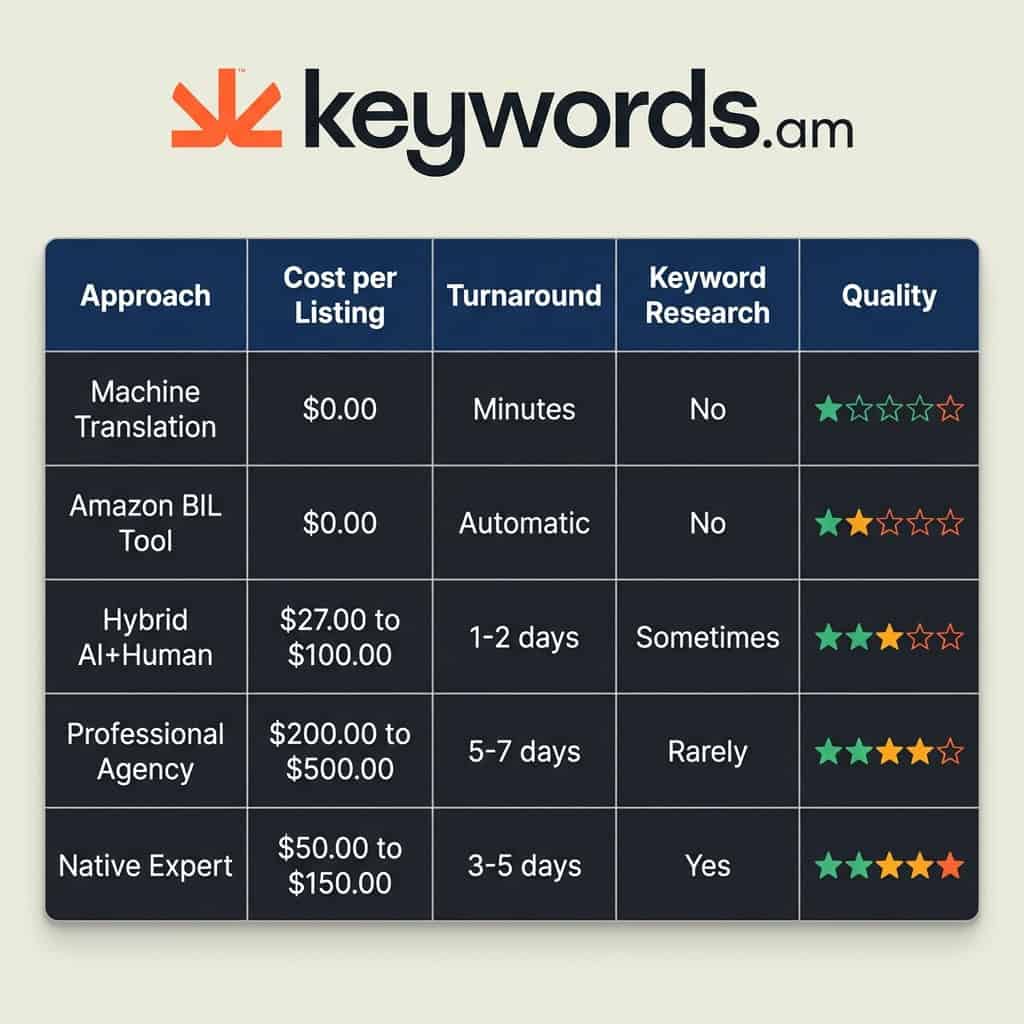
Machine translation costs near zero but misses keywords and nuance. Professional agencies charge $200-500 per listing. Hybrid AI+human approaches balance speed, cost, and quality.
Machine Translation (Google Translate, DeepL, Amazon Translate): These tools are free or nearly free and provide instantaneous results. However, they offer no keyword optimization, frequently produce awkward or unnatural phrasing, and completely miss cultural context. Amazon Translate offers a free tier of 2 million characters per month for 12 months, making it useful for internal review, understanding competitor listings, or creating a rough first draft that a human will heavily edit. Relying solely on these tools for a live listing is a recipe for failure.
Amazon’s Build International Listings (BIL) tool: This free tool is built into Seller Central and automatically translates and syncs listings and pricing across marketplaces. It uses basic machine translation with no keyword optimization or localization. It is best used for quickly testing a product’s viability in a new marketplace before committing significant resources, but it is not a long-term solution for competitive products.
Professional Translation Agencies: Agencies typically charge $200-500 per listing, with a 5-7 day turnaround. The quality of the linguistic translation is generally high, but most agencies translate text without conducting marketplace-specific keyword research. Sellers must provide the keyword list. This option is best for complex products in regulated categories (like medical devices or supplements) or for high-stakes flagship product listings where absolute accuracy is paramount. Costs for A+ Content can be significantly higher, often billed per word.
Hybrid AI + Human Review: This approach uses a sophisticated AI model to generate a high-quality first draft, which is then reviewed, edited, and optimized by a human native speaker who is also an Amazon expert. Costs range from $27-100 per listing with a 1-2 day turnaround. Services like AmzLens offer this balanced approach, making it a scalable and cost-effective solution for sellers expanding with large catalogs across multiple marketplaces.
Native Marketplace Experts: These are freelance Amazon sellers or consultants located in the target country, often found on platforms like Fiverr Pro or the Amazon Service Provider Network. They typically charge $50-150 per listing and, if vetted properly, understand both the language and the dynamics of their local Amazon marketplace. This is often the best option for achieving the highest-quality results on key ASINs, as they combine linguistic skill with practical e-commerce knowledge.
Approach |
Cost per Listing |
Turnaround |
Keyword Research |
Cultural Accuracy |
Best For |
|---|---|---|---|---|---|
Machine Translation (DeepL/Google) |
Free |
Minutes |
None |
Low |
Drafts, competitor research |
Amazon BIL Tool |
Free |
Automatic |
None |
Low-Medium |
Testing new marketplaces |
Hybrid AI + Human |
$27-100 |
1-2 days |
Sometimes |
Medium-High |
Scaling across marketplaces |
Professional Agency |
$200-500 |
5-7 days |
Rarely |
High |
Complex/regulated products |
Native Marketplace Expert |
$50-150 |
3-5 days |
Yes (if Amazon-experienced) |
Highest |
Key ASINs, high-revenue products |
Even the best translator, however, cannot perform the most critical preliminary step in any amazon listing translation project: keyword research in the target language.
Why Does Keyword Research Matter Before Translation?
Translating English keywords directly into another language rarely produces the terms local buyers actually search. Local keyword research must happen before amazon listing translation begins.
Direct keyword translation fails because search behavior is culturally and linguistically determined. “Stainless steel water bottle” in English might translate literally to a German phrase that technically describes the product but is not what shoppers type into the Amazon search bar. They might search “Trinkflasche Edelstahl” (drinking bottle stainless steel) or “Isolierflasche” (insulated bottle) instead. Relying on direct translation means missing the highest-volume, most relevant search terms and forfeiting sales.
Each marketplace has its own unique search volume distribution. A keyword with 50,000 monthly searches in the US might have a translated equivalent with only 2,000 searches in Germany, while a different local phrasing might have 15,000. Without local data, sellers are flying blind, optimizing for the wrong terms and leaving money on the table.
A concrete workflow for a “yoga mat” illustrates the process:
1. Identify Seed Keywords: Start with the core English term, “yoga mat.”
2. Generate Initial Translations: Use a tool like Google Translate or DeepL to find the direct German translation, which is “Yogamatte.”
3. Conduct Marketplace Research: Use a specialized Amazon keyword tool to search for “Yogamatte” on Amazon.de. Analyze the search results page and the keyword data.
4. Discover Local Synonyms: The research reveals that while “Yogamatte” is used, high-volume related terms include “Gymnastikmatte” (gymnastics mat) and “Fitnessmatte” (fitness mat). These terms represent a significant portion of the market demand.
5. Build a Prioritized Keyword List: Create a final keyword glossary that includes all three terms (“Yogamatte,” “Gymnastikmatte,” “Fitnessmatte”), prioritized by their local search volume and relevance.
6. Translate Around Keywords: Provide this glossary to the translator with explicit instructions to incorporate these specific, data-backed terms into the title, bullet points, and description naturally.
The Amazon keyword research methodology provides a framework for this process that applies across all languages. Tools like Keywords.am support multiple Amazon marketplaces, allowing sellers to research keywords in German, Japanese, and other languages before translation begins. Helium 10’s Magnet and Cerebro also support international marketplaces, offering another option for data gathering.
What Tools Can Manage Multi-Marketplace Listings?
Sellers can manage multi-marketplace listings using Seller Central bulk uploads, Amazon’s Selling Partner API, or third-party software like FlatFilePro for centralized listing management.
Seller Central Bulk Uploads (Flat Files): Amazon provides category-specific inventory file templates (or “flat files”) that allow sellers to upload and update listing information in bulk using a spreadsheet. While powerful, these files are notoriously complex and unforgiving. Each marketplace has slightly different templates and valid values, making the process prone to errors. However, for sellers comfortable with spreadsheets, this is a free and effective way to manage dozens or hundreds of listings at once.
Third-Party Listing Management Software: Several software solutions exist to simplify this process. Tools like FlatFilePro, Linnworks, or ChannelAdvisor provide a more user-friendly interface for managing product data. They often include features for syncing inventory and pricing, as well as for pushing listing updates to multiple marketplaces simultaneously. These tools carry a subscription cost but can save immense amounts of time and prevent costly errors for sellers with large catalogs.
Amazon Selling Partner API (SP-API): For large brands or technically advanced sellers, the SP-API allows for direct, programmatic management of listings. By building a custom application or using a pre-built connector, sellers can automate listing creation, updates, and synchronization. This approach offers the most flexibility and power but requires significant development resources.
With the right keywords and management tools identified, the next step is to execute the translation workflow.
How Do You Set Up a Translation Workflow for Multiple Marketplaces?
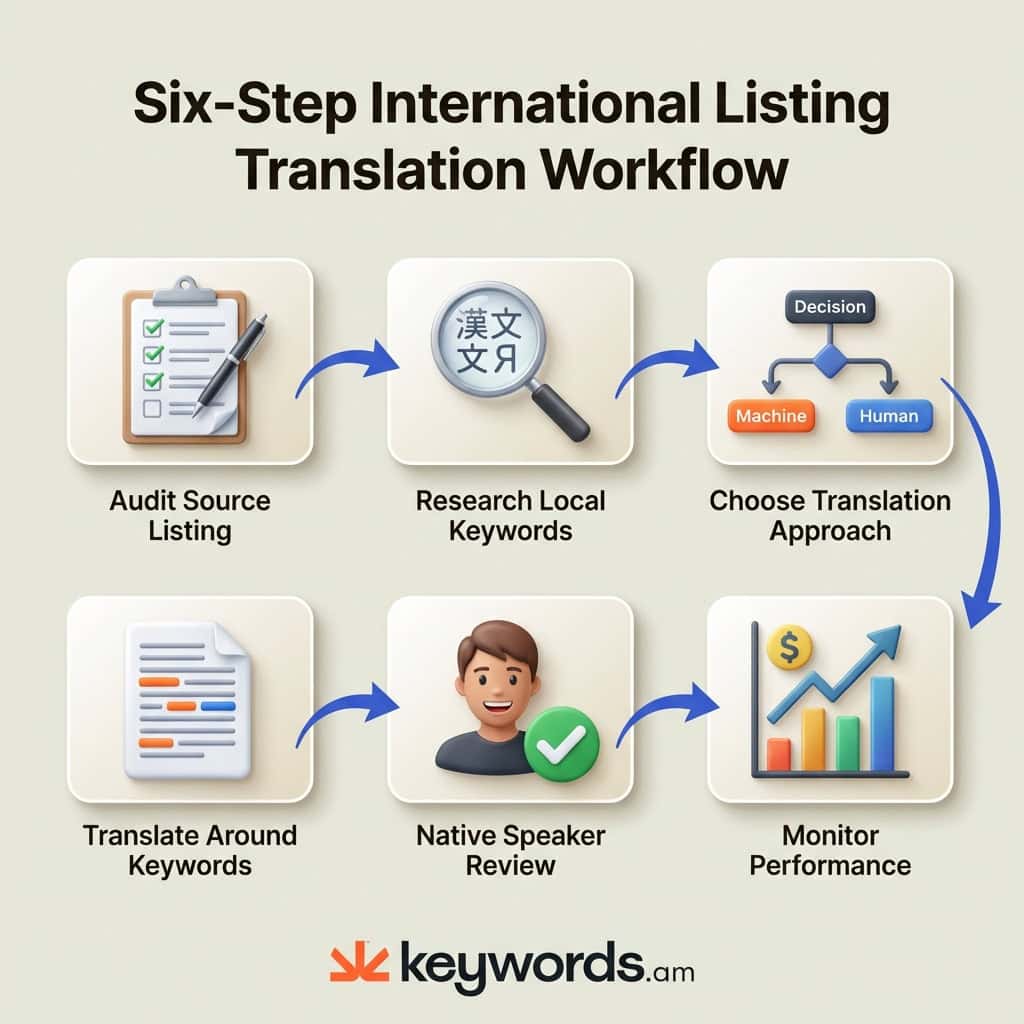
An effective amazon listing translation workflow follows six steps: audit source listings, research local keywords, select translation approach, translate and optimize, review with native speakers, and monitor performance.
Step 1: Audit Your Source Listing. The quality of the translated listing can never exceed the quality of the source. Before any translation work begins, the primary English listing must be fully optimized. Garbage in equals translated garbage out. Check that the title, bullet points, description, backend keywords, and images are accurate, compelling, and compliant with Amazon’s terms of service.
Step 2: Research Keywords in Each Target Marketplace. This is the most crucial step. Use marketplace-specific tools to build a comprehensive glossary of translated and localized keyword equivalents, ranked by search volume. This research forms the strategic foundation of the listing, ensuring the translator knows exactly which terms to prioritize for maximum visibility.
Step 3: Choose Your Translation Approach per Marketplace. Create a decision matrix based on revenue and strategic importance per ASIN. For a catalog of 200 products, the top 10 highest-revenue ASINs should be assigned to a native marketplace expert. The next 50 mid-tier ASINs are suitable for a hybrid AI+human service. The remaining 140 low-priority or test items can be processed using the BIL tool or machine translation with a light human review to start.
Step 4: Translate and Optimize. Provide the translator with the keyword glossary, the optimized source listing, and a clear brief outlining all marketplace-specific requirements (e.g., “Use formal German,” “Include VerpackG compliance text”). Instruct them to perform keyword-first translation, which means writing the copy around the prioritized keywords, not translating the English text word-for-word.
Step 5: Native Speaker Review. Even professional translations benefit from a final check by a native speaker who is also an Amazon shopper. This is not just proofreading for grammar; it is cultural validation. This person’s job is to read the listing and flag anything that sounds unnatural, awkward, or “foreign.” This step ensures the tone matches local expectations and builds trust with potential buyers.
Step 6: Monitor and Iterate. After launch, track key metrics like keyword rankings, sessions, and conversion rate in each marketplace for at least 30-60 days. Use tools like Brand Analytics in Seller Central to see which keywords are driving traffic. Be prepared to adjust listings based on this real-world performance data, using Amazon listing tools for international expansion to manage the process efficiently.
Even experienced sellers make costly translation mistakes. Avoiding the most common ones is key to success.
What Are the Most Common Amazon Translation Mistakes?
The costliest amazon listing translation mistakes are skipping keyword research, translating literally instead of localizing, ignoring compliance requirements, and neglecting to localize images containing text.
Mistake 1: Translating Keywords Literally. “Laptop stand” might become a phrase no one searches for in the target language. Always research first to find the actual search terms used by local shoppers. This is the single most common and damaging mistake.
Mistake 2: Ignoring Measurement Units and Standards. US sellers often list product dimensions in inches on Amazon.de, which uses centimeters, or use Fahrenheit instead of Celsius in descriptions. This creates confusion, hurts conversion rates, and increases product returns from frustrated buyers.
Mistake 3: Skipping Compliance Text. Missing the VerpackG registration number on Amazon.de listings or the UKCA marking for the UK can get listings suppressed or accounts suspended. Compliance issues lead to a complete loss of sales, not just poor performance.
Mistake 4: Not Localizing Images and A+ Content. If product images contain English text (instructions, feature callouts, infographics), they must be recreated with localized text. The same applies to A+ Content. The models or lifestyles depicted in images should resonate with the local culture to build trust and rapport.
Mistake 5: Using One Translator for All Languages. A single German translator attempting a Japanese translation (or vice versa) through an intermediary language like English produces double-translation errors. Avoid this “telephone game” by using distinct, native speakers for each target language to ensure accuracy and nuance.
Mistake 6: Not Updating Backend Search Terms. Sellers often translate the visible front-end of the listing but leave the backend keywords in English. Amazon’s A10 algorithm indexes these terms independently for each marketplace, so they must be in the local language to have any effect on search ranking.
Frequently Asked Questions About Amazon Listing Translation
Q1: How much does it cost to translate an Amazon listing?
Machine translation is free, hybrid AI+human services cost $27-100 per listing, and professional agencies charge $200-500 per listing, depending on the language and complexity.
Costs vary significantly by language pair. Japanese and Chinese translations typically cost more than European languages due to their complexity. Sellers should budget approximately $50-150 per ASIN for a high-quality, keyword-optimized translation across most European marketplaces. Translating A+ Content can add several hundred dollars per ASIN, as it is often priced per word.
Q2: Can I use Google Translate for my Amazon listings?
Google Translate can produce a rough first draft but should never be used as-is for a live Amazon listing. It fundamentally lacks the ability to perform keyword optimization and misses critical cultural nuance.
Tools like DeepL tend to produce more natural-sounding translations for European languages. However, both tools can make significant errors, such as using the wrong gender for nouns in German or French, which immediately signals to a native speaker that the listing was poorly translated. Use machine translation as a starting point, then have a native speaker heavily edit and optimize for local search terms.
Q3: Does Amazon automatically translate listings?
Amazon’s Build International Listings (BIL) tool can auto-translate listings between linked marketplaces. It uses a basic machine translation engine without any keyword optimization or cultural adaptation.
BIL is a useful tool for testing new marketplaces with minimal initial investment. For any competitive category, however, auto-translated listings will almost always underperform manually optimized listings by a significant margin in terms of both traffic and conversion.
Q4: Which Amazon marketplace should I expand to first?
Most US-based sellers expand to the UK first because of the shared language, followed by Germany, which is Amazon’s second-largest European marketplace with over 95 million active customers, offering maximum revenue potential.
The UK requires minimal translation but needs adaptation for British spelling and post-Brexit compliance. Germany offers the largest European customer base but requires full German translation plus rigorous adherence to compliance documentation for packaging and electronics. Sellers should also consider product-market fit; a product popular in the US may not have the same appeal in Japan or Italy.
Q5: How long does it take to translate an Amazon listing?
Machine translation takes minutes, hybrid services can deliver in 1-2 days, and professional agencies typically require 5-7 business days per listing per language.
A complete and proper international launch process takes longer. Factor in additional time for keyword research (1-2 days), native speaker review (1-2 days), and marketplace compliance verification. A realistic timeline for a high-quality launch in one new marketplace is 2-3 weeks from start to finish.
Q6: Do I need different backend keywords for each marketplace?
Yes. Backend search terms are a critical part of listing optimization and must be in the local language of each marketplace. Keyword search behavior differs significantly across countries and cultures.
Amazon indexes backend keywords per marketplace independently. Using English backend keywords on Amazon.de will provide zero benefit for ranking on German search terms. Each marketplace requires its own dedicated keyword research to identify the most effective terms for both the visible listing content and the hidden backend search term fields.
Conclusion
Successful amazon listing translation requires more than simply converting words; it requires a deep adaptation to the search behavior, commercial culture, and regulatory environment of each marketplace. By implementing a workflow that prioritizes local keyword research before any translation occurs, choosing the right translation method for each ASIN’s strategic value, and rigorously monitoring performance, sellers can avoid common and costly pitfalls.
The most critical differentiator in amazon listing translation is the order of operations: research keywords first, then translate. This approach ensures that every listing is built on a solid foundation of actual customer search demand rather than on linguistic guesswork. An optimized listing speaks the customer’s language and uses their search terms, making the product discoverable and desirable.
International keyword research begins with understanding what local buyers actually search for. Explore Keywords.am’s multi-marketplace keyword research to build a localized keyword strategy and start the expansion process correctly.