Comparison
The 10 best Helium 10 alternatives for Amazon sellers (ranked by use case)
Helium 10 alternatives ranked by use case for 2026. Compare 10 Amazon seller tools by pricing, features, free tiers, and best-for labels after the price hike.

Helium 10 killed its $39 Starter plan in early 2026, and Platinum now sits at $129 per month. If you only touch keyword research and listing optimization, you’re paying for PPC, inventory, and profit modules you never open. The best helium 10 alternatives cost less and do fewer things better, and this guide ranks 10 of them by use case, pricing, and seller type.
The comparison table comes first for quick scanning, followed by individual tool reviews, agency and high-volume seller sections, and a checklist for evaluating any replacement.
Why are sellers switching from Helium 10 in 2026?
Helium 10 removed its Starter plan and raised Platinum to $129/mo in 2026, pushing budget-conscious sellers toward focused alternatives that cost less.
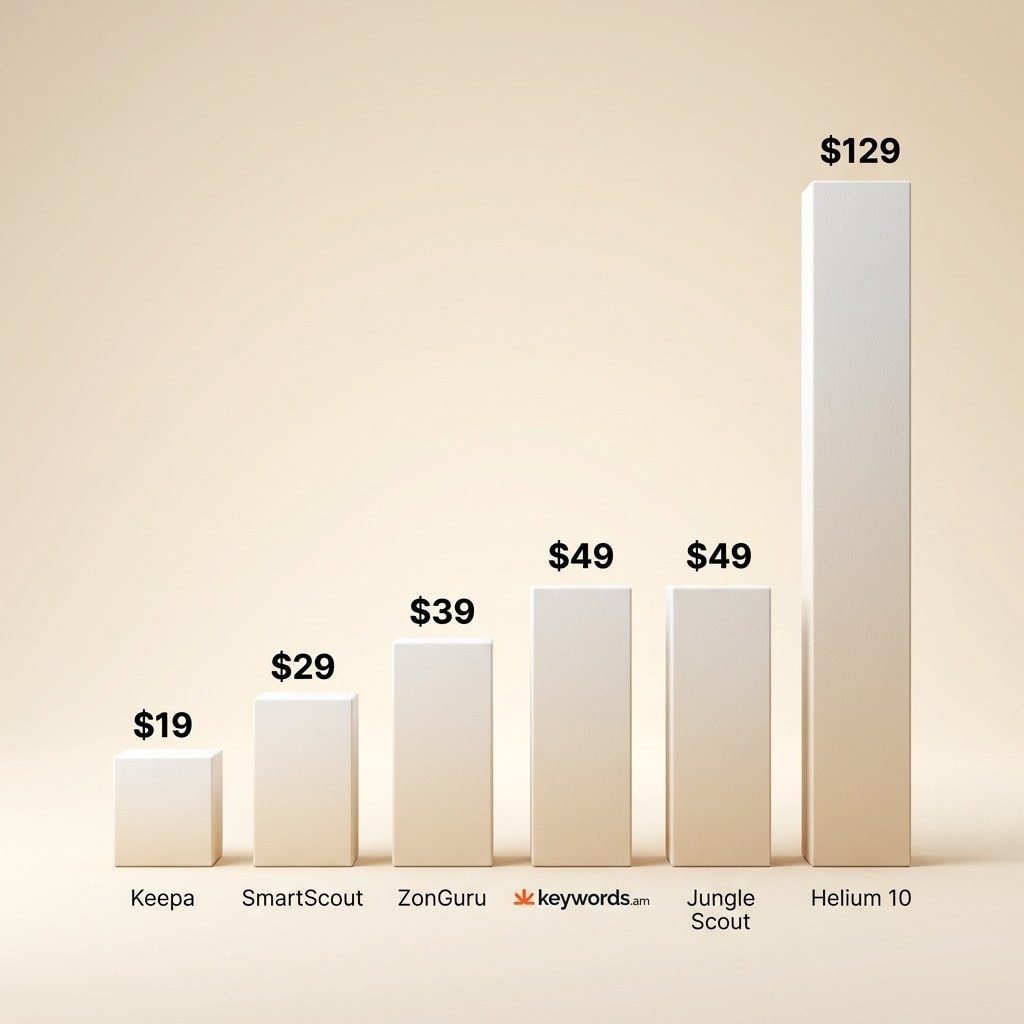
The Helium 10 pricing page confirms it: the $39/mo Starter plan is gone for new sign-ups, and Platinum costs $129/mo ($99 billed annually), a roughly 25 to 30 percent jump from the old entry price. The platform still packs 30+ tools, but most sellers only touch Cerebro, Magnet, and the listing builder. Paying for the full suite doesn’t make sense when the advertising and inventory tabs collect dust.
User satisfaction has also softened. Based on the author’s review of Helium 10’s G2 listing in July 2026, the aggregate rating sits below its historical high, with reviews pointing to billing complaints and complexity overload (retrieved from g2.com/products/helium-10, July 2026). When sellers just want to check search volumes, clicking past ten unused modules adds friction. With Platinum as the new price floor, here’s how the alternatives stack up.
How do the top 10 Helium 10 alternatives compare?
The cheapest paid options are Keepa at ~$19/month and SmartScout at $29/month, while Keywords.am and ZonGuru offer the strongest free-to-paid upgrade paths.
| Tool | Starting Price | Free Tier | Marketplaces | Chrome Extension | Best For |
|---|---|---|---|---|---|
| Keywords.am | $49/mo ($39/yr) | Yes (Explore) | 21 | Yes | Keyword research & listing optimization |
| Jungle Scout | $49/mo | No | 10+ | Yes | Product research & validation |
| SmartScout | $29/mo | No | US, EU | Yes | Market intelligence & brand analysis |
| AMZScout | ~$45/mo | 7-day trial | US, EU | Yes | Budget product research |
| ZonGuru | $39/mo | 7-day trial | 10+ | Yes | Niche hunters & listing optimization |
| Data Dive | $39/mo | No | US | Yes | PPC keyword mining |
| Viral Launch | $69/mo ($25 lite) | 14-day trial | US | Yes | Product launches & market research |
| SellerApp | $50/mo | Freemium | US, IN, EU | Yes | PPC optimization |
| Keepa | ~$19/mo | Yes (limited) | 11 | Yes | Price tracking & sales rank history |
| SellerSprite | $70/mo | Yes (limited) | 9 | Yes | International keyword research |
Pricing verified against vendor pages as of early 2026 and subject to change.
What are the best Helium 10 alternatives in 2026?
The right tool depends on the job. Pick Jungle Scout for product research, Keywords.am for listing optimization, or SmartScout for market intelligence.
1. Keywords.am: best for keyword research and listing optimization
Keywords.am drops product discovery modules and focuses entirely on listing work. The TFSD Framework provides real-time keyword coverage across Title, Features, Search Terms, and Description in a single editor. Pricing: Free (Explore), $49/mo Seller ($39/yr), $129/mo Brand ($99/yr), $299/mo Agency ($249/yr).
Best for solo sellers and agencies prioritizing search visibility. The TFSD workflow tracks which terms sit in the product title versus the backend keyword fields, preventing duplicates and wasted characters. Direct Seller Central publishing removes copy-paste errors, coverage extends to 21 Amazon marketplaces, and the Amber AI assistant drafts contextual copy inside the editor. The tradeoff: no product research or PPC management here.
2. Jungle Scout: best for product research and validation
Jungle Scout built its reputation on product discovery. The Opportunity Finder pairs with a large product database, and Jungle Scout claims high accuracy on sales estimates (see their published data methodology at junglescout.com/data/). Pricing starts at $49/mo (Starter), $79/mo (Growth Accelerator), and $399/mo (Brand Owner).
Best for new sellers validating product ideas and established brands tracking competitors. The database filters by category, sales volume, and review count to surface low-competition niches. Listing optimization stays basic compared to dedicated alternatives, so read the Helium 10 vs Jungle Scout breakdown before committing.
3. SmartScout: best for market intelligence and brand analysis
SmartScout focuses on macro-level market data rather than individual product tracking. The brand map and subcategory traffic data show exactly where revenue concentrates. Pricing starts at $29/mo (Basic), $97/mo (Essentials), and $187/mo (Business).
Best for wholesale sellers, arbitrage operators, and brand acquisition firms. The visual dashboards highlight dominant players and market share. Filtering entire brands by FBA reliance or review count speeds up prospecting. Clear limitation: SmartScout offers no listing optimization or keyword writing tools.
4. AMZScout: best for budget-friendly product research
AMZScout targets entry-level sellers with accessible discovery tools. A lifetime access option is rare in a subscription-heavy market. Monthly plans typically fall between $45 and $60, with annual billing around $400/year.
Best for new sellers wanting basic product research without recurring fees. The Chrome extension overlays profitability data on search results, and a margin calculator accounts for FBA fees. Keyword tools lack the database scale of dedicated alternatives.
5. ZonGuru: best for niche validation and listing optimization
ZonGuru blends product discovery with a visual listing optimization workflow. The Love/Hate feature analyzes review sentiment across competing products to surface market opportunities. Pricing: $39/mo (Researcher), $49/mo (Seller).
Best for private label sellers wanting research and listing tools in one dashboard. Understanding why a customer left a one-star review builds the roadmap for iteration. The keyword index is smaller than Keywords.am or Helium 10, so obscure niches may show gaps.
6. Data Dive: best for PPC keyword mining and deep data
Data Dive turns raw Amazon search data into structured spreadsheets. The standout is keyword and ASIN-level granularity with extensive search volume histories. Pricing: $39/mo (Starter), $149/mo (Standard), $490/mo (Enterprise).
Best for PPC-focused sellers and analysts comfortable in spreadsheets. Advanced sellers build custom pivot tables to identify bidding targets based on historical trends. The tradeoff: a steep learning curve and no AI writing assistant, so sellers process data themselves. Pair it with amazon-ppc-optimization tactics for the full workflow.
7. Viral Launch: best for product launches and market research
Viral Launch combines market intelligence with launch execution tools. The standalone Market Intelligence tool at $25/mo is one of the cheapest entry points for reliable market data. The Essentials plan runs $69/mo, and the full Pro tier costs $99/mo.
Best for sellers launching new products who need coordinated strategy alongside keyword tools. The system flags niches with declining search volume trends, which prevents costly inventory orders in dying categories. Pro Plus at $199/mo runs higher than newer competitors.
8. SellerApp: best for PPC automation on a budget
SellerApp focuses on advertising spend optimization through automated bid adjustments and keyword harvesting. Rule-based bid management monitors campaigns around the clock. A freemium tier exists for basic tracking, and paid plans begin around $50/mo.
Best for sellers who want dedicated PPC management without enterprise pricing. Automated rules pause campaigns exceeding target ACoS thresholds. Geographic scope is limited, mostly US and India, with sparser support for European or Asian marketplaces.
9. Keepa: best free alternative for price tracking
Keepa is the foundational price tracking tool used by nearly every experienced Amazon seller. It embeds detailed price history charts directly onto every product page. The free tier covers most basic tracking, and Premium costs roughly $19/mo.
Best for budget sellers, arbitrage operators, and wholesale buyers tracking price trends and sales rank velocity. Keepa is purely a price and rank aggregator, so pair it with a text-based alternative for full coverage.
10. SellerSprite: best for international keyword research
SellerSprite targets the global market with keyword data across nine international marketplaces and historical search volume trends. A limited free tier is available, and Premium starts at $70/mo.
Best for sellers expanding into the EU, Japan, or other international marketplaces. Direct English translations often miss localized buyer intent, and SellerSprite surfaces the exact phrasing local buyers use. Pair it with strong reverse ASIN lookups for competitor mapping. The UI feels dated compared to Western competitors.
Which Helium 10 alternative fits your seller type?
Choose based on your priorities: keyword research, product discovery, PPC optimization, or budget. Stacking two focused tools often beats one expensive suite.
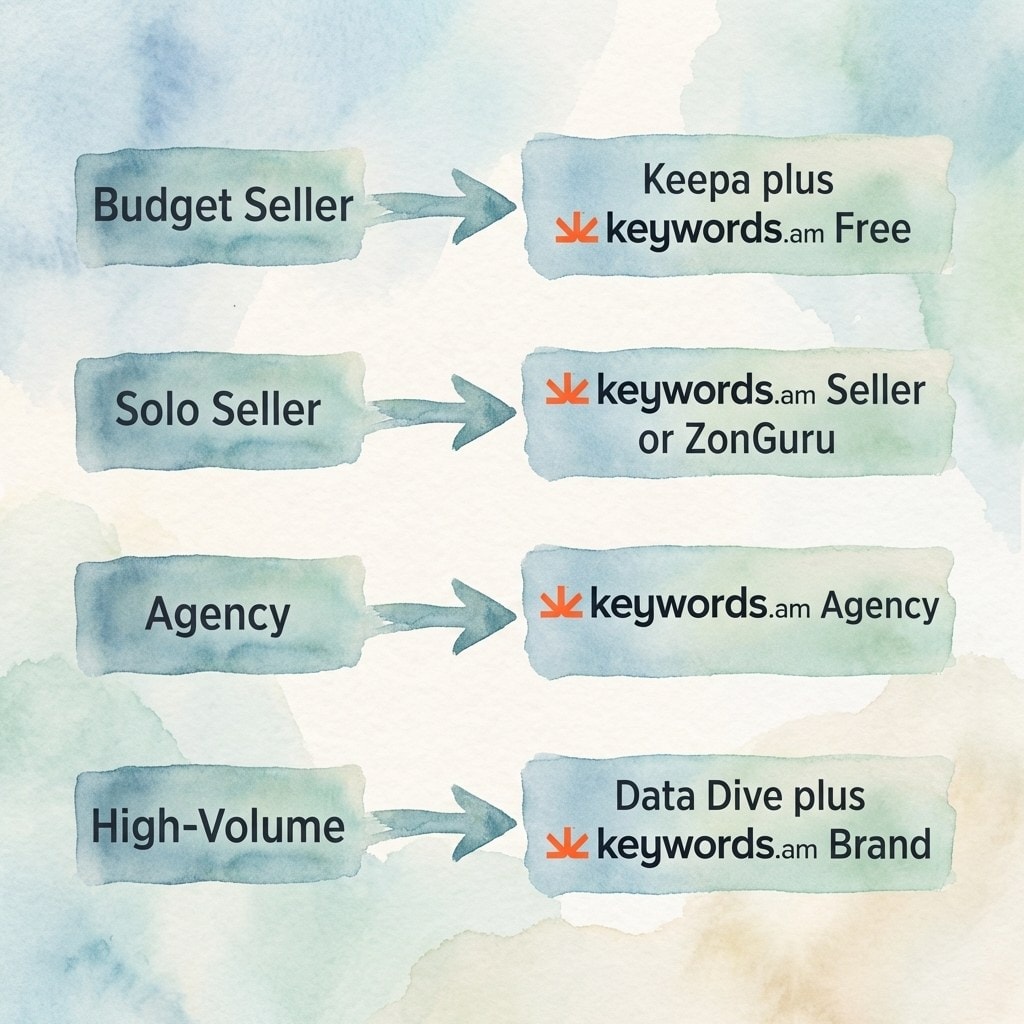
Different seller types need different capabilities. A quick routing guide:
- Agencies managing multiple brands: Keywords.am Agency at $249/yr or Jungle Scout Brand Owner provide the necessary scale and seat count.
- High-volume sellers (100+ SKUs): Pair Data Dive Standard with Keywords.am Brand for a strong data plus optimization engine.
- Sellers replacing Cerebro specifically: Use the Keywords.am reverse ASIN tool with KPS scoring for the same core workflow without the suite cost.
- New or budget sellers: Combine Keepa’s free tier with Keywords.am Explore for $0/mo price tracking plus basic keyword research.
- Tool stacking strategy: A dedicated keyword tool like Keywords.am plus a research platform like Jungle Scout or SmartScout usually costs less than a single all-in-one suite.
For a side-by-side of the two most-searched suites, see the Helium 10 vs Jungle Scout comparison covering data accuracy, marketplace coverage, and listing workflow.
What should agencies look for in a Helium 10 alternative?
Flat-rate pricing can be significantly cheaper at scale than per-ASIN models. Helium 10 Diamond ($279/mo) only covers 1,000 ASINs, so an agency with 10 clients at 100 SKUs each is already at the limit and forced into Enterprise pricing to onboard one more client.
| Tool | 10 client products | 25 | 50 |
|---|---|---|---|
| Keywords.am Agency | $299/mo | $299/mo | $299/mo |
| DataDive | $149/mo | $149/mo | $490/mo |
| Jungle Scout | $149/mo | $149/mo | Cobalt (custom) |
| SmartScout | $97/mo | $187/mo | Enterprise |
| ZonGuru | $49-99/mo | $99-159/mo | Enterprise |
| Helium 10 | $279/mo | $279/mo (near limit) | Enterprise needed |
Team seats matter as much as sticker price. Helium 10 caps its $279/mo Diamond plan at 5 seats, Jungle Scout offers 10 on Brand Owner, and Keywords.am includes multi-user support on every plan starting at $49/mo Seller. That matters for small agencies that don’t want an enterprise contract just to share access with one virtual assistant.
White-label reporting is the agency-specific feature most tools skip or hide behind enterprise pricing. Keywords.am and SellerApp build it into agency tiers, with your logo on audit reports and custom CTAs. Helium 10 and Jungle Scout require manual export-and-rebuild workflows, which adds significantly more manual effort for agencies delivering 20+ reports per month.
Sizing the right plan:
- Small (1-5 clients, under 50 SKUs): Keywords.am Seller ($49/mo) or ZonGuru Researcher.
- Mid-size (5-20 clients, 100-500 SKUs): Keywords.am Agency ($299/mo) for flat-rate predictability, or DataDive Standard ($149/mo) for competitor intelligence.
- Large (20+ clients, 500+ SKUs): Keywords.am Agency still works due to the unlimited model, or price out custom Enterprise plans from DataDive or SellerApp.
What should high-volume sellers look for in a replacement?
High-volume sellers care about two things tool brochures rarely mention: per-SKU economics and batch operation throughput. Sticker price hides big cost differences once you scale.
| Tool | 50 SKUs | 100 SKUs | 250 SKUs | 500 SKUs | Per-SKU @ 500 |
|---|---|---|---|---|---|
| Keywords.am | $30 | $60 | $120 | $120 | $0.24 |
| DataDive | $39 | $97 | $249 | $490 | $0.98 |
| Carbon6 | $99 | $99 | $199 | $199 | $0.40 |
| Perpetua | $695+ | $695+ | $1,500+ | $2,500+ | $5.00+ |
| Teikametrics | $250+ | $400+ | $800+ | $1,500+ | $3.00+ |
| Pacvue | $500+ | $750+ | $1,500+ | $3,000+ | $6.00+ |
PPC-focused tools (Perpetua, Teikametrics, Pacvue) look expensive but charge as a percentage of ad spend, which can pencil out for sellers running $50k+/month in ads. For pure listing and keyword work, Keywords.am and Carbon6 dominate the per-SKU math.
Batch operations save hours per cycle. A 50-SKU listing update done one ASIN at a time takes most of a working day. Tools built for batch processing complete the same work in under an hour.
| Task (50 SKUs) | Helium 10 | Keywords.am | DataDive |
|---|---|---|---|
| Initial audit | 8-10 hours | 15-20 min | 25-30 min |
| Keyword gap analysis | 5-6 hours | 10 min | 15 min |
| Coverage check | 4-5 hours | 5 min | 10 min |
| Total | 17-21 hours | 30-35 min | 50-55 min |
Assuming a $100/hour fully loaded internal rate (illustrative only, adjust to your team’s actual cost), that time delta translates into meaningful annual savings that can more than cover a year of subscription on a batch-first tool.
What to optimize for at high volume:
- Unlimited keyword tracking instead of per-keyword tiers
- Flat or seat-based pricing that doesn’t penalise SKU growth
- API access for automation pipelines
- Batch upload plus apply for bulk listing changes
- Multi-marketplace coverage (most large catalogs span US, UK, and EU at minimum)
What should you look for in any Helium 10 replacement?
Evaluate alternatives on five factors: keyword data accuracy, marketplace coverage, workflow depth, learning curve, and pricing transparency. Feature count alone tells you nothing about utility.
- Keyword accuracy. Run the same seed keyword through two tools and compare estimates. If they’re wildly different, one is wrong. Cross-check with your own search-term reports and read up on Amazon search volume methodology.
- Marketplace coverage. Keywords.am covers 21 marketplaces, Keepa tracks 11, Jungle Scout handles 10+, and Data Dive is almost exclusively US. Match the geography to your catalog.
- Workflow depth. Can you go from keyword research to a published listing inside one tool? Exporting CSVs to Seller Central wastes time that compounds across dozens of SKUs.
- Learning curve. Helium 10’s complexity is exactly why many sellers only use a fraction of its modules. Simpler tools often ship faster ROI.
- Pricing transparency. Some tools gate essentials behind enterprise tiers or impose per-ASIN fees as your catalog grows. A $39/mo plan that costs $149 at 100 SKUs isn’t really $39.
For a broader methodology, see the Amazon keyword research methodology guide and the Amazon listing optimization walkthrough.
Frequently Asked Questions About Helium 10 Alternatives
Is there a free alternative to Helium 10?
Yes. Keywords.am offers a free Explore plan with keyword research, 3 projects, and 21 marketplaces. Keepa’s free tier covers price history on every Amazon product. You can start with the free Amazon keyword tool right now.
What is the cheapest Helium 10 alternative?
Keepa Premium is the cheapest at roughly $19/month for price tracking and sales rank data. For keyword work, SmartScout starts at $29/mo and Keywords.am at $49/mo (or $39 billed annually).
Is Jungle Scout better than Helium 10?
Jungle Scout usually wins on product research and validation, while Helium 10 has broader tool breadth. For sellers who only need one of those, the focused tool is better value. Read the Helium 10 vs Jungle Scout comparison for a detailed test.
Is Helium 10 worth it in 2026?
At $129/mo for Platinum, it’s worth it only if you actively use five or more modules (Cerebro, Magnet, listing builder, Profits, Inventory Protector). Most sellers touch three, which makes a cheaper specialized alternative the better choice.
Which Helium 10 alternative is best for beginners?
Keywords.am with its free Explore plan and AMZScout with its 7-day trial and lifetime option are the most beginner-friendly. Both have simpler interfaces than Helium 10’s 30-tool dashboard.
Conclusion
- The right alternative matches your workflow. Paying $129/mo for tools you ignore hurts margins on every order.
- Start free. Keywords.am Explore and Ke