
With 476,000 new sellers joining Amazon in 2025, competition is fierce. Honestly, it’s a jungle out there for the 2 million active sellers. The reality is, the right tools can be a total game-changer. But with tons of options, sellers often waste money. They buy suites that are too complicated or end up with a bunch of tools that don’t work well together.
And this causes problems: clunky workflows, data all over the place, and subscription overload. It’s not about having *more* tools. It’s about having the *right* ones. This guide? It’s got the 25 best Amazon seller tools for 2026. We looked at hands-on testing. We considered what other sellers are saying, the value for the price, and how well each tool works with others. It cuts through the hype. You’ll find essential software in six key areas. Plus, clear advice tailored to your business stage and budget.
Table of Contents
- TL;DR: What Are the 25 Best Amazon Seller Tools?
- What Are the Best Amazon Seller Tools for Keyword Research?
- Which Listing Optimization Tools Convert Keywords into Sales?
- What Are the Best PPC Management Tools for Amazon Sellers?
- Which Inventory Management Tools Do Amazon Sellers Need?
- What Analytics Tools Should Amazon Sellers Use?
- Which Repricing Tools Help Win the Amazon Buy Box?
- How Should You Build Your Amazon Seller Tool Stack?
- FAQ: Best Amazon Seller Tools Questions
- Conclusion
⚡ TL;DR
- Build a focused stack of 4-6 specialized tools instead of one bloated all-in-one suite – most sellers only use 20% of features they pay for
- Keywords.am ($49-299/mo) leads for listing-focused keyword research with its TFSD Framework and KPS scoring system
- Helium 10 Cerebro remains the gold standard for competitive intelligence and reverse ASIN analysis
- Sellerboard ($19/mo) offers the best value for profit tracking – essential for understanding true P&L
- Start with a $100-200/month Starter Stack (Keywords.am + Sellerboard + free native tools) before scaling up
- Free Amazon tools (Brand Analytics, Listing Quality Dashboard) are underutilized powerhouses – use them first
- Add PPC automation (Perpetua, Quartile) only when ad spend exceeds $1,000/month for positive ROI
Here’s the thing though: many sellers are inefficient. They use, like, 20% of the features from maybe five different tools. So they’re paying for a lot of stuff they don’t even use. That said, the alternative is better. A focused stack of specialized tools. These tools excel at one thing. And they integrate cleanly. In my experience, that “do one thing and do it well” idea? It gets better results, and it doesn’t cost a fortune. A much better choice.
TL;DR: What Are the 25 Best Amazon Seller Tools?
Okay, so you want the best Amazon seller tools? Here’s the thing though: 2026 has a bunch of ’em, and they kind of fall into 6 main groups.
- Keyword Research: Keywords are huge. You’ve got Keywords.am, Helium 10 Cerebro, Jungle Scout Keyword Scout, MerchantWords, and Sonar.
- Listing Optimization: Helium 10 Listing Builder, ProductScope AI, ZonGuru Listing Optimizer, Amazon Listing Quality Dashboard, and Cosmy help get your listings looking good.
- PPC Management: Honestly, PPC is tough. But Helium 10 Adtomic, Perpetua, Quartile, and Ad Badger can help.
- Inventory & FBA Management: Gotta keep track of your stuff! SoStocked, RestockPro, Jungle Scout Inventory Manager, and Amazon AWD are options.
- Analytics & Reporting: Sellerboard, Nova Analytics, ManageByStats, and Amazon Brand Analytics give you the data. Numbers are your friend.
- Repricing: Seller Snap, RepricerExpress, and Aura can auto-adjust prices.
That said, choosing the right tool really depends on your specific needs.
What Are the Best Amazon Seller Tools for Keyword Research?
Understanding what customers type into Amazon is super important. Keyword research tools help you figure out those exact phrases. It gives you the info you need for listings that get seen and ad campaigns that actually make money. Honestly, success starts with getting this right.
1. Keywords.am – Best for Listing-Focused Keyword / Search Intent Research
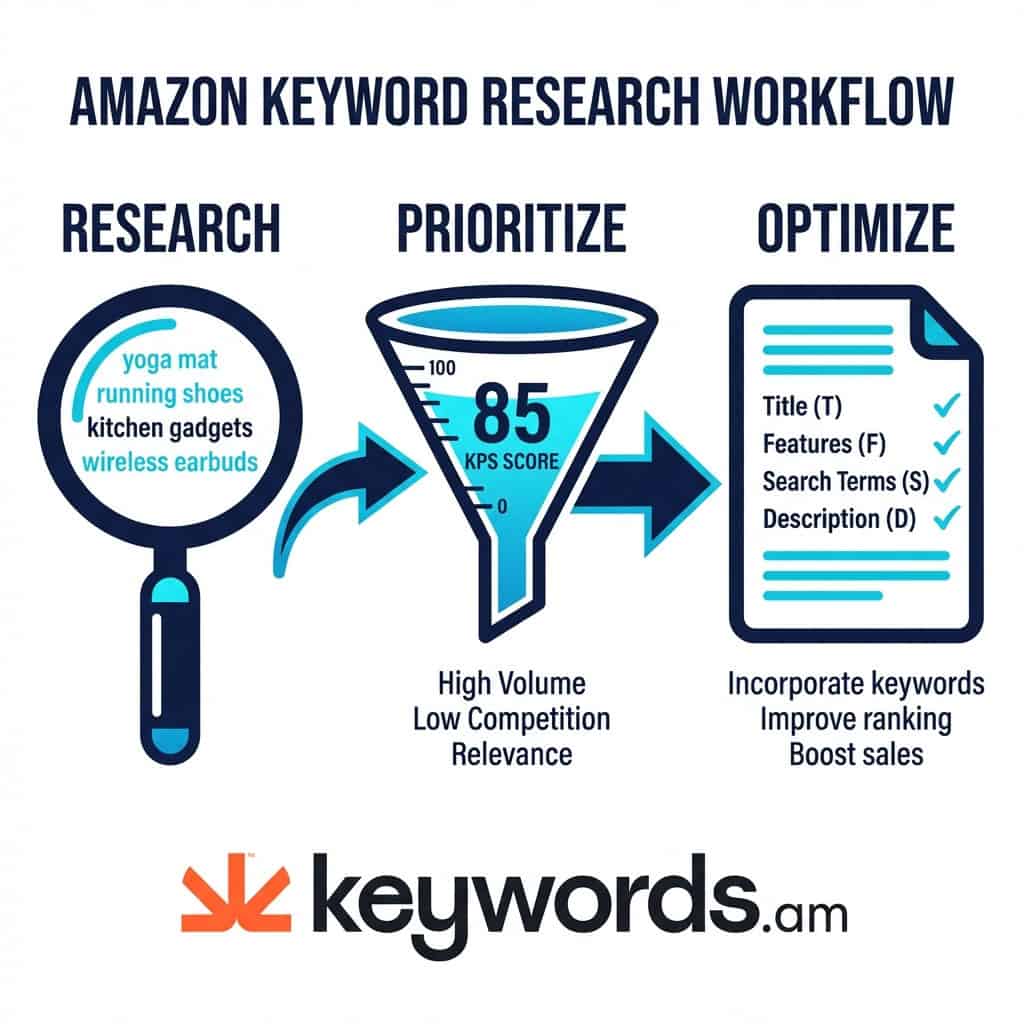
Keywords.am? It’s all about making listing optimization efficient and data-driven. The workflow guides you from the very start of research all the way to a listing that’s ready to go live, and it’s all in one place.
- TFSD Framework: A way of putting keywords in the Title, Features (bullet points), Search Terms, and Description to get the most impact.
- KPS Scoring: The Keyword Priority Score (0-100) looks at demand, relevance, and opportunity using data from Amazon Brand Analytics. This helps you focus on the keywords that are most likely to work.
- Swiss Army Knife: This backend keyword processor cleans up your search terms. It gets rid of duplicates and formats them, so you can make the most of that 500-byte limit. It’s a common pain point to deal with as described in these guides to Amazon backend keywords.
- Amber AI: It’s an Amazon-trained AI assistant. It suggests keywords, checks listings, and helps you improve your copy.
- 21 Marketplace Support: Character and byte-limit tracking for different countries makes going global easier.
- Pricing: $49–$299/mo.
- Best for: Agencies and sellers who want to make their listing quality and workflow as good as possible.
2. Helium 10 Cerebro – Best for Competitive Intelligence
Helium 10’s Cerebro lets you really dig into what your competitors are doing. It has tons of past data and reverse ASIN capabilities, and that’s why it’s a big deal for checking out the competition.
- Key Features: You get up to 2 years of trend data, and it analyzes organic vs. paid keyword distribution. It also includes the Magnet tool for finding more keywords. This Reverse ASIN lookup explained guide covers the core function in detail.
- Pricing: Part of the Helium 10 suite, so it’s $29-$399/month.
- Best for: Sellers who need really detailed competitive info and are ready to pay for a premium, all-in-one tool.
3. Jungle Scout Keyword Scout – Best for Beginners
Jungle Scout is pretty easy to use for keyword research. If you’re just starting out on Amazon, it’s a good option.
- Key Features: It has a simple interface, and it focuses on PPC keywords with bid suggestions. Plus, it works well with the rest of the Jungle Scout product research suite.
- Pricing: Starts at $29/month.
- Best for: New sellers who want keyword help that isn’t too complicated.
4. MerchantWords – Best for Search Volume Data
MerchantWords has been around for a while. It’s one of the first Amazon keyword databases, and it’s known for giving reliable search volume estimates.
- Key Features: A big keyword database, its own search volume estimates, and a “Keyword Multiplier” to help you find similar keywords.
- Pricing: It depends on how much data you want.
- Best for: Sellers who need a separate source of keyword data to use with other tools.
5. Sonar by Sellics – Best Free Option
Sonar is free, and it actually has quite a few features. That said, it’s a good starting point or a way to add to your existing research.
- Key Features: Free Amazon keyword tool with basic reverse ASIN lookup.
- Pricing: Free!
- Best for: Sellers on a tight budget, or for quickly checking if keyword ideas from other places make sense.
Which Listing Optimization Tools Convert Keywords into Sales?
Effective listing optimization? It’s pretty much taking keywords and turning them into product pages that actually sell. Here’s the thing though, these tools help with the writing, check keyword density, and make sure Amazon sees your keywords. Want a comparison? See this list of the best Amazon listing optimization tools.
6. Helium 10 Listing Builder + Scribbles – Best All-in-One Suite
Helium 10’s suite? It’s got a lot. It gives you a place to write and fix your listings, plus track keyword use as you go.
- Key Features: Scribbles tracks keywords, AI generates titles and bullets, and an index checker shows if Amazon sees the keywords.
- Pricing: Full AI needs the Diamond plan ($229/month).
- Best for: Power users already using Helium 10.
7. ProductScope AI – Best for AI-Generated Listings
This tool uses AI to write a lot of good listing copy. It’s been trained on many successful product pages.
- Key Features: GPT-4o trained on 1,500+ converting listings, A+ Content, and supports 13 marketplaces.
- Pricing: $24-$69/month (annual pricing).
- Best for: Sellers wanting an AI approach to making listings fast.
8. ZonGuru Listing Optimizer – Best for Listing Scoring
ZonGuru gives you visual feedback on your listing. It’s easy to see what to fix.
- Key Features: Real-time score, compares to competing ASINs, and a clean interface.
- Pricing: Part of the ZonGuru suite.
- Best for: Visual learners who want immediate feedback.
9. Amazon Listing Quality Dashboard – Best Free Native Tool
Amazon gives you this tool in Seller Central. It helps you meet their basic quality rules.
- Key Features: Flags missing attributes and shows basic ways to optimize. Recently enhanced with AI.
- Pricing: Free (in Seller Central).
- Best for: All sellers to check quality before using other tools.
10. Cosmy – Best for AI Agents Era
Cosmy is new and it’s focused on the future. It optimizes listings so AI agents like Amazon Rufus can find them.
- Key Features: Focuses on semantic optimization. Gets ready for algorithmic changes in 2026.
- Pricing: Varies.
- Best for: Forward-thinking sellers getting ready for AI product searches.
What Are the Best PPC Management Tools for Amazon Sellers?
Paid advertising gets you noticed and boosts sales, but honestly, managing campaigns manually? It’s just not scalable and it’s inefficient. PPC tools handle bidding automatically, pull out those converting keywords, and fine-tune budgets. The goal? To get the best possible return on ad spend (ROAS).
11. Helium 10 Adtomic – Best for Helium 10 Users
Adtomic? It works right with Helium 10’s keyword info. This makes for a pretty smooth workflow if you’re already using the suite.
- Key Features: AI handles bids and budgets. And it automatically harvests keywords from search term reports.
- Pricing: You’ll need at least the Platinum plan.
- Best for: If you’re already in the Helium 10 ecosystem and want your advertising all in one place, this is for you.
12. Perpetua – Best for Hands-Off Automation
Perpetua is made for those who want to set a general strategy and then let AI take over the daily grind.
- Key Features: Optimizes for specific goals (like a target ACoS). Plus, it supports all Amazon ad types, including DSP. Strong conversion performance too.
- Pricing: Pricing depends on how much you’re spending on ads.
- Best for: Sellers who want a “set it and forget it” thing going on with their Amazon PPC.
13. Quartile – Best for Data-Driven Enterprises
Quartile? It’s a platform for big players. They process billions in ad spend. They use AI to drive performance for high-volume sellers.
- Key Features: They’ve got six AI algorithms. Data updates every hour. Bidding is fully automated.
- Pricing: Premium pricing. It’s for large-scale advertisers.
- Best for: High-volume sellers and agencies that manage tons of accounts.
14. Ad Badger – Best for Mid-Market Sellers
Ad Badger finds a nice middle ground, I think. It gives you powerful automation, but you still have control. It’s an accessible option for growing businesses.
- Key Features: Bid optimization recommendations are clear. It automates negative keywords. And the pricing is reasonable.
- Pricing: It varies based on ad spend.
- Best for: If you’re pulling in between $50K and $500K annually and you’re ready to ditch the manual PPC management, this is a good fit.
Which Inventory Management Tools Do Amazon Sellers Need?
Traffic alone won’t cut it. You need stuff to sell! Inventory tools are there to help you avoid running out of stock, and honestly, that’s super important. They also help with reordering and making your FBA shipping process smoother.
15. Seller 365 – best for end-to-end workflows
includes InventoryLab for inventory management and shipping workflows—so you can manage and list inventory, prep, box, label, and ship faster while reducing errors, without stacking multiple subscriptions.
- Key features: InventoryLab (inventory management, listing, prep & ship).
- Price: $69/month.
- Best for: Sellers who want end-to-end inventory and shipping workflows inside a broader ops suite.
16. SoStocked (Carbon6) – Best for Advanced Forecasting
SoStocked offers, in my experience, really detailed sales predictions. It takes lots of things into account when figuring out what you’ll need.
- Key Features: 12-month forecasts using 14 different factors, Amazon Warehousing & Distribution (AWD) integration, and it even looks at things like seasonal changes and any promotions you’re running.
- Pricing: Starts at $158/month.
- Best for: Established sellers who have pretty complicated supply chains and need detailed forecasting.
17. RestockPro – Best for Supplier Management
This tool is specifically designed for sellers dealing with lots of suppliers. And those purchase orders? They can be a real headache.
- Key Features: Restock advice specifically tailored for FBA, supplier and PO management built right in, and it helps with product bundles.
- Pricing: $249-$654/month.
- Best for: Sellers managing lots of suppliers and a lot of SKUs.
18. Jungle Scout Inventory Manager – Best Integrated Option
If you’re already using Jungle Scout, their Inventory Manager is a solid choice. It’s often “good enough”.
- Key Features: It works really well with the product research tools.
- Pricing: Included with the Jungle Scout suite.
- Best for: Jungle Scout users who don’t need anything too fancy for inventory.
19. Amazon AWD – Best Native Solution
Amazon’s Warehousing & Distribution service automates FBA resupply directly. Here’s the thing though, it’s from Amazon.
- Key Features: Automatic inventory distribution to FBA centers, it’s built right into Seller Central, and you pay only for what you use.
- Pricing: Pay-as-you-go.
- Best for: Sellers who want Amazon to handle inventory placement for them.
What Analytics Tools Should Amazon Sellers Use?
Are you *really* profitable? Analytics tools actually help see past all those Amazon fees to show your real profit and loss. That means you can make smart, data-backed choices to grow your business.
20. Sellerboard – Best for Profit Tracking
Sellerboard is, honestly, one of the best Amazon seller tools if you want to see how profitable you are. It tracks a lot of different fee types – over 100, in fact.
- Key Features: Real-time profit dashboard, COGS tracking by batch or period, and profit forecasting.
- Pricing: It starts at $19/month. Pretty accessible, right?
- Best for: Any seller wanting accurate P&L info without messing with crazy spreadsheets.
21. Nova Analytics – Best for Real-Time Data
If you run a fast-moving business, data that’s a day old is just too slow. Nova Analytics gives you data refreshes almost in real time.
- Key Features: Hourly data refresh, P&L accuracy of 99.5% (validated against the SP-API, which is worth noting), and unlimited KPI customization.
- Pricing: Expect premium pricing. It’s really for serious operators only.
- Best for: High-volume sellers where getting data *right now* can save you from big mistakes.
22. ManageByStats (Carbon6) – Best Free Option
ManageByStats, which is part of the Carbon6 thing, has a free plan now. It gives you good dashboards and supports multiple marketplaces.
- Key Features: You get detailed reports, support for multiple marketplaces, and, well, it’s free.
- Pricing: Free plan!
- Best for: Sellers on a budget. You get more than just what you see in Seller Central.
23. Amazon Brand Analytics – Best Native Intelligence
This one’s free, but only if you’re Brand Registered. The reality is, it gives you awesome first-party data straight from Amazon.
- Key Features: Search Query Performance reports, market basket analysis, and customer demographic data.
- Pricing: Free, but you need to be Brand Registered.
- Best for: Seriously, all Brand Registered sellers. It should be where you start.
Which Repricing Tools Help Win the Amazon Buy Box?
You want that Buy Box, right? In competitive categories, it’s pretty much a must. Automated repricing tools? They adjust prices automatically, responding to what your competitors do. And they do it in real-time. The aim? Protect your profit margins while getting you more sales.
24. Seller Snap – Best AI Repricer
Seller Snap uses an AI based on game theory. It doesn’t just use simple rules to adjust pricing. Honestly, it makes smarter moves.
- Key Features: An AI that adapts its strategy for each listing. Also, real-time repricing. And support for multiple modes – AI, rule-based, or even manual!
- Pricing: $250-$800/month.
- Best for: Established resellers with huge catalogs. Repricing manually? It’s impossible at that scale.
25. Seller 365 – Best for Automation
Seller 365 Best for Automationincludes SmartRepricer to automate Amazon pricing and stay competitive without constant manual changes.Key features: SmartRepricer (automated repricing). Price: $69/month. Best for: Sellers who want repricing included alongside core seller workflows.
26. RepricerExpress – Best Value Repricer
This tool is fast. Really fast. Repricing happens lightning-fast across many marketplaces. It’s a cost-effective choice for sellers who are selling globally.
- Key Features: Near-instant repricing is what they claim. Support for 11 marketplaces – including eBay. Worth noting: it’s got strong margin protection settings.
- Pricing: Approximately $80-$320/month.
- Best for: Multi-marketplace sellers. You need fast, reliable automation. And you don’t want to spend a lot of money.
27. Aura – Best for Walmart + Amazon
So, you sell on both Amazon and Walmart? Aura could be the answer. It’s a single repricing solution, managing your pricing on both.
- Key Features: AI-powered repricing – for both Amazon AND Walmart! Plus, detailed logging of price changes. They offer bulk upload support.
- Pricing: Competitive.
- Best for: Sellers growing on Walmart.
How Should You Build Your Amazon Seller Tool Stack?
Picking the right tools? It really depends where your business is at. Honestly, just throwing more software at the problem isn’t always the answer. The reality is, you want a focused, connected setup. It should fix specific problems. And it definitely shouldn’t give you dashboard overload or bust your budget.
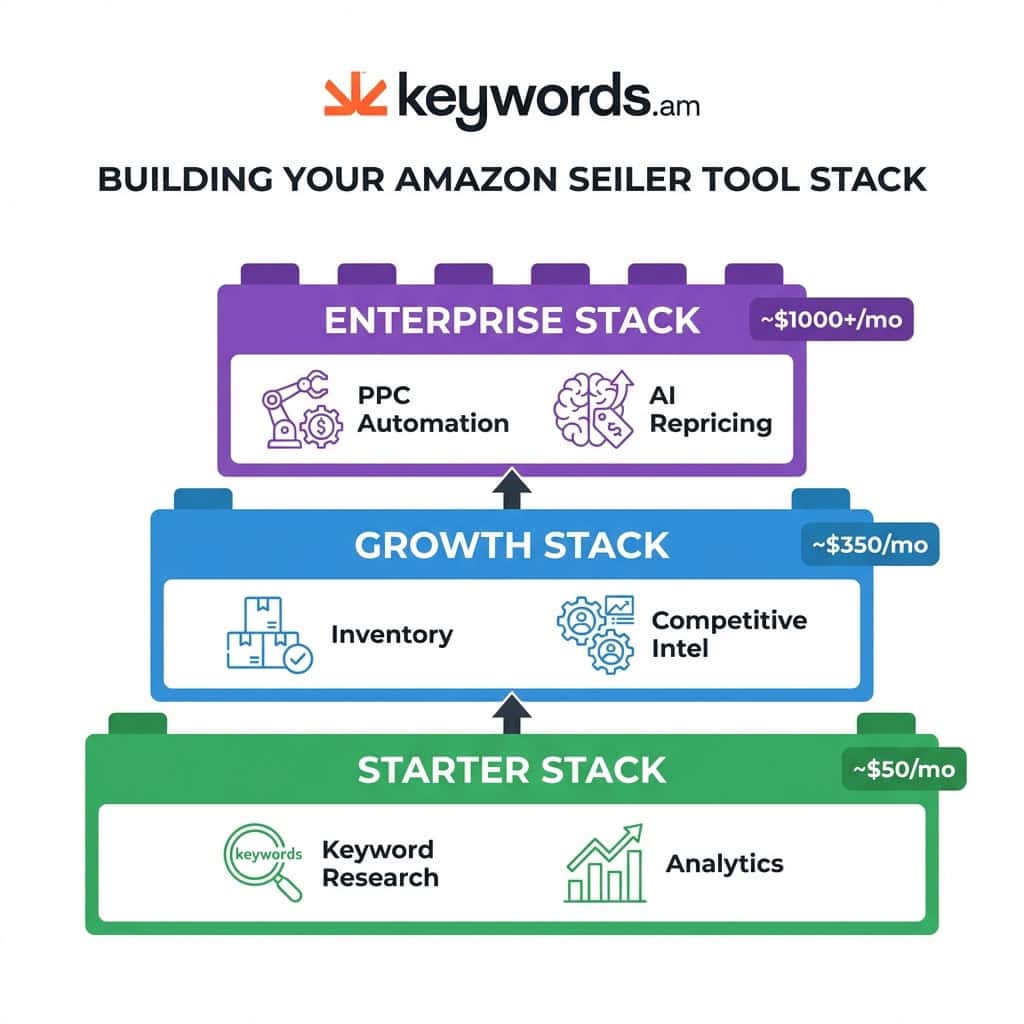
Starter Stack ($100-200/month):
This is all about growing smart and efficiently. It focuses on the basics.
Tool |
Purpose |
Cost |
|---|---|---|
Keywords.am Starter |
Keyword research + listing optimization |
$49/mo |
Sellerboard |
Profit analytics |
$19/mo |
Amazon Brand Analytics |
Native intelligence |
Free |
Sonar |
Supplementary research |
Free |
Growth Stack ($300-500/month):
For serious sellers that are scaling. You need more firepower.
Tool |
Purpose |
Cost |
|---|---|---|
Keywords.am Growth |
Full optimization workflow |
$129/mo |
Helium 10 Platinum |
Competitive intelligence |
$99/mo |
SoStocked |
Inventory forecasting |
$158/mo |
Sellerboard |
Profit analytics |
$19/mo |
Enterprise Stack ($800-1500/month):
At this point, workflow is king. Worth noting: you want specialized, high-performing tools.
Tool |
Purpose |
Cost |
|---|---|---|
Keywords.am Scale |
Team & agency features |
$299/mo |
Quartile or Perpetua |
PPC automation |
Variable |
Seller Snap |
AI repricing |
$250+/mo |
FAQ: Best Amazon Seller Tools Questions
What tools do successful Amazon sellers use?
Successful sellers? They usually have around 4-6 specific tools. A single massive suite? Nope. The reality is, a typical setup includes keyword research (Keywords.am or Helium 10 are good examples), profit tracking (like Sellerboard), and then something for PPC automation OR inventory management. It all depends on your business.
Is Helium 10 worth it in 2026?
Helium 10? It’s still powerful, especially that Cerebro feature – great for checking out the competition. But here’s the thing though, the plans are $229-$399 a month! Because of that, a lot of sellers find they get a better return by using a combination of cheaper, more focused tools. You’ve got to figure out which of the 40+ features you’ll actually use.
What’s the best free Amazon seller tool?
Amazon’s own stuff is honestly the best place to start. Think Amazon Brand Analytics. Also, the Listing Quality Dashboard. And don’t forget the Automate Pricing tool. All free, and all useful. As for third-party tools, Sonar is a pretty good free option for basic keyword research.
How many tools do I need to sell on Amazon?
You can get going with just 2 or 3 essentials. Keyword research and listing optimization? Essential. Profit tracking? Also essential. Then, as things get more complicated, and you’re spending more on ads or struggling with inventory, add tools for PPC, inventory, or even repricing.
Which Amazon tool is best for beginners?
Jungle Scout is often suggested. It’s not too hard to learn, and it’s really good for product research. But that said, if you just want to nail your listings right from the start, Keywords.am guides you through optimization without overwhelming you with features. Both have plans starting under $30 a month.
Do I need PPC tools if Amazon has automated campaigns?
Amazon’s automated campaigns are okay to begin with. But they don’t have all the fancy bid optimization stuff. Nor do they have negative keyword harvesting. And strategic control? Forget about it. Dedicated PPC tools offer all that. Once you’re spending over $1,000 a month on ads, a dedicated PPC tool almost always pays for itself.
What’s the difference between Helium 10 and Jungle Scout?
Helium 10? It’s got a lot more depth and way more features. Great for keyword research and checking out what your competitors are doing. So, experienced sellers might like it more. Jungle Scout is better at product research, and the interface is kind of easier to use for beginners.
Are Amazon seller tools tax deductible?
In most cases, yes they are. Software subscriptions you use for your Amazon business are usually considered business expenses you can deduct. Worth noting: always talk to a tax person to get advice specific to your situation.
Conclusion
Honestly, a ton of tools won’t guarantee success. It’s more about *how* you use them. In 2026, smarts win.
Tool choice matters. Starting out? Don’t waste money on enterprise bells and whistles. In my experience, focused tools are better. They beat those clunky all-in-one things, especially when it counts. And Seller Central’s free tools? Underused gold.
Here’s the thing though: consistency is key. So, audit first. What are you actually using? What are you paying for but ignoring? Cut the extras. Eliminate any overlap you see.
The reality is, Amazon success starts simple. It starts with great keywords. Also, listings need to be *perfectly* optimized.
Start there. Try Keywords.am free to experience how a focused listing optimization workflow can drive results. It’s pretty straightforward.