
When an Amazon business grows, going from just a few products to hundreds, early-stage tools can struggle to keep up. Sellers often start with something like Helium 10. It’s got lots of features, great for getting started. But here’s the thing though: as you get bigger, that tool can actually slow you down. It puts limits on keywords, tracking, and doing things in bulk. And honestly, high-volume sellers end up wasting time on tasks that should be quick. Workflows made for smaller businesses just don’t cut it.
The search for alternatives to Helium 10? It’s not about finding more features. The reality is, it’s about finding the right ones. Features built for speed and scale. What a seller doing seven or eight figures needs is very different. They need platforms that let them do a lot of things at once, with pricing that’s clear and fair, and doesn’t punish them for growing. Plus, they often want API access so they can build their own automated systems. Worth noting: changing tools is kind of a rite of passage for brands aiming to be the best. This article looks at the top Helium 10 alternatives in 2026 for big Amazon sellers. We’re comparing them based on what matters when you’re big: performance, price, and how efficient they make you.
Table of Contents
- Why Do High-Volume Sellers Leave Helium 10?
- What Do High-Volume Sellers Need in a Software Suite?
- Why Is Keywords.am the Best Alternative for Batch Listing Optimization?
- Why Choose DataDive for Competitor Intelligence?
- What Makes Perpetua the Leader in PPC Ad Management at Scale?
- How Does Teikametrics Deliver AI-Powered Automation?
- What Does Carbon6 Offer for Unified Operations?
- When Should High-Volume Sellers Consider Pacvue?
- How Does Pricing Compare Across Helium 10 Alternatives at Scale?
- How Much Time Can Batch Operations Save High-Volume Sellers?
- How to Choose the Right Helium 10 Alternative?
- Frequently Asked Questions About Helium 10 Alternatives
- The Final Verdict
⚡ TL;DR
- Helium 10 Diamond plan only allows 5,000 keywords. It doesn’t really do batch operations either. This can be a problem if you’ve got 100+ SKUs.
- Keywords.am gives you the best bang for your buck when it comes to fixing up a lot of listings at once. It’s $0.24/SKU for 500 products and they have flat-rate pricing.
- Batch operations can save a lot of time – like, a LOT of time. Say you’re doing 50 SKUs, it could cut your work from 17 hours to just 30 minutes.
- Perpetua and Teikametrics are the top dogs when it comes to AI and PPC ads, especially if you’re spending a lot.
- DataDive is awesome for checking out the competition and doing market research so you can make smart product decisions.
- Carbon6 puts everything in one place, which is convenient. Pacvue is more for huge, enterprise-level businesses.
- Build a collection of specialized tools! Don’t just depend on one platform that tries to do everything.
Why Do High-Volume Sellers Leave Helium 10?
High-volume sellers often find Helium 10’s pricing plans restrictive. And feature limits? Those can be a real pain as product catalogs grow. The platform’s structure can create operational bottlenecks. Managing dozens, or even hundreds, of SKUs? It can be tough.
While Helium 10 gives you an impressive set of tools… keyword research, product discovery, listing optimization – it’s not all roses. Its architecture isn’t really made for handling a huge stack of products at once. The primary pain point? Lack of batch processing. Here’s the thing though: updating a product title across, say, 100 listings is manual. One. By. One. Honestly, there is no central dashboard for changes across multiple ASINs. Brand managers waste a lot of time on simple updates. This extends to keyword tracking too. Usage caps can be reached fast with a big product catalog. So, the tools aren’t very effective for market monitoring. For example, the Diamond plan is $359 per month. But for a seller with 200 SKUs, the 5,000 keyword tracking limit means only 25 keywords per product. And that’s really not enough for serious optimization. In my experience, you need more.
What Do High-Volume Sellers Need in a Software Suite?
High-volume sellers need software that just works for them. It has to be about getting things done fast. We’re talking real batch operations. Predictable, flat-rate pricing is a must, honestly. And strong API access. These things help them handle huge product lists, keep costs down, and automate stuff. This keeps the business growing.
Going big changes what you need in software. The focus shifts. You don’t want every possible feature. You want stuff that’s great at making boring tasks easier. The right software? It’s a game changer. Look, a small team can run a huge catalog. They can do it fast and accurately. That said, it won’t be easy.
True Batch Operations
What are “batch operations?” Honestly, it’s all about choosing a bunch of products and then doing something to all of them at the same time. It’s not just seeing data for lots of products all together. It’s about actually *doing* stuff.
Here’s the thing though: for someone selling tons of stuff, it means updating product titles, descriptions, and backend keywords for a whole product line all at once. One workflow. Imagine that! This means running keyword jobs on hundreds of ASINs together or exporting data for an entire brand without having to do it manually. Batch operations are a game changer. In my experience, this is the biggest time-saver for managing a large catalog. It lets a team be proactive. No more just reacting.
Predictable, Flat-Rate Pricing
Businesses grow. Teams get bigger, tool usage increases. And honestly, some pricing models? They just don’t work. Per-user fees or usage tiers? They get expensive. Really expensive. So high-volume sellers? They tend to like flat-rate pricing. It offers unlimited access to the main stuff for a fixed monthly or annual fee. Here’s the thing though: predictability is key for budgets. You need to plan. It’s hard when costs jump around. Worth noting: flat-rate means you aren’t penalized for adding staff or more products. Think of HubSpot’s Sales Hub Professional at $500/month.
Flat-rate pricing kind of aligns the software with your growth goals. It becomes a stable platform. You scale without worrying about rising costs. The reality is, nobody wants that. No fear of escalating costs sounds good, right? That said, it’s pretty much what you need. You can’t grow if you’re always watching the pennies.
Robust API Access
API access? It’s how you get real automation and system integration. Sellers doing big volume? They’ve got a lot of software going on. Think inventory management, ERP systems, and data warehouses. A good API lets all this talk to Amazon seller tools. This means custom workflows you just can’t get otherwise.
For example, say a seller wants sales data in a special dashboard. They also want listing updates tied to inventory. Or they want keyword research feeding right into ads. It’s possible with an API. Honestly, this kind of integration is essential. You’ll need it to build an efficient, automated operation. No question.
Here’s the thing though, off-the-shelf solutions only get you so far. An API lets you do way more.
Why Is Keywords.am the Best Alternative for Batch Listing Optimization?
Keywords.am? It’s a platform really made for Amazon listing optimization, especially if you’re doing a lot of listings at once. The pricing is flat-rate, and honestly, that’s a big deal if you have tons of products. It’s pretty cost-effective. The features are built to handle lots of keyword processing and content updates. And that cuts down on manual work. A lot.
So, for sellers who spend way too much time optimizing hundreds of listings, Keywords.am could be a great solution. It’s built to handle bulk actions. You upload ASINs, process keywords, and then update your whole catalog super fast. This is way faster than other tools. Look, platforms like Helium 10 can be slow for listing management; it can be a manual task. Here’s the thing though: The pricing is from $49 to $299 a month for full access. Predictable costs, right? That’s really attractive to high-volume sellers.
The workflow focuses on speed. But there’s more. Users can manage everything from one spot, applying the same optimization to every product. This is valuable when using frameworks like the TFSD (Title, Features, Search Terms, Description) methodology. It ensures every listing is solid. It focuses on doing one job well. And that’s listing management. Worth noting: all-in-one suites just can’t match this level of efficiency. And this makes it ideal for large brands and agencies managing multiple Amazon accounts. For a comparison, check out Keywords.am vs. Helium 10. It breaks down the advantages for scaled operations.
Why Choose DataDive for Competitor Intelligence?
DataDive is a market research tool. It provides deep insights into what competitors are doing and uncovers niche opportunities. It’s honestly ideal for sellers who focus on picking products and keywords using data. Its strength? Comprehensive analysis of market stuff, search trends, and competitor weaknesses.
Lots of tools offer keyword research. DataDive is different, though. Its competitive analysis is super detailed. You can deconstruct top products to see their keyword strategies, pricing history, and sales velocity. It lets sellers do that! This level of insight is important if you’re a high-volume seller wanting to get into new markets. Or protect your spot in markets you’re already in. The reality is, the tool is good at finding long-tail keyword chances. And understanding what customers really want in a specific category.
DataDive’s pricing? It ranges from $39 to $490 per month. Plans vary based on research volume and how many users you have. This structure allows sellers to choose a plan that fits how much research they’re doing. For big brands, the higher-tier plans offer what’s needed for constant market monitoring. Also, in-depth analysis of a lot of product lines. But here’s the thing though, it doesn’t focus on batch listing optimization. That said, its powerful research capabilities make it a valuable tool. Especially for a high-volume seller. It gives the strategic insights you need to make smart choices.
What Makes Perpetua the Leader in PPC Ad Management at Scale?
Perpetua is, honestly, a pretty advanced advertising platform. It uses AI. The aim? To automate and then improve your Amazon PPC campaigns. It’s really designed for brands who are spending quite a lot on ads. Its main job is to get you the best possible return on ad spend (ROAS). It does this through smart bidding, finding great keywords, and generally managing campaigns.
Here’s the thing though, managing PPC campaigns when you have tons of products? It can take as long as listing optimization! Perpetua tackles this with some clever AI. This AI handles the daily adjustments needed for your ad campaigns. It’s pretty cool. Sellers get to set their overall goals. Then, the software sorts out the nitty-gritty of bid adjustments and keyword targeting. For businesses spending thousands – or even tens of thousands – of dollars on advertising each month, this kind of automation is key. It’s essential for staying profitable and expanding your ad efforts effectively.
Perpetua’s pricing starts at $695 each month. It goes up depending on how much you spend on ads. This makes it a premium option for, well, serious advertisers. That said, this investment gets you access to really powerful automation. You also get detailed performance analytics. Worth noting: these analytics are really vital for managing complicated advertising setups. The reality is, its cost might be too much for smaller sellers. But for brands with high sales volumes? The potential to improve ROAS and save time can bring a huge return on investment. Perpetua is a specialized tool focusing on one critical piece of your Amazon business. And, in my experience, it excels in that role.
How Does Teikametrics Deliver AI-Powered Automation?
Teikametrics has Flywheel 2.0. It’s an AI-powered platform. It automates key things for Amazon businesses. But it mainly focuses on ad optimization.
Teikametrics connects marketplace data and ad performance. Inventory levels too. It uses that to make automated decisions that are smart. It wants to be the optimization answer for everything. Honestly, it uses AI to try and grow your whole business. Its main thing is connecting ads with inventory. They call this “Marketplace Optimization.”
This helps stop you running out of stock. Especially on things you advertise a lot. And, it makes sure you spend ad money on products that’ll make the most back. The AI learns from data. Flywheel 2.0 refines bidding and keyword targeting. So, you get better results over time. It’s designed to do this non-stop.
That said, pricing for Teikametrics starts around $250 per month. Here’s the thing though: it’s usually based on a percentage of your ad spend. This is pretty much normal for AI advertising. This ties the cost to how big your advertising is. If you sell a lot and want a hands-off approach, this could work. And if you value sales and inventory data being linked, give Teikametrics a look.
What Does Carbon6 Offer for Unified Operations?
Carbon6? It’s a bunch of tools. Honestly, the platform is trying to be your one-stop shop. It wants to manage pretty much every part of your Amazon business. That includes product research, and even the dreaded financial management.
The Carbon6 platform puts a lot of stuff under one subscription.
The main thing with Carbon6 is just how much it covers. Instead of signing up for a ton of different tools, it offers a single place for your e-commerce needs. Keyword research is included. Listing optimization? Yep. Inventory management? Of course. PPC? Even that’s there! And get this: financial services like VAT compliance are also part of the deal. For sellers who like a simple, all-in-one thing, and who don’t want to mess with hooking up a lot of different software, Carbon6 is worth a look.
Here’s the thing though: Carbon6 has a lot of tools. The sheer number is over 18! So, it covers a lot, but individual tools might not be as super-specialized as some standalone options. Keywords.am, for example, can handle batch processing like a boss. Perpetua is great for PPC. That said, for sellers who want a solution that is good enough across a bunch of tasks, and they want the convenience of one dashboard, Carbon6 can be a powerful hub.
When Should High-Volume Sellers Consider Pacvue?
Pacvue? It’s an advertising, retail, and intelligence platform. It’s really for big brands and agencies managing seriously big ad budgets on several marketplaces.
The Pacvue platform needs granular control, automation rules that are next-level, and detailed reporting. Here’s the thing though, it’s built to handle crazy complexity. Users can manage global ad campaigns and get performance insights.
Pacvue gives a unified view of ad performance on a lot of retail media networks, not just Amazon. And honestly, that’s pretty cool.
The pricing shows it’s for enterprises. It starts around $500 per month. Then you’ll pay a percentage of ad spend. So, it’s one of the pricier choices, I think. That said, the reality is it’s best for brands with big marketing teams and hefty budgets.
For those users, Pacvue has power and flexibility. You can execute sophisticated ad strategies and, I don’t know, drive market share. Worth noting: competitive advantage can be yours.
How Does Pricing Compare Across Helium 10 Alternatives at Scale?
For a high-volume operation, just looking at the price tag doesn’t cut it. You have to consider the monthly cost per SKU.
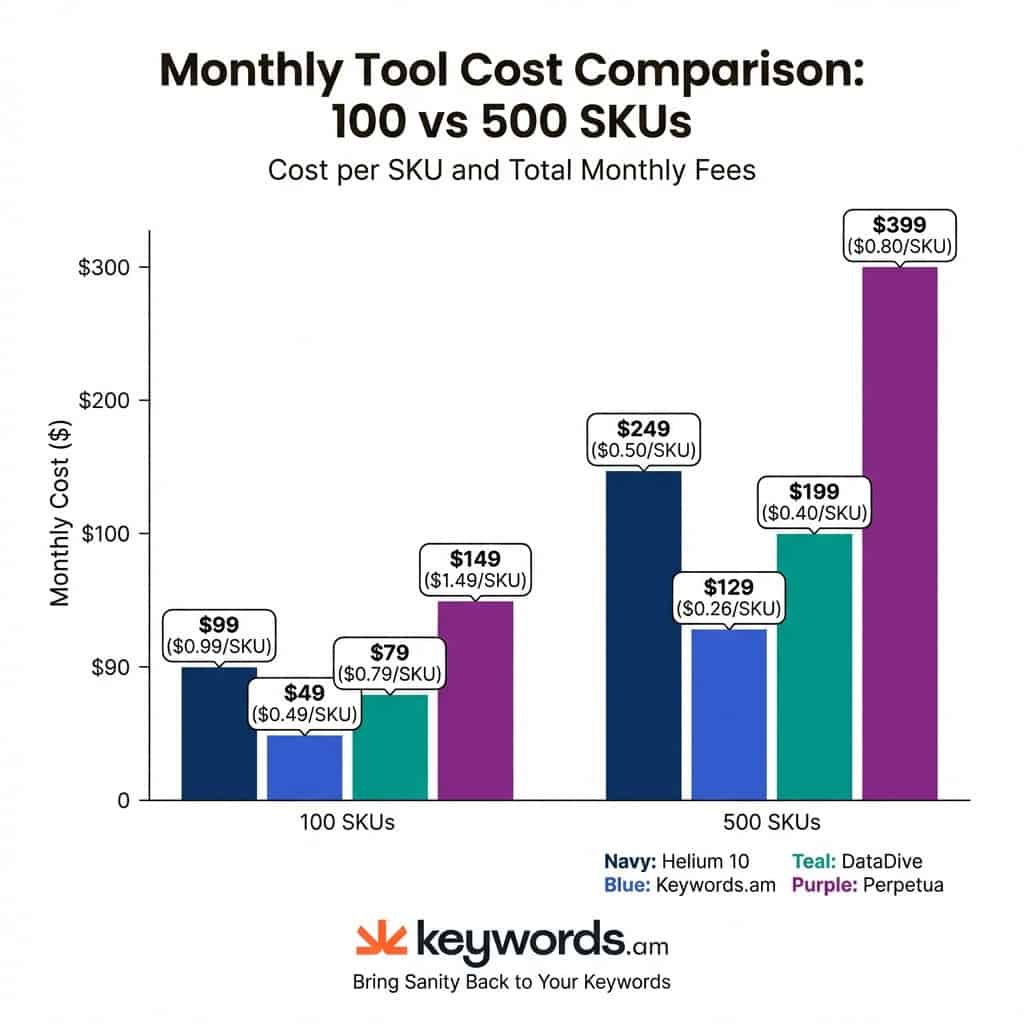
Below, there’s a table. It estimates monthly costs at different catalog sizes to show how pricing models change. Honestly, you need to look beyond the sticker price and think about the cost per SKU. Here’s the table:
|
Tool |
50 SKUs |
100 SKUs |
250 SKUs |
500 SKUs |
Per-SKU Cost (500 SKUs) |
|---|---|---|---|---|---|
|
Keywords.am |
$30 |
$60 |
$120 |
$120 |
$0.24 |
|
DataDive |
$39 |
$97 |
$249 |
$490 |
$0.98 |
|
Perpetua |
$695+ |
$695+ |
$1,500+ |
$2,500+ |
$5.00+ |
|
Teikametrics |
$250+ |
$400+ |
$800+ |
$1,500+ |
$3.00+ |
|
Carbon6 |
$99 |
$99 |
$199 |
$199 |
$0.40 |
|
Pacvue |
$500+ |
$750+ |
$1,500+ |
$3,000+ |
$6.00+ |
Note: Pricing for PPC-focused tools like Perpetua, Teikametrics, and Pacvue is heavily dependent on ad spend and is represented here as an estimate for a seller of the corresponding catalog size.
The numbers don’t lie. There’s a big difference in how these tools are priced. Keywords.am and Carbon6? They seem to be the most scalable if you’re managing a lot of SKUs. The per-SKU cost goes down as your catalog gets bigger. That said, Perpetua, Teikametrics, and Pacvue are kind of different. They’re designed for optimizing big ad budgets, so the software cost is a smaller part of the whole thing. It’s all about perspective, I guess.
How Much Time Can Batch Operations Save High-Volume Sellers?
Batch operations can offer some serious time savings. Honestly, it’s a lot! They can slash listing optimization time by 97%. That turns a 17-hour manual headache into a 30-minute automated workflow. This is especially true for high-volume Amazon sellers.
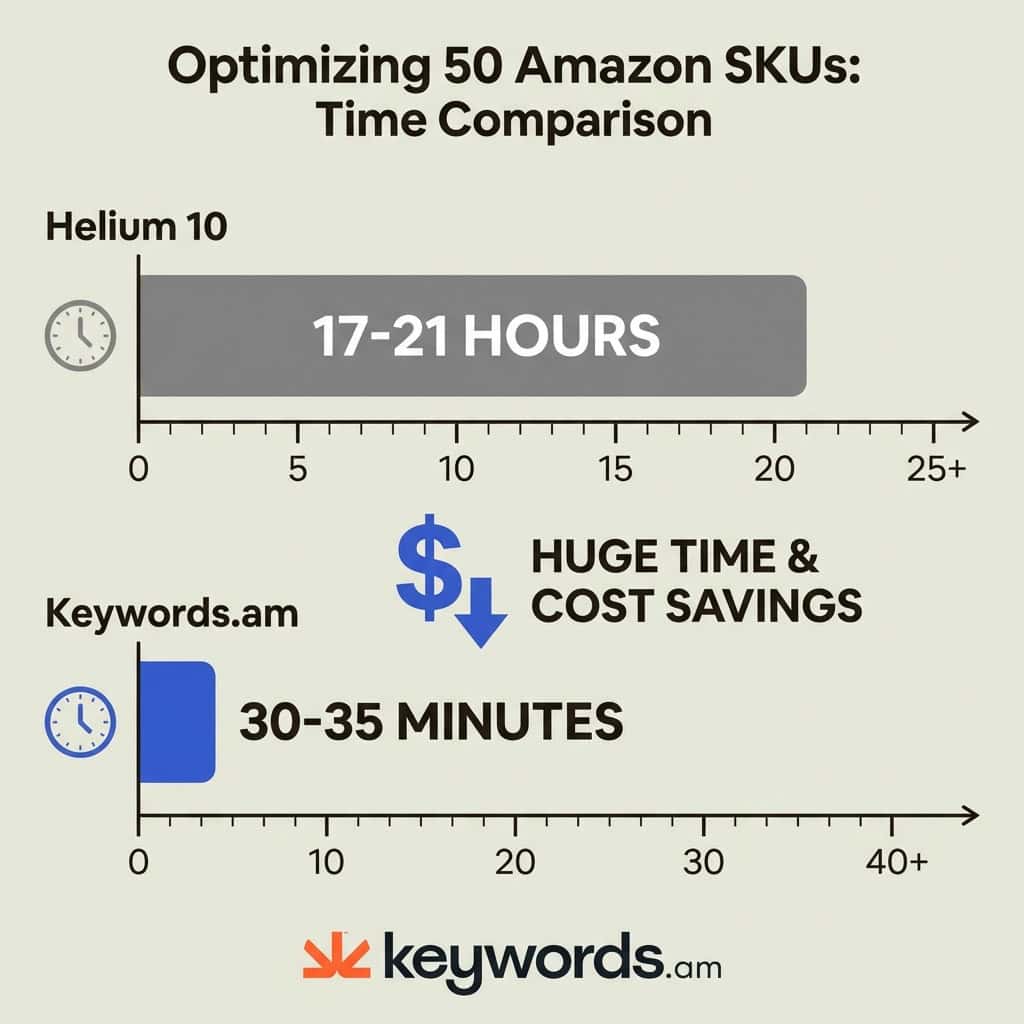
The biggest return on investment? Time. Listing optimization really highlights that. A simple task shows the gains. Consider updating product features across 50 SKUs.
Think about the manual workflow. Imagine a tool without batch operations. A brand manager has to open each listing. Then, make edits, save changes, and move on. It’s repetitive. A conservative estimate? 20 minutes per SKU. For 50 SKUs, that’s 1,000 minutes. Or almost 17 hours of manual work. That’s two full days gone for one update.
In contrast, there are platforms built for batch operations. Keywords.am is one. It changes the game. The manager uploads 50 ASINs. Next, they apply changes across all of them. All in one interface. Updates deploy simultaneously. The entire process takes less than 30 minutes. From upload to completion. That’s a 97% time reduction.
|
Task |
Helium 10 |
Keywords.am |
DataDive |
|---|---|---|---|
|
Initial audit (50 SKUs) |
8-10 hours |
15-20 min |
25-30 min |
|
Keyword gap analysis |
5-6 hours |
10 min |
15 min |
|
Coverage check |
4-5 hours |
5 min |
10 min |
|
Total |
17-21 hours |
30-35 min |
50-55 min |
Worth noting: labor costs matter. At $100 per hour, batch tools save $800+ per 50-SKU cycle. That saved time? Reinvest it. Market research, maybe? Strategic planning. Or even new products! Grow your business. Don’t just maintain it.
How to Choose the Right Helium 10 Alternative?
Picking the right Helium 10 alternative? It all depends. You need to figure out what’s really slowing you down right now. Is it listing optimization? Maybe PPC? Or even just market research?
Honestly, the best alternatives don’t try to do everything. They zoom in on your biggest headaches. The reality is, the perfect setup isn’t one tool to rule them all. It’s a collection of specialized tools. Tools that crush specific, high-impact needs. Conduct a totally honest review. Where does your team waste time? Doing boring, repetitive stuff? Is it manually updating product listings, day after day? Is it PPC campaign management? Or is it just endless market research? This answer? It’ll guide you to the tool that gives you the biggest, quickest win. For a bigger picture, check out the best Amazon seller tools for 2026.
For Listing Optimization & SEO
Maintaining a huge product catalog? It takes a lot of time. And effort. A specialized batch processing tool seems like the way to go, honestly. Keywords.am? It’s made for this. The focus is on solving listing management bottlenecks. That said, it’s efficient. Powerful too. And cost-effective. For brands serious about Amazon SEO at scale, this is probably the best option.
Finding the best Amazon keyword research tool is part of the puzzle. Worth noting: integrating that research into listings is where batch tools really shine. Here’s the thing though, you’ll need good keywords first.
For PPC & Advertising
For some businesses, advertising is how they really grow. It’s also where things get complicated. So, a good PPC management platform? Honestly, it’s a must. Perpetua and Teikametrics are big names. They both offer some pretty amazing AI-driven automation to handle big advertising budgets. But, picking between them? It often depends. What level of integration are you looking for with, like, your other business data? Here’s the thing though, Teikametrics tries to do more, you know? They also include inventory data, which is useful. In my experience, that’s helpful. It’s a more holistic view.
For Market & Competitor Research
Want to find new chances and beat competitors? Then you need a killer research tool. Seriously. DataDive helps. It gives you the detailed market info you need. Think product development. Or even breaking into new markets. You’ll make smart, data-backed choices. In my experience, these details matter.
For All-in-One Operations
Some sellers just want one platform to do everything. And honestly, that’s understandable. Carbon6 is pretty much that. It puts a lot of different tools under one subscription. You won’t have to jump between different services. It simplifies things. Here’s the thing though: it trades specialized depth for that convenience.
For Enterprise-Level Needs
Big companies need big tools. So, if you’re a major brand or agency handling millions of dollars, you need something serious. Honestly, you just can’t get by with basic software.
Pacvue? It gives you advanced features. You also get pretty much total control. And there’s super detailed reporting. That said, it’s not cheap, but you get what you pay for.
It helps to manage complex global advertising and retail stuff at a really high level. Worth noting, smaller businesses probably don’t need this much power. But the reality is, if you’re dealing with that kind of scale, Pacvue is a solid choice. It’s got a lot of features that smaller platforms just don’t offer. In my experience, it’s worth the investment if you’re spending big bucks on ads.
Frequently Asked Questions About Helium 10 Alternatives
So, what do big-time Amazon sellers usually ask when considering options to Helium 10? It’s often the same stuff.
Pricing matters. How much does it cost when you scale things up? And what about limits? Usage limits can be a real pain.
Migration is another biggie. What’s the easiest way to move everything over? No one wants to lose data. Honestly, it’s a headache to think about.
People want to know about specializations. Which tools are best for which jobs? For example, some are good at product research, others at competitor analysis. The reality is some tools are better than others at specific things.
What is the best Helium 10 alternative for 100+ SKUs?
Keywords.am? It offers the best value, honestly, if you’re a high-volume seller. You’re talking about managing 100+ SKUs. Expect flat-rate pricing. It’s $60-$299/month. And no per-ASIN limits.
But, if you mainly need PPC management, Teikametrics or Perpetua are options. They’re a fit, maybe even a better one. That said, they do cost more. The reality is, Keywords.am has a real plus at this scale. It’s that bulk ASIN audit feature. This allows catalog-wide optimization. You won’t get stuck in one-at-a-time workflows. These workflows? They plague Helium 10, in my experience. Worth noting.
Does Helium 10 have usage limits on the Diamond plan?
Yes, Helium 10 Diamond has limits. Keyword tracking is capped at 5,000 keywords. And honestly, there are other feature limits, too.
These aren’t super clear when you first sign up. But you’ll see them as your catalog grows. Many sellers find out about these limits after they’ve already committed to the platform. It’s frustrating! Add-ons like Market Tracker 360 ($500/mo) are needed for bigger businesses. Worth noting: that price adds up fast.
So, the reality is, you might end up paying a lot more than you thought. Add-on costs can really impact your budget. Here’s the thing though: these extra costs often weren’t part of the original plan. It can be a real shock.
How much does Helium 10 cost for high-volume sellers?
Helium 10 Diamond comes in at $359/month. But high-volume sellers? They often need a lot more. Think about extra keyword tracking, plus Market Tracker 360. This can easily add $500-900/month.
Enterprise pricing exists. You’ll need to talk to sales, though. The prices aren’t public. Here’s the thing though: for sellers with, say, 200+ SKUs, the true cost? It often goes way beyond what you first thought. The reality is, alternatives with flat-rate pricing look a lot more attractive.
Can sellers migrate from Helium 10 to Keywords.am?
Yep, migration is definitely possible. Keywords.am imports listings right from Seller Central. So, migrating takes just minutes per ASIN. You won’t lose any data from your Helium 10 projects either.
A lot of sellers, honestly, run both tools for a bit during the switch. They compare what each tool shows them. This makes sure everything keeps running smoothly. The direct Seller Central link? It means your old data and current listings move over easy peasy. You don’t have that worry about losing stuff that you sometimes get switching platforms. Here’s the thing though, it’s pretty quick to move everything over.
What is the difference between Keywords.am and DataDive?
Keywords.am? It really focuses on listing optimization. You get that TFSD editor workflow. DataDive, on the other hand, puts its weight behind competitor research. And product intelligence is baked in, with some AI copywriting thrown in. So, they’re different.
A lot of high-volume sellers use them both together. Here’s the thing though: they do different stuff. DataDive gives you strategic research. It also offers the competitive intelligence to spot opportunities. Keywords.am then handles execution of those insights. It does batch listing optimization. Worth noting: in my experience, this covers both the analytical and operational sides of selling on Amazon. It’s a pretty powerful combo, honestly.
Is Helium 10 still worth it for Amazon FBA in 2026?
Helium 10 is still valuable, honestly. Especially for solo sellers. And it’s also good for those managing fewer than 50 SKUs. High-volume sellers? That’s a different story. The reality is, per-ASIN limits plus one-at-a-time workflows cost a lot of time. Other tools might be better for them.
The platform isn’t flawed. It’s designed for a specific operation size. Sellers need to evaluate their current catalog size. Also their growth trajectory. It’s all about whether Helium 10’s structure aligns with their needs. Worth noting.
The Final Verdict
So, the best software for big Amazon sellers? It’s the kind that grows as you grow. It tackles those crazy operational headaches. Helium 10? Honestly, it’s great for starting out. And scaling. But its batch processing isn’t ideal. Plus, its pricing can be a problem when you’re dealing with tons of products.
Alternatives exist! Here’s the thing though. Each Helium 10 alternative here tackles specific issues that come with selling a lot. Keywords.am? It’s all about batch optimization. Perpetua? AI advertising power. Pacvue? Enterprise-level control. The reality is, Amazon sellers have a lot of good choices today.
The most effective approach? Build your own software toolkit. Choose the best tool for each key area. Efficiency matters. Automation too. And scalability? Super important. High-volume sellers can create a solid base. It supports long-term growth. And even market leadership. Pretty much.