
📑 Table of Contents
- Quick Verdict: How Do Helium 10 and Jungle Scout Compare in 2026?
- What Does Each Tool Actually Cost in 2026?
- How Does Keyword Research Compare Between Helium 10 and Jungle Scout?
- Product Research and Listing Optimization: Where Do They Diverge?
- How Accurate Is the Data From Each Tool?
- Who Should Choose Helium 10, Jungle Scout, or Neither?
- Frequently Asked Questions About Helium 10 vs Jungle Scout
- Conclusion
⚡ TL;DR
- Helium 10 packs a huge feature suite. It starts at $99 per month for annual plans.
- Jungle Scout Catalyst crushes product research. And it starts at a much lower $29 per month entry point.
- That annual pricing gap between base tiers is huge. An $840 difference.
- Neither platform gives you real-time keyword coverage tracking while writing listings.
- Accuracy claims from both companies are just marketing. They base those numbers on internal testing.
- Sellers focused just on listing optimization usually overpay. Buying all-in-one bundles is an expensive habit.
Amazon sellers burn an average of $100 to $300 a month on software. The helium 10 vs jungle scout choice eats up most of that budget. This helium 10 vs jungle scout comparison comes straight from Keywords.am (a direct competitor to both platforms). It has zero affiliate links. Nobody earns a dime from either side of this breakdown. Sellers need raw facts. You have to evaluate the best Amazon SEO tools without affiliate marketers skewing the data. This guide exposes 2026 pricing for every tier. It breaks down features. And it provides a harsh decision framework based on how you actually sell.
Quick Verdict: How Do Helium 10 and Jungle Scout Compare in 2026?
Helium 10 offers a broader feature set starting at $99/month (annual), while Jungle Scout provides stronger product research starting at $29/month (annual) with its Catalyst platform.
For most beginners, price is what drives that first click. And these two platforms couldn’t be more different at the entry level. Here’s a head-to-head across the six dimensions sellers care about most.
Dimension |
Helium 10 |
Jungle Scout |
Winner |
|---|---|---|---|
Keyword Research |
Deep filtering via Cerebro |
Basic trends via Keyword Scout |
Helium 10 |
Product Research |
Black Box |
Opportunity Finder |
Jungle Scout |
Listing Optimization |
Listing Builder integration |
Basic AI Assist |
Helium 10 |
PPC Tools |
Comprehensive Adtomic suite |
Simple bid estimates |
Helium 10 |
Pricing |
Starts at $1,188 per year |
Starts at $348 per year |
Jungle Scout |
Ease of Use |
Steep learning curve |
Clean intuitive dashboard |
Jungle Scout |
Go with Helium 10 if you need heavy PPC management and deep reverse ASIN lookups. Pick Jungle Scout for simple product validation and direct supplier sourcing. Pricing structures dictate most of those early purchase decisions. Here is the exact mathematical breakdown next.
What Does Each Tool Actually Cost in 2026?
Helium 10 starts at $99/month (annual Platinum) with no cheaper paid tier. Jungle Scout Catalyst starts at $29/month (annual Starter), making it $840/year cheaper at entry level.
The helium 10 vs jungle scout pricing gap is way wider than most comparison sites admit. Helium 10 used to have a cheaper Starter tier. It’s gone now. As of 2026, Platinum at $99/mo annual is the cheapest paid plan they sell.
The pricing data below comes directly from the official Helium 10 pricing page and Jungle Scout pricing page. Verified March 2026.
Helium 10 Pricing Tiers (2026)
* Free: $0 (Highly restricted daily uses for basic tools)
* Platinum: $129 per month or $99 per month billed annually ($1,188 per year)
* Diamond: $359 per month or $279 per month billed annually ($3,348 per year)
* Enterprise: $1,499 per month or custom annual pricing
Jungle Scout recently overhauled its core suite under the Catalyst rebrand. They are clearly targeting a much lower financial barrier to entry. It is an aggressive pricing strategy. They want to capture brand new sellers long before those businesses scale.
Jungle Scout Catalyst Pricing Tiers (2026)
* Starter: $49 per month or $29 per month billed annually ($348 per year)
* Growth Accelerator: $79 per month or $49 per month billed annually ($588 per year)
* Brand Owner: $149 per month or $129 per month billed annually ($1,548 per year)
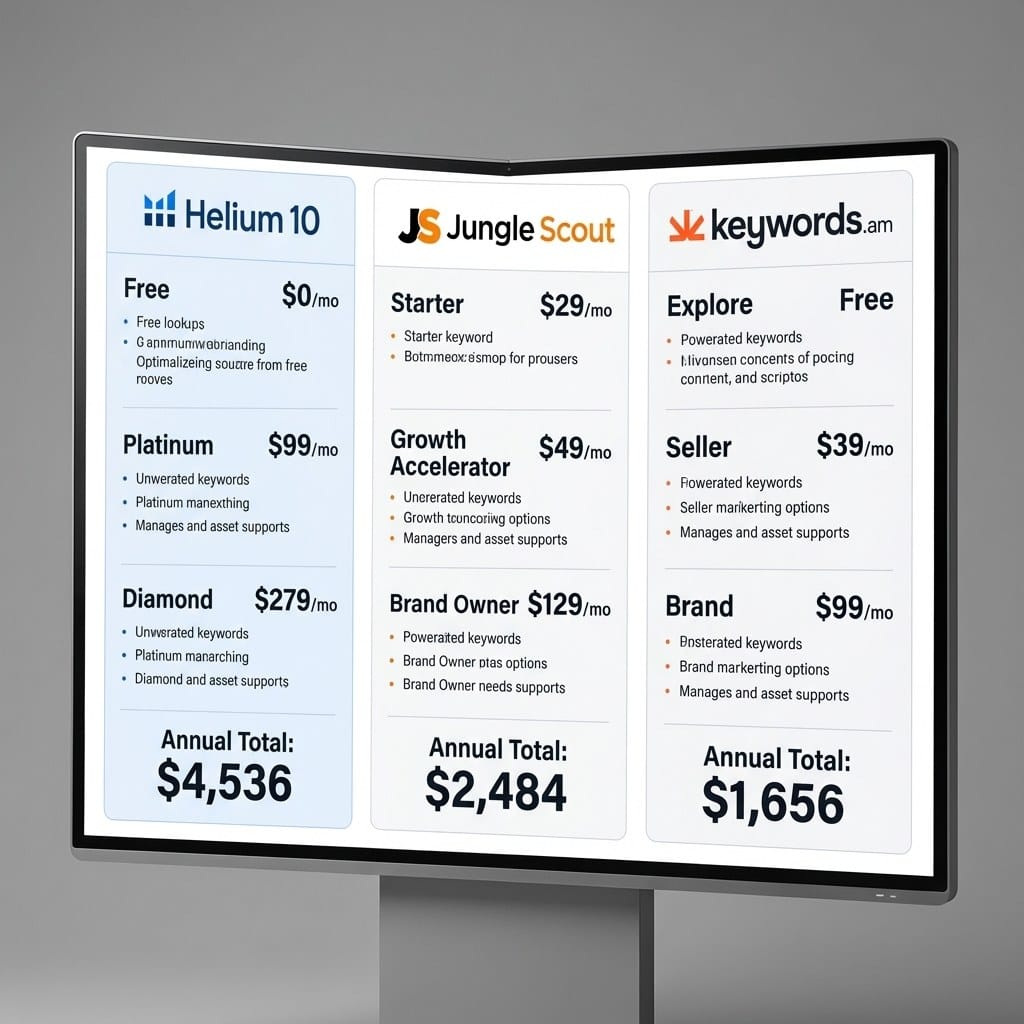
Annual Cost Comparison Matrix
Tier Level |
Helium 10 Annual Cost |
Jungle Scout Annual Cost |
Total Difference |
|---|---|---|---|
Entry Paid |
$1,188 (Platinum) |
$348 (Starter) |
JS is $840 cheaper |
Mid-Tier |
$3,348 (Diamond) |
$588 (Growth Accelerator) |
JS is $2,760 cheaper |
Top-Tier |
Custom (Enterprise) |
$1,548 (Brand Owner) |
Highly variable |
That $840 difference between entry-level annual plans is a big deal for new sellers. The exact amount covers a small initial inventory order. Or it funds two months of aggressive PPC testing. Helium 10 justifies its premium price tag by cramming over thirty separate tools into one dashboard. Sellers who master every single tool can easily recoup that cost. But sellers who only log in once a week? They waste hundreds of dollars.
Free tools show exactly how differently these two companies operate. Helium 10 maintains a genuine free tier. It severely restricts the number of daily queries. But it still provides access to a free Chrome extension, a basic keyword tool, a PPC audit feature, and a simple sales estimator. Jungle Scout abandoned the freemium model years ago. They currently offer zero free tiers. Zero free trials. The Jungle Scout Chrome extension is now just a completely separate product. You have to pay $19 per month just to use it on Amazon product pages.
But price tags only matter if the features actually fit your daily workflow. The technical capabilities of each tool dictate your true return on investment.
How Does Keyword Research Compare Between Helium 10 and Jungle Scout?
Helium 10 Cerebro and Magnet provide deeper keyword filtering with competitor-based reverse lookups, while Jungle Scout Keyword Scout offers simpler volume and trend data better suited to product validation.
Keyword research is the absolute foundation of any Amazon strategy. It is also where the helium 10 vs jungle scout debate gets the most heated. Both platforms attack this task from totally different technical angles. Helium 10 splits its primary keyword engine into two pieces. Cerebro handles the complex reverse ASIN lookups. You paste a competitor’s ASIN directly into Cerebro. The system spits back the exact search phrases that competitor ranks for. It shows their specific organic positions and sponsored ad placements. Magnet handles the forward research. You type a broad seed term like “garlic press” into Magnet. The tool instantly generates thousands of related long-tail phrases.
The real power of Helium 10 lives in its granular filters. Power users can restrict thousands of search results by exact word count. Or organic rank range. Or sponsored rank position. Cerebro also packs the proprietary CPR metric (Cerebro Product Rank). It calculates the exact number of product sales needed over an eight-day window to rank on page one for a specific keyword. You can compare multiple ASINs simultaneously to uncover overlapping keyword gaps in any niche. That extreme level of detail makes it a heavy hitter in any best Amazon keyword research tool guide.
Jungle Scout simplifies that entire process through a single tool called Keyword Scout. It gives you basic search volume numbers, historical trend graphs, and PPC bid estimates. Those historical graphs display seasonality beautifully. They help sellers avoid launching winter products in May. You can track organic and sponsored keywords over specific time periods. Keyword Scout’s interface is just… cleaner. Less scary for someone who’s never run a reverse ASIN report. Most beginners pick it up in a single afternoon and start validating products right away.
Here’s the thing: both tools have real weaknesses. Helium 10 throws so much data at you that a seller with one SKU feels like they’re drinking from a firehose. Without aggressive filtering, it’s just noise. Jungle Scout swings the other direction. It doesn’t offer granular filter controls, and there’s no way to run a multi-ASIN reverse lookup that maps an entire competitor landscape in one shot.
Sellers who focus heavily on reverse engineering top competitors often look for a dedicated Cerebro alternative if Helium 10 is too expensive. Keyword research naturally feeds right into listing optimization. And these two software giants diverge sharply in how they handle that critical transition.
Product Research and Listing Optimization: Where Do They Diverge?
Jungle Scout leads in product research with Opportunity Finder and sales estimates, while Helium 10 leads in listing optimization with Listing Builder. Neither offers real-time keyword tracking.
Sellers usually buy Jungle Scout for one very specific reason. The platform built its entire early reputation on the Product Database and Opportunity Finder. These tools let sellers filter Amazon’s huge product catalog by category, price point, monthly sales volume, and competition level. The integrated Supplier Database then connects those sellers directly with verified overseas manufacturers. It actually pulls real US Customs import records. It verifies exactly which factories supply top-selling Amazon brands. That one specific feature justifies the subscription cost alone for many private label sellers.
Helium 10 offers a tool called Black Box for product research. It works well and pulls large amounts of catalog data. It includes advanced filters (like searching specifically for products with low review counts but high monthly revenue). But honestly, it’s rarely why people sign up. The interface feels clinical compared to Jungle Scout’s more visual, friendly layout.
Now flip to listing optimization and the story changes fast. Helium 10 owns this category between the two. The Listing Builder pulls keyword lists straight from Cerebro and Magnet output. It funnels that data through Frankenstein (their keyword deduplication tool) so you start writing with a clean keyword list. From there, it tracks which keywords you’ve used in the title, bullets, and description. There’s also a Listing Analyzer that scores existing product pages on a proprietary scale. Jungle Scout did recently introduce its own Listing Builder and an AI Assist tool for automated content generation. But it remains significantly less mature and less integrated than the Helium 10 equivalent.
A huge workflow gap exists in both software platforms. Neither tool gives you real-time keyword coverage indicators during the actual writing process. Sellers have to write a sentence. Save their progress. And manually refresh the page just to see if they hit their target phrases. Neither platform publishes directly to Seller Central with a visual side-by-side diff review. You still have to copy and paste your optimized text manually into Amazon Seller Central. Dedicated listing software uses the TFSD Framework (Target, Focus, Secondary, Discovery) to systematically track keyword coverage live. Both of these big suites skip that workflow entirely.
Data accuracy remains the elephant in the room. Every single software provider loudly claims their internal numbers are the most precise on the market.
How Accurate Is the Data From Each Tool?
Both tools estimate Amazon search volumes and sales using proprietary models. Neither publishes independently verified accuracy rates, so treat self-reported numbers as marketing claims.
Spend five minutes on any helium 10 vs jungle scout Reddit thread and you’ll hit the accuracy argument. Jungle Scout says their sales estimates are about 84 percent accurate (their own study). Helium 10 puts their number around 76 percent (also their own study). Here’s the kicker: both of those figures come from internal company research. Nobody outside these companies has independently verified either number against real Amazon data.
So what does “accuracy” even mean in this context? It depends on which number you’re measuring. Search volume accuracy is how close estimated monthly searches land to real Amazon user searches. And Amazon doesn’t share that raw data with anyone. Sales estimate accuracy is how close BSR-based unit sales predictions land to actual orders.
The Best Seller Rank algorithm changes constantly. Amazon updates BSR hourly based on recent sales velocity (not historical lifetime sales). Software tools snapshot this hourly data and run it through their predictive models. If a tool misses a crucial snapshot during a peak buying hour, the monthly estimate skews wildly. Sudden lightning deals spike a product’s BSR artificially. That temporarily breaks the estimation models of both tools until the algorithm corrects itself days later. Keyword relevance dictates whether suggested phrases actually convert for your specific product category.
When someone says “84 percent accurate,” ask: accurate at what? A tool might nail sales predictions for a best-seller on page one. That same tool might be wildly off for a product sitting on page four with only 12 reviews.
Bottom line: treat every number from every tool as a compass, not a GPS coordinate. Whether Magnet says 10,000 searches or Keyword Scout says 12,000, the trend line matters more than the exact figure. When real money is on the line (think: ordering a container from Alibaba or setting a $500/day PPC budget), cross-reference between tools. Don’t bet the farm on one platform’s estimate.
So which one should you actually buy? Here’s a decision framework that cuts through the noise.
Who Should Choose Helium 10, Jungle Scout, or Neither?
Choose Jungle Scout for product research at a lower price. Choose Helium 10 for the broadest feature set. Choose a focused alternative for listing optimization workflows.
Here’s the uncomfortable truth: buying a 30-tool suite when you only use three features is just lighting money on fire.
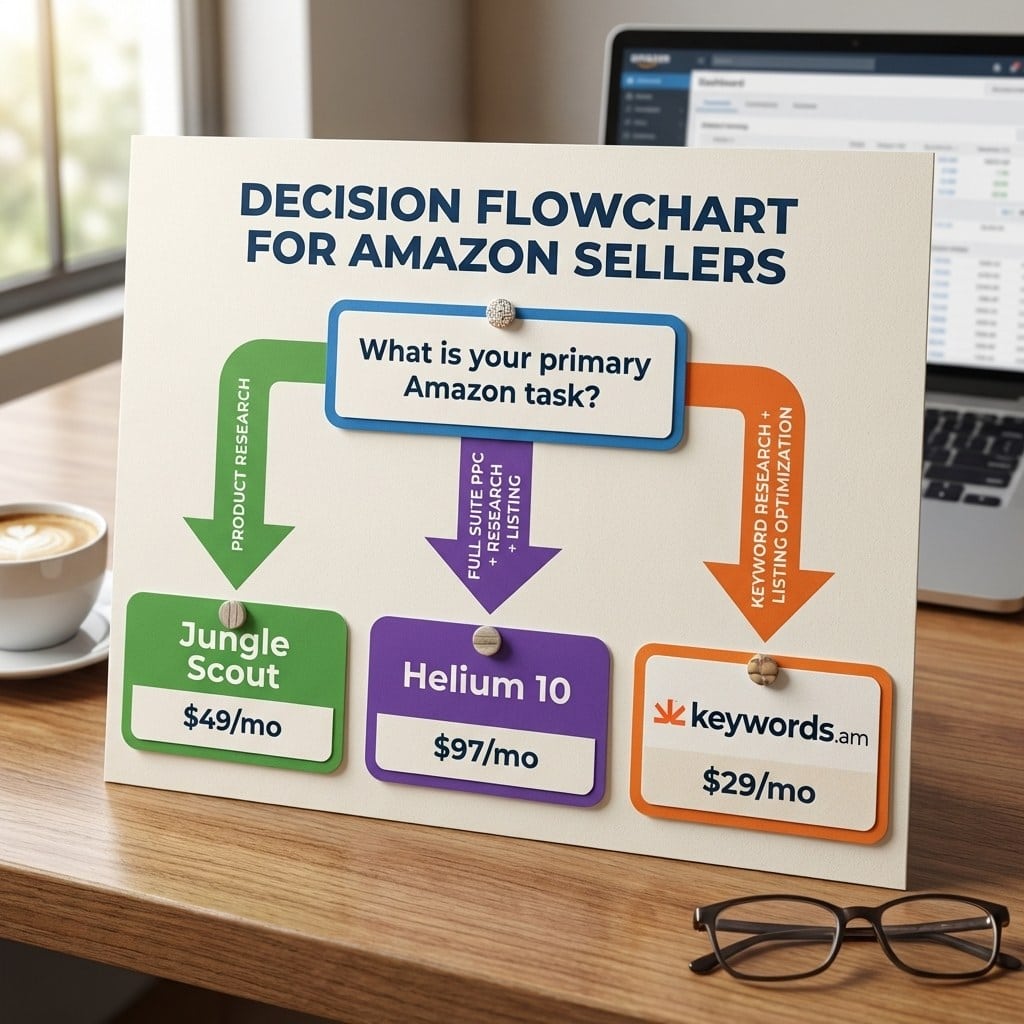
Software Decision Matrix
Your Priority |
Best Choice |
Why |
|---|---|---|
Product research + beginner friendly |
Jungle Scout Starter ($29/mo annual) |
Best product research tools, lower learning curve |
Broadest feature set + PPC management |
Helium 10 Platinum ($99/mo annual) |
30+ tools covering every Amazon selling task |
Keyword research + listing optimization only |
Keywords.am Seller ($39/mo annual) |
Purpose-built for optimization workflow, fraction of the cost |
Enterprise / large catalog |
Helium 10 Diamond or JS Brand Owner |
Scale features, multi-user, advanced analytics |
Different seller personas need completely different software stacks. The Bootstrapper generally chooses Jungle Scout. The low entry cost and excellent supplier database help them validate their first product safely. The Portfolio Manager or Agency usually picks Helium 10. They need deep PPC integration through Adtomic. And they need comprehensive reverse ASIN lookups to manage dozens of distinct product lines.
The Brand Manager focused purely on organic ranking usually chooses neither. Many experienced sellers run highly customized hybrid setups. They buy a basic annual Jungle Scout subscription purely for product sourcing and validation. Then they use a separate, dedicated platform for daily listing maintenance and keyword tracking. You can explore Jungle Scout alternatives and Helium 10 alternatives for high-volume sellers to see how focused tools replace different parts of these bloated suites.
Comparing these bloated suites head-to-head against focused alternatives often exposes glaring workflow inefficiencies. Read the Keywords.am vs Helium 10 breakdown. It shows exactly how purpose-built optimization software handles keyword tracking natively. The Keywords.am vs Jungle Scout comparison details the stark differences in modern listing management.
Dedicated listing software uses advanced scoring systems like the KPS (Keyword Performance Score). It grades listings based on actual search volume placement. The TFSD Framework (Target, Focus, Secondary, Discovery) allows sellers to organize keywords efficiently. Both platforms currently lack this specialized workflow structure. They also force you to manually update Seller Central. Dedicated software pushes updates directly via API.
Before locking in a subscription, here are the questions sellers ask most often about this decision.
Frequently Asked Questions About Helium 10 vs Jungle Scout
Here are the most common questions Amazon sellers ask when comparing Helium 10 and Jungle Scout in 2026.
Yes. Many sellers use Jungle Scout for product research. Then they use Helium 10 (or a focused alternative) for listing optimization. The tools serve totally different primary functions.
Helium 10 offers a free-forever tier with limited tool access. They also have free standalone tools like their Chrome extension and sales estimator. Jungle Scout offers zero free tiers. No free trial either.
Keywords.am starts at $39/month (annual). It focuses heavily on keyword research and listing optimization. You get features like real-time keyword coverage tracking and direct Seller Central publishing.
Helium 10 includes Adtomic for PPC campaign management and bid optimization. Jungle Scout lacks a dedicated PPC management tool. But Keyword Scout does provide basic PPC bid estimates for research.
Both tools use proprietary estimation models. Jungle Scout self-reports approximately 84% accuracy. Helium 10 claims similar ranges. But neither has published independently verified accuracy data.
As of March 2026, Jungle Scout does not offer a free trial or a free tier. Their Chrome extension is a separate paid product at $19/month.
Conclusion
The choice between these two platforms boils down to your current business stage and daily operations.
- Jungle Scout wins cleanly on product research and entry pricing ($29/mo annual vs $99/mo).
- Helium 10 wins easily on feature breadth and free functional tools.
- Neither platform excels at focused, efficient listing optimization workflows.
- The right choice depends entirely on which specific features you use daily.
Identify your top three daily Amazon tasks before opening your wallet. Match those specific operations directly to the software that executes them best. Do not buy the platform with the longest feature list if you only plan to launch a single product this year.
For sellers whose workflow centers heavily on keyword research and listing optimization, Keywords.am offers a completely free Explore plan. You can map out your entire listing strategy and publish directly to Seller Central. All without paying for fifty redundant features you will never touch.