Keyword Research
Best Amazon Keyword Research Tool 2026: 10+ Tools Compared (Ultimate Guide)
Compare 10+ best Amazon keyword research tools for 2026. Feature matrix, pricing comparison, and expert picks for beginners, agencies, and enterprise sellers.

Finding the best Amazon keyword research tool 2026 isn’t just about the numbers. It’s about survival. Increase production based on a demand prediction that’s 40% off and you’ll end up with inventory nobody wants while missing the products people actually buy.
It’s happening to Amazon sellers everywhere. Too many are still chasing vanity metrics: huge keywords that look great on a report but don’t drive sales. Sellers waste budget bidding on broad terms like “travel umbrella” because a tool reported 45,000 searches, only to find conversion is near zero because the searchers are browsing, not buying.
This guide compares the leading Amazon keyword tools against newer, intent-focused options across three dimensions: data accuracy, optimization depth, and return on investment.
The Shift to Intent-Based Algorithms in 2026
Picking the best Amazon keyword research tool for 2026 isn’t about keyword stuffing anymore. Amazon’s A9 algorithm has changed. Exact-match keyword targeting alone no longer drives ranking the way it used to.
The algorithm now runs on LLMs and “COSMO” (Commonsense Knowledge) graphs. As Search Engine Journal has reported, A9 tries to understand what shoppers mean, not just the words they type.
Most keyword tools haven’t caught up. They still output “estimated search volume” that can be off by 30-40% compared to what Amazon actually sees. Trusting those numbers leads to optimizing for traffic that doesn’t exist.
Semantic Anchoring: How COSMO Graphs Redefine Relevance
In early 2024, Amazon’s research team published COSMO (COmmonSense knowledge for e-COmmerce). Amazon Science describes how they’re using LLMs to figure out what shoppers really want. Type “shoes for pregnancy” and COSMO knows you’re probably looking for slip-on, comfortable, breathable shoes, even if you didn’t say so.
To rank in 2026, tools can’t just match keywords. They have to understand what a customer means. The best Amazon keyword research tool 2026 has to handle semantic anchoring. Volume alone isn’t enough; what matters now is analyzing buyer intent and ranking keywords by their conversion potential.
Smart sellers no longer rely on a single all-in-one platform. The best stack mixes broad-discovery tools with targeted, accurate ones built specifically for the optimization workflow, and increasingly pairs keyword optimization with Amazon Attribution to track off-Amazon traffic and measure real ROAS.
Competitive Analysis: Choosing the Best Amazon Keyword Research Tool 2026
Keywords.am: The Listing-Focused Specialist
Keywords.am is built for one job: turning keyword research into a ranking listing. It skips product research and inventory and focuses entirely on the optimization workflow that A9 actually rewards. The TFSD Framework and KPS (Keyword Priority Score) are the core differentiators against the all-in-one suites.
Strengths:
- Intent-Aware Methodology: KPS scores keywords by conversion potential and ranking opportunity, not raw volume. That avoids the “vanity volume” trap competitors fall into.
- Byte-Level Backend Counting: Counts backend search terms in bytes (the unit Amazon actually indexes by), not characters. Prevents silent de-indexing that catches sellers using character-based tools.
- Direct Seller Central Publishing: Pushes optimized listings to Seller Central without copy-paste. Closes the gap between research and live ranking.
- Pricing: Free Explore tier available; paid plans start at $49/mo. Compares favorably against $99-200/mo all-in-one suites for sellers who only need optimization.
Weaknesses:
- No Product Research: Doesn’t replace Helium 10 or Jungle Scout for the “what should I sell” phase. Pair it with one of those for the full workflow.
- No PPC Automation: Optimization-focused only; ad management lives elsewhere.
For a side-by-side breakdown against the suite leader, see the Keywords.am vs Helium 10 comparison.
Helium 10: The “All-in-One” Platform
Helium 10 remains the heaviest name in the space and a strong contender for the top Amazon keyword tool in 2026. It rolls your whole Amazon business into one platform.
Strengths:
- Cerebro: Still the standard for reverse ASIN competitor lookups.
- Breadth: Inventory, automated emails, and PPC tools bundled into one subscription.
Weaknesses:
- Cost efficiency: $100+/month is steep, and most sellers use a fraction of the feature set. If you only need keyword optimization, you’re paying for a lot of unused inventory and PPC modules, and there are free and cheaper Helium 10 Magnet alternatives worth considering before committing to that price, including a Helium 10 Black Box alternative if product research is the only feature driving your subscription.
- Optimization logic: Tools like Frankenstein and Scribbles still treat keywords as a flat list rather than ranked by intent or SEO weight.
Jungle Scout: The Product Research Leader
Jungle Scout is the go-to for figuring out what to sell. The interface is clean and the product-discovery side is genuinely strong.
Strengths:
- Opportunity Finder: Spots niches with healthy demand but soft competition.
- User experience: Easy to learn, friendly for first-time sellers.
Weaknesses:
- Data granularity: Keyword data is fine for product discovery but lacks the depth needed for serious ranking work.
- Optimization constraints: The listing builder doesn’t cover the backend indexing requirements that 2026 Amazon SEO demands.
Data Dive: The Research Workflow Specialist
Data Dive structures research into repeatable “dives” rather than one-off lookups. It plugs into the tools you already run and adds workflow on top.
Strengths:
- Guided workflows: Repeatable dive templates so you don’t reinvent the process each time.
- AI-powered insights: AI assists with copy drafts and product briefs.
Weaknesses:
- Dependency: Pulls data from other sources like Jungle Scout, so it’s a workflow layer, not a standalone research tool.
- Learning curve: The dive structure takes time to learn. If you prefer free-form research, the constraints feel rigid.
SellerSprite: The International Market Expert
SellerSprite has one of the largest keyword databases out there and is the strongest pick for sellers operating across multiple Amazon marketplaces.
Strengths:
- Extensive database: Keyword coverage is genuinely deep, especially for non-US markets.
- Market research: Solid competitor and trend tools for international categories.
Weaknesses:
- Complex interface: A lot of data on screen at once. New users find it overwhelming.
- Metric overload: Surfaces too many metrics without prioritizing what actually matters.
AMZScout: The All-Rounder for Beginners
AMZScout covers product discovery, keyword research, and competitor tracking in one tool. A solid starting point if you’re new to selling on Amazon.
Strengths:
- Ease of use: Clean layout. New sellers find products and keywords without getting lost.
- Value: A lifetime plan exists. If you’re in it long-term, the math beats monthly subscriptions.
Weaknesses:
- Data accuracy: Search volume estimates aren’t always spot-on, a common issue with this class of tool.
- Limited advanced features: Lighter on agency-grade and large-portfolio capabilities.
MerchantWords: The Original Keyword Database
MerchantWords is one of the original Amazon keyword tools and has years of historical search data behind it.
Strengths:
- Historical data: Long timeframe of keyword data, useful for spotting how search trends have shifted.
- Simple interface: Focused entirely on keyword research, easy to learn.
Weaknesses:
- No broader features: No listing creation or PPC tools. It stops at the keyword export.
- Volume estimates: Sellers regularly question the accuracy of MerchantWords’ volume numbers vs. competing tools.
SellerApp: The Data-Driven Platform
SellerApp combines automation and data-led decision making across keyword research and PPC.
Strengths:
- PPC integration: Strong Amazon ad campaign management.
- AI automation: AI scoring grades listings and suggests improvements.
Weaknesses:
- Higher price point: Pricier than budget options, which matters for smaller sellers.
- Complexity: Advanced features have a learning curve.
Keyword Tool Dominator: The One-Time-Fee Option
Pulls keyword ideas directly from Amazon’s autocomplete suggestions to surface long-tail terms shoppers actually search for.
Strengths:
- One-time payment: Pay once. No monthly fee.
- Long-tail focus: Strong at surfacing less-competitive, highly-targeted phrases.
Weaknesses:
- No search volume data: Suggestion-based; you’ll need a separate tool for volume.
- Limited scope: No reverse ASIN, no competitor analysis. Suggestions only.
Sonar: The Free Powerhouse
Sonar, by Perpetua, is free and includes a reverse ASIN lookup, which most free tools don’t.
Strengths:
- Completely free: Zero cost. A win for budget-watching sellers.
- Reverse ASIN: Rare in free tools.
Weaknesses:
- Basic functionality: Lacks the detailed filtering and depth of paid platforms.
- Data depth: Smaller keyword database than the paid alternatives.
KeywordTool.io: The Suggestion Engine
Similar to Keyword Tool Dominator. Pulls ideas from autocomplete; the paid version unlocks more features.
Strengths:
- Idea generation: Generates hundreds of keyword suggestions quickly.
- Multi-platform: Works for Amazon, Google, YouTube, and others.
Weaknesses:
- Relies on Google data: Volume estimates often come from Google, which doesn’t translate cleanly to Amazon.
- Not a full suite: Missing the broader feature set Amazon-specific tools offer.
Amazon Product Opportunity Explorer: The First-Party Data Source
Amazon’s own free tool. Surfaces what shoppers search for but can’t find, and suggests product ideas based on Amazon’s own data.
Strengths:
- First-party data: Data straight from Amazon. The most reliable source available.
- Niche identification: Strong at pinpointing market gaps based on actual shopper demand.
Weaknesses:
- Not a keyword tool: Built for market research, not for keyword optimization in listings.
- Limited scope: Available only to professional sellers in select countries.
The “Volume Trap” in Third-Party Estimates
Amazon doesn’t expose precise search volume data through its public API.
The volume figures you see in Helium 10, Jungle Scout, or any other Amazon keyword tool are estimates, often built on clickstream data. Compare the same keyword across different tools and the numbers can vary by more than 50%.
The weather-forecast analogy. Relying on these estimates is like planning a beach trip from an old almanac instead of checking the actual forecast. Yes, April usually rains, but what if it’s sunny today?
The strategic risk. Base a launch on an estimated 22,000 monthly searches when the real intent-driven volume is much lower, and you’ll burn budget on PPC while your organic ranking erodes. Amazon’s algorithm penalizes listings that don’t convert (low Unit Session Percentage) by showing them less.
The solution. Shift attention from volume to relevance.
The Specialist Approach: Keywords.am Methodology
Keywords.am isn’t built to flash big numbers. It’s built for one job: ranking. The platform focuses entirely on Amazon SEO and listing optimization.
It does this through three pillars: the TFSD Framework, signal-based optimization, and precision byte counting.
1. The TFSD Framework
Ranking isn’t about scattering keywords everywhere. You need a structure. The TFSD framework sorts keywords by the weight Amazon’s algorithm gives each field:
- T (Title): the most important field. Place your highest-priority keywords here in their exact form.
- F (Features): bullet points. Must be readable for shoppers and indexable by Amazon.
- S (Search Terms): the backend field. The hidden space for variations and supplementary terms.
- D (Description): gives the A9 algorithm context to understand your product.
The platform guides you through this in real time with green and orange coverage indicators that keep multi-word phrases intact instead of just checking single tokens. See the full TFSD Framework guide.
2. Keyword Priority Score (KPS)
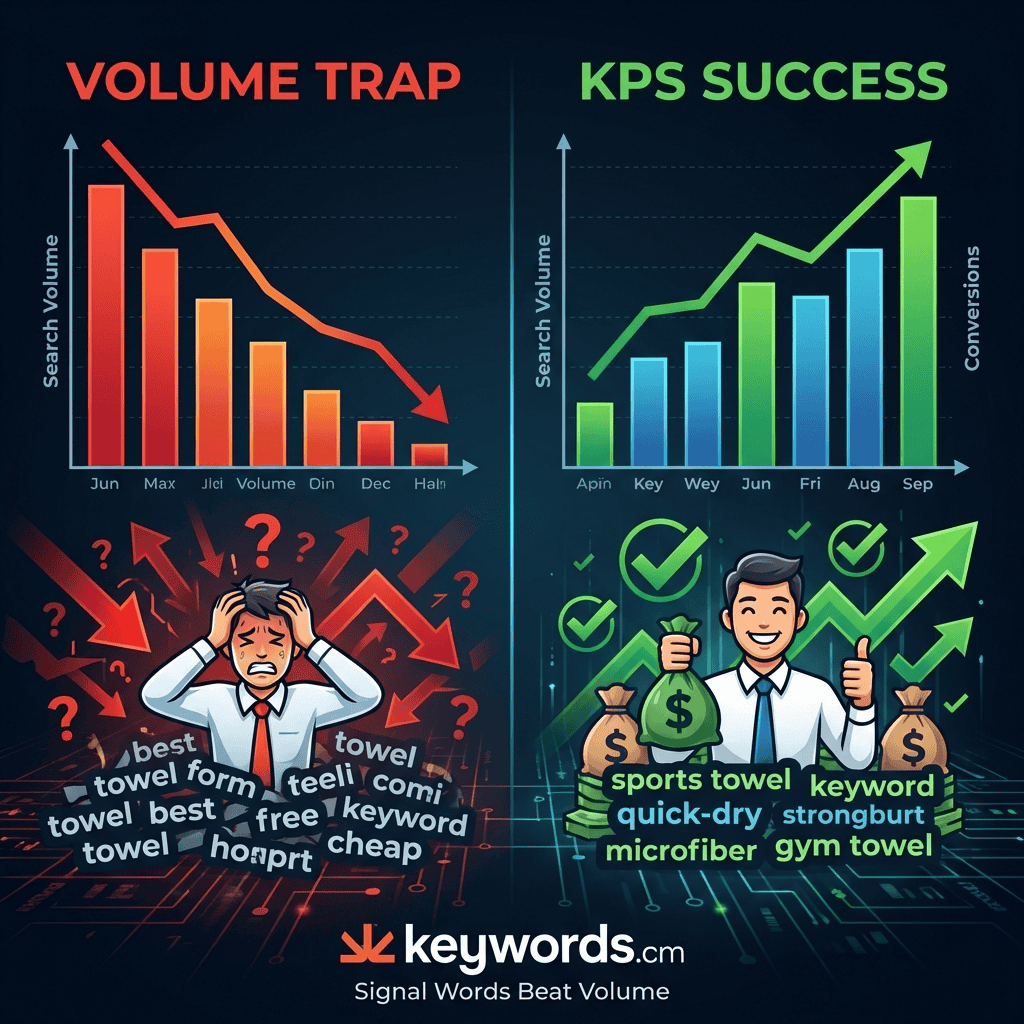
Keywords.am doesn’t chase raw search numbers that often lead nowhere. Instead, the Keyword Priority Score (KPS) evaluates estimated conversion rate, competition density, and product relevance, then assigns a 0-100 score.
A high KPS means the keyword is likely to drive sales and offers a real chance of ranking. That’s a more useful signal than search volume alone.
3. Precision Byte Counting
A common 2026 compliance trap: backend search terms. Amazon indexes those keywords by bytes, not characters. Multi-byte characters (umlauts, accented vowels, special symbols) can push a 249-character string past the 250-byte limit and silently suppress the entire field.
Keywords.am counts at the byte level, so you stay compliant and avoid silent de-indexing.
The Physics of Indexing: Bytes vs. Characters
The Amazon Seller Central documentation is clear: search terms must be under 250 bytes. Regular English characters use 1 byte each. Special characters (umlauts, accented vowels, non-Latin scripts) can take up to 4 bytes.
A character-counting tool can let you save a 249-character string that’s actually 270 bytes. Amazon doesn’t truncate it; it silently ignores the whole field. Any reliable Amazon keyword tool has to index by bytes. Understanding these backend keyword best practices often decides whether you show up in search or disappear.
4. Automated Data Hygiene (the Swiss Army Knife)
Pulling competitor data gives you a flood of raw keywords, most of which is noise: duplicates, filler words, irrelevant terms. Cleaning that by hand in spreadsheets eats hours and introduces errors.
The Swiss Army Knife is the built-in data cleaner. It strips duplicates, removes filler, and preps keywords for indexing in a single pass.
Feature Comparison Matrix

| Feature | Keywords.am | Helium 10 | Jungle Scout | Data Dive | SellerSprite | AMZScout | MerchantWords | SellerApp | Sonar |
|---|---|---|---|---|---|---|---|---|---|
| Reverse ASIN | ✅ | ✅ | ✅ | ✅ | ✅ | ✅ | ✅ | ✅ | ✅ |
| Seed Keywords | ✅ | ✅ | ✅ | ✅ | ✅ | ✅ | ✅ | ✅ | ✅ |
| KPS Scoring | ✅ | ❌ | ❌ | ❌ | ❌ | ❌ | ❌ | ❌ | ❌ |
| Byte Counter | ✅ | ❌ | ❌ | ❌ | ❌ | ❌ | ❌ | ❌ | ❌ |
| TFSD Mapping | ✅ | ❌ | ❌ | ❌ | ❌ | ❌ | ❌ | ❌ | ❌ |
| PPC Integration | ❌ | ✅ | ✅ | ✅ | ✅ | ✅ | ❌ | ✅ | ❌ |
| AI Listing Builder | ❌ | ✅ | ✅ | ✅ | ✅ | ✅ | ✅ | ✅ | ❌ |
| Marketplaces | 10+ | 15+ | 10+ | 10+ | 10+ | 10+ | 10+ | 10+ | 8 |
Price Comparison of Top Amazon Keyword Tools
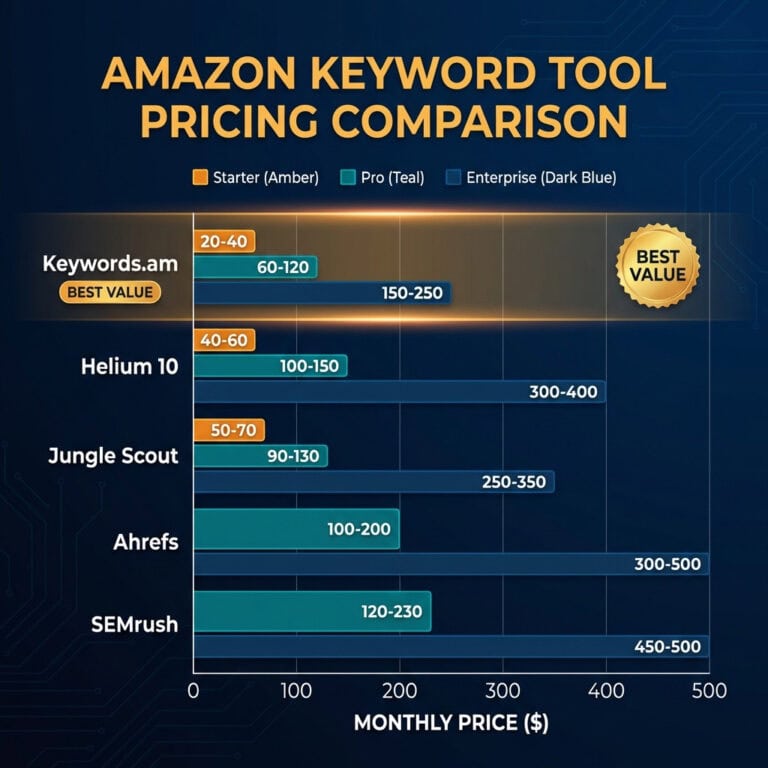
| Tool | Free Trial / Plan | Seller Plan (monthly) | Pro Plan (monthly) | Enterprise / Agency Plan |
|---|---|---|---|---|
| Keywords.am | 7-day Free Trial | $30 | $60 | $120 |
| Helium 10 | Free Limited Plan | $39 | $99 | $249+ |
| Jungle Scout | 7-day Money Back | $49 | $69 | $129+ |
| Data Dive | Contact for Trial | $39 | $149 | $490 |
| SellerSprite | Free Trial | $79 | Varies | Varies |
| AMZScout | Limited Free Tools | $59.99 | $399.99 (Annual) | Custom |
| MerchantWords | 3 Free Searches | $35 | $79 | $149 |
| SellerApp | 7-day Free Trial | $99 | Varies | $250+ |
| Sonar | Completely Free | N/A | N/A | N/A |
| Keyword Tool Dominator | 3 Free Searches | $70 (One-Time) | N/A | N/A |
Note: Prices are approximate and subject to change. Annual plans often provide significant discounts.
Which Keyword Tool is Best For You?
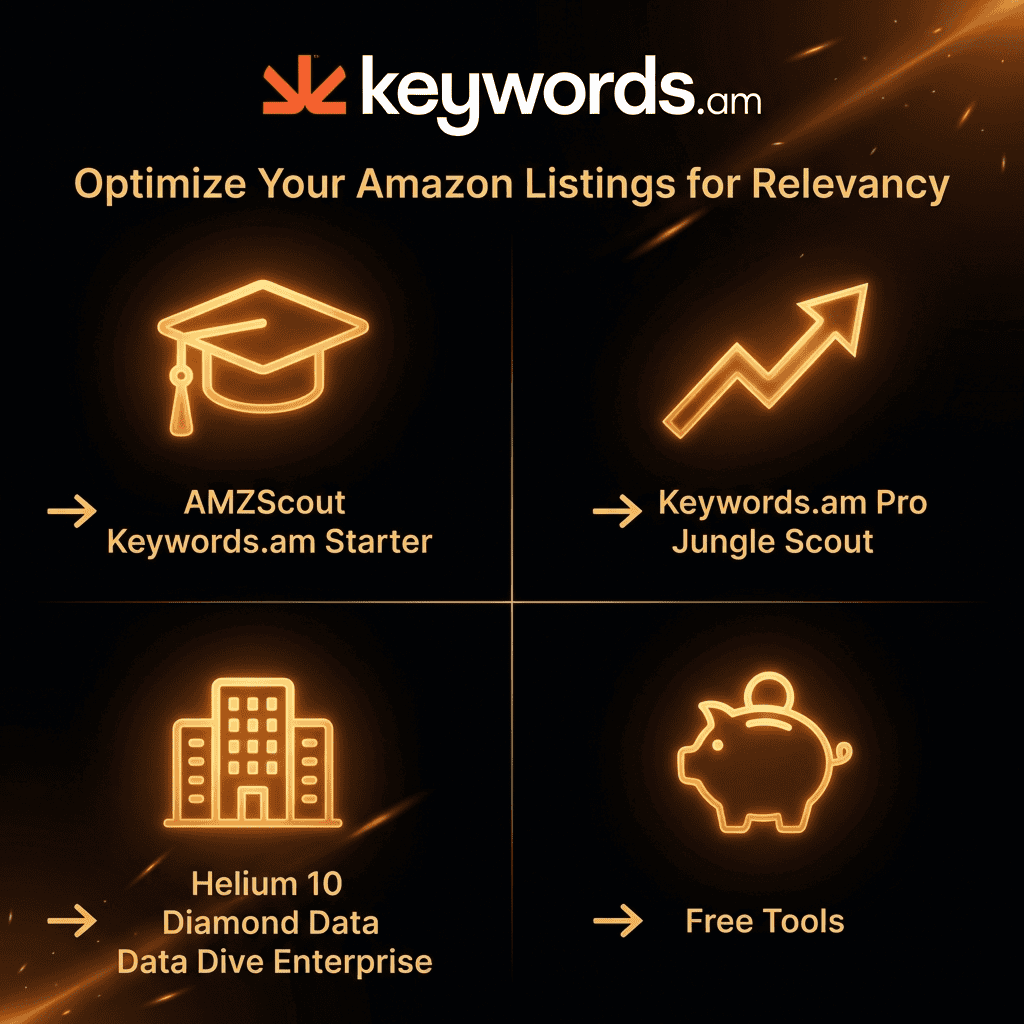
There’s no one-size-fits-all best Amazon keyword research tool 2026. The right pick depends on where your business is and what you’re trying to achieve.
Best for Beginners
If you’re starting out, ease of use and price are everything. AMZScout has a simple interface with strong core features. If budget is tight, Sonar is genuinely free and includes basics like reverse ASIN lookup. Hard to beat as a starting point.
Best for Growing Sellers
Growing sellers need broader data. Helium 10 is still a strong all-in-one choice with tools well beyond keywords. Jungle Scout is the better pick if you’re still hunting for new products to sell.
Best for Agencies/Enterprise
Agencies and enterprise sellers need data they can trust and tools that integrate cleanly. Keywords.am is a strong pick for SEO and ranking, with features no competitor offers (byte counting, TFSD framework).
For deep market data and structured workflows, Data Dive is built around repeatable processes that team-based research benefits from.
Best Free Options
Tight budget doesn’t mean no options. Sonar is probably the best free Amazon keyword tool overall. Amazon’s Product Opportunity Explorer is essential alongside it: first-party data for market research, even if it’s not strictly a keyword tool.
Verdict: Constructing the 2026 Tech Stack
The “best” tool depends on what you’re solving for. Look at where your business actually stands and what you need right now:
- Finding new products? Jungle Scout and the Amazon Product Opportunity Explorer are still the strongest tools for niche discovery.
- Managing a large inventory? Helium 10 is the right backbone for big catalogs.
- Ranking and SEO focus? Keywords.am gives you the specific data to dominate search results.
Top brands in 2026 don’t rely on a single tool. They use broad-discovery platforms for the big picture, then feed the output into Keywords.am for targeted optimization and ranking work.
Scaling with Intelligence: The Specialist’s Advantage
Scaling is hard. The “kitchen sink” approach (throwing every tool at the problem) just adds technical debt as the business grows. Managing multiple brands requires clean separation. Top agencies use Keywords.am to audit listings and verify every Signal Word hits green in the TFSD Framework, brand by brand.
Sellers who go from ranking to dominating are usually the ones writing titles that convert and focusing on features that sell. A good Amazon keyword research platform should deliver actionable results, not a flood of data you have to translate into decisions yourself.
Frequently Asked Questions

Q: Why do my keywords get indexed but not ranked?
A: Usually it’s the backend search terms. Many top-rated Amazon keyword tools count characters instead of bytes, which silently de-indexes your terms when special characters push the byte count over 250. Keywords.am counts bytes precisely so you don’t get de-indexed without realizing it.
Q: Is search volume the best metric for keyword research?
A: No. Volume measures interest, not purchase intent. High search volume often means browsing, not buying. Target “Signal Words” instead: lower volume, much higher conversion rates. KPS scoring identifies these.
Q: Can I use Helium 10 and Keywords.am together?
A: Yes. Elite sellers often pull initial competitor data from Helium 10 (Cerebro), then load that list into Keywords.am to clean it, prioritize it, and publish it to Seller Central.
Q: How often should I update my product’s keywords?
A: Quarterly is the right cadence for most sellers. Amazon’s search behavior shifts constantly, and listings need to stay fresh. Refresh before big sales events like Prime Day or major holidays.
Q: What is the difference between frontend and backend keywords?
A: Frontend keywords appear in customer-facing fields: title, bullets, description. Backend keywords live in the “Search Terms” field in Seller Central, hidden from shoppers. Both contribute to indexing, but backend terms are the place for synonyms, common typos, and competitor terms you don’t want in public copy.
Q: How long does it take to see results from keyword optimization?
A: Amazon usually indexes changes within a day or two, but real movement in organic ranking can take weeks. Sales velocity, conversion rate, and review count all factor in. Keywords are necessary but not sufficient.
Q: Is it better to target single keywords or long-tail phrases?
A: Both. Short head terms drive volume but face brutal competition. Long-tail phrases (3+ words) have lower volume but much higher purchase intent and conversion rates. A quality keyword research tool helps you find the right balance for your category.
Q: How do I know if my keywords are being indexed by Amazon?
A: Run a manual check: search Amazon for your ASIN plus the keyword (e.g., “B012345678 wireless headphones”). If your product appears, you’re indexed for that term. Some tools also automate indexing checks at scale.
Q: Can I rank for keywords in a different language?
A: Yes, if you sell in a marketplace where that language is spoken. Spanish keywords in the US marketplace, for example. Add other-language terms to your backend search terms to reach broader audiences.
Q: What are “striker” keywords?
A: Striker keywords are your highest-priority terms: the ones with the best mix of relevance and conversion potential. Place them in the title for maximum impact.
Ready for Data You Can Bet Your ASIN On?
Estimates? They’re not written in stone, are they? If you want the best Amazon keyword research tool, start a free trial of Keywords.am today. The real thing to keep an eye on is what actually matters: the revenue coming in. What do you think?