
⚡ TL;DR
- TFSD = Title, Features, Search Terms, Description – the hierarchical framework matching Amazon A10 algorithm’s relevance weighting
- Features are conversion layers – benefit-driven bullets with secondary keywords (don’t repeat Title keywords)
- Title gets highest weight – 200 characters max, Brand + Main Keyword + Differentiator, no promotional phrases
- Search Terms = 249 BYTES – not characters; exceeding this limit causes Amazon to ignore the entire field
- Description is for storytelling – lowest SEO weight but critical for conversion
- Stop “Chaos Optimization” – random keyword stuffing dilutes relevance and hurts CTR
- Keywords.am enforces this – real-time byte counters and “Traffic Light” coverage indicators for 21 marketplaces
Amazon listing optimization often suffers from a lack of engineering rigor. “Experts” frequently advise sellers to prioritize volume over structure, resulting in keyword-stuffed titles that serve neither the algorithm nor the customer.
This approach is Chaos Optimization, and it is the primary reason brands fail to index for high-value keywords.
The TFSD Framework replaces guesswork with a rigid, hierarchical blueprint: Title, Features, Search Terms, Description.
This framework is not a creative suggestion. It is an engineering constraint derived from reverse-engineering the Amazon A10 algorithm’s relevance weighting. It ensures listings are indexed for thousands of keywords while maintaining the readability required for conversion.
What is the TFSD Framework?
TFSD stands for Title, Features, Search Terms, Description.
It defines the priority order for maximizing relevance signals. The Amazon A10 algorithm assigns different weights to keywords based on their location within the listing. Treating all listing fields equally is a fundamental error.
The TFSD Framework operates as a Waterfall of Relevance:
- Title: The highest-weighted field. Keywords here send the strongest indexing signal to the A10 algorithm.
- Features (Bullet Points): Secondary weight. Ideal for natural language benefits and medium-volume keywords.
- Search Terms (Backend): The catchment area for high-value keywords that do not arguably fit into the visible listing content (synonyms, misspellings, Spanish variations).
- Description: The lowest SEO weight for ranking, but critical for conversion and brand storytelling.
Adhering to this hierarchy aligns the listing structure with the algorithm’s parsing logic, maximizing discoverability.
Why “Chaos Optimization” Fails
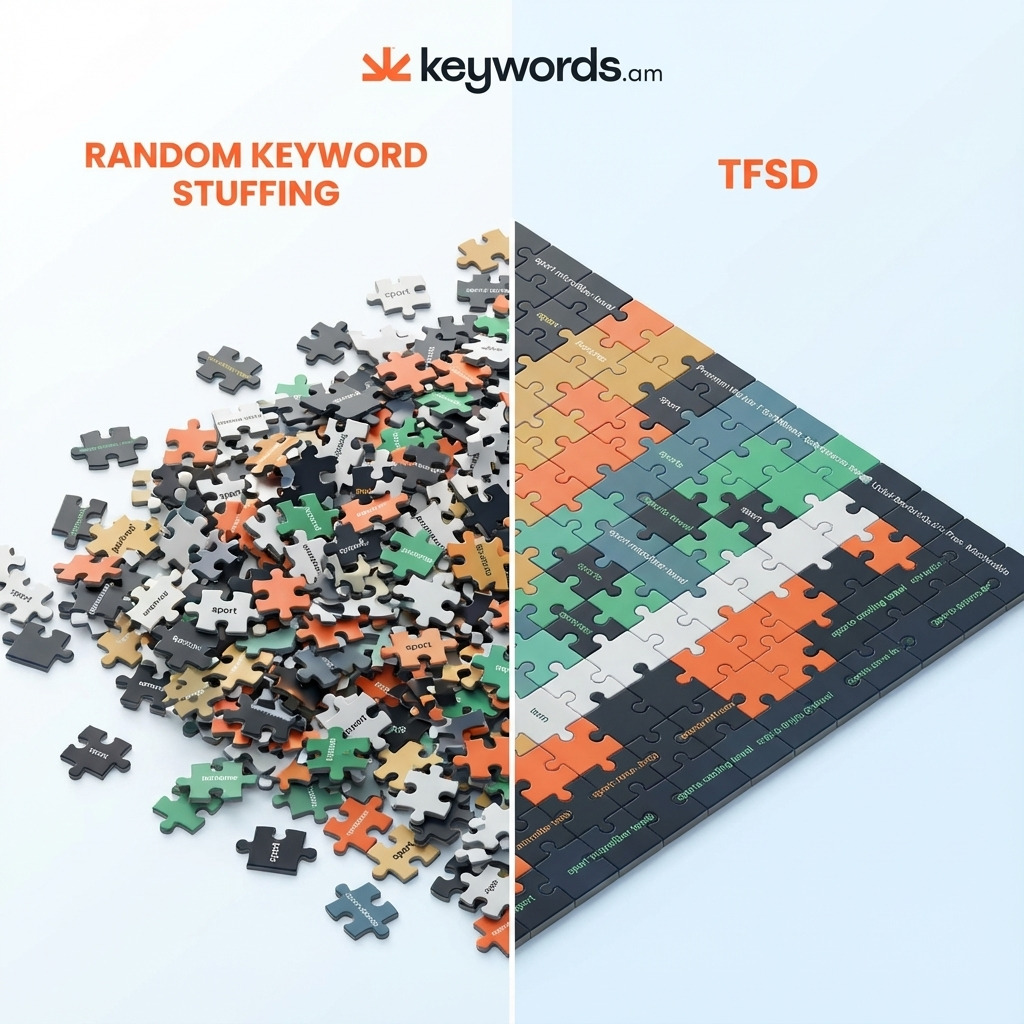
“Chaos Optimization” is characterized by the indiscriminating insertion of unique keywords into any available field without regard for their “home.” A typical example:
Title: Garlic Press Stainless Steel Kitchen Tool Ginger Crusher Mincer Chopper Slicer Grater Peeler Set Best Professional Heavy Duty Soft Handle (Silver)
While technically “optimized” for keyword presence, this title fails two critical engineering tests:
- Click-Through Rate (CTR) Degradation: The spam-like appearance deters human clicks, lowering the organic CTR signal fed back to the algorithm.
- Signal Dilution: By attempting to rank for every possible synonym in the highest-value field, the listing fails to establish strong relevance for its core identity (“Garlic Press”).
The TFSD Framework forces the segregation of keywords. Core terms occupy the Title; long-tail layout variations are relegated to Backend Search Terms. This maximizes the “Signal to Noise” ratio.
The Hierarchy of Relevance: Technical Constraints
Success requires understanding the hard technical limits of the Amazon platform.
1. Title: The 200-Character Constraint
The Title serves as the primary indexing key. According to Amazon’s Product Title Requirements, strict adherence to length and formatting is mandatory.
- Constraint: Generally 200 characters.
- Optimal Structure: Brand + Main Keyword + Key Differentiator + Size/Color.
- Restriction: Usage of promotional phrases in the Title (e.g., “Best,” “Premium”) is a policy violation and wastes character count on non-indexing terms.
2. Features: The Conversion Layer
The five bullet points serve as the primary conversion mechanism.
- Optimization Strategy: Begin each bullet with a capitalized benefit, followed by the explanation containing secondary keywords.
- Inefficiency: Repeating Title keywords in the Bullet points. The A10 algorithm does not award additive points for repetition. Space in the bullets should be reserved for unique, secondary keywords.
3. Search Terms: The Byte Limit (249 Bytes)
The Backend Search Terms field is the most frequently mishandled component. While some newer documentation references character counts, the rigorous engineering standard for guaranteed indexing across all marketplaces remains the byte limit.
- The Hard Limit: 249 BYTES.
- Byte vs. Character Distinction: In standard ASCII (English), 1 character equals 1 byte. However, multi-byte characters (accents, emojis, or non-Latin scripts like Japanese) increase the byte count significantly.
- Critical Failure: Exceeding the 249-byte limit often results in Amazon ignoring the entire field. This “silent killer” is why many listings flatline.
- Strategic Usage: Uses this field as a “synonym engine” for misspellings, Spanish translations (e.g., “ajo”), and alternative phrasing that disrupts readability in the main content.
Implementing TFSD with Precision
Implementation requires a systematic triage of keyword data. You cannot manage this effectively in a standard spreadsheet.
Step 1: Data Triage
Using tools like Reverse ASIN, aggregate a master keyword list and sort by relevance and search volume.
- Tier 1 (Top 3-5): Assign to Title.
- Tier 2 (Next 10-20): Assign to Features.
- Tier 3 (High Volume, Low Readability): Assign to Search Terms.
- Remainder: Description or discard.
Step 2: Structured Writing
Draft the Title for human readability first, ensuring Tier 1 keywords are present. If a keyword compromises readability, it must continue down the waterfall to the Features or Backend.
Step 3: Backend Optimization
Populate the Search Terms field with all remaining valid keywords from Tier 3.
- Optimization Protocol: Remove duplicates found in Title or Bullets. Do not use commas (” “), as they consume valid bytes without adding SEO value.
Technical Enforcement via Keywords.am
Spreadsheets lack the real-time validation required to enforce these technical constraints effectively. The Keywords.am editor was engineered to act as a strict validation layer for the TFSD framework.
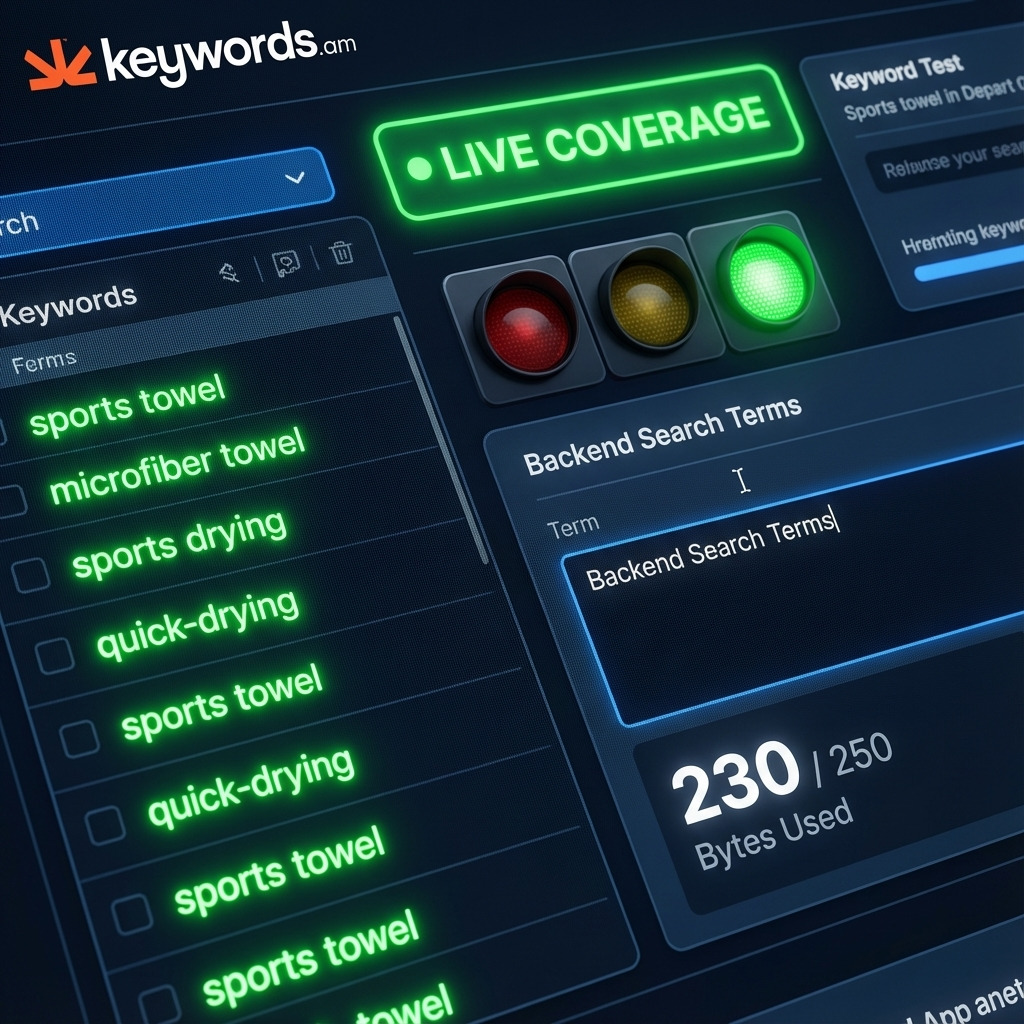
Live Coverage Verification (“Traffic Lights”)
The editor analyzes keyword presence against the master list in real-time.
- Green: Exact Phrase Match detected.
- Yellow: Broad Match (all constituent words present).
- Red: Keyword missing.
This provides immediate visual confirmation of the listing’s relevance coverage.
Algorithmic Byte Counting
The system calculates usage based on bytes, not characters, specific to the encoding of 21 different Amazon marketplaces. This prevents the “silent failure” of exceeding the backend limit. For example, if you are listing in Amazon Japan, our tool adjusts the counter to account for multi-byte Kanji characters.
One-Click “Add Unused” Automation
To maximize efficiency, the “Add Unused” function programmatically scans the listing, identifies all unused keywords from the master list, de-dupes them, and populates the Backend Search Terms field up to the exact 249-byte limit. This eliminates manual copy-paste errors and ensures maximum keyword utilization.
This feature pairs perfectly with our Amber AI assistant, which can help generate optimization suggestions if you get stuck, and our Keyword Tracking tool to monitor result post-launch.
Moving From Intuition to Engineering
The Amazon marketplace rewards sellers who treat listing optimization as an engineering problem rather than a creative writing exercise.
The TFSD Framework provides the necessary architecture to maximize relevance signals within Amazon’s technical constraints. It ensures every character serves a specific indexing or conversion purpose.
Ready to structure your success?
Start optimizing with the TFSD Framework on Keywords.am today.
Frequently Asked Questions (FAQ)
What defines the “TFSD” in the framework?
TFSD stands for Title, Features, Search Terms, and Description. It represents the hierarchy of relevance weighting used by the Amazon search algorithm.
Why is the byte limit 249 instead of 250?
Amazon strictly enforces a limit of less than 250 bytes. To ensure safety and guarantee indexing across all systems and marketplaces, Keywords.am enforces a hard stop at 249 bytes. Exceeding this limit often causes the entire search terms field to be rejected.
Can I repeat keywords in the backend search terms?
No. Amazon’s search algorithm does not reward keyword frequency (repeating a word 5 times). It rewards unique token relevance. If “garlic” is in your Title, placing it in the Backend Search Terms is a waste of precious byte space.
Does the TFSD Framework work for international marketplaces?
Yes. The framework is universal to the Amazon search engine logic (A9/A10). However, the byte limits vary by language encoding. The Keywords.am editor automatically adjusts its counters for 21 supported marketplaces, ensuring your German, Japanese, or French listings are technically compliant.