Listing Optimization
Best AI Amazon Listing Tools for Solo Sellers: 5 Time-Saving Options for 2026
Compare 5 AI Amazon listing tools built for solo sellers. See which saves most time, pricing under $50/mo, and real output quality tested on the same product.

The average solo Amazon seller spends over three hours writing a single product listing from scratch. For someone juggling sourcing, shipping, customer service, and a dozen other responsibilities, that’s time that could launch an entirely new product instead. AI Amazon listing tools promise to cut that time dramatically, but not all AI is created equal. Generic tools like ChatGPT produce keyword-stuffed copy that violates Amazon’s guidelines. Enterprise suites charge $99+ per month for features solo sellers will never use. This guide compares five AI Amazon listing tools specifically for one-person operations managing fewer than 10 SKUs. Each tool was evaluated on three criteria that matter most to solo sellers: affordable pricing under $50 monthly, minimal learning curve, and output quality that requires minimal editing.
- What Makes an AI Listing Tool Solo Seller-Friendly?
- How Does Keywords.am Amber AI Compare for Solo Sellers?
- What Does Helium 10 Scribbles Offer Solo Sellers?
- Can Sellesta AI Deliver for Quick Listing Generation?
- How Does CopyMonkey Handle AI Listing Copy?
- Is Amazon’s Free AI Listing Tool Enough for Solo Sellers?
- AI Listing Tool Comparison: Same Product Test
- When Should Solo Sellers Use AI vs Hire a Writer?
- Frequently Asked Questions About AI Amazon Listing Tools
- Conclusion
What Makes an AI Listing Tool Solo Seller-Friendly?
Solo seller-friendly AI listing tools combine three elements: affordable pricing under $50/mo, minimal setup requiring no training, and keyword-informed output that reduces editing time.
Pricing fit matters. Most solo sellers manage fewer than 10 SKUs. Paying $99/mo for enterprise features represents a significant percentage of margin that could fund inventory instead. The sweet spot for solo seller tools falls between $30-$50/mo: enough to access quality features without enterprise overhead.
Learning curves kill adoption. If a tool takes two hours to learn, most solo sellers won’t use it. The best tools for one-person operations work intuitively within five minutes. As one Keywords.am user noted, they felt “comfortable using the software in less than 5 minutes.”
Keyword awareness separates useful from useless. Generic AI doesn’t know which keywords matter for a specific product. Amazon-specific tools that integrate keyword research data produce copy that’s optimized from the start, rather than requiring manual keyword insertion after the fact.
Output quality determines actual time savings. If AI-generated copy needs extensive editing, the time-saving promise evaporates. The goal is output that’s 80% ready to publish.
For a broader perspective on AI tools beyond listing creation, see the complete guide to best Amazon AI tools for sellers.
How Does Keywords.am Amber AI Compare for Solo Sellers?
Keywords.am Amber AI generates listings informed by real keyword research data, producing copy that’s optimized from the start rather than requiring manual keyword insertion after the fact.
Keyword-informed generation sets this tool apart. Unlike generic AI that writes first and hopes for optimization later, Amber AI uses the priority scores from keyword research (KPS) to weight which terms appear where. High-priority keywords naturally flow into titles and bullets, while lower-priority terms populate backend search fields.
The TFSD structure ensures completeness. Every listing follows the TFSD Framework: Title, Features, Search Terms, Description. The systematic approach means no section gets neglected.
One-click optimize accelerates the workflow. Solo sellers can run an ASIN audit on any product, then transform that audit into a draft listing with a single click. The AI analyzes what’s missing and generates copy that fills the gaps.
Smart Listing Generator handles creation from scratch. For new products, the tool generates complete listings based on brand voice settings that carry across all projects.
Pricing
$49/mo (Starter), $129/mo (Growth), $299/mo (Scale)
Best for
| Solo sellers who already do keyword research and want AI that uses that data Pros | Cons |
|---|---|
| Keyword-informed AI output | Requires keyword research first |
| $49/mo entry pricing | Not pure AI copywriting focus |
| ASIN audit + optimize flow | Fewer SKU credits on Starter |
| Founder support via call | Newer tool (less brand recognition) |
What Does Helium 10 Scribbles Offer Solo Sellers?
Helium 10 Scribbles provides AI-assisted listing creation with color-coded keyword tracking. High-traffic terms show in red and moderate terms in yellow for visual optimization guidance.
The visual keyword system makes optimization intuitive. Red indicates high-volume keywords that should appear prominently. Yellow marks moderate-traffic terms. Blue covers supplementary phrases. The color coding shows at a glance whether important terms have been included.
Listing Builder integration speeds up publishing. The AI writes copy that follows Amazon’s guidelines and syncs directly to Seller Central. Changes can push live with a single click.
The full suite is included. Access to Cerebro for reverse ASIN lookup, Magnet for keyword generation, and other research tools justifies the higher price point for sellers planning to scale.
The learning curve is real. Reviews from Revenue Geeks consistently note that Scribbles can be “too advanced for new sellers.” Solo sellers should expect to invest time in tutorials before creating their first listing through the platform.
Pricing
$39/mo (Starter with limits), $99/mo (Platinum for full features)
Best for
| Solo sellers planning to scale who want comprehensive data tools alongside AI Pros | Cons |
|---|---|
| Powerful keyword research suite | $99/mo for full features |
| Color-coded optimization | Steep learning curve |
| Direct Seller Central sync | Overkill for <5 SKUs |
| Established brand trust | Dashboard can feel overwhelming |
Can Sellesta AI Deliver for Quick Listing Generation?
Sellesta AI generates Amazon listings in seconds using data from 20 million listings, suggesting title, bullet, and keyword changes with one-click implementation after Seller Central authorization.
Speed is the primary value proposition. Full listing drafts generate in under 60 seconds. For solo sellers who need to launch products quickly, this acceleration matters.
The training dataset is substantial. With 20+ million listings informing its suggestions, the AI has seen enough patterns to produce reasonable first drafts for most product categories.
One-click implementation reduces friction. After authorizing an Amazon account, sellers can apply suggested changes directly without copy-pasting between tools.
Output quality varies. Honest reviews from Marketing by Emma note that Sellesta AI output can feel “keyword-stuffed” and lack emotional appeal. One reviewer described it as “a bit underwhelming” because it produced “just another keyword-stuffed listing” despite being Amazon-specific.
Pricing
Free tier available, paid plans from approximately $29/mo
Best for
| Solo sellers who need quick first drafts and are comfortable with editing Pros | Cons |
|---|---|
| Very fast generation | Output needs editing |
| Free tier to test | Can feel keyword-stuffed |
| Large training dataset | Less copywriting polish |
| One-click apply to Amazon | Requires SC authorization |
How Does CopyMonkey Handle AI Listing Copy?
CopyMonkey uses NLP to analyze top-performing listings in your category, then generates product descriptions, bullets, and PPC copy optimized for both Amazon’s algorithm and human readers. Category analysis differentiates this approach. Before generating copy, CopyMonkey studies what’s working for competitors in the same product category. This competitive intelligence informs the output. PPC copy comes included. Beyond listing copy, the tool generates ad copy for Amazon advertising campaigns, added value for solo sellers running sponsored product ads. Continuous optimization updates listings over time. Paid plans include ongoing monitoring and suggestions for improving existing listings based on performance data. Copy flow remains a concern. Reviews note that while CopyMonkey handles keyword placement well, the actual readability “isn’t up to snuff where it counts, the flow of the copy.” Solo sellers should expect to polish the output.
Pricing
Free basic plan, $49/mo for advanced features
Best for
| Solo sellers focused primarily on copywriting quality over keyword research Pros | Cons |
|---|---|
| Strong competitor analysis | Copy flow can be choppy |
| PPC copy included | $49/mo for full features |
| Continuous optimization | Less keyword research depth |
| Category-specific training | Focused tool (not all-in-one) |
Is Amazon’s Free AI Listing Tool Enough for Solo Sellers?
Amazon’s native AI listing tools are free and generate approximately 70% of required product attributes. Solo sellers remain fully responsible for accuracy and can’t use them for existing product updates.
What the free tool does well. Creating listings from product images, website URLs, or brief descriptions works reasonably. According to Amazon’s official blog, sellers using these tools see a 40% increase in listing quality scores.
The 70% stat means manual completion is required. Generating “approximately 70% of required product attributes” sounds helpful until solo sellers realize the remaining 30% still needs manual work.
Bulk limitations restrict utility. The spreadsheet bulk-listing feature only works for new products. Sellers wanting to improve existing inventory can’t use this approach.
Compliance risk exists. As one Seller Central forum user warned: “AI so far has no concept of category rules on words you cannot use.” Using these tools risks listing suppression if the generated copy violates category-specific restrictions.
Pricing
Free (included in Seller Central)
Best for
| New product launches when budget is zero Pros | Cons |
|---|---|
| Completely free | Only for new products |
| Built into Seller Central | No category rule awareness |
| 70% attribute generation | Manual review required |
| A+ Content support | No keyword research integration |
AI Listing Tool Comparison: Same Product Test
Testing all five AI Amazon listing tools on the same product reveals significant differences in keyword integration, copy readability, and editing time required before listings are publish-ready.
| Tool | Pricing | Keyword Integration | Output Quality | Editing Time | Best For |
|---|---|---|---|---|---|
| Keywords.am Amber AI | $49/mo | High (uses your research) | Good | Low | Data-driven solo sellers |
| Helium 10 Scribbles | $39-99/mo | High (built-in research) | Very Good | Low | Scaling sellers |
| Sellesta AI | Free-$29/mo | Medium | Fair | Medium | Quick first drafts |
| CopyMonkey | Free-$49/mo | Medium | Good | Medium | Copy-focused sellers |
| Amazon Native AI | Free | None | Fair | High | Budget-conscious newbies |
Time savings estimates: AI Amazon listing tools typically save 60-80% of manual writing time. A listing that took 3+ hours manually can reach publish-ready state in under 30 minutes with the right tool. Keyword-informed tools produce more usable drafts. The comparison confirms the thesis: AI that uses keyword research data generates copy requiring less post-generation editing than AI that writes blind. Price-to-value favors the middle tier. Tools in the $30-50 range offer the best ROI for solo sellers, sophisticated enough to produce quality output, affordable enough to justify on thin margins.
| Feature | Keywords.am | Helium 10 | Sellesta | CopyMonkey | Amazon AI |
|---|---|---|---|---|---|
| Keyword research | Yes | Yes | Limited | No | No |
| Brand voice | Yes | No | No | No | No |
| ASIN audit | Yes | Yes | Yes | No | No |
| Seller Central sync | Yes | Yes | Yes | No | Built-in |
| Free tier | No | Yes (limited) | Yes | Yes | Yes |
When Should Solo Sellers Use AI vs Hire a Writer?
AI Amazon listing tools excel at initial drafts for standard products, while human writers add value for premium brands, complex products, or listings requiring emotional storytelling that AI struggles to deliver.
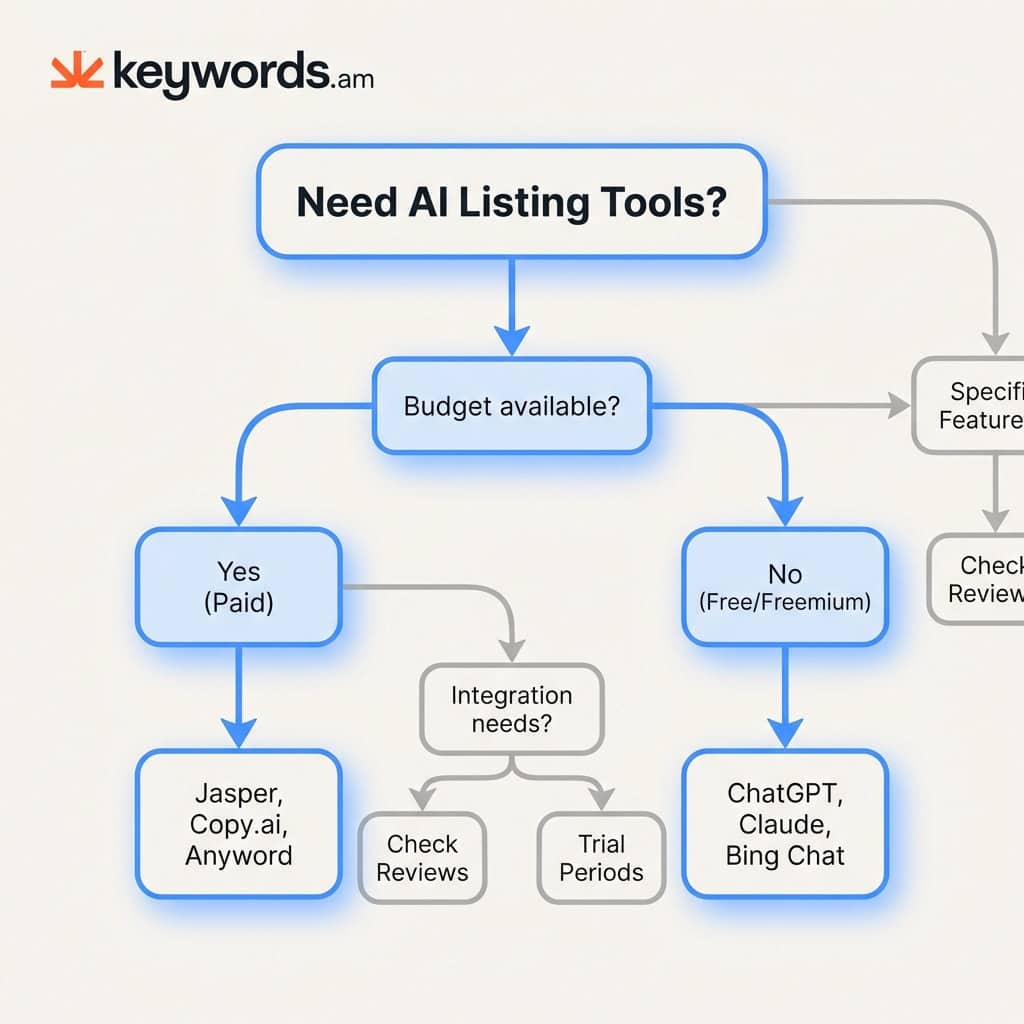 AI sweet spots include: - Standard products with straightforward benefits - High-volume listing creation where speed matters more than artistry - Backend keyword optimization where readability isn’t visible Human writers add value for: - Premium brands where voice consistency matters - Complex technical products requiring nuanced explanation - Listings where emotional connection drives purchase decisions The hybrid approach wins for most solo sellers: Use AI for the first draft, then apply human polish where it matters most, typically the first bullet point and the product description. This approach captures 80% of AI’s time savings while preserving the quality that converts. For a deeper analysis of when each approach makes sense, see the complete comparison of AI vs human Amazon listing writing.
Frequently Asked Questions About AI Amazon Listing Tools
What is the best free AI tool for Amazon listings?
Amazon’s native AI listing tool is the best free option, generating drafts from product images or descriptions directly in Seller Central without additional cost. However, it only works for new products and lacks keyword research integration.
Can Amazon detect AI-generated listings?
Amazon allows AI-generated content as long as it follows platform guidelines. The risk isn’t detection, it’s publishing copy that violates category-specific word restrictions. Sellers remain responsible for compliance regardless of how copy was generated.
How much time do AI Amazon listing tools save?
AI Amazon listing tools typically save 60-80% of manual writing time, reducing listing creation from 3+ hours to under 30 minutes for most standard products. Actual time savings depend on how much editing the AI output requires.
Are AI Amazon listing tools worth it for a solo seller?
For solo sellers managing more than 3 products, AI Amazon listing tools typically pay for themselves within one month through time savings and improved listing quality. At $30-50 monthly, even five hours saved per month delivers positive ROI.
What’s the difference between generic AI and Amazon-specific AI tools?
Amazon-specific AI tools are trained on successful listings and understand platform guidelines, while generic AI like ChatGPT produces copy that often violates character limits or category rules. The key difference is keyword awareness, Amazon-specific tools can integrate research data.
Do I need keyword research before using AI listing tools?
Keyword research dramatically improves AI output quality. Some tools like Helium 10 include research built-in. Others like Keywords.am integrate with your existing research. Amazon’s native AI works without keywords but produces less optimized output.
Conclusion
The right AI Amazon listing tool for solo sellers depends on workflow and budget, but three patterns emerged from this comparison of AI Amazon listing tools:
- Keyword-informed AI produces better output. Tools that use keyword research data generate copy requiring less editing than tools that write blind.
- Pricing under $50/mo fits solo seller economics. Enterprise suites at $99+ per month include features most one-person operations will never use.
- All AI output needs review. Even the best tools produce copy that benefits from human polish, especially for the first bullet point and product description.
The immediate action: Pick one tool and test it on a low-priority listing this week. Compare the AI output against manual writing to measure actual time savings. For solo sellers ready to see how keyword-informed AI works in practice, Keywords.am offers free ASIN audits that demonstrate how Amber AI analyzes listings and generates improvement recommendations.