Tool Roundup
Best Amazon Seller Tools for Aggregators: Enterprise Solutions for Portfolio Management (2026)
Discover the best Amazon seller tools for aggregators managing 100+ brands. Compare Pacvue, Teikametrics, Carbon6, and DataHawk enterprise features and pricing.

Thrasio, remember them? They raised $3.4 billion. They bought over 200 brands. Then they filed for bankruptcy. A fragile tooling infrastructure was a big problem. See, when aggregators try to run over 100 Amazon brands with software built for single sellers… The operational and financial models? They just collapse.
This has created demand for specialized Amazon seller tools. These tools should handle portfolio-scale operations. Still, per-brand SaaS pricing adds up fast. I mean, $200-500 per month, per brand? It multiplies across a portfolio pretty quick. That results in costs of $20,000-50,000 per month. And that’s just for basic tools!
But it’s not just about the expense. These tools often lack key features. Portfolio-wide visibility is one. API access for automation is another. And then there’s integration with internal business intelligence (BI) systems. Professional aggregators depend on these things. This guide compares enterprise platforms. They’re designed for aggregator scale. The analysis will cover API capabilities and portfolio management features. Pricing models are important too, it’s worth noting.
This guide is different. We don’t recommend standard tools like Helium 10 or Jungle Scout. The focus here is only on solutions that offer enterprise pricing. Plus they need strong API access and multi-brand portfolio capabilities.
- What Are the Best Amazon Seller Tools for Aggregators?
- Why Did Thrasio-Style Aggregators Struggle with Operations?
- What Are the Best Enterprise Amazon Tools for Aggregators in 2026?
- Enterprise Tool Reviews: Pacvue, Teikametrics, and Carbon6
- How Do DataHawk and Perpetua Compare for Analytics and Advertising?
- When Should Aggregators Build Custom Data Stacks?
- How Should Aggregators Evaluate Enterprise Tool ROI?
- Frequently Asked Questions About Amazon Aggregator Tools
- Conclusion
What Are the Best Amazon Seller Tools for Aggregators?
The best Amazon seller tools for aggregators? They absolutely must have API access. This allows for automation. Plus, portfolio-wide dashboards are key. And, enterprise pricing? That’s super important. Finally, you need integration with internal BI systems like Snowflake or BigQuery.
Managing over 100 brands, thousands of SKUs, and 10+ global marketplaces is just… different. A single seller faces very different problems.
The Thrasio case makes this point really clear. Over 200 brands, 1,600 employees - that’s a scale challenge right there.
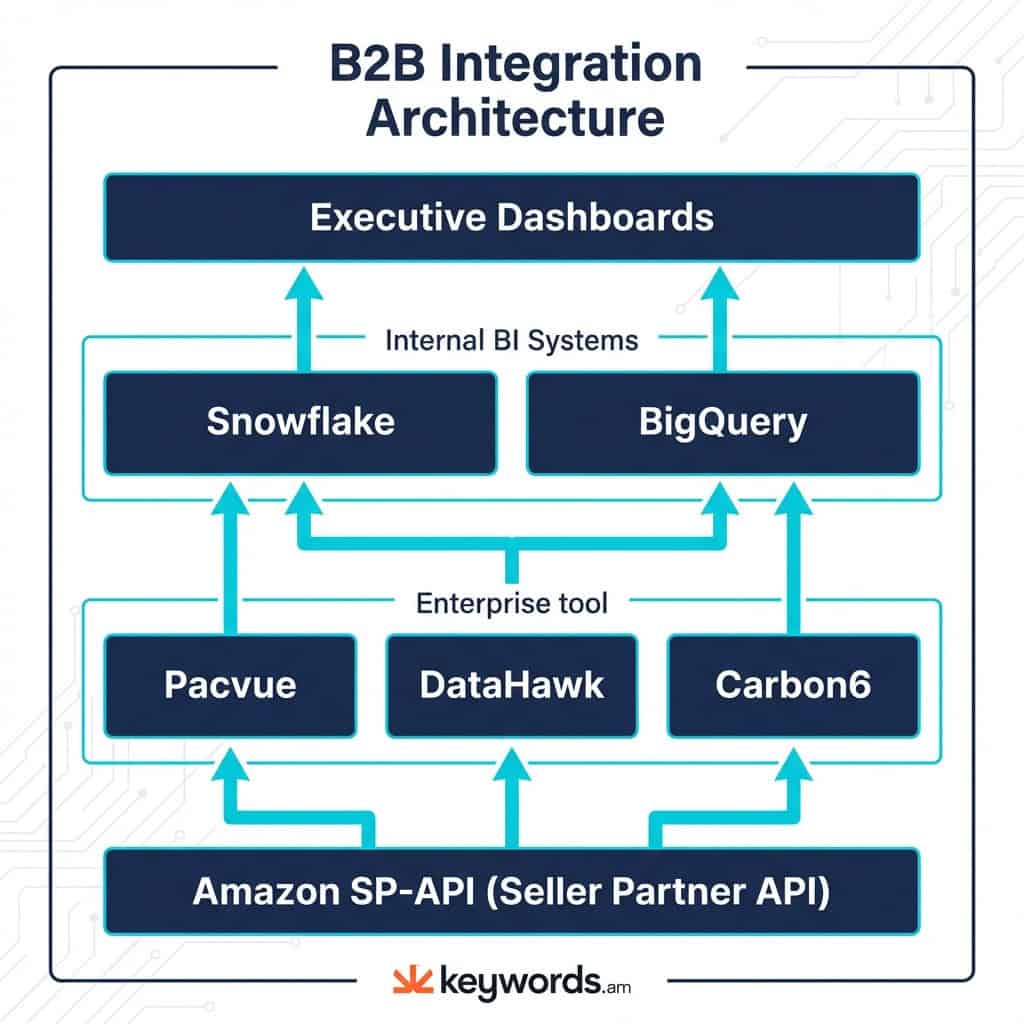
Aggregators need programmatic data access to feed custom internal systems. They have to connect tool data with platforms like Snowflake and BigQuery to build dashboards and run M&A due diligence. Standard seller tools often lack the APIs to support this.
Portfolio-wide visibility is another big differentiator. Operators need performance metrics across all brands in one place rather than logging into 100 separate accounts.
Per-brand pricing models break at scale. A tool charging $449/month becomes $44,900/month for a 100-brand aggregator. Unsustainable. Enterprise tools offer custom pricing models built for this scale.
Integration with the existing private-equity tech stack is essential for accurate reporting and unified operations. Specialized solutions like Amazon listing optimization tools can plug into this larger setup as focused components, and fulfillment decisions such as choosing seller fulfilled prime over FBA affect both operational costs and portfolio-wide ranking strategies.
Why Did Thrasio-Style Aggregators Struggle with Operations?
Thrasio bought 200+ brands and didn’t have the operational setup to handle them. Customer data extraction from Amazon is constrained, and their tooling couldn’t keep up.
The real problem was growth pace. The valuation bubble meant aggregators were paying ~7x EBITDA for brands that turned out to be hard to operate. John Hefter, a Thrasio co-founder, called some of them “Chinese vaporware garbage” at the height of the boom.
Integrating 200+ brands became an operational mess. Each had its own supply chain, marketing strategy, and data footprint, and all of it needed to be standardized. Amazon doesn’t help here: it restricts how much customer data sellers can pull, which makes the cross-selling aggregators depend on harder than it should be.
The tooling gaps made it worse. Without dedicated enterprise-grade aggregator tools, getting a unified view across all brands was nearly impossible.
The lesson is straightforward: software-and-tooling aggregators like Threecolts (raised $200M) and Carbon6 (acquired for $210M) have thrived in the same market where brand aggregators struggled. Building the infrastructure is the better business model.
What Are the Best Enterprise Amazon Tools for Aggregators in 2026?
The best enterprise Amazon seller tools in 2026 are Pacvue, Teikametrics, Carbon6, DataHawk, Perpetua, and custom data stacks. Portfolio scalability should be the #1 evaluation criterion.
These tools fall into a few categories: advertising automation, advanced analytics, unified operational platforms, and custom builds.
Three things separate a true enterprise tool from a “premium” version: full API access, custom pricing built for a large portfolio, and dedicated support and onboarding. The support tier is worth paying for at scale.
When picking a tool, evaluate the depth of the API, the sophistication of portfolio management features, pricing flexibility, and integration with your existing tech stack. This framework ensures the tools you pick won’t buckle under the pressure of managing many brands.
Enterprise Tool Reviews: Pacvue, Teikametrics, and Carbon6
Pacvue, Teikametrics, and Carbon6 all bring something unique. Pacvue: $2,000-$20,000/month, retail-media-first. Teikametrics: AI starting at $149/month. Carbon6: 18 tools rolled into one.
Pacvue targets brands and aggregators that spend $50,000+ monthly on ads. Its features focus on advertising management: granular campaign automation, DSP management, daypart bidding, and deep integration with the Amazon Marketing Cloud. As an Advanced Amazon API Partner, it provides API access and offers Data-as-a-Service (DaaS) feeds directly to BI systems like Snowflake and BigQuery. It’s strong for advertising across many marketplaces (Amazon, Walmart, Instacart).
The barriers: high minimum spend, platform complexity, and a 2-3 month onboarding window with dedicated internal resources. Built for large, mature organizations.
Teikametrics centers on AI-powered optimization with its ARI generative AI engine. It automates bidding, budgeting, and inventory forecasting, and includes listing optimization. Pricing starts at $149/month for the AI tier, with custom pricing for enterprise clients. Attractive for mid-market aggregators that want AI benefits without an enterprise platform’s complexity. The downside is no native API, which limits integration with custom internal systems; it uses standard connections to the Amazon and Walmart APIs.
Carbon6 is a unified operational ecosystem. Carbon6 acquired 18 different tools (including SellerLegend and D8aDriven) and offers them through a single dashboard for reimbursements, inventory, advertising, and analytics. Enterprise clients get API access. SPS Commerce acquired Carbon6 for $210 million in January 2025, and the platform is positioned as a single-vendor solution for many operational needs.
The Carbon6 trade-off is integration consistency between the acquired tools. Some feel native to the suite; others still feel like separate products bolted together.
| Platform | Starting Price | API Access | Marketplaces | Best For |
|---|---|---|---|---|
| Pacvue | $2,000/mo | Yes (DaaS) | 100+ | Enterprise PPC |
| Teikametrics | $149/mo | No | Amazon, Walmart, TikTok | AI automation |
| Carbon6 | $200/mo | Enterprise only | Amazon, Walmart | Unified operations |
How Do DataHawk and Perpetua Compare for Analytics and Advertising?
DataHawk focuses on enterprise analytics with API access, Snowflake pipelines, and white-label reporting. Built for agencies handling 10+ brands. Perpetua focuses on goal-based advertising automation, starting at $695/month with DSP and Sponsored Ads management.
DataHawk supports Amazon, Walmart, and Shopify as an enterprise-grade marketplace analytics platform built for multi-account operations. Executive dashboards, anomaly detection, and AI-driven guidance are all included.
Its biggest strength is the composable API infrastructure: managed data pipelines and native connectors for Snowflake, BigQuery, Looker Studio, and Power BI. It functions as a data layer for aggregators feeding marketplace analytics into central BI systems.
DataHawk reports a 130% average revenue lift within six months and a 31% RoAS increase in 12 months. Acquired by Worldeye Technologies in March 2025, it’s now a top choice for portfolio analytics and BI integration.
Perpetua focuses on AI-powered advertising optimization and intelligence. The platform automates bidding and campaign creation for sponsored ads, manages the demand-side platform (DSP), integrates with the Amazon Marketing Cloud (AMC), and includes creative optimization tools.
Pricing starts at $695/month for up to $10,000 in ad spend, then shifts to a percentage-of-spend model for larger accounts. Custom pricing kicks in for spend over $500,000. Like Teikametrics, Perpetua relies on marketplace API connections rather than a native API, which can limit use in highly customized tech stacks. Best for aggregators focused on full-funnel advertising strategy. See Amazon AI tools for sellers for context on how AI is changing the space.
| Platform | Specialty | API | Data Export | Starting Price |
|---|---|---|---|---|
| DataHawk | Analytics | Yes | Snowflake, BigQuery | $200+/mo |
| Perpetua | Advertising | Via marketplace | AMC integration | $695/mo |
When Should Aggregators Build Custom Data Stacks?
Aggregators should consider custom data setups when handling 50+ brands with unique BI needs, or when competitive advantage depends on proprietary analytics. The “build vs. buy” question surfaces when an aggregator’s operations get large and complex enough that off-the-shelf tools can’t keep up.
A modern custom setup typically has the Amazon Selling Partner API (SP-API) at its core as the data source, a cloud data warehouse like Snowflake or BigQuery, a transformation tool like dbt, and a visualization layer like Looker or Tableau. This gives the most flexibility but requires serious engineering firepower to build and maintain.
The economics of custom builds are changing. Amazon will start charging subscription fees for SP-API developers in January 2026, which will affect total cost of custom solutions.
Even with a custom stack, specific tools often act as key data layers. An aggregator might use the Keywords.am API to feed Amazon backend keywords intelligence and listing analytics into their systems.
A custom stack typically costs $5,000-$15,000/month for infrastructure and engineering, which is competitive with enterprise platform costs of $10,000-$30,000/month.
How Should Aggregators Evaluate Enterprise Tool ROI?
Evaluate ROI on aggregator tools by calculating time saved across all operations × analyst cost per hour, plus any revenue lift from optimization, then subtract total platform cost (implementation and training included).
The biggest return comes from time savings, and you can put a number on it. The formula: (hours saved per brand per month) × (number of brands) × (analyst hourly rate). A platform that saves 10 hours per brand across a 100-brand portfolio at $75/hour analyst cost is worth $75,000/month in time alone.
Second, revenue lift. Vendors often share metrics: DataHawk says their clients see a 130% average revenue lift. Treat these numbers carefully but use them for modeling.
Don’t forget hidden costs. Enterprise platforms like Pacvue can take 2-3 months to implement, plus training and dedicated internal resources. Run a break-even analysis: how long until the investment pays for itself versus your current setup?
A working understanding of resources like the Brand Analytics guide helps too.
| Cost Factor | Individual Tools (100 brands) | Enterprise Platform |
|---|---|---|
| Monthly subscription | $20,000-50,000 | $5,000-20,000 |
| Implementation time | Minimal | 2-3 months |
| Analyst hours saved | Baseline | 10-20 hrs/brand/month |
| Data integration | Manual export | API/automated |
| Portfolio visibility | None | Full |
Frequently Asked Questions About Amazon Aggregator Tools
What is the best Amazon tool for managing 100+ brands?
It depends on what you’re optimizing for. For aggregators with 100+ brands, Pacvue offers the deepest enterprise-level features and the broadest marketplace coverage. Carbon6 is the better value if you care more about unified operations than advertising depth.
Advertising-heavy firms gravitate to Pacvue. Operationally-focused ones prefer Carbon6’s breadth across reimbursements, inventory, and analytics.
Do Amazon aggregators need API access to seller tools?
Yes. API access is essential for feeding data into internal BI systems like Snowflake and automating reporting across 100+ brands. It’s also key for M&A due diligence.
Without API access, aggregators are stuck doing manual data exports. That’s inefficient, error-prone, and prevents the real-time visibility needed for portfolio decisions.
How much should aggregators budget for Amazon seller tools?
Enterprise aggregators typically budget $10,000-$30,000/mo for core tools. That can rise to $20,000-$50,000+ when running individual seller subscriptions across a 100+ brand portfolio.
Don’t forget implementation costs (2-3 months of integration) plus ongoing support and training.
Can Keywords.am work for Amazon aggregators?
Yes. Keywords.am is a specialized listing intelligence layer that plugs into aggregator stacks via API. It handles keyword research, listing optimization, and the TFSD Framework at scale.
It doesn’t replace platforms like Pacvue. It complements them with deep listing optimization capability that broader platforms typically lack.
What happened to Thrasio and what does it mean for aggregator tooling?
Thrasio filed for Chapter 11 after acquiring 200+ brands. Operational scaling challenges, including tooling gaps, were a contributing factor. A cautionary tale about underinvesting in infrastructure.
The success of software aggregators like Threecolts (raised $200M) and Carbon6 (acquired for $210M) suggests that building the tooling infrastructure is a solid business even when the brand roll-up strategy itself runs into trouble.
Which enterprise Amazon tool has the best API?
DataHawk has the most composable API infrastructure, with managed Snowflake and BigQuery pipelines. Pacvue’s Data-as-a-Service (DaaS) offering is also strong for enterprise analytics.
Teikametrics and Perpetua mostly rely on marketplace API connections rather than exposing native APIs, which limits custom integrations.
Conclusion
The days of using single-seller tools to manage huge Amazon portfolios are over. Modern aggregator tools have evolved to deal with enterprise needs. The financial and operational models break down when you get really big.
Enterprise pricing can save an aggregator $20,000-$30,000/month on a 100-brand portfolio. API access is a must for integrating with the BI systems that run a modern business. Thrasio’s story shows that investing in operations is as important as buying up brands. The aggregators doing best are building tech stacks that combine a core enterprise platform with specialized tools and custom BI for competitive edge.
To get started: audit how much you’re spending on tools right now and figure out the real per-brand cost across the portfolio. Then request enterprise pricing from Pacvue, Teikametrics, and Carbon6 and compare directly. Evaluate internal API needs against each platform’s features.
For better listing intelligence at aggregator scale, explore Keywords.am’s multi-brand workspace to see how the TFSD framework applies across an entire portfolio.