
📑 Table of Contents
- What Changed with Amazon’s A10 Algorithm for SEO Tools?
- What Are the Four Types of Amazon SEO Tools?
- Quick Comparison: All 12 Amazon SEO Tools at a Glance
- How Does Each Amazon SEO Tool Perform? (12 Individual Reviews)
- How Do You Build the Right Amazon SEO Tool Stack?
- Frequently Asked Questions About Amazon SEO Tools
- Conclusion
Eighty percent of Amazon sellers now use AI-powered tools for optimization, according to Jungle Scout’s 2025 State of the Amazon Seller report, yet 40% of enterprise brands still report profitability concerns. The gap isn’t access to tools. It is choosing the right ones. With 9.7 million Amazon sellers competing globally and dozens of SEO platforms flooding the market, picking the wrong technology stack costs more than just monthly subscription fees; it costs months of wasted ranking momentum.
Most sellers fall into the trap of overpaying for features they never use. An individual seller might spend $200 per month on a full-suite platform but only utilize the keyword research module, leaving 25 other tools untouched. Conversely, a scaling brand might rely on a basic free tool that misses critical data on external traffic or conversion rates, effectively flying blind against competitors with deeper insights.
This guide categorizes 12 Amazon SEO tools by function, compares actual pricing tier-by-tier, and demonstrates how to build a stack matched to a specific seller stage. Unlike listicles that simply rate tools based on feature counts, this comparison accounts for the A10 algorithm shift, where organic conversion and seller authority now outweigh keyword stuffing and ad spend. By understanding these distinctions, sellers can stop paying for tool sprawl and start investing in the capabilities that drive rank.
What Changed with Amazon’s A10 Algorithm for SEO Tools?
Amazon’s A10 algorithm now prioritizes organic sales velocity, seller authority, and external traffic over paid ad performance, making listing optimization and conversion-focused tools more valuable than keyword-stuffing approaches.
The shift from the A9 to the A10 algorithm fundamentally altered how Amazon ranks products. Under the previous A9 system, advertising sales and keyword density were the primary drivers of visibility. A seller could effectively buy their way to the top of search results through aggressive PPC campaigns and basic keyword inclusion. In contrast, A10 has rebalanced the equation to focus heavily on customer satisfaction metrics and organic interest.
External traffic now contributes 15-20% of ranking weight, a significant increase from its near-zero impact under A9. Amazon rewards sellers who bring customers from outside the platform (social media, blogs, or email lists) because it expands their customer base. This traffic is weighted more heavily than internal PPC traffic because it demonstrates genuine demand rather than just ad spend. Tools that help track or facilitate external traffic have become essential components of a modern SEO stack.
Conversion rate thresholds have also tightened. Products converting above 15% typically secure positions in the top 10 search results, while those falling below 8% struggle to maintain page one visibility regardless of keyword optimization. If a listing converts at a low rate, no amount of keyword research will sustain its ranking. The algorithm interprets low conversion as a sign of poor relevance or quality, demoting the product to protect the shopper experience.
This reality dictates a new approach to tool selection. Pure keyword research tools are no longer sufficient on their own. Sellers must prioritize listing optimization and conversion-focused tools that directly impact the metrics A10 values most: sales velocity, review quality, and click-through rates. The days of “set it and forget it” keyword stuffing are over; the new era requires continuous optimization of the entire customer journey.
What Are the Four Types of Amazon SEO Tools?
Amazon SEO tools fall into four categories: keyword research, listing optimization, rank tracking, and competitor analysis. Each addresses a different stage of the optimization workflow.
Understanding the specific function of each tool prevents redundancy in a software stack. Many sellers unknowingly pay for three different tools that all perform keyword research while lacking a single tool for effective listing optimization. Breaking the landscape down into four distinct categories clarifies where budget should be allocated and where gaps exist.
Keyword Research Tools identify what shoppers are actually searching for. These platforms aggregate search volume data, relevance scores, and competitive density to help sellers select the right terms. Tools like Helium 10 Cerebro and Jungle Scout are staples in this category, providing the raw data foundation for any SEO strategy. For a deeper dive into this category, review the guide on keyword research tools.
Listing Optimization Tools bridge the gap between data and the final published product. They turn raw keyword lists into ranking-ready titles, bullet points, and descriptions. Platforms like Keywords.am and ZonGuru specialize in this area, offering features that score listing quality and ensure all critical keywords are indexed. This category has grown in importance as A10 places higher value on conversion-optimized content. More details can be found in the analysis of listing optimization tools.
Rank Tracking Tools monitor the position of products for specific keywords over time. While research tools predict potential, tracking tools measure actual performance. Knowing whether a product moved from position 15 to position 5 after an optimization update is crucial for validating strategy. Dedicated trackers offer more granularity and frequency than generalist all-in-one suites.
Competitor Analysis & Advertising Tools provide intelligence on rival strategies and manage paid visibility. This broad category includes reverse ASIN lookups to steal competitor keywords and ad management platforms to optimize spend. Tools like SellerApp and Perpetua fit here, helping sellers understand the market landscape and adjust their tactics to outmaneuver opponents.
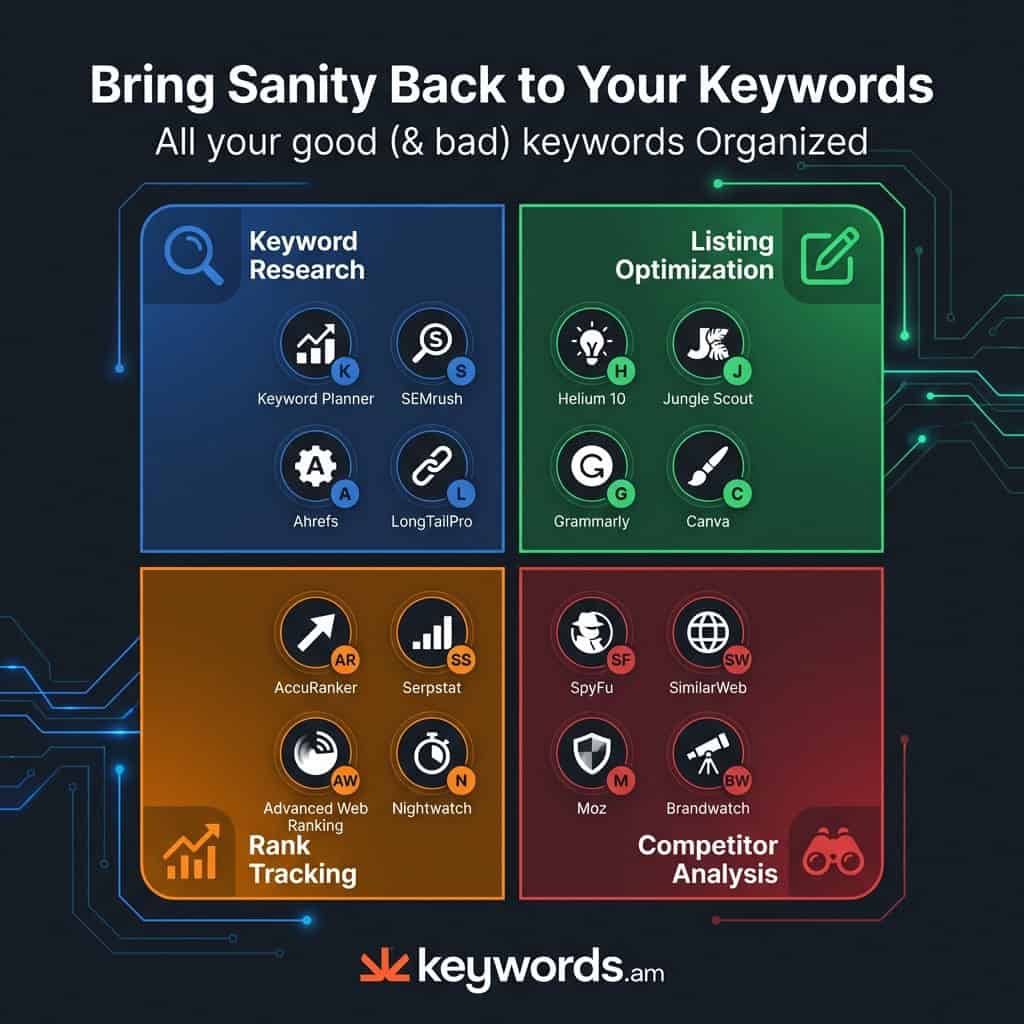
Tool Category Breakdown
Category |
What It Does |
Key Tools |
Price Range |
|---|---|---|---|
Keyword Research |
Find shopper search terms, volume, relevance |
Helium 10, Jungle Scout, Viral Launch, MerchantWords |
$29-$199/mo |
Listing Optimization |
Turn keywords into optimized titles, bullets, backend terms |
Keywords.am, ZonGuru |
$30-$249/mo |
Rank Tracking |
Monitor keyword position changes over time |
Helium 10, DataHawk |
$39-Custom |
Competitor Analysis & Ads |
Reverse ASIN, share of voice, ad optimization |
SellerApp, AMZScout, Perpetua, Pacvue |
$44-$695+/mo |
The next section examines each tool in detail, starting with the full-suite platforms and working down to the specialists.
Quick Comparison: All 12 Amazon SEO Tools at a Glance
This comparison table covers all 12 tools with their primary category, starting price, best-for use case, and standout feature to help sellers quickly narrow their shortlist.
For sellers who need immediate answers, this table summarizes the key differentiators of every tool reviewed in this guide. It highlights the primary category and starting price to help match options to budget and operational needs.
Master Comparison Table
Tool |
Category |
Starting Price |
Best For |
Standout Feature |
|---|---|---|---|---|
Helium 10 |
Full Suite |
$29/mo (annual) |
All-in-one sellers |
30+ integrated tools |
Jungle Scout |
Research + Listing |
$29/mo (annual) |
Product research |
Opportunity Finder |
Keywords.am |
Listing Optimization |
$49/mo |
Listing optimization |
TFSD Framework + Publish to SC |
Viral Launch |
Keyword Research |
$69/mo |
Keyword specialists |
Hourly rank tracking |
SellerApp |
All-in-One (Budget) |
Free/$49/mo |
Budget-conscious sellers |
Free tier available |
AMZScout |
Research + International |
$44.99/mo |
International sellers |
Lifetime purchase option |
ZonGuru |
Listing Optimization |
$39/mo |
Listing quality |
Listing quality score |
MerchantWords |
Keyword Database |
$35/mo |
Raw keyword data |
Largest keyword database |
Keyword Tool Dominator |
Basic Keywords |
<$70 one-time |
One-time budget buy |
Lifetime license |
DataHawk |
Enterprise Analytics |
Custom |
Enterprise teams |
Custom dashboards |
Perpetua |
Advertising + SEO |
$695/mo |
Ad-heavy sellers |
AI bid optimization |
Pacvue |
Enterprise Advertising |
Mid-hundreds/mo |
Enterprise brands |
Multi-marketplace ads |
How Does Each Amazon SEO Tool Perform? (12 Individual Reviews)
Each tool review below covers core features, real pricing by tier, honest limitations, and the specific seller profile that benefits most, with no promotional fluff or affiliate-driven rankings.
The following reviews provide a deep dive into the capabilities and constraints of each platform. Pricing and features are current as of early 2026, reflecting the latest updates in the Amazon seller software ecosystem.
1. Helium 10: Best Full-Suite Platform
Helium 10 has established itself as the heavyweight champion of Amazon seller tools, offering a massive suite of over 30 distinct applications. It covers nearly every aspect of the selling journey, from product research with Black Box to keyword research with Cerebro and Magnet. Its ecosystem is designed to keep sellers within a single dashboard for all their operations.
For SEO specifically, Cerebro is the industry standard for reverse ASIN lookups, allowing sellers to see exactly which keywords competitors are ranking for. Magnet complements this by generating related keywords based on a seed term. The suite also includes Scribbles for listing optimization and Frankenstein for keyword processing, though these are often considered utilitarian compared to newer, AI-driven specialists. The platform also extends into operations with Inventory Protector and Alerts, making it a comprehensive operating system for many businesses.
Pricing:
* Starter: $29/mo (billed annually). Limited access to tools.
* Platinum: $99/mo. The standard plan for most active sellers.
* Diamond: $279/mo. Adds multi-user logins and advanced PPC features.
* Free Plan: Available but highly restricted, suitable only for very basic testing.
Best For:
Sellers who want everything in one place and are willing to pay a premium for integration. It is ideal for those who will actually utilize at least 5-10 of the tools in the suite.
Limitations:
The sheer size of Helium 10 can be its downfall. New sellers often find the interface overwhelming, and paying $99 or $279 a month is inefficient if only using one or two features. While the research tools are top-tier, the listing optimization tools like Scribbles have not evolved as quickly as dedicated competitors, lacking deep semantic analysis or direct publishing capabilities. For a direct comparison, see the analysis of Keywords.am vs Helium 10.
2. Jungle Scout: Best for Product Research + Keyword Discovery
Jungle Scout is often the first tool new sellers encounter. Originally built as a product research tool to validate sales data, it has expanded into a comprehensive all-in-one platform. Its strength remains in its data accuracy for sales estimates and product viability, which is critical for the initial “what to sell” phase.
On the SEO front, Jungle Scout offers Keyword Scout, a powerful research tool that provides search volume trends and PPC bid estimates. The Listing Builder feature helps incorporate these keywords into listing copy. Jungle Scout’s interface is generally considered more user-friendly and modern than Helium 10’s, making it a favorite among beginners and those who prioritize ease of use. The Opportunity Finder is particularly unique, helping sellers discover high-demand, low-competition niches that might be missed with standard keyword research.
Pricing:
* Basic: $29/mo (billed annually).
* Growth/Professional: ~$49-69/mo.
* Brand Owner: ~$125/mo.
* Enterprise (Cobalt): $500-700/mo range for large brands.
Best For:
Sellers who are in the product launch phase and need strong validation data alongside their keyword research. It serves well as a primary tool for finding and launching products.
Limitations:
While Listing Builder is functional, it lacks the depth of dedicated optimization platforms. It does not offer direct publishing to Seller Central for all fields, and its focus on backend search term optimization is less granular. Sellers looking for advanced linguistic analysis or semantic optimization might find it basic.
3. Keywords.am: Best for Listing Optimization Workflow
Keywords.am positions itself as a specialist rather than a generalist. It is a purpose-built listing optimization platform designed to bridge the gap between keyword research and a live, ranking listing. The core of the platform is the TFSD framework (Title, Features, Search Terms, Description), which ensures that every indexable part of a listing is fully utilized.
Unlike general suites, Keywords.am focuses entirely on the writing and publishing workflow. It features Amber AI to assist with content generation and a “Swiss Army Knife” tool that automatically fills backend search terms to maximize character limits without redundancy. A standout feature is the direct integration with Seller Central, allowing users to push updates immediately without copy-pasting into Amazon’s backend. The platform also provides a “Knowledge” system that remembers brand facts, ensuring tone and factual consistency across all listings.
Pricing:
* Starter: $49/mo.
* Growth: $129/mo.
* Scale: $299/mo (includes white-label reporting).
* No free tier, but pricing is highly competitive for the feature set.
Best For:
Sellers and agencies who already have a research process (or tool) and need a superior workflow for creating, optimizing, and publishing high-converting listings. The Agency plan is particularly strong for agencies requiring white-label reports.
Limitations:
It is not a full suite. It does not perform product research, inventory management, or PPC automation. It is designed to be paired with a research tool like Helium 10 or Jungle Scout. See more on the features page.
4. Viral Launch: Best for Keyword Research Depth
Viral Launch began as a launch service but evolved into a data-heavy software suite. It is best known for its “Market Intelligence” tool, which provides deep insights into market trends and historical data reliability. For SEO, its Keyword Research tool is powerful, offering relevance scores and opportunity scores that help sellers prioritize terms.
A unique feature is its focus on hourly rank tracking in its higher tiers, which is significantly faster than the daily updates provided by most competitors. This allows for near real-time monitoring of how listing changes impact visibility. The “Listing Dojo” feature allows for split testing, though it is less of a pure optimization editor than others on this list.
Pricing:
* Essentials: $69/mo.
* Pro: $99/mo.
* Pro Plus Ads: $199/mo.
* 14-day free trial available.
Best For:
Data junkies and sellers who need granular, high-frequency rank tracking data. It appeals to those who want to see the immediate impact of their SEO changes.
Limitations:
The entry price point is higher than competitors like Jungle Scout or Helium 10’s starter plans. It lacks the direct publishing features of Keywords.am and the massive ecosystem of Helium 10. The interface can also feel more complex for beginners.
5. SellerApp: Best Budget All-in-One
SellerApp is a comprehensive platform that offers a solid balance of features for a lower price point. Based in India, it provides keyword research, listing optimization, and PPC automation. It is often cited as a great value option because it includes a functional free tier and affordable paid plans.
The platform includes a Chrome extension for on-page analysis and a dashboard that unifies organic and paid data. Its PPC tools are surprisingly capable for the price, offering rule-based automation that is usually reserved for much more expensive software. For SEO, the keyword research tool provides adequate volume and competition data for most sellers.
Pricing:
* Free Tier: Available with limited data.
* Pro Lite: ~$39-49/mo.
* Professional: ~$50-100/mo depending on ad spend.
Best For:
Budget-conscious sellers and beginners who need a “good enough” all-in-one solution without the high monthly costs of the market leaders.
Limitations:
The data accuracy is sometimes rated slightly lower than the top-tier giants. Customer support can be variable due to time zone differences. The user interface is functional but lacks the polish of Jungle Scout or Helium 10.
6. AMZScout: Best for International Sellers
AMZScout is a favorite among sellers operating in non-US marketplaces. While most tools focus heavily on Amazon.com, AMZScout has built a reputation for providing reliable data across a wide range of international Amazon territories. It offers a strong product research extension and a keyword tool that supports these various markets.
A major selling point is its pricing model, which often includes lifetime access options for a one-time fee. This is a rarity in the SaaS world and offers immense value for long-term sellers. The toolset covers product discovery, keyword research, and simple competitor tracking.
Pricing:
* Monthly: $44.99/mo.
* Quarterly: ~$169.99.
* Lifetime: ~$1,599.99 (check for current offers).
Best For:
International sellers and those who prefer a one-time capital expense over a recurring monthly subscription.
Limitations:
The keyword database is generally smaller than Helium 10 or Jungle Scout, especially for long-tail US terms. Data updates can be less frequent. Listing optimization features are minimal compared to specialists.
7. ZonGuru: Best Alternative Listing Optimizer
ZonGuru is another strong contender in the listing optimization space. Its “Listing Quality Score” (LQS) is a well-regarded metric that helps sellers understand how well their listing adheres to Amazon’s best practices. The tool also includes keyword research and business metrics features.
One of ZonGuru’s unique collaborations is with Alibaba, allowing for smoother sourcing workflows. On the SEO side, the “Keywords on Fire” tool provides a visual representation of keyword strength and competitor usage. The listing editor is drag-and-drop and intuitive.
Pricing:
* Researcher: $39/mo.
* Seller: $49/mo.
* Enterprise: Scales up to $249/mo based on SKU count.
Best For:
Sellers who want a dedicated listing tool with a specific focus on quality scoring and visual data presentation.
Limitations:
Pricing scales with SKU count, which can become expensive for sellers with large catalogs. It has fewer integrations than the major suites and a smaller user community. It does not cover as many marketplaces as Keywords.am.
8. MerchantWords: Best Raw Keyword Database
MerchantWords is one of the “OG” tools in the Amazon space. It is primarily a massive database of search terms collected over many years. Unlike other tools that estimate volume based on rank, MerchantWords claims to use proprietary algorithms on actual search data to provide volume estimates.
It excels at providing sheer volume of keyword ideas. If you are stuck and need to find every possible variation of a search term, MerchantWords will likely have it. It also offers “Digital Shelf” analytics to see share of voice.
Pricing:
* Silver: $35/mo.
* Gold: $79/mo.
* Platinum: $149/mo.
Best For:
Sellers and agencies who need massive lists of raw keyword data to export and analyze in Excel or other systems.
Limitations:
It is almost purely a data provider. It lacks a listing optimization workflow, AI writing assistance, or direct publishing. You get the data, but you have to do the work elsewhere.
9. Keyword Tool Dominator: Best Free/Budget Option
Keyword Tool Dominator is a straightforward, no-frills tool that scrapes Amazon’s autocomplete suggestions. This is valuable because autocomplete represents high-intent searches: terms that Amazon is suggesting because other customers are typing them.
It does not provide sophisticated search volume estimates or competitive data, but it is excellent for finding long-tail keywords that other tools might miss. The pricing model is a simple lifetime license for a very low cost.
Pricing:
* One-time: Under $70 for a lifetime license.
Best For:
Bootstrapped beginners who need to find keywords but cannot afford a monthly subscription.
Limitations:
No search volume data (uses a relative 1-10 popularity score). No listing optimization, rank tracking, or competitor analysis. It is purely a keyword discovery tool.
10. DataHawk: Best for Enterprise Analytics
DataHawk is a powerful analytics platform designed for larger teams and brands. It goes beyond simple SEO tools to offer comprehensive monitoring of digital shelf performance, content compliance, and financial metrics.
Its strength lies in its customizability. Enterprise teams can build dashboards that track specific KPIs across hundreds of ASINs. It offers excellent connectivity with other business intelligence tools.
Pricing:
* Custom: Pricing is not public and requires a demo. Based on ASIN count and credits.
Best For:
Large brands and agencies that need to report on SEO performance at a granular level to stakeholders.
Limitations:
Overkill for the average seller. The sales process is longer, and the tool has a steeper learning curve. It is not designed for the “solopreneur.”
11. Perpetua: Best for Advertising-Focused SEO
Perpetua is primarily an advertising optimization platform, but in the A10 era, advertising and SEO are inextricably linked. Perpetua uses AI to manage bids and budgets, which drives sales velocity, a key organic ranking factor.
While not a traditional SEO tool, its ability to drive traffic and sales has a direct positive impact on organic rank. It offers some organic tracking features to show the “halo effect” of ad spend.
Pricing:
* Starter: $695/mo (typically).
* Plus: Percentage of ad spend.
Best For:
Sellers with significant ad budgets (usually $5k+/mo) who want to automate their PPC to boost total sales and organic rank.
Limitations:
The price tag is prohibitive for most. It is not a tool for keyword research or listing writing; it is a tool for traffic generation.
12. Pacvue: Best for Enterprise Advertising at Scale
Pacvue is an enterprise-grade commerce acceleration platform. Like Perpetua, it focuses on advertising but adds layers for retail operations and sales analytics. It supports multiple marketplaces beyond Amazon, including Walmart and Instacart.
For SEO, Pacvue provides deep insights into “Share of Voice,” helping brands understand their organic vs. paid visibility compared to competitors.
Pricing:
* Enterprise: Mid-hundreds per month plus a percentage of ad spend (~3%). Contracts are often annual and substantial.
Best For:
Multinational brands and large agencies managing complex, multi-channel retail media strategies.
Limitations:
Completely out of reach and unnecessary for small to mid-sized sellers. It requires a sophisticated team to operate effectively.
How Do You Build the Right Amazon SEO Tool Stack?
Build your Amazon SEO stack by matching tools to your seller stage: beginners need research plus listing optimization, scaling sellers add rank tracking, enterprises add advertising.
The most effective sellers do not buy every tool; they buy the right tools for their current growth phase. A stack approach prevents feature overlap and ensures every dollar spent contributes to ROI.
Beginner Stack ($60-80/mo)
For a seller launching their first 1-5 products, the priority is accurate data and a quality listing.
* Tools: Jungle Scout (or Helium 10 Starter) + Keywords.am Starter.
* Why: You need Jungle Scout for product validation and keyword discovery. You need Keywords.am to take those keywords and build a listing that converts, ensuring you don’t waste your launch traffic. This covers the entire research-to-publish workflow affordably. Learn more about the keyword research methodology that supports this stack.
Scaling Stack ($100-160/mo)
For sellers with 5-20 products focusing on growth and optimization.
* Tools: Helium 10 Platinum + Keywords.am Growth.
* Why: Helium 10 Platinum adds rank tracking and broader operations tools. Keywords.am Growth allows for more active optimization and team access. This combination gives full visibility into performance while maintaining a high velocity of listing updates.
Agency Stack ($200-400/mo)
For teams managing client accounts.
* Tools: Helium 10 Diamond + Keywords.am Scale + DataHawk (optional).
* Why: Helium 10 Diamond allows for multi-user access. Keywords.am Scale provides white-label reporting, which is critical for showing value to clients. DataHawk can be added if custom client dashboards are required.
Enterprise Stack ($700+/mo)
For brands with massive catalogs and ad budgets.
* Tools: Full Suite (Helium 10/Jungle Scout) + Perpetua (Ads) + DataHawk (Analytics).
* Why: At this level, ad optimization via Perpetua or Pacvue drives the velocity needed for SEO. DataHawk provides the executive-level reporting. The cost is negligible compared to the ad spend being managed.
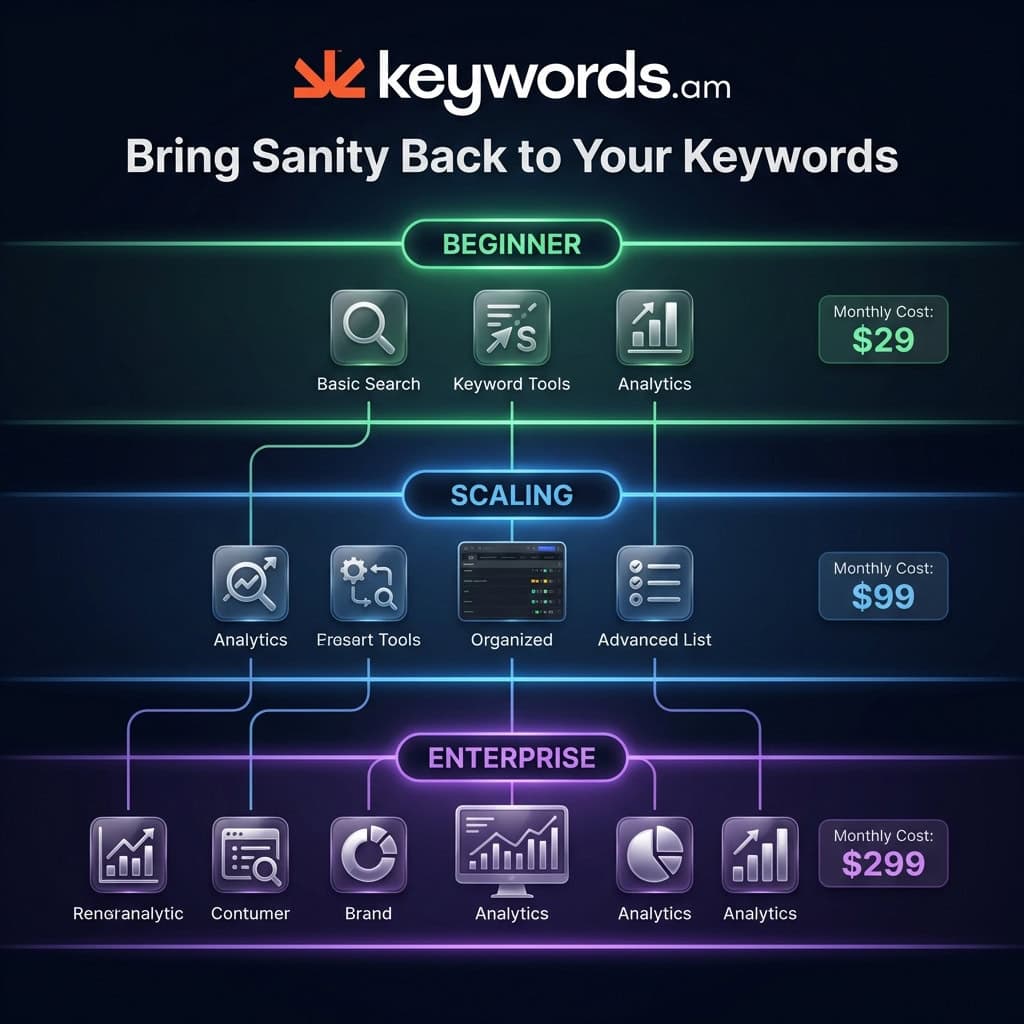
Decision Matrix: Which Tool Do You Need?
If You Need… |
Choose |
Monthly Cost |
Why |
|---|---|---|---|
Everything in one place |
Helium 10 Platinum |
$99/mo |
30+ tools, established ecosystem |
Product + keyword research |
Jungle Scout |
$29-49/mo |
Best product validation |
Listing optimization focus |
Keywords.am |
$30-60/mo |
TFSD workflow, SC publish |
Maximum keyword data |
MerchantWords or Viral Launch |
$35-69/mo |
Deep databases |
Budget-friendly start |
SellerApp Free + Keyword Tool Dominator |
<$70 total |
Free tier + one-time purchase |
Enterprise advertising |
Perpetua or Pacvue |
$695+/mo |
AI bid optimization |
Frequently Asked Questions About Amazon SEO Tools
These frequently asked questions cover tool pricing, stack building, international support, the TFSD framework, and whether SEO tools can guarantee rankings.
Q1: What is the best free Amazon SEO tool?
SellerApp offers the most useful free tier with limited keyword research and listing analysis, while Amazon’s own Brand Analytics provides free search frequency data for brand-registered sellers.
While “free” often comes with significant limitations in the SaaS world, SellerApp provides enough functionality for a new seller to get a basic grasp of their market. Amazon’s native tools have improved drastically. The Search Query Performance Dashboard and Product Opportunity Explorer are completely free and offer data directly from Amazon, though they lack the workflow features of third-party software. Keyword Tool Dominator is another strong mention here; while not free, its low one-time cost makes it accessible.
Q2: Do I need more than one Amazon SEO tool?
Most successful sellers use two to three complementary tools: one for keyword research, one for listing optimization, and optionally one for rank tracking or competitor analysis.
It is rare to find a single tool that is best-in-class at everything. A “jack of all trades” suite often has a weak link, usually in the listing optimization or specialized analytics features. The most efficient setup is often a strong research tool (like Jungle Scout) paired with a specialized execution tool (like Keywords.am). The goal is to avoid paying for overlapping features; do not buy two different keyword research subscriptions.
Q3: How is Amazon SEO different from Google SEO?
Amazon SEO focuses on purchase intent and conversion rate within a closed marketplace, while Google SEO targets informational queries across the open web with backlinks and domain authority as key factors.
The fundamental difference is intent. Google users are often looking for answers (“how to clean running shoes”), while Amazon users are looking to buy (“white running shoes size 10”). Amazon’s A10 algorithm cares far less about backlinks, domain age, or page speed. Instead, it prioritizes metrics that indicate a likelihood to purchase: click-through rate, conversion rate, price competitiveness, and inventory history.
Q4: What Amazon SEO tool is best for beginners?
Beginners should start with Jungle Scout ($29/month annual) for product and keyword research paired with Keywords.am ($49/month) for listing optimization, covering the full workflow under $60 per month.
This combination is powerful because it addresses the two biggest hurdles for beginners: finding a viable product and creating a professional listing. SellerApp is a valid alternative for those with zero budget, but the data limitations may slow down progress. The priority for any beginner should be mastering one research tool and one optimization tool before adding complex analytics or ad software.
Q5: How much should I budget for Amazon SEO tools?
Individual sellers typically spend $60 to $160 per month on two to three complementary tools, while agencies and enterprises may invest $300 to $700 or more for full-stack coverage.
Budgeting should be viewed as an investment in data accuracy. Spending $100 a month to ensure you aren’t launching a product in a dead category is money well spent. Start with a minimal viable stack (research and optimization) and only add rank tracking or advanced competitor analysis when you have active sales to monitor. The most common waste is subscribing to an Enterprise-level plan before having an Enterprise-level business.
Q6: Can Amazon SEO tools guarantee higher rankings?
No tool guarantees rankings because Amazon’s A10 algorithm considers conversion rate, seller performance, inventory health, and pricing alongside keyword optimization factors.
Tools are enablers, not magic wands. They provide the data to make informed decisions and the workflow to execute them efficiently. If your product has a 2% conversion rate due to poor quality or high pricing, no amount of SEO software will keep it on page one. Rankings are the result of the total seller package: product, price, fulfillment, and optimization.
Q7: What is the TFSD framework for Amazon listing optimization?
TFSD stands for Title, Features, Search Terms, and Description. These are the four indexable fields in an Amazon listing that determine keyword coverage and search visibility.
This framework simplifies the complex task of optimization. By breaking the listing down into these four components, sellers can systematically ensure they are targeting the right keywords in the right places. Keywords.am built its entire platform around this concept, providing a live editor that visualizes keyword coverage across these fields, helping sellers avoid gaps that spreadsheets often miss.
Q8: Which Amazon SEO tools support international marketplaces?
Keywords.am covers 21 marketplaces with intent-aware localization, Helium 10 supports major markets, and AMZScout focuses specifically on international seller needs with cross-marketplace data.
Selling internationally is not as simple as translating keywords; “sweater” in the US is “jumper” in the UK. Tools with true localization features understand these nuances. Keywords.am excels here by adapting keyword strategy to regional shopping behaviors. AMZScout is also notable for its broad support of non-US Amazon domains, making it a strong choice for global sellers.
Conclusion
The right Amazon SEO stack depends on seller stage, tool specialization, and budget. Start minimal, invest in the categories that match your bottleneck.
The landscape of Amazon selling has matured. The “wild west” days of ranking with simple tricks are gone, replaced by the sophisticated, data-driven environment of the A10 algorithm. In this new reality, your tool stack is your competitive advantage.
- Algorithm Alignment: Amazon now prioritizes listing quality and organic conversion over raw keyword volume. Your tools must reflect this shift.
- Specialization Wins: No single tool is perfect at everything. Specialist tools often outperform generalist suites in critical areas like listing optimization.
- Stage-Appropriate Stacks: Don’t overspend. A beginner can compete effectively with a $129/mo stack, while agencies need the power of $400/mo setups.
- Price Transparency: Look closely at tier limits. “Starting at” prices often exclude the features you actually need.
- Action Over Analysis: The best tool is the one you use. Start minimal, master your workflow, and expand only when necessary.
If your current bottleneck is turning mountains of keyword research into a published, high-converting listing, the gap in your stack is clear. Keywords.am’s TFSD framework bridges the divide between research and revenue, enabling you to publish optimized content directly to Seller Central. Start optimizing your workflow today with the Seller plan at $49/month.