
📑 Table of Contents
- Why Do Amazon Reviews Matter More in 2026 Than Ever Before?
- What Is the Review Flywheel (and Why Do Most Sellers Start It Backwards)?
- How Does Keyword Targeting Drive More Positive Amazon Reviews?
- How to Get Reviews on Amazon: The Best Strategies for 2026
- How Does the 2026 Variation Review Split Affect Your Review Count?
- How Does Review Velocity Become a Ranking Signal?
- Frequently Asked Questions About Amazon Reviews
- Conclusion
⚡ TL;DR
- Start with keywords, not solicitation — the review flywheel begins at keyword targeting, not post-sale asks.
- Qualified buyers review better — accurate product expectations lead to positive reviews consistently.
- Variation review split is live — the 2026 rollout cuts displayed review counts by 30-70% for functionally different items.
- Safest solicitation methods — Amazon Vine and the Request a Review button carry zero compliance risk.
- Velocity beats volume — fresh review velocity carries more algorithmic ranking weight than a static total count.
Only 1 to 2 percent of Amazon buyers leave a review after receiving their order. A product selling 500 units a month generates just 5 to 10 new ratings. The 2026 variation review split threatens to cut that low number in half. Most guides on how to get reviews on Amazon jump straight to solicitation tactics. Asking the wrong buyer for a review does more harm than good. A negative rating from a confused customer destroys organic rank and sales momentum.
This amazon review strategy relies on a 5-stage review flywheel. The system starts with precise keyword targeting and ends with compounding review velocity. It details how to prepare for the variation review split. Every competitor guide treats reviews as an isolated post-sale solicitation problem. Learning how to get more reviews on Amazon starts upstream at keyword targeting.
Why Do Amazon Reviews Matter More in 2026 Than Ever Before?
Amazon reviews directly drive conversion: products rated 4+ stars capture 94% of purchases, and a one-star improvement can boost sales up to 26%.
Only a tiny fraction of Amazon buyers leave feedback. Recent industry data confirms the 1 to 2 percent baseline. A brand moving 500 units monthly might only see a handful of new ratings without active intervention. This low supply collides with steep buyer demands. Products crossing the 4.0-star threshold capture 94 percent of all Amazon purchases. Falling below a 4.0 rating leaves sellers competing for just 6 percent of remaining market share.
Moving from a 3-star to a 4-star rating boosts the Amazon conversion rate by up to 35 percent. This is a threshold effect, not a linear one. Buyers filter out lower-rated items on sight. They scan search results and skip anything sitting at 3.5 stars or lower. A fractional rating drop makes advertising unprofitable.
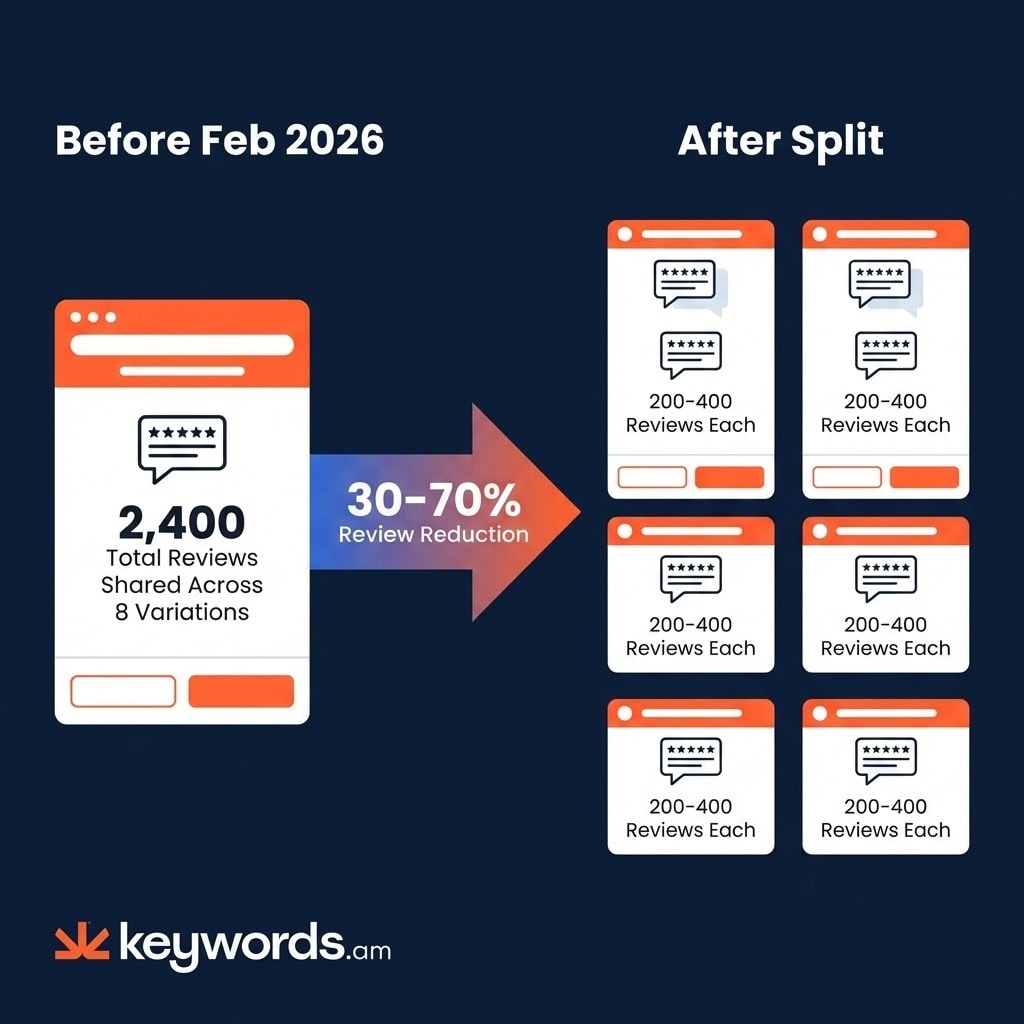
The 2026 variation review split rolls out between February and May. Functionally different variations will no longer share reviews. A listing currently holding 2,400 shared reviews across eight different styles could plummet to 300 ratings per variation overnight. Sellers face a steep conversion drop if they ignore these rollout details. The sudden loss of social proof causes buyers to hesitate, leading to abandoned carts and lost market share.
Review velocity acts as a core ranking signal. Fresh reviews carry more algorithmic weight than older ratings. A steady stream of new positive feedback tells Amazon the product remains relevant to current search trends.
What Is the Review Flywheel (and Why Do Most Sellers Start It Backwards)?
Understanding how to get reviews on Amazon requires a system, not a single tactic. The review flywheel has five stages: keyword targeting, listing optimization, qualified conversion, review solicitation, and review velocity. Most sellers skip to Stage 4.
The five stages operate as a sequential loop: target precise keywords, optimize listing accuracy, convert qualified traffic, solicit feedback, and leverage the resulting review velocity. Each phase feeds into the next. Breaking the chain anywhere weakens the outcome.
Most sellers jump to Stage 4 and wonder why results stay weak. Solicitation feels like the most direct lever a brand can pull. Sending emails and adding product inserts seems like active marketing. But the upstream problem undermines this isolated approach. Wrong keywords attract the wrong buyers.
Consider a brand targeting the phrase “heavy duty phone case” but selling a slim minimalist case. This aggressive targeting gets traffic. It also guarantees disappointed buyers. Those mismatched buyers open the package, realize the product fails their specific need, and process a return or leave a one-star rating. Soliciting a review from this buyer invites damage.
The flywheel effect relies on each stage compounding the next. Better keywords attract better-matched buyers. Strong listing optimization strategy ensures accurate expectations. Accurate expectations lead to zero surprises upon delivery. Satisfied buyers generate fewer returns and leave more positive reviews naturally. Those positive reviews build higher organic rank. Higher rank drives more qualified traffic into the loop. The flywheel starts with Stage 1: targeting the keywords that attract buyers who will actually be satisfied with the physical product.
How Does Keyword Targeting Drive More Positive Amazon Reviews?
Targeting keywords that match buyer intent attracts customers whose expectations align with the product, leading to higher satisfaction and more positive reviews.
The real answer to how to get reviews on Amazon starts before the sale. Stage 1 involves focused keyword targeting. The TFSD Framework guide outlines how relevance-first keyword selection filters for qualified traffic. Chasing broad search volume attracts generic, unpredictable buyers. TFSD-optimized listings pull in buyers whose search intent matches the physical item. This filters out people looking for features the product lacks.
Stage 2 requires listing accuracy. Titles, images, bullet points, and A+ content need to set expectations that match reality. Promising a “waterproof” item when the product is only water-resistant guarantees angry feedback. Proper product title optimization ensures the core features are clear upfront. Accurate product image optimization prevents visual misunderstandings regarding size or scale. Detailed A+ content optimization provides visual confirmation of materials and functionality.
Stage 3 is qualified conversion. Qualified traffic with accurate expectations converts at a higher rate. Review sentiment improves under these same conditions. The mechanism driving higher conversion also drives better reviews. Buyers get what they expected when they clicked the search result. No surprises means no unforced negative reviews. A buyer who expects a premium, heavy-duty tool and receives one will gladly leave a five-star rating.
Reviews from qualified buyers naturally contain the keywords they searched for. Buyers searching for a “stainless steel water bottle for hiking” use those exact phrases in their five-star text. This reinforces keyword relevance signals for the Amazon search algorithm. The algorithm reads the review text, sees the target keywords, and boosts organic rank for those terms.
How to Get Reviews on Amazon: The Best Strategies for 2026
The most effective 2026 review strategies include Amazon’s Request a Review button, the Vine program, compliant product inserts, and automated follow-up emails.
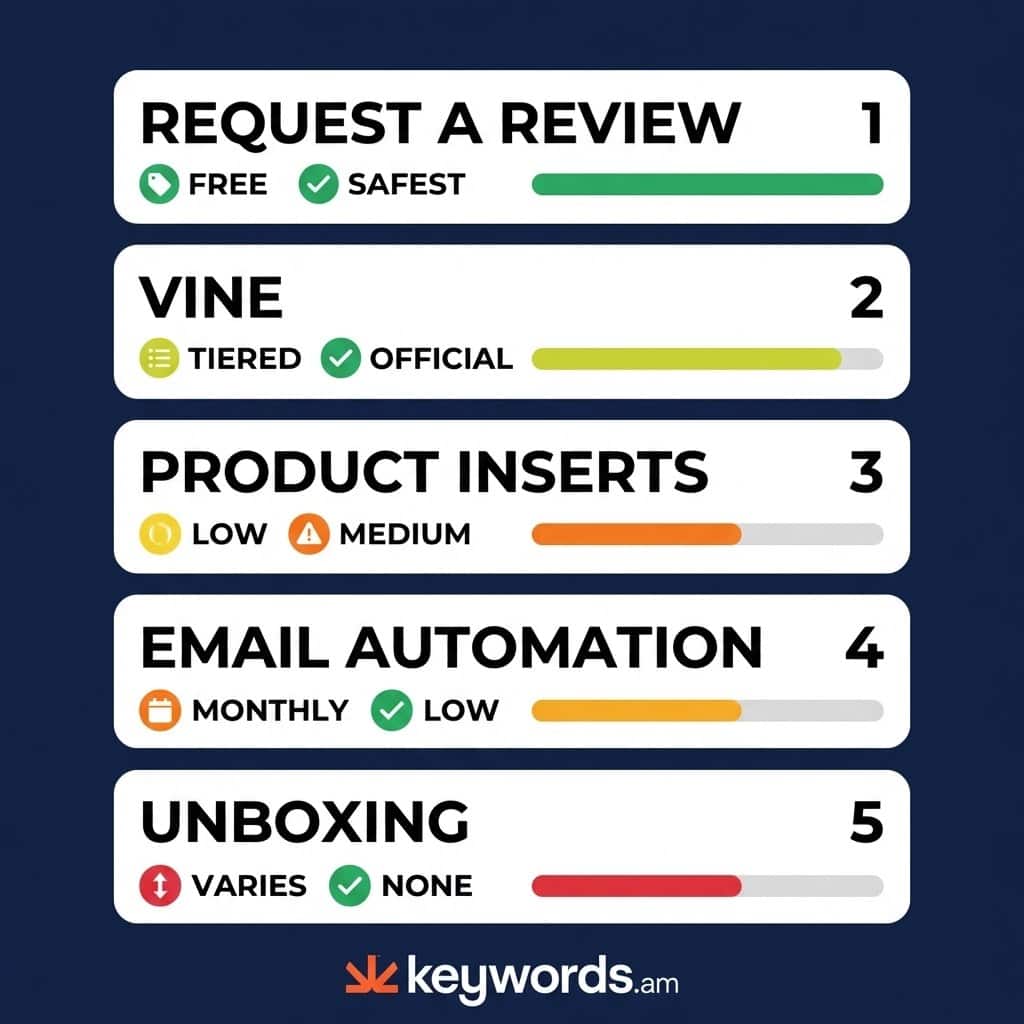
Amazon’s native Request a Review button remains the safest method available. The button becomes active 5 to 30 days post-delivery. Consistent use generates roughly a 52 percent increase in reviews during the first 15 days. Amazon controls the messaging. The platform sends a standard, translated email asking for both a product rating and seller feedback. Sellers cannot manipulate the text.
The Amazon Vine program utilizes tiered pricing for 2026. Enrollment is free for 1 to 2 units, $75 for 3 to 10 units, and $200 for 11 to 30 units per parent ASIN. Products need fewer than 30 existing reviews to qualify. Vine works best as a launch strategy. Trusted reviewers receive the item for free in exchange for honest feedback. Amazon charges the fee 7 days after the first Vine review posts to the listing.
Product inserts require careful adherence to Amazon’s anti-manipulation policy. Inserts cannot offer financial incentives. They cannot use review-specific conditional language. They cannot direct traffic to external review sites. Compliant language looks simple: “We’d love to hear about your experience. Find your order in Your Orders.” Non-compliant language risks account suspension: “Leave us a 5-star review and get a free gift.” Brands should consult an A/B testing guide to measure different compliant insert designs.
Follow-up email automation tools trigger the Request a Review button programmatically. They operate within the approved 5 to 30 day window. Software presses the button at scale so sellers do not have to click through hundreds of orders inside Seller Central. The physical unboxing experience also influences organic review rates. Thoughtful packaging triggers natural review behavior without any direct solicitation. A memorable unboxing exceeds baseline expectations and prompts buyers to share photos of their purchase.
Method |
Cost |
Timeline |
Expected Impact |
Compliance Risk |
|---|---|---|---|---|
Request a Review Button |
Free |
5-30 days post-delivery |
~52% increase in reviews |
None (Amazon-managed) |
Amazon Vine |
$0-$200/ASIN |
Product launch phase |
Up to 30 reviews per ASIN |
None (official program) |
Product Inserts |
$0.10-0.50/unit |
Ongoing |
Moderate (varies) |
Medium (strict language rules) |
Follow-up Email Automation |
$20-100/month |
5-30 days post-delivery |
10-20% rate improvement |
Low (uses Amazon’s system) |
Unboxing Experience |
Varies |
Ongoing |
Low-moderate organic lift |
None |
How Does the 2026 Variation Review Split Affect Your Review Count?
Starting February 2026, Amazon is splitting reviews between functionally different variations, which could reduce displayed review counts by 30-70% for affected listings.
Amazon will separate review pools for functionally different product variations. Reviews remain shared only between variations with minor cosmetic differences. Color, size, pattern, and pack quantity variations will continue sharing a combined review count. Functionally different variations involving power, compatibility, material, or core design receive isolated review pools.
The rollout occurs by category from February 12 through May 31, 2026. Amazon sends email notifications 30 days before changes hit specific products. Sellers should prepare now rather than waiting for the automated warning. A parent ASIN holding 2,400 shared reviews across eight functionally different variations faces a steep cliff. When the split occurs, each variation could drop to just 200 to 400 isolated reviews overnight. This visual drop hurts conversion rates at the moment a buyer clicks the specific variation.
Still Shares Reviews |
Reviews Now Split |
|---|---|
Color variations |
Different power/wattage |
Size (same function) |
Platform compatibility |
Pattern |
Model or generation |
Pack quantity |
Bundle composition |
Secondary scent |
Primary scent/flavor |
Model fitment |
Material or design |
Per-variation keyword strategy acts as the primary defense against the split. For sellers figuring out how to get reviews on Amazon after the split, each variation needs independent keyword targeting to build a standalone review base. Software solutions facilitate proper keyword clustering. When reviews split, each distinct variation must attract the right buyers independently without relying on the parent ASIN’s historical momentum.
A dedicated variation listing strategy protects against total review collapse. Sellers should audit variation families today. Identify which specific ASINs face the split based on functional differences. Begin building per-variation keyword clusters and distinct review pipelines before the algorithm change hits the category.
How Does Review Velocity Become a Ranking Signal?
Review velocity, the rate of new reviews over time, signals product trust to Amazon’s algorithm and carries more ranking weight than total review count alone.
Fresh reviews carry more algorithmic ranking weight than older ones. A product gaining 10 positive reviews per week outranks a stagnant competitor holding 5,000 total reviews but only generating 1 recent rating per week. Velocity beats static volume. The algorithm prioritizes current buyer sentiment over historical dominance.
Review content reinforces keyword relevance. Buyers searching “organic turmeric supplement” leave positive reviews mentioning those exact terms. These natural text insertions strengthen the listing’s relevance signal for those keywords. Following a product description guide helps seed this vocabulary in the buyer’s mind before purchase. They read the terminology in the description and echo it back in their public feedback.
Healthy review velocity requires a 5 to 15 percent sales-to-review conversion rate. Reviews typically appear on the live listing within 72 hours of submission. Target velocity depends on the category competition. Competitive categories demand 15 to 20 new reviews per week to maintain page one visibility.
The compound flywheel relies on a continuous loop. Better keywords attract qualified buyers. Qualified buyers leave accurate positive reviews. Positive reviews drive higher organic ranking. Higher ranking brings more qualified traffic. More traffic generates higher review velocity. This is the complete amazon review strategy that turns keyword targeting into a self-reinforcing cycle.
Frequently Asked Questions About Amazon Reviews
These are the most common questions sellers ask about how to get reviews on Amazon.
Conclusion
- The review flywheel starts at keyword targeting (Stage 1), not solicitation (Stage 4).
- Qualified buyers leave better reviews more often. Fix the traffic before fixing the ask.
- The 2026 variation review split makes per-variation keyword strategy essential.
- Review velocity beats review volume as a ranking signal.
Audit top 5 ASINs today. Check whether current keywords attract the type of buyer who genuinely benefits from the product. If a mismatch exists, fix the targeting there before adding any review solicitation tactics. The question of how to get reviews on Amazon has a simple answer: start with the right keywords. Visit the TFSD Framework guide to align keyword strategy with long-term review goals.