
📑 Table of Contents
- Why do most Amazon competitor analyses fail to change anything?
- How do you identify your actual Amazon competitors (and why most sellers pick the wrong ones)?
- What does the keyword-first competitor analysis framework look like?
- What do competitor reviews reveal that keyword data cannot?
- How do you turn Amazon competitor analysis into a listing optimization plan?
- Frequently asked questions about Amazon competitor analysis
- Conclusion
⚡ TL;DR
- Keywords are the foundation: They directly explain a product’s pricing power, review velocity, and organic rank.
- Search-based competitors matter more: Identifying who shares your target search terms is far more valuable than analyzing catalog-based rivals.
- Reverse ASIN lookup is essential: This step extracts the full keyword profile of your top three competitors instantly.
- The keyword gap matrix categorizes opportunities: It segments data into complete gaps, ranking gaps, and your unique advantages.
- Listing optimization maps directly to gaps: You can apply keyword insights straight to your title, bullets, backend, and A+ content.
- Refresh your data quarterly: Trigger a new analysis whenever a fresh competitor enters page one for your primary target keywords.
Your competitor outsells you 3:1 on the same product. The price is identical. The reviews are strikingly similar. The real difference is 47 keywords they rank for that you have never targeted. Most Amazon competitor analyses miss this hidden dynamic. They follow a predictable checklist. Sellers evaluate six specific pillars: pricing, reviews, best seller rank, listings, advertisements, and keywords. They look at all six items simultaneously. Guides from agencies like beBOLD Digital or software companies like SmartScout teach this exact model. The result is always the same. Sellers compile massive spreadsheets full of observations. They check every box and end up changing absolutely nothing.
This happens because treating all six pillars equally creates noise. It ignores the root cause of ranking success. A keyword-first Amazon competitor analysis framework solves this paralysis. It uses competitor keyword data as the ultimate foundation for every strategic decision. The following five steps will show you how to extract competitor keywords, find critical gaps, and turn those insights into measurable ranking wins.
Why do most Amazon competitor analyses fail to change anything?
Most Amazon competitor analyses fail because they treat pricing, reviews, and keywords as equal checkboxes instead of identifying which data point actually drives the others.
The standard six-pillar competitor analysis model appears in nearly every Amazon selling guide. Sellers track competitor pricing, count reviews, monitor BSR fluctuations, evaluate listings, audit ads, and finally glance at keywords. This approach produces spreadsheets full of observations but no priority. Sellers stare at the data without knowing what to change first.
Pricing data without keyword context is useless. A competitor priced 15 percent higher who also ranks for 47 more keywords is not overpriced. They are simply capturing specific demand that you miss. Their higher price is supported by their visibility on highly relevant search terms. Keywords explain the pricing power.
Reviews present a similar illusion. Reading competitor reviews tells you what customers think, but never how they found the listing in the first place. Keyword data reveals the exact search terms that delivered those buyers. If you only look at the six pillars as separate silos, you will constantly chase symptoms instead of treating the disease. Keywords act as the foundation. They explain the other five metrics clearly. Without keyword intelligence, an Amazon competitor analysis is just a list of random facts.
How do you identify your actual Amazon competitors (and why most sellers pick the wrong ones)?
Your real Amazon competitors are the ASINs that rank for the same search terms you target, not every product in your subcategory.
Sellers usually default to analyzing catalog-based competitors. They pull up their Amazon subcategory and pick the top five best-selling products. This approach is fundamentally flawed. You need to focus on search-based competitors instead. These are the specific products competing for the exact same customer searches. Analyzing catalog neighbors often leads you down the wrong path entirely.
Consider two garlic presses sitting in the exact same subcategory. One brand optimizes entirely around the phrase “easy clean garlic press” and focuses on busy parents. The other targets “professional chef garlic mincer” and appeals to culinary enthusiasts. These two products might share zero keywords. They are catalog competitors. But they are not keyword competitors. Analyzing the professional mincer will not help the easy-clean brand rank higher for its core terms. They serve different intents entirely.
Identify your true search-based competitors using a quick method. First, search your top five target keywords directly in the Amazon search bar. Then write down the specific ASINs that show up on page one for at least three of those searches. Those ASINs showing up over and over? Those are your actual keyword competitors. Keep your deep Amazon competitor analysis limited to just three to five of these products. Looking at the whole subcategory just dilutes your focus with useless data. Isolating your real search competitors guarantees every single insight actually matters to your target audience.
What does the keyword-first competitor analysis framework look like?
The keyword-first framework follows five steps: extract competitor keywords, build a gap matrix, analyze listing structure, cross-reference PPC data, and prioritize gaps by impact.
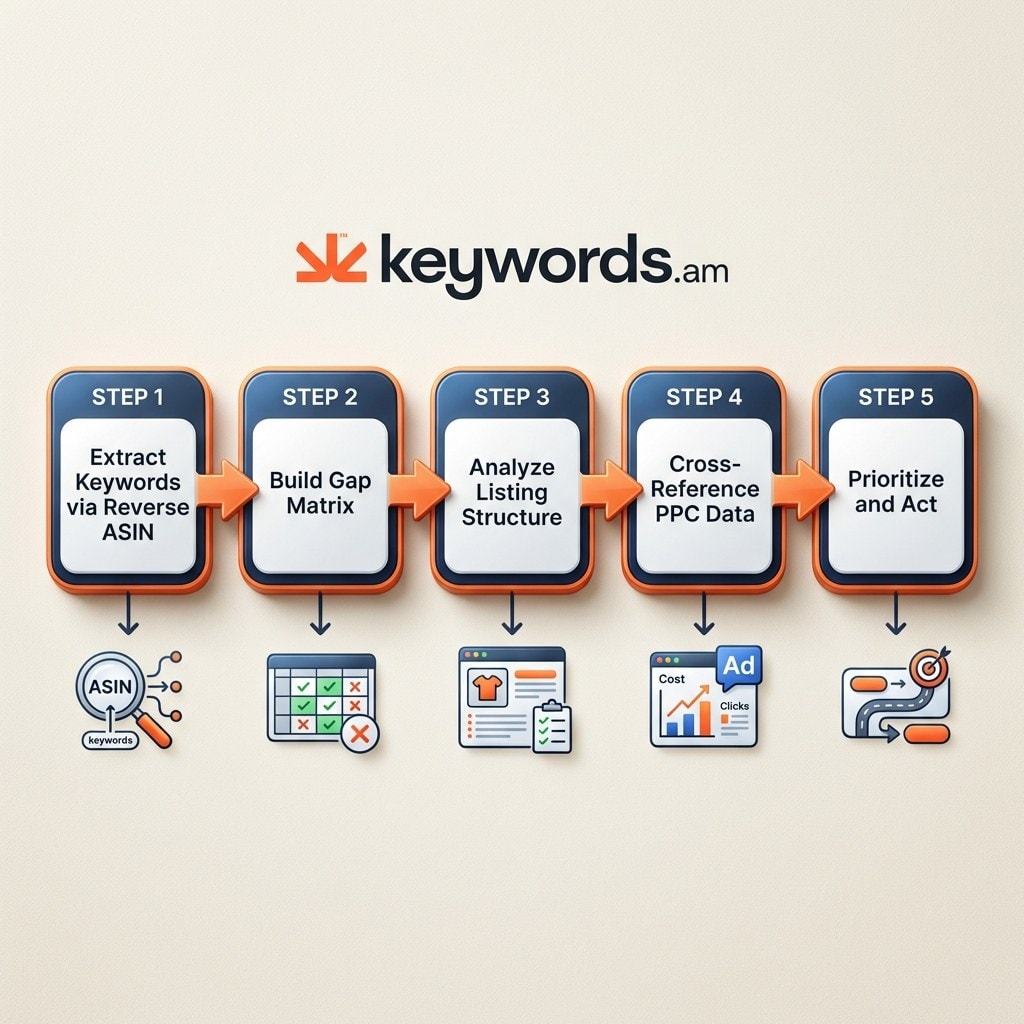
Step 1: Extract competitor keywords via reverse ASIN lookup
You cannot analyze what you cannot see. The first step requires pulling the complete keyword profile for your top three competitors. You achieve this using a reverse ASIN lookup tool. Focus on gathering three specific metrics for every keyword. Note the exact search volume. Record the competitor’s organic ranking position. Evaluate the relevance score for the term. This raw data forms the baseline for your entire Amazon competitor analysis strategy.
Step 2: Build a keyword gap matrix
Raw keyword lists are overwhelming. You must categorize every keyword into three distinct buckets to make the data actionable. Complete gaps are the exact search terms your competitor captures while you miss them completely. Ranking gaps show exactly where a competitor beats your position by three or more spots. And your advantages are the search terms you dominate while the competitor doesn’t even show up.
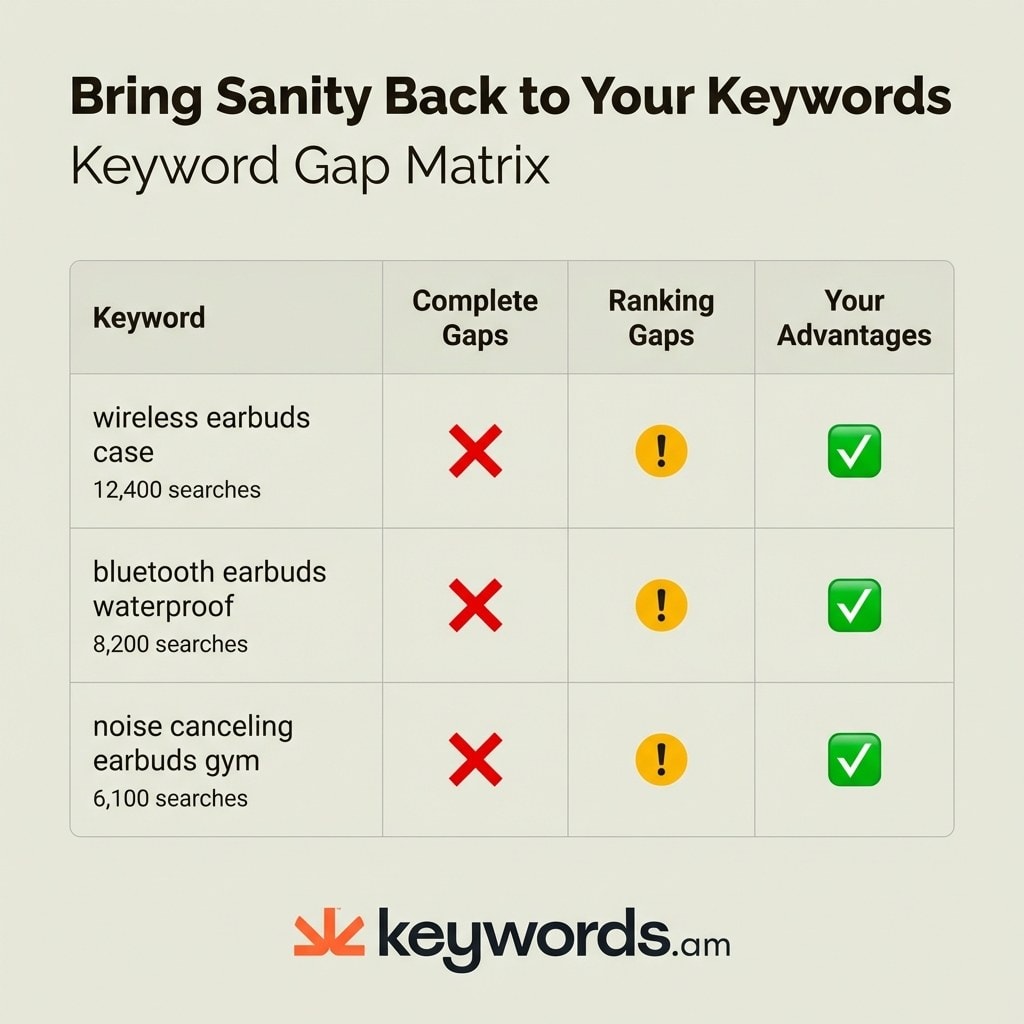
Keyword |
Monthly Search Volume |
Competitor Rank |
Your Rank |
Gap Category |
|---|---|---|---|---|
wireless earbuds case |
12,400 |
4 |
Unranked |
Complete Gap |
bluetooth earbuds waterproof |
8,200 |
2 |
15 |
Ranking Gap |
noise canceling earbuds gym |
6,100 |
3 |
22 |
Ranking Gap |
small earbuds for sleep |
4,500 |
Unranked |
3 |
Your Advantage |
running earbuds with hooks |
3,200 |
5 |
Unranked |
Complete Gap |
Step 3: Analyze their listing structure through the keyword lens
Look closely at how your competitors distribute their highest-volume terms. Do they place primary keywords at the front of their title? Which terms do they bury in their backend search terms? The TFSD Framework provides a reliable model for understanding this distribution. Analyzing their structural choices reveals exactly how much weight Amazon places on specific listing fields for those targeted terms.
Step 4: Cross-reference with PPC data
Organic rankings only tell half the story. You need to know which keywords your competitors actively bid on. Sponsored Brand presence on a specific keyword signals heavy strategic investment. If a competitor pays heavily for a keyword and also ranks organically for it, that term is clearly driving sales. You can build a highly effective Amazon PPC keyword strategy by targeting the exact terms your competitors value most.
Step 5: Prioritize the gaps
You will likely find hundreds of gaps. Do not try to close them all at once. Use three strict factors to rank your opportunities. Check the search volume first so you know the term is actually worth targeting. Then look at competition density to figure out if you can realistically rank. And always check product relevance, because the keyword has to describe your specific item perfectly. High volume, low competition, and high relevance. That combination is your top priority target. Amazon’s listing optimization guidelines are clear here. Putting the right keywords in the right listing fields directly boosts your search visibility.
What do competitor reviews reveal that keyword data cannot?
Competitor reviews reveal the exact language customers use to describe features, which becomes a source of long-tail keyword opportunities that tools alone miss.
Keyword research tools are powerful. But they often miss the nuanced, conversational phrases real humans type into search bars. Customers might search for “lightweight” or “easy to assemble” or “fits in backpack” when looking for outdoor gear. Traditional keyword databases often miss these natural phrases completely. But mining competitor reviews grabs these hidden gems so you can turn them into high-converting Amazon backend keywords.
Go read the 1-star and 5-star reviews for your top three competitors first. Ignore the middle and focus on the extremes. Those 1-star reviews instantly expose product flaws you can exploit in your own copy. When buyers constantly complain about a competitor’s flimsy handle, your listing needs to scream about its reinforced steel grip. But 5-star reviews offer even more search optimization value. They expose the exact words that turn a casual browser into a paying customer. Hunt for repeated adjectives and hyper-specific use cases. A recent Jungle Scout report shows over 60 percent of Amazon shoppers read at least four reviews before buying. That makes review language a literal transcript of your buyer’s vocabulary.
Cross-reference these review phrases directly with your keyword gap matrix. Suppose customers repeatedly praise a competitor’s product for being “easy clean” in their reviews. You then check your data and see that “easy to clean” gets 5,000 monthly searches. If you currently do not rank for that phrase, you have just found a high-confidence gap. Review mining validates the search data. It proves that real people use those exact words when they have their credit cards ready.
How do you turn Amazon competitor analysis into a listing optimization plan?
Map each keyword gap to a specific listing field: high-volume complete gaps go to title and bullets first, while long-tail gaps go to backend search terms.
Data collection means nothing without implementation. Your keyword gap matrix must translate directly into listing updates. Start by applying a strict prioritization rule based on the indexing weight of different Amazon fields. Take your highest-volume complete gaps and insert them into your product title and bullet points first. These areas carry the heaviest indexing weight. They signal the strongest relevance to Amazon’s algorithm. The Amazon keyword research methodology guide covers this indexing hierarchy in detail.
Next, address your ranking gaps. These are terms where you already index but sit too far down the page to capture traffic. Reinforce these specific keywords within your bullet points and product description. Increasing their frequency and prominence can push your existing rank higher. Finally, take your long-tail gaps and the conversational phrases you mined from competitor reviews. Place these directly into your backend search terms and A+ content. Natural language fits perfectly in these secondary fields without disrupting the readability of your main listing.
Amazon competitor analysis is not a one-time project. You must establish a baseline refresh cadence. Plan to run a full analysis quarterly to catch gradual market shifts. But you should also trigger an immediate re-analysis under specific conditions:
* A new competitor suddenly enters page one for three or more of your primary keywords.
* Your product experiences a BSR drop of 20 percent or more without an obvious cause.
* Seasonal shifts drastically change search behavior (like the transition into Q4 holiday shopping).
* Major events like Prime Day end and the massive ranking shuffles finally stabilize.
Frequently asked questions about Amazon competitor analysis
These are the most common questions sellers ask when building an Amazon competitor analysis process.
Three to five keyword competitors gives enough data for a meaningful gap matrix without creating spreadsheet paralysis from too many data points. Focus on keyword competitors, not every seller in your subcategory. The quick method from earlier (checking top five keywords for overlapping page-one ASINs) identifies the right targets immediately.
Partially. Brand Analytics Search Query Performance provides free keyword share data for brand-registered sellers, but full reverse ASIN lookup requires a dedicated tool. For sellers lacking Brand Registry, investing in one of the best Amazon SEO tools fills the gap.
Never copy blindly. Competitor keywords may target a different customer segment. Use the gap matrix to filter for relevance to your specific product. A competitor ranking for a “commercial kitchen garlic press” when you sell a home-use product should be ignored regardless of the search volume.
Reverse ASIN lookup is one step in the process used to extract keywords. Amazon competitor analysis is the full strategic framework for interpreting and acting on that data. While reverse ASIN handles the technical extraction, the keyword-first framework dictates the broader strategic context of gap analysis, prioritization, and listing optimization.
Yes. Keyword gaps from organic analysis become high-priority PPC targets. Keywords competitors rank for organically that you miss are prime Sponsored Products candidates. Running PPC on competitor gap keywords allows you to capture relevant traffic immediately while working on organic ranking. See the PPC keyword strategy guide for campaign setup.
Conclusion
- Keywords are the foundation of Amazon competitor analysis because they explain pricing power, review velocity, and organic visibility clearly.
- Search-based competitors who share your keyword targets matter significantly more than catalog-based competitors who merely share your product category.
- The complete five-step framework moves from extraction to gap matrix building, listing analysis, PPC cross-referencing, and final prioritization.
- Maintaining a quarterly refresh cadence with trigger-based re-analysis keeps your strategy sharp when rankings inevitably shift.
Pick your top three keyword competitors today using the quick identification method. Run a reverse ASIN lookup on all three products and build your very first keyword gap matrix immediately. Amazon competitor analysis is only as good as the keyword data behind it, and Keywords.am provides the reverse ASIN lookup, keyword gap matrix, and KPS scoring that power each step of the framework.