PPC
The Amazon PPC optimization strategy for low-ACOS campaigns (that captures profitable sales others miss)
Build a four-campaign low-ACOS cluster alongside your main Amazon PPC campaigns to capture cheap, profitable clicks your primary ads keep missing.

Your main campaigns hit $50,000 per month in sales at 28% ACOS. You’re profitable. But you’re also ignoring thousands of cheap clicks that could convert at 8-12% ACOS if you had campaigns designed to catch them. That gap is where a focused Amazon PPC optimization strategy earns back real margin.
This isn’t about fragmenting your account. It’s about adding a focused profitability layer on top of your core campaigns.
Amazon ACOS averaged 30.2% and Sponsored Products CPCs sat near $1.12 as of 2025, per Sequence Commerce. High ad costs squeeze margins. Capturing conversions below $0.50 builds a serious financial advantage.
Most sellers approach Amazon PPC optimization by tweaking bids and adding negatives to their primary ad structure. That conventional approach cuts waste, but it can’t fundamentally change the underlying economics. Primary campaigns serve mixed goals of volume and profitability, and they bid aggressively to win competitive placements. This architectural mixing means they routinely overpay for long-tail queries or exhaust budgets before cheaper evening traffic arrives.
Building a dedicated low-ACOS campaign cluster solves this margin leak. Ultra-conservative bids ensure the cluster only captures traffic that’s profitable by definition. Main campaigns continue driving volume and ranking, while the cluster quietly captures cheap incremental conversions in the background. Winners graduate to manual control, losers get negated, and the cluster acts as a profitability safety net rather than a replacement strategy.
What is a low-ACOS campaign cluster (and why does it sit alongside your main campaigns)?
A low-ACOS campaign cluster is a set of four ultra-conservative campaigns built to capture profitable incremental sales at bids too low for your main campaign architecture.
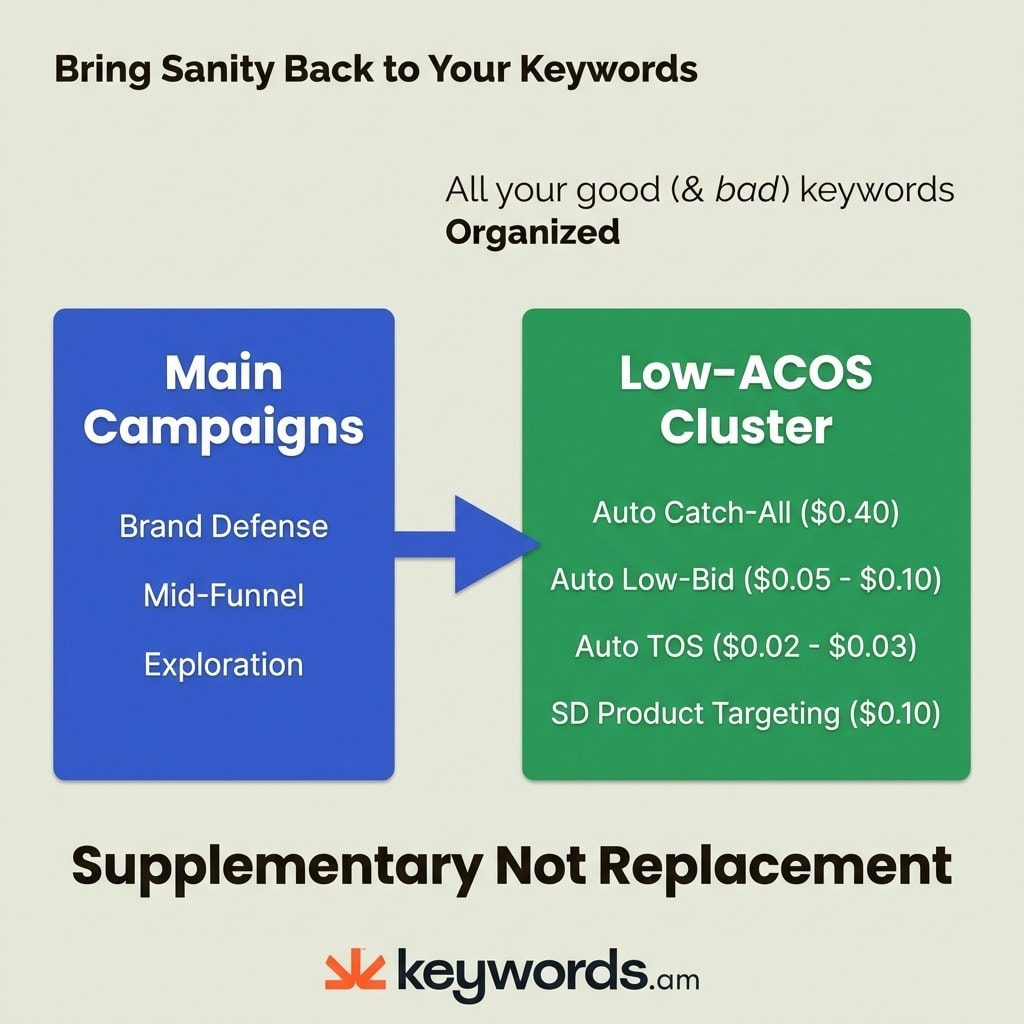
Stop mixing goals. Separate the drive for volume from the need for pure profit. The four campaigns are an auto catch-all, an auto low-bid, an auto top-of-search, and a Sponsored Display product-targeting campaign. They run at the same time, and strict bid limits stop them overpaying for a click.
These campaigns don’t replace current ads. If you’ve already built your core structure using a consolidated Amazon PPC campaign structure, the cluster simply adds a profitability layer on top. The main architecture carries the heavy lifting for keyword ranking and top-line revenue, while the cluster sweeps the floor for missed opportunities.
Cannibalization is a common fear when running multiple auto campaigns. The math makes internal competition impossible here: a $0.40 cluster bid won’t ever steal impressions from a $1.50 primary bid. The cluster wins an auction only when the primary campaign misses it, usually because the main campaign is out of daily budget or the query is too long-tail to be targeted directly.
Data from Jungle Scout’s State of the Amazon Seller 2024 report shows around three-quarters of third-party sellers use Sponsored Products ads, and Sponsored Products still absorbs the majority of ad spend. Yet very few sellers deploy dedicated low-bid profitability campaigns alongside their primary structure. They leave cheap inventory on the table for competitors to claim.
How does the auto catch-all campaign work?
The auto catch-all campaign adds all ASINs at $0.40 bids per targeting group with down-only bidding, capturing mid-funnel converting queries at a defended cost.
Setting up this initial campaign creates the broadest net in the cluster. You load every active product in the catalog into a single campaign, set strict rules, and keep the maximum acquisition cost capped.
| Setting | Value |
|---|---|
| Targeting Groups | Close match, Loose match, Substitutes, Complements |
| Starting Bid | $0.40 per group |
| Bid Strategy | Down only |
| Placement Modifiers | None |
| Daily Budget | $5 to $10 |
Starting at $0.40 generates enough visibility on relevant mid-funnel terms. With Sponsored Products CPCs averaging around $1.12 as of 2025, a $0.40 bid wins placements where competition is lighter or during off-peak hours. That bid stays low enough to defend margins on most standard products.
Look at the math. Jungle Scout’s 2024 Amazon advertising report puts the average Amazon conversion rate near 9.87% as of 2025. A $0.40 CPC at a 10% conversion rate results in a $4.00 cost per sale. On a $25 product, that’s a 16% ACOS. The economics work automatically, and down-only bidding ensures Amazon never artificially inflates the bid to win a competitive placement.
The purpose here is pure utility. This campaign catches converting queries that main campaigns miss due to budget exhaustion, and it prevents overpaying for clicks. If a buyer searches a highly specific five-word phrase, the primary campaign might bid $1.50 for it via broad match, while the catch-all wins that exact click for $0.40 whenever the primary campaign is paused or out of budget.
How do you configure the auto low-bid and top-of-search campaigns?
The low-bid campaign uses $0.05 to $0.10 bids with a +100% TOS modifier, while the TOS campaign uses $0.02 to $0.03 bids with a +900% modifier to capture cheap top-of-search clicks.
The catch-all casts a wide net. The next two campaigns slice that targeting logic into tighter configurations for cheaper discovery, using placement modifiers to steal high-converting spots without risking expensive base bids.
Set up two ad groups for the low-bid campaign. Put “close match” and “substitutes” in the first group with a $0.10 base bid. Drop to $0.05 for the second group holding “loose match” and “complements”. Set bidding to down-only and add a +100% top-of-search placement modifier. These base bids start so low that doubling them still keeps costs down: a $0.10 base with a 100% modifier is a $0.20 bid for the top row of results.
Amazon’s own advertising documentation and third-party studies from Perpetua’s 2024 benchmark report both note that top-of-search placements convert materially better than rest-of-search or product-page placements, roughly two to three times better depending on category. Winning those placements for $0.20 generates outsized returns.
The auto top-of-search campaign pushes this logic further. It uses the same two-bucket ad group structure with bids dropped to microscopic levels: $0.03 for close match and substitutes, $0.02 for loose match and complements. The campaign applies a +900% top-of-search modifier alongside a small $3 to $5 daily budget.
| Targeting Group | Base Bid | TOS Modifier | Effective TOS Bid |
|---|---|---|---|
| Close match + Substitutes | $0.03 | +900% (10x) | $0.30 |
| Loose match + Complements | $0.02 | +900% (10x) | $0.20 |
That math caps top-of-search impressions at $0.30. A $0.30 effective bid only wins the top row on queries where competition is virtually non-existent, which usually means highly specific, high-intent long-tail queries. Multiple third-party click-share studies (including Varos and Pacvue) put the first row of Amazon search results at well over half of total search clicks, so paying pennies for these placements delivers exceptional ROAS.
Why should the cluster include Sponsored Display product targeting?
Sponsored Display product targeting at $0.10 bids captures low-cost incremental conversions from product detail pages and category browse, reaching a funnel stage that Sponsored Products can’t access.
Sponsored Products ads rule the search results, but they miss the browsing behavior that follows a click. Adding a Sponsored Display layer ensures the cluster covers the entire shopping journey.
Target the specific sub-category along with two or three related ones. If you’re selling a stainless steel water bottle, you target the exact browse node for that item plus related nodes like camping accessories. Optimize the campaign for conversions with a $0.10 starting bid and down-only bidding.
Sponsored Display CPCs are reported anecdotally by sellers in public forums like r/FulfillmentByAmazon to range from roughly $0.70 to $2.50 as of 2025, though Amazon doesn’t publish an official benchmark. A $0.10 bid only wins near-empty auctions, and shoppers on detail pages are already in the middle of comparing options. Catching their attention while they evaluate a competitor’s listing at a fraction of the normal cost delivers real incrementality.
This addresses a different psychological state than search intent. Search queries show active demand for a solution, while product targeting captures comparative intent. The cluster needs both channels to maximize the profitability safety net, because missing either one leaves cheap clicks for other sellers to claim.
How do you graduate winners and negate losers from the cluster?
After 10 to 21 days, graduate search terms meeting your ACOS target into manual campaigns for scaling, and negate non-converting terms to protect cluster profitability.
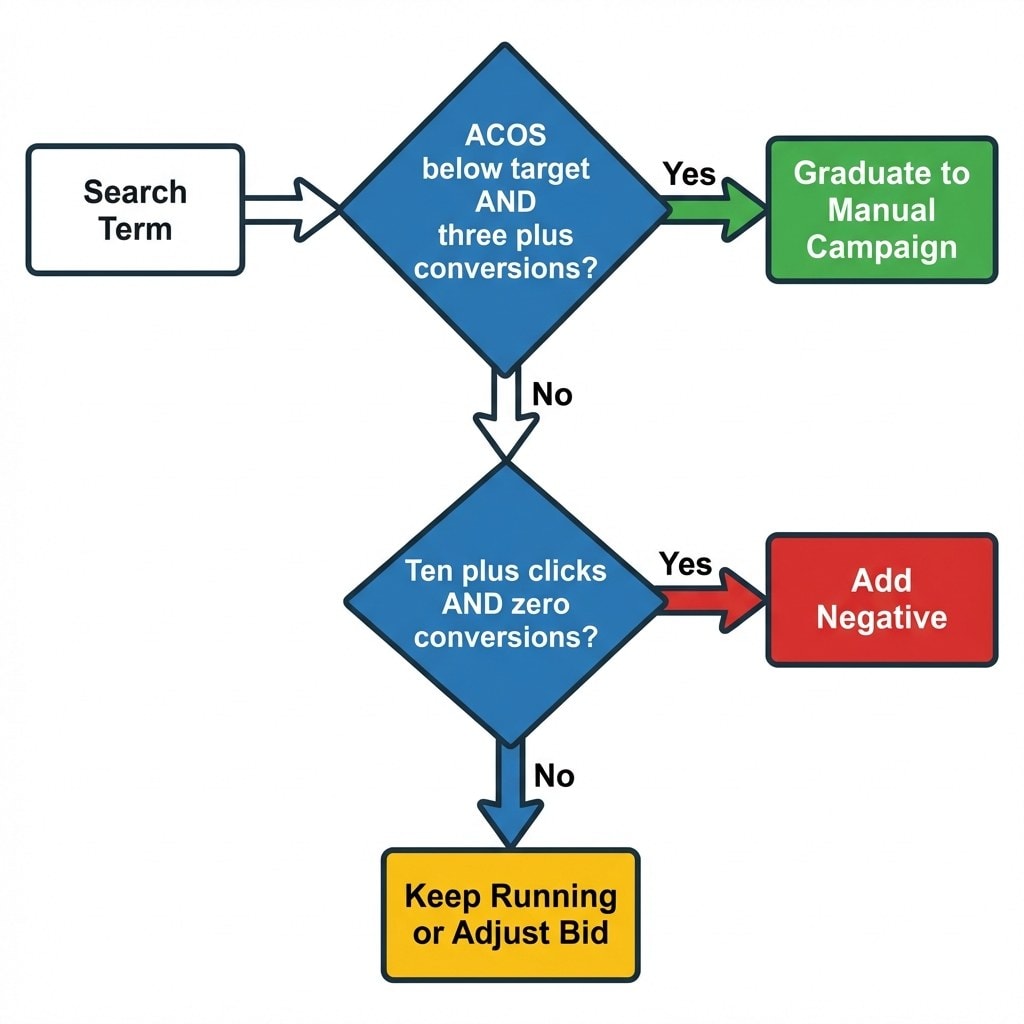
Gathering data takes time. Judging performance on just five clicks kills the discovery engine entirely. Wait 10 to 21 days for real patterns, and don’t judge a term’s conversion rate until it hits at least 20 clicks.
Optimization requires a rigid decision matrix.
| Scenario | Action | Where |
|---|---|---|
| ACOS below target + 3+ conversions | Graduate to manual exact match at higher bid | Scale winners |
| ACOS above target + 10+ clicks + 0 conversions | Add as negative exact in cluster | Protect margins |
| ACOS slightly above target + converting | Lower bid by 20% and retest for 7 days | Optimize in place |
| Very few impressions | Increase bid by $0.05 or leave running | Give it time |
Move high-performing terms into exact match manual campaigns, then set bids specifically to push volume. This feeds directly into your standard keyword strategy pipeline, and it pairs well with the Amazon keyword research methodology you use for organic ranking. Keep the winning term running in the auto cluster too: the ultra-low bid costs almost nothing and occasionally catches cheaper variations of the phrase.
Stay disciplined with negation. Block non-converting terms as negative exact inside the cluster, and never use negative phrase match here. Negative exact preserves similar long-tail variations that might still convert profitably. Read our full breakdown on Amazon negative keywords if you’re not sure which match type to apply.
Review the cluster weekly and adjust bids every two to four weeks. You can validate the true volume of graduated terms using Brand Analytics search query performance reports before heavily increasing manual bids, assuming your account is enrolled in Amazon Brand Registry.
How does keyword research quality affect cluster performance?
Auto campaigns read your listing content to match search queries, so listings with poor keyword coverage generate irrelevant matches and waste the cluster’s budget on non-converting traffic.
Amazon evaluates text inside the product listing to measure relevance. The algorithm reads titles, bullets, descriptions, and backend terms, and that exact text determines which customer searches trigger auto campaigns. Poorly indexed listings feed garbage traffic into the cluster.
If your listing fails to include the phrase “stainless steel water bottle,” your auto campaigns will never show for that exact query. The product could be identical to the search intent, but the algorithm lacks the semantic bridge to make the connection. This silent failure destroys auto campaign performance before the ads even launch.
Backend keyword limits create another hidden trap. Amazon caps backend keywords at 250 bytes, and going over by one character can cause the entire field to drop from the index. Thousands of matches disappear silently.
The low-ACOS cluster works both ways. The cluster uses listing text for matching, but the resulting converting terms also expose missing keywords in the copy. Export the search term report every month, check those converting phrases against the backend fields, and add missing terms to improve organic ranking.
Better keyword research feeds better-indexed listings, better listings feed more accurate auto targeting matches, and accurate matches make the cluster radically more profitable. This compounding cycle proves why a proper reverse-ASIN process is the foundational step for any Amazon PPC optimization strategy.
Frequently Asked Questions About Amazon PPC Optimization
Won’t a low-ACOS cluster cannibalize my main campaigns?
No. The cluster’s bids sit under $0.40, so they only win auctions your main campaigns aren’t already winning. If your main campaigns bid $1.50 on a term, a $0.40 cluster bid never wins that same impression. The cluster captures surplus inventory your main campaigns leave behind.
How long before I see results from the cluster?
Allow 10 to 21 days minimum for statistically meaningful data, with enough clicks per search term to make reliable graduation or negation calls. Rushing decisions on three to five clicks per term leads to false negatives. The cluster is designed for patient, systematic discovery.
What ACOS target should I set for the cluster?
Set the cluster target at your break-even ACOS or lower, since the whole point is profitable incrementality rather than volume growth. If your break-even ACOS is 35%, the cluster should target 25% to 30%. Conservative targets ensure every sale from the cluster adds margin, not just revenue.
Can I run this cluster with a small daily budget?
Yes. Start at $5 to $10 per day per campaign ($20 to $40 total daily) and scale individual campaigns based on performance. Low bids stretch daily budgets further, and a $10 daily budget at a $0.40 CPC yields around 25 clicks per day. At a 10% conversion rate, that’s two to three sales per day from the cluster alone.
How does the cluster interact with my Amazon ACOS and TACOS targets?
The cluster typically pulls blended ACOS down because it only wins profitable impressions, and it also improves TACOS as graduated winners drive organic rank on those queries. Track both metrics before and after launching the cluster to isolate its contribution. Expect measurable movement after 60 to 90 days.
Conclusion
The low-ACOS cluster fundamentally shifts how you capture profitability on Amazon.
- The cluster is supplementary. It adds a profitability layer on top of your core campaign structure rather than replacing it.
- Four campaigns cover three Sponsored Products strategies (catch-all, low-bid, TOS) plus one Sponsored Display channel.
- Graduation rules turn the cluster into a systematic pipeline for discovering cheap clicks, validating profitability, and scaling winners.
- Keyword research quality is the upstream input that determines cluster effectiveness.
- Weekly search-term reviews plus monthly bid adjustments keep the cluster running efficiently without constant tinkering.
Set up Campaign 1 today. The auto catch-all at $0.40 bids takes ten minutes to launch and starts generating data immediately.
The cluster works, and it works significantly better when listings have complete keyword coverage that gives Amazon’s algorithm accurate matching signals. Run your first reverse-ASIN scan on your top ASIN now with the free Amazon keyword tool, or start a Keywords.am annual plan to feed your cluster with better indexation data every week.
Keywords.am: Data you can bet your ASIN on.