
Table of Contents
- What is Amazon keyword cannibalization?
- Does bidding on the same keyword in multiple campaigns hurt your Amazon PPC?
- How does PPC cannibalize organic sales on Amazon?
- How do you detect keyword overlap between your own ASINs?
- What are the best fixes for Amazon keyword cannibalization?
- How should you distribute keywords across Amazon variation listings?
- Frequently Asked Questions
TL;DR
- Amazon keyword cannibalization: Your listings or campaigns compete for search terms, which fragments data and wastes ad spend.
- PPC keyword overlap: Mostly a myth. Amazon’s auction system picks one ad per seller per keyword, stopping internal bid inflation.
- PPC-to-organic cannibalization: This is real, and it’s costly. Paid ads steal clicks from high-ranking organic spots.
- Catalog-level keyword overlap: Multiple ASINs targeting the same terms? That’s the most damaging kind. It splits sales velocity and weakens individual product rank.
- Detecting cannibalization: Run a reverse ASIN lookup on your own catalog. Find overlapping keyword territories and ranking positions.
- Proven fixes: Use negative keyword routing for PPC data. Gradually reduce bids for PPC-organic overlap. Strategically assign keyword territories across ASINs.
- Variation listings: A chance to multiply keyword coverage. Distribute unique backend search terms across individual child ASINs.
A supplement brand consistently pulled in $2 million a month. But then things shifted: their organic sales ratio dipped from 60-70% to just 30-40% right after they started aggressive PPC bidding. At the same time, their Total ACOS (Advertising Cost of Sales) jumped from 13% to 30%. Turns out, paid advertising was directly cannibalizing organic sales. One targeted fix saved the company an estimated six figures annually. That’s a huge win.
Amazon keyword cannibalization? It’s a complex, often misunderstood problem for sellers. Lots of people misinterpret its forms. They’ll focus on minor issues, while more damaging types never get diagnosed. This guide lays out a clear taxonomy of the three main Amazon keyword cannibalization types. It provides a straightforward detection audit and specific, proven fixes. This isn’t just another “cannibalization is bad” talk. It busts common myths and delivers actionable strategies. Too much existing advice only covers basic PPC overlap, completely missing critical catalog-level problems.
What is Amazon keyword cannibalization?
Amazon keyword cannibalization happens when your own listings, campaigns, or ASINs fight each other for the same search terms. This splits up your performance data, sales velocity, or ad spend.
Simply put, your products or campaigns accidentally compete for Amazon visibility. Think of it like a sports team scoring an own goal. The internet often mixes distinct problems under “keyword cannibalization.” But knowing these differences? It’s crucial.
This guide introduces a three-type taxonomy:
Type |
What Competes |
Verdict |
Severity |
|---|---|---|---|
PPC keyword overlap |
Same keyword in multiple campaigns/match types |
Mostly a MYTH |
Low (data fragmentation only) |
PPC-to-organic cannibalization |
Paid ads stealing clicks from organic rank |
REAL and costly |
Medium-High |
Catalog-level keyword overlap |
Multiple ASINs targeting identical search terms |
REAL and underdiagnosed |
High |
Sellers often mix up these types. Why? PPC cannibalization, especially basic keyword overlap, hogs online discussions. Yet catalog-level overlap between multiple ASINs usually causes the biggest, most underdiagnosed damage. This misdirected focus stops sellers from fixing major revenue leaks. A good Amazon PPC campaign structure actually helps avoid early pitfalls.
Let’s look at each type, starting with the one sellers fear most but matters least.
Does bidding on the same keyword in multiple campaigns hurt your Amazon PPC?
No. Amazon’s auction system picks one ad per seller, per keyword, per auction. Your campaigns aren’t bidding against each other. And they won’t inflate your CPC.
Lots of people think bidding on the same keyword across multiple campaigns will inflate your CPC. They assume it creates internal competition. That’s largely false. Amazon’s auction mechanics make sure only one ad from a single seller usually shows up per search query. Your bids go against other sellers. Not your own campaigns. And your CPC won’t rise just because three campaigns target the same keyword.
Here’s the real issue with PPC keyword overlap: data fragmentation. When a keyword pops up in multiple campaigns, impressions, clicks, and sales data just scatter. Say Keyword X gets 100 clicks a month. If those clicks split across five campaigns (like 30, 25, 20, 15, 10 clicks each), then no single campaign collects enough data to really optimize. This dispersal messes up accurate performance assessment, bid adjustments, and targeting refinements. Fragmentation? It slows optimization cycles. Especially at high scale, when you’re aiming for aggressive ACOS targets. A clear Amazon PPC keyword strategy helps you manage keyword deployment.
How does PPC cannibalize organic sales on Amazon?
PPC-to-organic cannibalization occurs when sellers shell out for ad clicks on keywords where they already rank top 3 organically. That’s money wasted on traffic they’d get for free.
That supplement brand, pulling in $2 million monthly? It saw its organic sales ratio drop from 60-70% to 30-40% after some PPC tweaks. Its TACOS also jumped from 13% to 30%. For that kind of revenue, a TACOS increase from 13% to 30% means an extra $340,000 a month in needless ad spend. This clearly shows PPC-to-organic cannibalization: ad dollars went to clicks that would’ve happened organically anyway.
Here’s the thing: running ads on a keyword where you already have a top-three organic rank isn’t always bad. Smart bidding can snag two page-one spots – an ad and an organic listing. That effectively blocks competitors. So the real question becomes, do the extra sales from the ad justify its cost? It’s not about whether bidding is inherently wrong.
TACOS is your crucial diagnostic. Say your TACOS for keywords where a product organically ranks in the top three goes over 20%. Then ads are probably just eating into existing organic clicks, not bringing in new sales. The average healthy TACOS on Amazon, from $68 million in monthly sales data, sits around 13.4%. To detect this, compare organic rank against ad placement for your top keywords. Amazon Brand Analytics Search Query Performance (SQP) helps here; it shows organic versus ad click share.
You can fix PPC-organic cannibalization with bid adjustments. But the third type? That needs a whole different approach. It’s often built right into your catalog architecture.
How do you detect keyword overlap between your own ASINs?
Do a reverse ASIN lookup on your own ASINs. Build a keyword overlap matrix. Then flag any pair that shares over 40% of the same keywords with similar ranking positions.
Detecting catalog-level keyword overlap, the most damaging kind of Amazon keyword cannibalization, means a systematic audit. Most sellers use reverse ASIN lookup tools for rivals. But using this tool on your own ASINs? That’s key for figuring out internal cannibalization.
Here’s how the detection process works:
- Pull Keyword Data: Grab comprehensive keyword data for relevant ASINs using a reverse ASIN lookup tool. Focus on products in the same category or those appealing to similar buyer personas.
- Build a Keyword Overlap Matrix: Compile your data into a matrix. It should show keywords and corresponding organic ranks for each ASIN.

Keyword |
ASIN-1 Rank |
ASIN-2 Rank |
ASIN-3 Rank |
Overlap Risk |
|---|---|---|---|---|
organic vitamin c serum |
#8 |
#12 |
— |
Medium |
vitamin c face serum |
#5 |
#7 |
#15 |
High |
anti aging serum |
#3 |
— |
#22 |
Low |
best vitamin c serum |
#6 |
#9 |
#11 |
High |
- Flag High-Risk Overlaps: Look for ASIN pairs sharing over 40% of primary keywords. Both should rank between 5 and 30. If one ranks #1 and another #45, it’s probably not cannibalization. The #45 product is just weak. Overlap becomes a problem when both ASINs rank close enough to split customer attention and sales.
- Measure Sales Velocity Impact: See if the combined conversion rate and sales velocity of overlapping ASINs is lower than one single, well-optimized, high-ranking ASIN. This tells you the real cost of cannibalization. If you’re merging ASINs, check out Amazon SKU rationalization using the “Grow-Fix-Kill” framework.
Finding the problem is just half the battle. Now, for the three fixes that actually work. One for each type of cannibalization.
What are the best fixes for Amazon keyword cannibalization?
So, the three proven fixes are: negative keyword routing for PPC overlap, gradually cutting bids for PPC-organic cannibalization, and assigning keyword territories across ASINs for catalog overlap.
Solving Amazon keyword cannibalization effectively means specific, tailored strategies. A generic approach? That risks fixing the wrong problem or even creating new ones.
Fix 1: Negative Keyword Routing (for PPC Overlap)
For PPC keyword overlap, negative keyword routing works best. Add exact-match negative keywords in your lower-priority campaigns. This directs all traffic for a specific keyword to the best-performing campaign. Say Campaign A converts at 15% for “blue widget,” and Campaign B converts at 8% for the same term. Add “blue widget” as an exact-match negative to Campaign B. That funnels all traffic to Campaign A. This tactic consolidates data, speeds up optimization, and improves reporting. A well-designed Amazon PPC keyword strategy is crucial for effective campaign architecture.
Fix 2: Bid Reduction Strategy (for PPC-Organic Cannibalization)
To ease PPC-to-organic cannibalization, gradually reduce your bids. For keywords where your product organically ranks 1-3, cut PPC bids by about 20% every two weeks. Keep an eye on organic rank and total sales (not just PPC sales). If organic rank holds steady and total sales are stable, you’ve eliminated unnecessary spending. Use TACOS, not ACOS, to gauge success; TACOS shows if ads genuinely add incremental revenue.
Fix 3: Keyword Territory Assignment (for Catalog Overlap)
For catalog-level overlap, give each ASIN distinct “primary keyword territories.” Use your reverse ASIN data for this. Each product should own a unique keyword cluster, featured in its title and bullet points. Generic category terms can be shared, but mostly they should live in backend keywords. For example, Product A might spotlight “vitamin c serum for dark spots” in its title, while Product B uses “vitamin c serum for wrinkles.” The generic “vitamin c serum” could be in both backends. After redistributing, check Amazon keyword indexing for all terms.
Got variation listings? There’s a fourth opportunity: using child ASINs as keyword multipliers.
How should you distribute keywords across Amazon variation listings?
Each child ASIN in a variation listing gets its own 249-byte backend search term field. Distributing different long-tail keyword clusters across children multiplies your total keyword coverage. No cannibalization.
Parent-child variation listings offer an untapped keyword optimization chance. The parent ASIN handles broad terms, but each child ASIN has its own 249-byte backend search term field. Most sellers just duplicate backend keywords across children. That’s a waste of prime real estate. Think about it: five color variations duplicating keywords means only 249 bytes of unique coverage. But distributing distinct long-tail clusters across children? That expands your total backend keyword space to 1,245 bytes (5 children x 249 bytes each). It multiplies coverage without internal competition.
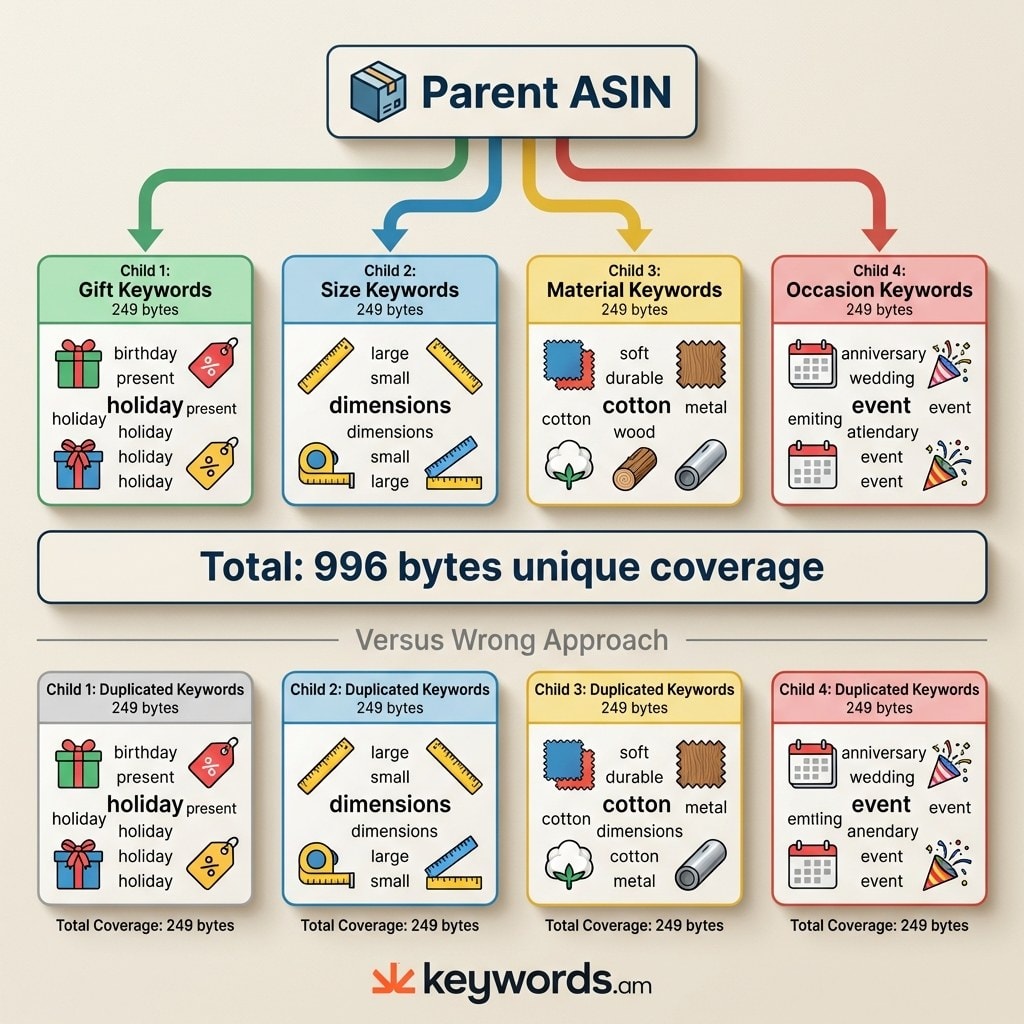
Effective distribution strategies:
- Color Variations: Assign unique long-tail keywords based on use cases or buyer intent. Child 1 could target “gift for mom,” Child 2 might focus on size/dimension, and Child 3 on material/features.
- Size Variations: Each size targets use-case specific keywords. A small size might target “travel-size,” while a larger size goes for “family pack.”
To check for variation cannibalization, use Amazon Brand Analytics Search Query Performance. If multiple child ASINs pop up for the same keywords and split clicks 50/50, they’re splitting sales velocity. Healthy variation keyword distribution means each child ASIN dominates different long-tail keywords. The parent, of course, captures the head term. See the backend keywords guide for a detailed allocation strategy.
Frequently Asked Questions About Amazon Keyword Cannibalization
These are the most common questions Amazon sellers ask about Amazon keyword cannibalization, overlap, and variation keyword strategy.
Conclusion
Navigating Amazon keyword cannibalization needs a nuanced understanding, beyond common misconceptions. Effective sellers differentiate overlap types to apply precise, impactful solutions.
Key takeaways:
* PPC keyword overlap? Mostly a myth. Prioritize consolidating fragmented data for efficient campaign optimization.
* PPC-to-organic cannibalization is costly, but easy to fix with bid reduction testing.
* Catalog-level keyword overlap is the most damaging and underdiagnosed problem. That needs reverse ASIN analysis of your product catalog.
* Variation listings are powerful keyword multipliers. Strategically distribute unique long-tail search terms across child ASINs.
As an immediate action, run a reverse ASIN lookup on your top 3-5 ASINs in the same category. Construct a keyword overlap matrix. If any pair shares over 40% of primary keywords with similar rank positions, you have catalog cannibalization. Identifying these overlaps highlights the critical need for effective keyword tracking and reverse ASIN tools. That transforms potential losses into optimized performance.