Amazon Fundamentals
Amazon A10 algorithm ranking factors explained (and the best keyword strategy for 2026)
Learn how the Amazon A10 algorithm ranks products in 2026. See the 7 ranking factors that matter most and the keyword strategy that boosts organic rank.

Most sellers want to rank higher on Amazon, but few understand the ranking engine deciding who shows up first. That gap between wanting and understanding is where rankings are won or lost. The Amazon A10 algorithm is what most of the seller community calls the current ranking system, and it rewards a very different set of behaviors than the A9 model that came before it.
The problem with most A10 guides is they read like grocery lists. They name factors but never connect each one to a specific keyword decision. That leaves sellers optimizing blindly, stuffing more terms into titles and hoping something sticks while PPC costs climb.
This guide maps each Amazon A10 algorithm ranking factor to a concrete keyword research or placement decision. By the end, you’ll have a playbook that feeds every signal the ranking engine looks for.
What is the Amazon A10 algorithm and why should sellers care?
The Amazon A10 algorithm is the community label for the current ranking system that decides which products appear when shoppers search. It weights organic sales, external traffic, and seller authority more heavily than its predecessor did. A10 processes every query typed into the platform and orders the results based on which product Amazon believes is most likely to close the sale.
The shift from A9 happened gradually through continuous machine-learning updates rather than a single announcement. Amazon has never officially named its ranking engine, so “A10” is shorthand for the observable behavior sellers and tool vendors have measured since roughly 2020.
Ranking position dictates market share on this platform. The majority of Amazon clicks land on first-page results, and most shoppers never scroll past the top ten listings. If a product isn’t on page one, it’s practically invisible.
Amazon tweaks this engine constantly to maximize revenue and buyer satisfaction. Sellers who treat it like a rigid keyword-matching tool fail consistently. Those who understand the behavioral signals driving it tend to win.
What are the 7 ranking factors that actually matter in 2026?
The seven ranking factors that move the needle are text relevance, sales velocity, conversion rate, seller authority, external traffic, click-through rate and dwell time, and inventory availability. Each one requires a different keyword strategy response.
Text relevance is about whether your listing copy matches what shoppers actually type. Amazon no longer looks only for exact matches; the engine understands context, synonyms, and related concepts. Strategic placement using the TFSD framework beats brute-force stuffing every time.
Sales velocity and conversion rate operate as a performance flywheel. High daily sales tell the algorithm the product satisfies current demand. A strong conversion rate proves the listing turns browsers into buyers. A listing pulling a 15% conversion rate on modest traffic often outranks a competitor sitting at 5% on much larger volume.
Seller authority acts as a trust score inside the ranking engine. Account tenure, return rate, feedback ratings, and complaint resolution all feed into it. Sellers can’t fake tenure, but they can protect account health.
External traffic represents the biggest A10 shift. Traffic from social platforms, influencer content, and external blogs now boosts organic rankings directly. Amazon values buyer traffic it didn’t have to pay to acquire.
Click-through rate and dwell time provide behavioral confirmation. CTR shows the title and main image are working in search results. Dwell time confirms the listing content holds attention. Good product title optimization solves both at once.
Inventory availability is essentially binary. Run out of stock and rank drops fast, because A10 won’t send traffic to a listing that can’t ship. Consistent stock is not optional if ranking matters.
Organic versus paid sales weighting has shifted. Organic sales carry more ranking weight per transaction than PPC-driven sales, though sponsored purchases still contribute. This closed the loophole of buying organic rank purely through aggressive ad spend.
| Factor | What A10 Measures | Keyword Strategy Implication |
|---|---|---|
| Text Relevance | Keyword matching across the listing | Strategic placement using the TFSD framework |
| Sales Velocity & Conversion | Daily sales and browser-to-buyer ratio | Target terms that close sales, not high volume |
| Seller Authority | Account health, tenure, return rate | Maintain strong operational metrics |
| External Traffic | Clicks from off-Amazon sources | Optimize keywords in off-site content and blogs |
| CTR & Dwell Time | Search result clicks and time on page | Write compelling, readable titles and rich content |
| Inventory Availability | Current stock levels | Maintain consistent stock to preserve rank |
| Organic vs Paid Sales | Ratio of natural to sponsored conversions | Build organic momentum through targeted placement |
These factors didn’t appear out of thin air. They evolved from the older A9 logic, and understanding what changed reveals where to shift focus.
What actually changed from A9 to A10?
A10 shifted ranking weight from PPC-driven sales and exact keyword matches toward organic conversions, external traffic, seller authority, and behavioral engagement metrics. Under A9, sellers who crammed the most exact keywords into titles often won the top positions. Exact terms placed in the title mattered more than almost anything else.
Sellers could also buy organic rank under A9 by flooding a listing with aggressive PPC spend, creating an artificial sales velocity loop. A10 closed that loophole by giving organic sales more weight per transaction. PPC still helps, but it no longer purchases organic position at the same rate.
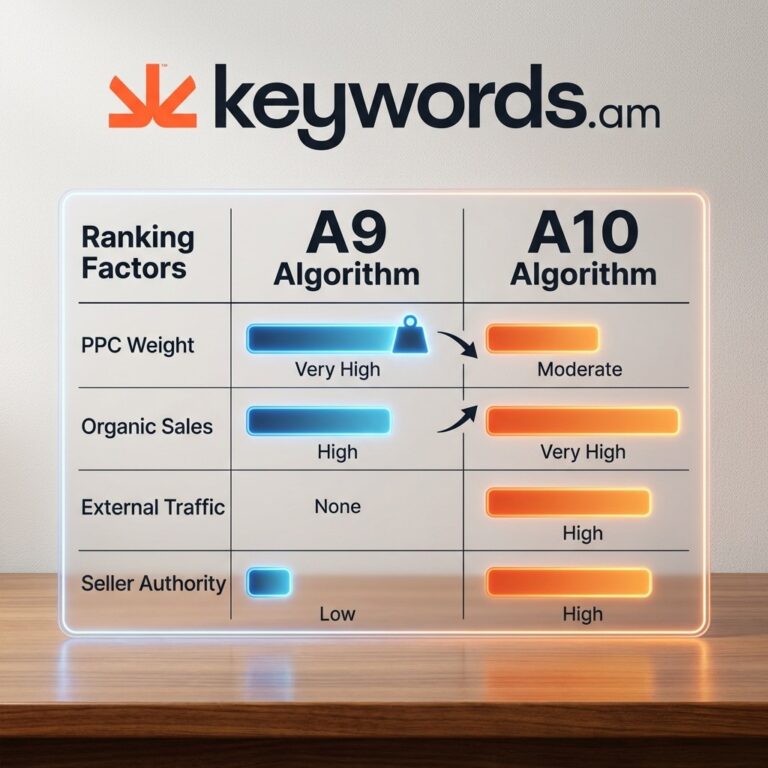
External traffic was irrelevant under A9. Now it serves as a genuine organic ranking signal. Amazon recognized that external brand building drives high-quality buyers to the platform, so it started rewarding sellers who deliver that traffic.
Seller authority barely mattered under A9. Account health determined whether you could sell at all, not where you ranked. That’s changed. Feedback scores, complaint rates, and account tenure now factor into search position, which pushes risky sellers down in results to protect buyers.
| Factor | A9 Weight | A10 Weight | What It Means for Sellers |
|---|---|---|---|
| Text Relevance (Keywords) | Very High | High | Still critical, but exact match is less dominant; semantic relevance matters more |
| PPC/Sponsored Sales | Very High | Moderate | Organic sales now carry more weight per transaction |
| Organic Sales Velocity | High | Very High | The strongest ranking signal available |
| External Traffic | None | High | Off-Amazon traffic directly boosts organic rankings |
| Seller Authority | Low | High | Account health and feedback affect visibility |
| CTR & Dwell Time | Low | Moderate-High | Behavioral signals confirm listing relevance |
| Inventory Status | Moderate | High | Stock-outs damage rank faster than before |
Knowing what changed is useful context. Knowing how to respond with keyword strategy is what actually moves rankings.
How does each ranking factor connect to your keyword strategy?
Each ranking factor demands a specific keyword approach. Text relevance needs strategic placement across TFSD layers. Sales velocity requires targeting keywords that convert. External traffic creates off-Amazon keyword opportunities.
Text relevance calls for coverage, not stuffing. Instead of cramming everything into the title, spread keywords across all listing sections using a structured framework. Hidden backend keywords work well here too, holding synonyms and variants the shopper won’t see but the algorithm will.
Sales velocity requires targeting converting keywords rather than vanity high-volume terms. A keyword with 50,000 monthly searches and a 0.1% conversion rate damages your metrics by pulling in window shoppers who bounce. A targeted term with 5,000 searches and a 3% conversion rate lifts rank. Prioritize by conversion potential, not raw volume.
External traffic makes off-Amazon keyword strategy matter. Keywords embedded in external blog posts, social captions, and influencer video descriptions that link to a listing contribute to ranking. When Google indexes an article pointing to a product, the anchor text passes external relevance signals into the ranking engine.
Click-through rate demands titles that balance keywords with human readability. A title stuffed with terms but unreadable to shoppers kills CTR, which then kills rank. The amazon listing optimization craft is finding phrasing that both indexes well and earns clicks.
Conversion rate means listing content must match keyword intent. If a listing ranks for “heavy duty garden hose” but the bullets describe a lightweight sprinkler hose, shoppers click, realize the mismatch, and leave. A10 demotes the listing for failing to satisfy intent. See the amazon conversion rate guide for more on protecting this metric.
Understanding these connections establishes the foundation. Turning them into action requires a repeatable process.
What does the keyword strategy playbook for A10 look like?
An A10-aligned keyword strategy starts with reverse ASIN research to find converting terms, uses coverage checks to find indexing gaps, then allocates keywords across TFSD layers based on priority scores.
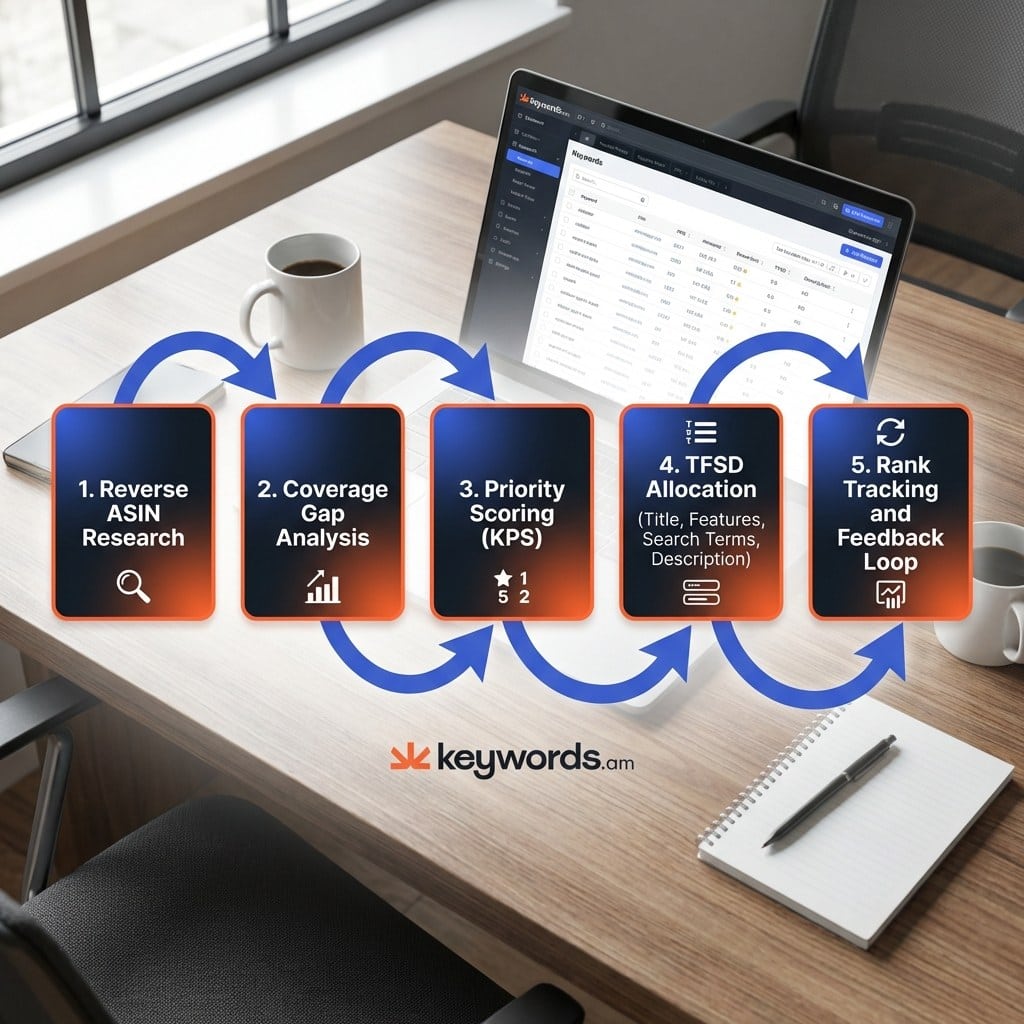
Step one is reverse ASIN research. Identify what top competitors are converting on, not just what they rank for. This reveals high-intent keywords the algorithm already rewards with sales. Basic seed keyword tools miss the hidden terms driving actual revenue, which is why a reverse ASIN lookup is the right starting point.
Step two uses coverage checks to find indexing gaps. If a listing isn’t indexed for a keyword, it can’t rank for it. Compare the extracted competitor keyword list against your current listing text and close the gaps. This forms the foundation of proper indexing.
Step three prioritizes the keyword list by conversion potential rather than raw search volume. Sort the pool by likely conversion impact, not total monthly searches. Raw search volume is often a vanity metric; actual conversion drives revenue and ranking power.
Step four allocates prioritized keywords across the four TFSD layers. Highest-priority terms go into the title. Strong secondary terms live in the bullet features (see the bullet points guide for structure). Broad long-tail phrases sit in the backend search terms. Supporting terms round out the description. This systematic keyword research methodology eliminates arbitrary placement.
Step five is tracking rank changes to measure the response. After pushing updates live, monitor which keywords moved and in which direction. This closes the feedback loop between actions and algorithmic reality, letting sellers double down on what works and fix what doesn’t.
Frequently Asked Questions About the Amazon A10 algorithm
Does PPC still help with organic ranking under A10?
Yes, PPC-driven sales still feed organic ranking, but A10 weights natural organic sales more heavily per transaction. PPC accelerates initial visibility while organic conversions sustain long-term position. A balanced approach using sponsored ads to seed velocity while building natural momentum remains the optimal play. See the amazon ppc optimization guide for more on getting this balance right.
Is the Amazon A10 algorithm actually real or just marketing hype?
A10 is the seller community’s label for a series of ranking updates Amazon has rolled out since around 2020. Amazon doesn’t publish version numbers or officially name its algorithm, but the observable shifts in ranking behavior are documented widely by sellers and tool vendors. The underlying factor changes are real regardless of what you call the engine.
How long does it take to see ranking changes after optimizing a listing?
Most keyword and listing edits produce measurable movement within 7 to 14 days, though competitive categories can take 30 days or longer. Initial indexing happens within hours, but position changes depend on fresh sales velocity and conversion data accumulating. Track target keywords daily for the first two weeks after any change.
Do backend keywords still affect A10 rankings in 2026?
Yes, backend search terms remain fully indexed and expand the queries your listing matches against. They’re the right home for synonyms, misspellings, and long-tail phrases that don’t fit naturally in visible copy. Amazon allows roughly 249 bytes in the search terms field (as of 2025), so use it deliberately.
Does Amazon use the same algorithm across all marketplaces?
The core ranking logic applies across all marketplaces, but factor weighting varies by market maturity, category density, and local shopper behavior. The US, UK, Germany, and Japan use the same underlying engine. External traffic and seller authority tend to carry different weights in less mature markets where data density is lower.
Conclusion
- Convert, don’t chase volume. The Amazon A10 algorithm rewards sellers who pick keywords that close sales, not those chasing high-volume vanity terms.
- Behavior drives ranking. Shoppers dictate position through their clicks, dwell time, and purchases; the algorithm follows.
- External traffic is a lever, not a nice-to-have. Off-Amazon traffic feeds organic rank directly and can differentiate a brand in a crowded category.
- Placement beats stuffing. Deliberate allocation across title, bullets, backend, and description outperforms cramming terms into any single field.
- Track what you change. Rank tracking closes the loop between what you optimize and what actually earns revenue.
Run a reverse ASIN lookup on your top competitors today. Compare their converting keywords against your current listing coverage. The gap between those two lists is where ranking opportunity lives. Start with the free Amazon keyword tool to pull that data and build a keyword list your listings can actually convert on.