
📑 Table of Contents
- What Is Amazon Rufus and How Does It Actually Work?
- How Fast Is Rufus Growing and Why Should Sellers Care?
- What Does Rufus Change About Amazon Keyword Strategy?
- How Does the TFSD Framework Already Prepare Listings for Rufus?
- What Are the 5 Practical Steps to Optimize Listings for Rufus?
- What Mistakes Should Sellers Avoid When Optimizing for Rufus?
- Frequently Asked Questions About Amazon Rufus AI Listing Optimization
- Conclusion
⚡ TL;DR
- Rufus adoption exploded from 3% to 38% of sessions in 2025, driving $12 billion in sales.
- Traditional keyword matching (A10) remains essential for indexing; Rufus is an additive layer.
- The TFSD framework (Title, Features, Search Terms, Description) prepares 80% of a listing for AI search.
- Natural language matters more now, but the shift is to benefit-first copy, not keyword removal.
- High-impact, low-effort Rufus tactics: fill every Seller Central field and seed Q&A sections.
- The 75/20/5 rule prevents sellers from over-investing in AI at the expense of core SEO.
Amazon Rufus reached 300 million customers in 2025 and drove $12 billion in incremental sales. By Black Friday, the AI shopping assistant was involved in 38% of all shopping sessions on the platform.^[ref-1] This is not a niche experiment anymore.
Sellers are caught between two conflicting camps. One insists “Rufus changes everything” and urges brands to rewrite entire catalogs. The other argues sellers should ignore it because keywords still work. Both are wrong. Rufus adds a layer of complexity without removing the foundational requirements of the A10 search algorithm.
This guide shows how the TFSD framework already covers the majority of what Rufus requires. Rather than abandoning proven keyword strategies, sellers can layer specific amazon rufus AI listing optimization tactics on top of existing work to capture AI-driven growth without sacrificing core keyword visibility.
What Is Amazon Rufus and How Does It Actually Work?
Rufus is Amazon’s conversational AI shopping assistant that analyzes product listings, reviews, Q&As, and web data to answer customer questions and recommend products.
Launched in early 2024 as a chat-based interface within the Amazon shopping app, Rufus is trained on Amazon’s product catalog, millions of customer reviews, community Q&A sections, and external web data.^[ref-2] This training data allows it to understand relationships between products and user intent in ways traditional keyword search cannot.
The core difference: traditional Amazon search requires specific keywords. Users type “running shoes flat feet” to find matching products. Rufus powers conversational queries like “what running shoes are good for flat feet?” and interprets the intent behind the question.^[ref-3]
Behind the scenes, Rufus is built on COSMO (Common Sense Knowledge Graphs for e-commerce), which maps products to use cases, attributes, and customer intents.^[ref-4] The critical implication for sellers: Rufus pulls from every available field. It reads the title, bullets, description, A+ content, images, Q&As, reviews, and backend search terms.^[ref-3] Sellers who only optimize titles and bullets are leaving data on the table.
How Fast Is Rufus Growing and Why Should Sellers Care?
Rufus grew from under 3% of sessions in early 2025 to 38% by Black Friday, reaching 300 million customers and driving $12 billion in incremental sales.
In early 2025, Rufus usage hovered under 3% of total Amazon shopping sessions. Many sellers dismissed it as a novelty.^[ref-5] That was a reasonable position at the time.
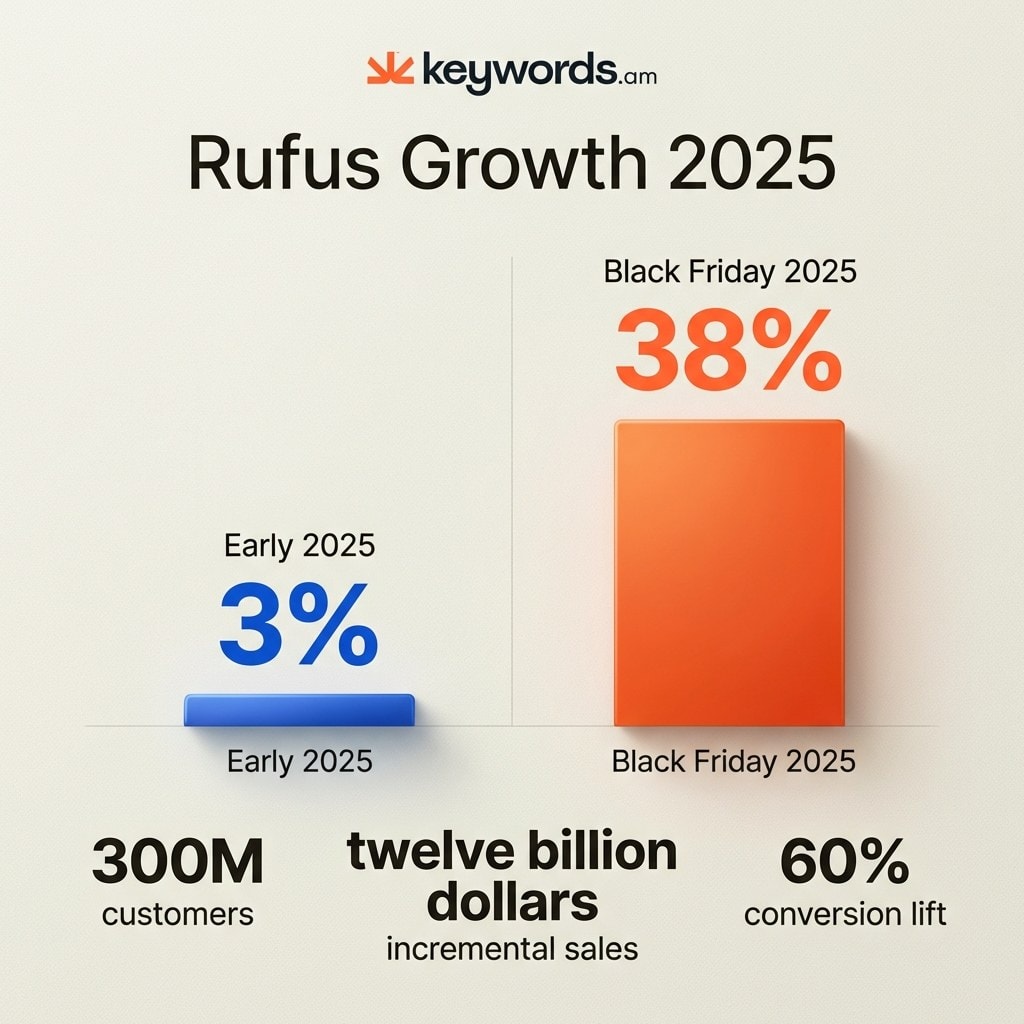
Then the adoption curve accelerated. By Black Friday 2025, Rufus was active in 38% of all shopping sessions, with monthly active users growing 140% year-over-year.^[ref-1] Shoppers are increasingly comfortable asking questions rather than typing keywords, and Amazon keeps pushing Rufus into more prominent positions.
The conversion data is what should get sellers’ attention: customers who engage with Rufus convert at a rate 60% higher than non-Rufus users.^[ref-1] Amazon reported $12 billion in incremental annualized sales from Rufus in 2025.^[ref-1] This technology is not getting shelved.
|
Metric |
Early 2025 |
Black Friday 2025 |
Trend |
|---|---|---|---|
|
Session share |
~3% |
38% |
12x growth |
|
Customer reach |
N/A |
300M customers |
N/A |
|
Conversion lift |
N/A |
+60% vs non-users |
N/A |
|
Incremental sales |
N/A |
$12B annualized |
N/A |
|
MAU growth |
N/A |
+140% YoY |
Accelerating |
What Does Rufus Change About Amazon Keyword Strategy?
Rufus shifts Amazon search from exact-match keyword matching toward semantic understanding, making natural language and context more important than keyword density alone.
Under the A10 algorithm, Amazon matched keywords in a user’s query to keywords in a listing. Exact match dominated. If a seller wanted to rank for “blue yoga mat,” that phrase needed to appear in the title or backend search terms.^[ref-6]
Rufus adds a semantic layer. When a shopper asks “What is the best gift for a 10-year-old who likes science?”, the query contains no product keywords. Rufus infers that a chemistry set or microscope is relevant based on product attributes, categories, and review sentiment.^[ref-3] A listing does not need the word “gift” to be recommended if its attributes establish suitability.
This does not mean sellers should abandon keywords. A10 still governs initial retrieval and indexing. Keywords in titles, bullets, and backend search terms remain the primary mechanism for appearing in standard search results.^[ref-6] The shift is about balance: keywords are still necessary for indexing, but keyword stuffing now carries a higher penalty. Rufus treats listings with disjointed, keyword-heavy text as lower-quality answers.^[ref-5]
The goal: write the best possible answer to a customer’s question while naturally incorporating core keywords for A10 indexing.
How Does the TFSD Framework Already Prepare Listings for Rufus?
The TFSD framework (Title, Features, Search Terms, Description) already structures listings the way Rufus reads them. Each layer now needs a natural-language polish.
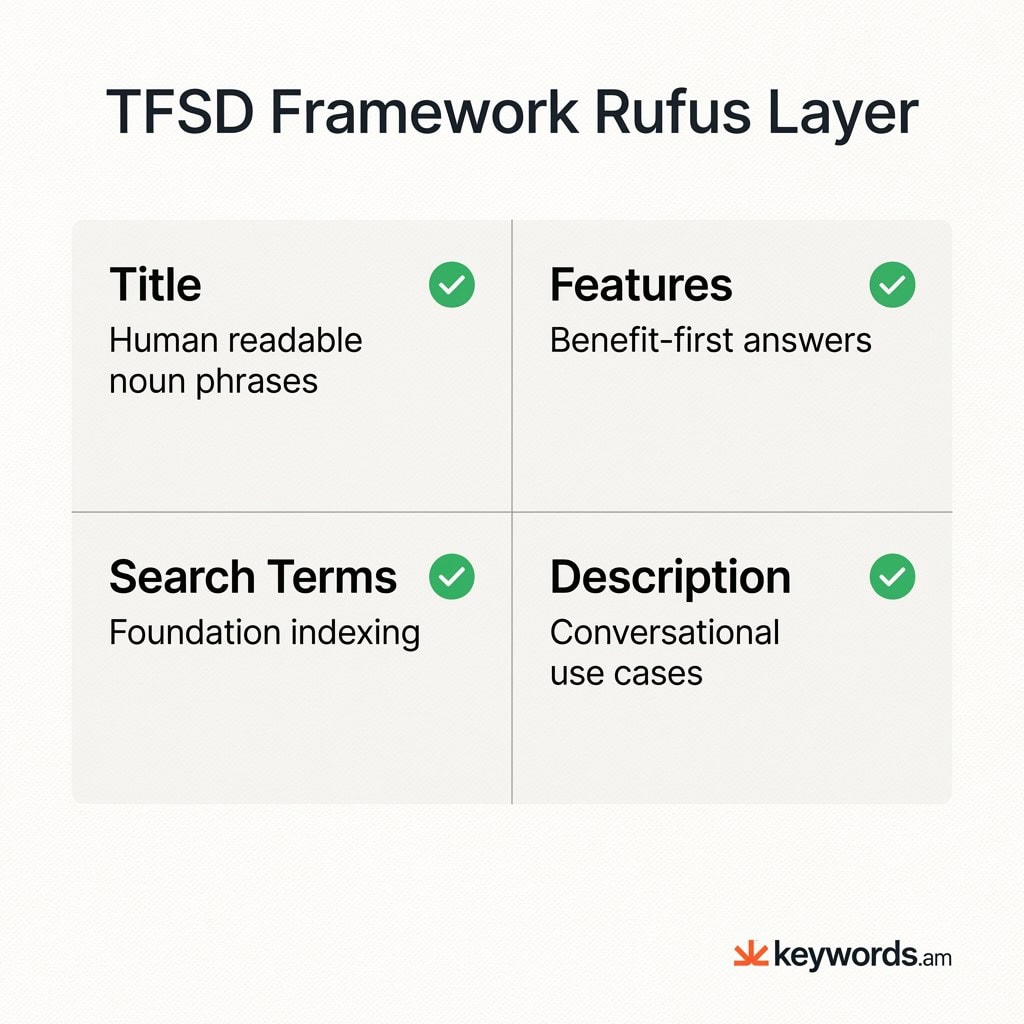
Sellers following the TFSD framework are in a strong position because this structure prioritizes the exact elements Rufus analyzes. The framework breaks down Amazon listing optimization into four layers, each serving a purpose that aligns with both human psychology and AI processing.
Title: TFSD has always advocated for clear, readable titles with primary keywords. For Rufus, the title must read as a complete noun phrase. “Stainless Steel Insulated Water Bottle 32oz, Keeps Drinks Cold 24 Hours” is superior to “Water Bottle Stainless Steel Insulated 32oz Cold Hot BPA Free.”^[ref-5] The first is an entity Rufus can parse. The second is unstructured data.
Features (Bullets): TFSD emphasizes benefit-driven bullets. Rufus looks for answers to customer problems. “Fits in standard car cup holders” beats “Compatible with most cup holders” because it directly answers the query “will this fit in my car?”^[ref-3] Sellers should review their Amazon bullet points to phrase them as answers.
Search Terms: Backend search terms remain critical for A10 indexing. Rufus does not read these fields directly, but products must be indexed to appear in any search context.^[ref-6] Search terms handle the foundation layer so visible content can focus on natural language.
Description: TFSD treats the product description as conversion copy. For Rufus, descriptions should answer comparison questions (“how does this compare to X?”) and use-case questions (“is this good for camping?”).^[ref-3] This provides the semantic data Rufus needs to make recommendations.
Keywords.am’s KPS (Keyword Performance Score) scoring identifies which keywords carry the most semantic weight, helping sellers optimize listings for rufus without guessing which terms matter most.
What Are the 5 Practical Steps to Optimize Listings for Rufus?
Optimize for Rufus by building comprehensive Q&As, writing benefit-first bullets, filling every Seller Central field, ensuring image-text consistency, and maintaining data accuracy across all fields.
Beyond the TFSD structure, these specific steps maximize visibility in Rufus results:
- Build a Q&A section with 8-12 questions. Rufus indexes Q&As aggressively. Seed questions covering materials, sizing, compatibility, and use cases.^[ref-5] A question like “Can this be washed in a dishwasher?” with a clear “Yes” gives Rufus a definitive data point.
- Write bullets as benefit statements. “Keeps drinks cold for 24 hours on hot summer days” triggers more Rufus matches than “24-hour cold retention.”^[ref-3] Natural language helps the AI understand value, not just specifications.
- Fill out every optional Seller Central field. Fields like “intended use,” “age range,” “occasion,” and “material type” feed directly into the COSMO knowledge graph.^[ref-5] If Rufus is looking for a “formal dress for a wedding,” it relies on these attributes. Empty fields are missed opportunities.
- Ensure image-listing consistency. Rufus cross-references text claims with image data. If bullets say “holds 32oz” but images suggest otherwise, the contradiction lowers the product’s reliability score.^[ref-3]
- Maintain accuracy across all fields. Rufus checks for consistency between title, description, A+ content, and reviews. A title saying “100% Cotton” while the description mentions “Polyester blend” is a red flag.^[ref-5] Consistent data is a primary ranking factor for AI recommendations. Sellers can refer to guides on AI vs human listing writing for quality benchmarks.
What Mistakes Should Sellers Avoid When Optimizing for Rufus?
Sellers should avoid abandoning traditional keyword SEO, rewriting all listings overnight, and stuffing conversational phrases awkwardly into existing copy.
The hype around AI leads to overreactions that damage performance. These are the traps to avoid:
Do not abandon traditional keyword SEO. Stripping high-volume keywords to sound more “conversational” kills indexing. A10 still handles the majority of search retrieval.^[ref-6] Integrate keywords naturally; do not remove them.
Do not rewrite every listing at once. Start with the top 5-10 performers. Measure impact. Roll out changes gradually.^[ref-5] This prevents a catalog-wide disruption if execution is flawed.
Do not stuff conversational phrases. Writing “Are you looking for a great water bottle for hiking?” in bullet points looks spammy to both humans and AI.^[ref-5] Rufus understands natural product language. It does not need chat-style prompts in listing copy.
Apply the 75/20/5 Rule. Keywords.am recommends this allocation of amazon rufus AI listing optimization effort: 75% on traditional keyword strategy (the foundation), 20% on copy quality improvement (natural language, benefit-first writing), and 5% on Rufus-specific additions (Q&A seeding, filling optional fields).^[our-data-1] This balance protects the existing revenue engine while preparing for AI-driven growth.
Frequently Asked Questions About Amazon Rufus AI Listing Optimization
> The most common questions sellers ask about optimizing for Amazon Rufus, answered with practical guidance for immediate implementation.
Conclusion
Amazon rufus AI listing optimization is not a separate discipline. It is the natural evolution of structured listing optimization that the TFSD framework already supports.
Rufus grew from a minor feature to a presence in 38% of shopping sessions. Conversational commerce is here to stay. But this does not make traditional SEO obsolete. The two systems work together: A10 provides the index, Rufus provides the intelligence.
A well-structured listing is already 80% prepared for Rufus. The remaining work involves refining tone, ensuring data completeness, and filling fields like Q&A that the AI prioritizes.
- Rufus grew from 3% to 38% of sessions in 2025, and the trajectory continues
- Traditional keyword SEO still matters. Rufus is additive, not a replacement
- The TFSD framework already covers 80% of what Rufus needs
- The 75/20/5 rule keeps optimization effort balanced
Next step: Review the top 5 listings. Fill every optional Seller Central field and add 3-5 Q&A entries. That takes 30 minutes and covers the highest-impact Rufus ranking factors. Start with the TFSD framework as the foundation, layer in natural language, and use the best Amazon listing optimization tools to identify which keywords carry the most weight for both traditional search and Rufus.
[^ref-1]: Amazon Rufus $12B Sales Impact
[^ref-2]: Amazon Rufus Launch
[^ref-3]: Seller Labs Rufus Optimization
[^ref-4]: Ecomtent COSMO Analysis
[^ref-5]: Ecomclips Rufus Guide 2026
[^ref-6]: MyAmazonGuy Rufus Strategies
[^our-data-1]: The 75/20/5 Rule, Keywords.am recommended time allocation