
📑 Table of Contents
- What is the fundamental difference between Amazon SEO and Google SEO?
- How do Amazon’s A10, COSMO, and Rufus compare to Google’s core algorithm?
- How does keyword strategy differ between Amazon and Google?
- How does content strategy differ between Google and Amazon?
- What are the most common mistakes Google SEO experts make on Amazon?
- Frequently Asked Questions About Amazon SEO vs Google SEO
- Conclusion
⚡ TL;DR
- Intent gap: Google optimizes for information discovery, while Amazon optimizes for purchase conversion. This drives every other difference.
- Algorithm: Google uses backlinks and E-E-A-T signals. Amazon relies on sales velocity, conversion rates, and the COSMO/Rufus AI layer.
- Keywords: Google targets semantic clusters across pages. Amazon requires field-specific distribution via the TFSD framework.
- Content: Google rewards 1,447-word authority pages. Amazon limits titles to 200 bytes and bullets to 1,000 characters.
- Backlinks: Foundational for Google, irrelevant for Amazon. External traffic is the only crossover signal.
- PPC: Google Ads do not boost organic ranking. Amazon PPC fuels the organic flywheel.
- What transfers: Research methodology, structured thinking, CRO skills, and competitive analysis transfer. The specific tactics do not.
90% of U.S. shoppers check Amazon even after finding a product on Google. That single stat explains why Google SEO professionals are flooding into Amazon optimization.
The problem? Google’s playbook can actually hurt you on Amazon. Assumptions about backlinks, content length, and keyword density that served you well for ten years don’t hold up when the algorithm is built around purchase behavior instead of information retrieval.
This Amazon SEO vs Google SEO comparison breaks down every major concept side by side. It also digs into the 2026 AI layer (COSMO and Rufus) that none of the other comparison articles on the SERP even mention, and spells out which of your existing skills carry over and which ones you’ll need to leave behind.
Factor |
Google SEO |
Amazon SEO |
|---|---|---|
Primary goal |
Information discovery |
Product purchase |
Core algorithm |
Google Core + E-E-A-T |
A10 + COSMO + Rufus AI |
Key ranking signal |
Backlinks + content quality |
Sales velocity + conversion rate |
Keyword strategy |
Long-tail semantic clusters across pages |
Field-specific distribution (TFSD) |
Content format |
Long-form (1,447 word avg for page 1) |
Character-limited fields + A+ Content |
Off-page signals |
Backlinks (foundational) |
External traffic (minor A10 signal) |
Paid-organic link |
Separate (Ads don’t boost organic) |
Connected (PPC fuels organic flywheel) |
AI layer (2026) |
AI Overviews changing CTR |
COSMO + Rufus replacing keyword matching |
Primary tool |
Ahrefs / Semrush + GSC |
Keywords.am + Brand Analytics |
What is the fundamental difference between Amazon SEO and Google SEO?
Here’s the short version: Google helps people find information, and Amazon helps people buy things. Every other difference flows from that one fact.
Google juggles 200+ ranking factors because it needs to sort the entire internet into useful answers. It leans on E-E-A-T because bad information hurts users and, by extension, ad revenue. The signals are broad: backlinks, content depth, page experience, brand mentions.
Amazon doesn’t care about any of that. Shoppers show up with credit cards out, and Amazon’s job is to match them with something worth buying. So the algorithm zeroes in on what actually predicts a sale: conversion rate, sales velocity, relevance, and seller track record. If a product doesn’t convert, it drops. Simple as that. The Amazon A10 algorithm breaks down how each signal weighs in.
How do Amazon’s A10, COSMO, and Rufus compare to Google’s core algorithm?
Google’s algorithm decides trust through backlinks and content quality. Amazon’s A10 skips all of that and watches what shoppers actually do: click, add to cart, buy, or bounce.
The A10 system grew out of the older A9 engine, but it now puts much heavier weight on real customer behavior. A product that converts well climbs. A product that racks up impressions without sales? It sinks fast. And that’s just the baseline, because Amazon recently layered two AI systems on top that have no Google equivalent.

COSMO: Amazon’s commerce knowledge graph
COSMO introduced a 6.3 million-node semantic knowledge graph built for commerce intent. Google’s Knowledge Graph maps world facts, but COSMO maps product relationships. It understands shopping contexts and buyer intent patterns. COSMO knows that a tent, a sleeping bag, and a portable stove all relate to a camping trip. This AI layer changes how products rank for broad queries.
Rufus AI: conversational product discovery
Think of Rufus as what happens when you combine a chatbot with a shopping assistant. Over 300 million users already interact with it, and Amazon says it’s influenced $12 billion in sales so far, with a 3.5x conversion lift on products it recommends. Google’s AI Overviews pull snippets from web pages. Rufus goes further: it actually recommends products based on a conversation. If someone asks “what do I need for a camping trip?”, Rufus doesn’t show ten blue links. It shows a tent, a headlamp, and a sleeping bag. Adapting to this shift is covered in the Rufus AI listing optimization guide.
Bottom line for 2026: listings need to speak to these AI systems, not just match keywords. That means spelling out use cases, explaining who the product helps, and describing the problem it solves. Old-school keyword stuffing won’t cut it anymore.
Signal Type |
Google |
Amazon |
|---|---|---|
Content relevance |
Semantic matching + entity recognition |
COSMO knowledge graph + keyword indexing |
Authority |
Backlinks + domain authority |
Sales velocity + review count |
User behavior |
CTR + dwell time + pogo-sticking |
Conversion rate + add-to-cart rate |
Technical |
Core Web Vitals + mobile-first |
Listing completeness + image count |
AI layer |
AI Overviews (changes CTR patterns) |
Rufus (conversational product discovery) |
Freshness |
Content freshness signal |
Sales recency + inventory availability |
How does keyword strategy differ between Amazon and Google?
On Google, keywords spread across pages, headings, and topic clusters. On Amazon, every keyword needs to land in a specific product field, and each field has a hard character cap.
If you’re coming from Google SEO, you’re used to building pillar pages and interlinking cluster content around a topic. Amazon doesn’t work that way. Keywords attach to a single product, not a page or a site. And there’s no room for sprawl: an Amazon title caps at 200 bytes, bullets at 1,000 characters, and backend search terms at just 249 bytes. The Amazon character limits guide has the full breakdown.
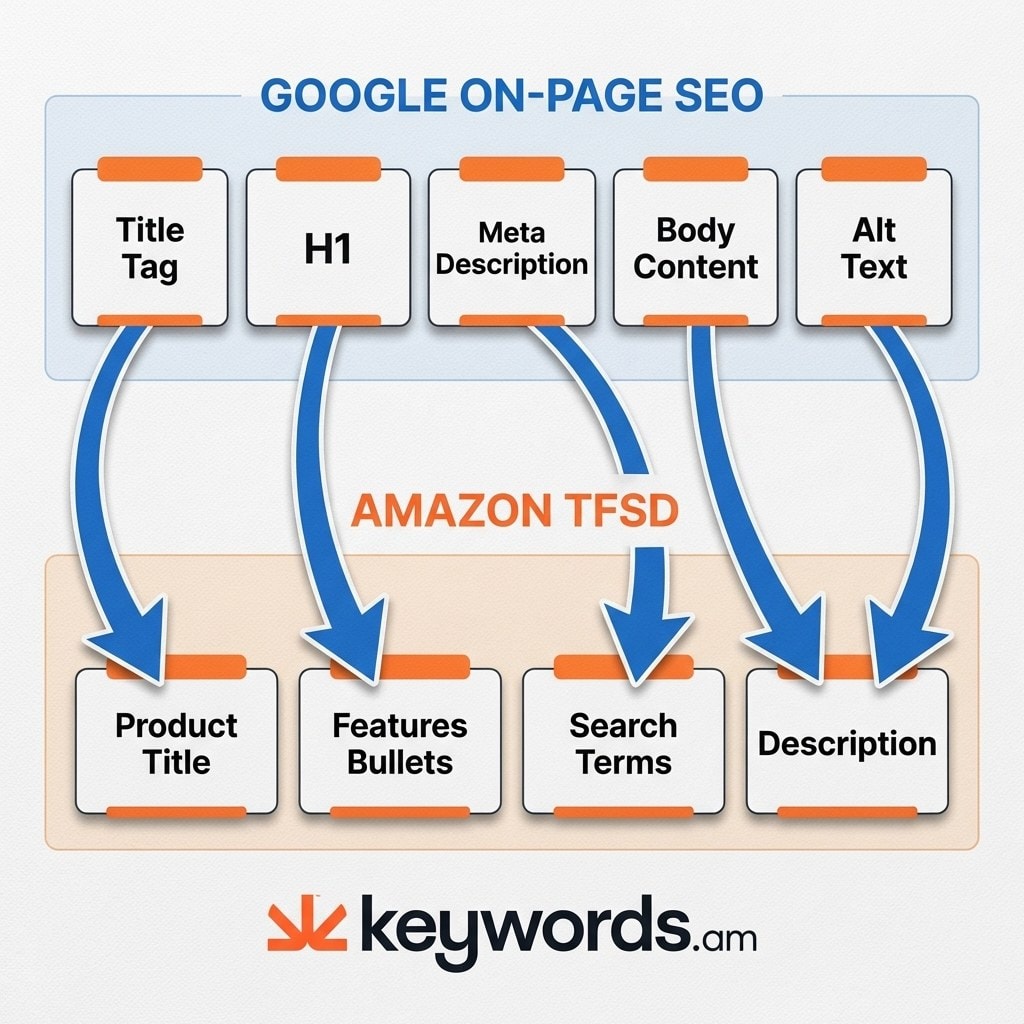
So where does Google’s on-page SEO map to on Amazon? That’s where TFSD comes in. It stands for Title, Features, Search Terms, and Description, and it’s the closest thing Amazon has to a structured on-page framework. Title tag becomes product title. Meta description becomes backend search terms. Body content becomes bullet points and A+ modules. Each TFSD field carries different algorithmic weight, so placement matters. The TFSD framework guide walks through the full methodology.
Keyword cannibalization works differently on each platform. On Google, two pages targeting the same keyword compete and hurt each other. On Amazon, multiple products from your own catalog targeting the same keyword is standard. Read more about Amazon keyword cannibalization to adjust catalog strategy safely.
Amazon backend search terms offer 249 bytes of invisible keyword space. Google dropped meta keywords years ago because of spam. Amazon still relies on backend terms to understand product relevance. Proper Amazon keyword indexing maximizes visibility for phrases that don’t fit naturally into public listing copy.
Google SEO uses Ahrefs, Semrush, and Google Search Console for volume data. Amazon requires specialized platforms. Keywords.am provides reverse ASIN lookups, search term reports, and keyword indexing checks based on actual Amazon shopping data. The Amazon Search Term Report reveals the exact queries customers use to find products.
How does content strategy differ between Google and Amazon?
Google loves long articles. Amazon loves short, scannable copy that gets shoppers to click “Add to Cart.” The content formats couldn’t be more different.
On Google, longer content tends to rank higher, with first-page results averaging around 1,447 words. Depth, comprehensiveness, and E-E-A-T signals all reward more thorough pages. Amazon flips that. The platform caps text to keep the buying experience fast: 200-byte titles, 1,000-character bullet points, 249-byte backend search terms. Every word has to earn its spot.
Try pasting a 2,000-word product description into Amazon. The platform will truncate it, and the shoppers who do see it will bounce. Mobile buyers especially don’t have patience for paragraphs when they’re three taps away from checkout. Effective Amazon copy is short, benefit-driven, and scannable. The Amazon product title optimization guide covers how to write within those constraints.
A+ Content: Amazon’s version of long-form
A+ Content swaps out the plain text description for rich images, comparison charts, and brand storytelling modules. Here’s the catch, though: Amazon’s search algorithm doesn’t index A+ Content text the way Google indexes page content. A+ exists to push conversion rates up, not to rank for keywords.
Backlinks: foundational on Google, irrelevant on Amazon
If you’ve spent years building backlink profiles, here’s the uncomfortable truth: Amazon doesn’t care. The platform never crawls the web to check who’s linking to a product page. Backlinks carry zero ranking weight. What does matter off-page? Sales velocity. And here’s where it gets interesting for Google SEOs: external traffic IS a minor A10 signal. So driving qualified visitors from social media, email lists, or blogs to an Amazon listing can actually help. That’s the one off-page area where Google experience pays off.
PPC: separate on Google, connected on Amazon
On Google, paid and organic live in separate worlds. Doubling your Google Ads spend won’t move your organic position one pixel. Amazon broke that wall down. Every sponsored sale on Amazon counts as a real sale in the algorithm’s eyes. More sponsored sales means higher velocity, which means better organic rank. It’s a flywheel, and it’s why PPC strategy on Amazon isn’t optional. A properly structured Amazon PPC campaign doesn’t just drive paid revenue; it builds organic momentum.
What are the most common mistakes Google SEO experts make on Amazon?
The biggest mistakes are building backlinks to product listings, writing long-form descriptions, obsessing over search volume instead of conversion rate, and ignoring pricing as a ranking factor.
Building backlinks to Amazon listings wastes budget. Many beginners buy link packages for product pages. Amazon does not use backlinks as a ranking signal. External traffic helps drive sales, but link authority carries zero weight.
Writing long-form product descriptions backfires. Writers paste 2,000-word blog posts into the product description field. Amazon truncates it. Conversion drops when shoppers face walls of text instead of scannable, benefit-driven bullet points.
Optimizing for search volume over conversion rate is a critical error. A Google SEO might find a keyword with 100,000 monthly searches and stuff it into the Amazon title. The product gets thousands of impressions but zero clicks. The conversion rate plummets, Amazon notices the poor performance, and the ranking drops.
Ignoring pricing as a ranking factor reveals a blind spot. Google does not factor product price into organic rankings. Amazon’s Buy Box algorithm considers pricing. A non-competitive price kills sales velocity. If a competitor drops their price by twenty percent, they will likely steal organic rank.
Neglecting AI readability is the newest mistake. Sellers still write copy for the old A9 algorithm. They stuff keywords and ignore the AI layers. COSMO and Rufus need context, defined use cases, and clear problem-solving language. Keyword-stuffed listings don’t satisfy AI intent matching.
What transfers from Google SEO to Amazon
The good news? More transfers than you’d think, as long as you separate the tactics from the thinking behind them.
- Keyword research process still works. The tools swap out (Ahrefs becomes Keywords.am), but that habit of digging through data, spotting gaps, and prioritizing opportunities? Identical.
- Structured data thinking translates directly to TFSD. If you’re good at putting the right content in the right schema fields, you’ll pick up Amazon field optimization fast.
- CRO instincts don’t care about platform. A/B testing headlines, swapping hero images, rewriting bullet points to improve click-through: that’s the same muscle whether you’re optimizing a landing page or a product listing.
- Technical SEO habits port over more than most people expect. Auditing compliance, chasing indexing bugs, and fixing catalog errors are all part of Amazon too. That background makes it much easier to troubleshoot Amazon listing suppression when it hits.
- Competitive reverse-engineering works on both sides. Figuring out what the top-ranked competitors target and how they structure content? Same playbook, different data source.
Frequently Asked Questions About Amazon SEO vs Google SEO
These are the questions Google SEO professionals ask most often when starting Amazon optimization.
Amazon is a product search engine. It processes over 300 million product searches daily, but every query carries purchase intent rather than informational intent. Amazon is the top product search engine, with 90% of shoppers checking Amazon even after finding products elsewhere.
Backlinks have no direct impact on Amazon product rankings. Amazon’s A10 algorithm uses sales velocity, conversion rate, and relevance signals instead of link authority. External traffic TO Amazon listings is a minor A10 signal, but the link itself carries no authority weight.
TFSD (Title, Features, Search Terms, Description) is a structured keyword distribution framework for Amazon listings. It functions as the Amazon equivalent of Google’s on-page SEO hierarchy (title tag, H1, meta description, body content). Read the full TFSD framework guide for implementation steps.
Google SEO experience transfers in methodology: keyword research process, structured optimization, and competitive analysis all apply. But specific tactics like backlink building and long-form content must change for Amazon’s purchase-focused algorithm.
COSMO is Amazon’s 6.3-million-node semantic knowledge graph built for commerce. Unlike Google’s Knowledge Graph which organizes world knowledge, COSMO maps product relationships, shopping contexts, and buyer intent patterns. Learn more about preparing listings for AI in this Rufus AI listing optimization guide.
Conclusion
At the end of the day, Amazon SEO vs Google SEO comes down to one question: are you helping someone find information, or helping them buy something? Every difference in algorithm, keyword strategy, content format, and ranking signal traces back to that split.
The COSMO and Rufus layer is the part most SEO professionals haven’t caught up with yet. It’s the reason keyword stuffing is dying on Amazon and why “AI-readable” listings are pulling ahead. TFSD gives Google SEO veterans a structured way to translate on-page thinking into Amazon terms without starting from scratch.
Start here: Map your top 10 keywords to TFSD fields today. Assign each to Title, Features, Search Terms, or Description. Read the TFSD framework guide and use Keywords.am to handle the Amazon-specific research that Google SEO tools can’t provide.