Keyword Research
Amazon keyword cannibalization - the 3 types most sellers get wrong (and proven fixes for each)
Amazon keyword cannibalization splits rankings and wastes ad spend. Learn the 3 types (PPC, PPC-organic, catalog), how to detect each, and the proven fixes.

Amazon keyword cannibalization happens when your own listings, campaigns, or ASINs compete against each other for the same search terms, fragmenting data, splitting sales velocity, or wasting ad spend. Most sellers hear the term and picture PPC campaigns bidding against themselves, but that’s the least damaging version of the problem. The more expensive types (paid ads eating organic clicks, and multiple ASINs splitting keyword authority) usually go undiagnosed for months.
One supplement brand doing around $2M/month saw its organic sales ratio drop from 60-70% to 30-40% after aggressive PPC scaling, with TACOS jumping from 13% to 30% (Signalytics case study). A single targeted fix reportedly saved them six figures a year. That’s the cost of misdiagnosing cannibalization.
This guide lays out a three-type taxonomy, a detection audit you can run today, and specific fixes for each type. It also covers the variation listing strategy most sellers miss, using child ASINs as keyword multipliers instead of duplicates.
What is Amazon keyword cannibalization?
Amazon keyword cannibalization is when your own listings, campaigns, or ASINs compete against each other for the same search terms, splitting performance data, sales velocity, or ad spend. It’s an own goal in your account. The tricky part is that the internet lumps three very different problems under one label.
Here’s the taxonomy this guide uses:
| Type | What Competes | Verdict | Severity |
|---|---|---|---|
| PPC keyword overlap | Same keyword in multiple campaigns or match types | Mostly a myth | Low (data fragmentation only) |
| PPC-to-organic cannibalization | Paid ads stealing clicks from organic rank | Real and costly | Medium-High |
| Catalog-level keyword overlap | Multiple ASINs targeting identical search terms | Real and underdiagnosed | High |
Sellers mix these up because PPC overlap dominates online discussion, while catalog-level overlap between multiple ASINs quietly causes the biggest damage. That misdirected focus is why revenue leaks stay open. A clean Amazon PPC campaign structure prevents most early pitfalls, but you also need to audit at the listing and catalog level.
Does bidding on the same keyword in multiple campaigns hurt your Amazon PPC?
No. Amazon’s auction system picks one ad per seller per keyword per auction, so your campaigns aren’t bidding against each other and won’t inflate your CPC. Your bids compete against other sellers, not your own account (Sermondo breakdown).
The real issue with PPC keyword overlap is data fragmentation. When one keyword appears in multiple campaigns, impressions, clicks, and sales scatter across them. Say a keyword gets 100 clicks a month split 30/25/20/15/10 across five campaigns, no single campaign has enough data to optimize confidently.
Fragmentation slows optimization cycles, which matters most at scale when you’re chasing aggressive ACOS targets. It’s not free (opportunity cost is real) but it’s not the CPC disaster most sellers fear. A clear amazon PPC optimization approach handles this with match-type hierarchy and negatives.
How does PPC cannibalize organic sales on Amazon?
PPC-to-organic cannibalization happens when sellers pay for ad clicks on keywords where they already rank in the top 3 organically. That’s spend on traffic they’d receive for free. Going back to that supplement brand, its organic ratio dropped from 60-70% to 30-40% and TACOS climbed from 13% to 30% after PPC scaling (source). On $2M/month, a TACOS jump of that size implies roughly $340K/month in extra ad spend, much of it displacing free clicks.
Bidding on a keyword where you already rank top 3 isn’t automatically wrong. Smart bidding can grab two page-one spots (ad plus organic) and block competitors. The real question is whether incremental sales from the ad justify the cost.
TACOS is your diagnostic. If TACOS on keywords where a product ranks top 3 organically climbs above 20%, ads are probably eating existing organic clicks rather than adding new ones. Signalytics cites an aggregate healthy Amazon TACOS around 13.4% in their sample. For deeper benchmarks, see the guides on amazon ACOS and amazon TACOS.
To detect PPC-organic cannibalization, compare organic rank against ad placement for your top keywords. Amazon Brand Analytics Search Query Performance shows organic versus ad click share side by side. The fix is bid reduction, not campaign deletion, and we’ll cover that below.
How do you detect keyword overlap between your own ASINs?
Run a reverse ASIN lookup on your own ASINs, build a keyword overlap matrix, and flag any pair that shares more than 40% of primary keywords with similar ranking positions. Most sellers point reverse ASIN tools at competitors and never think to point them at their own catalog, which is where the biggest opportunities hide.
The detection process:
- Pull keyword data. Grab keyword rankings for the ASINs you want to audit using a reverse ASIN lookup tool. Focus on products in the same category or appealing to the same buyer.
- Build a keyword overlap matrix. Compile the data so you can see keywords and each ASIN’s organic rank in one view.
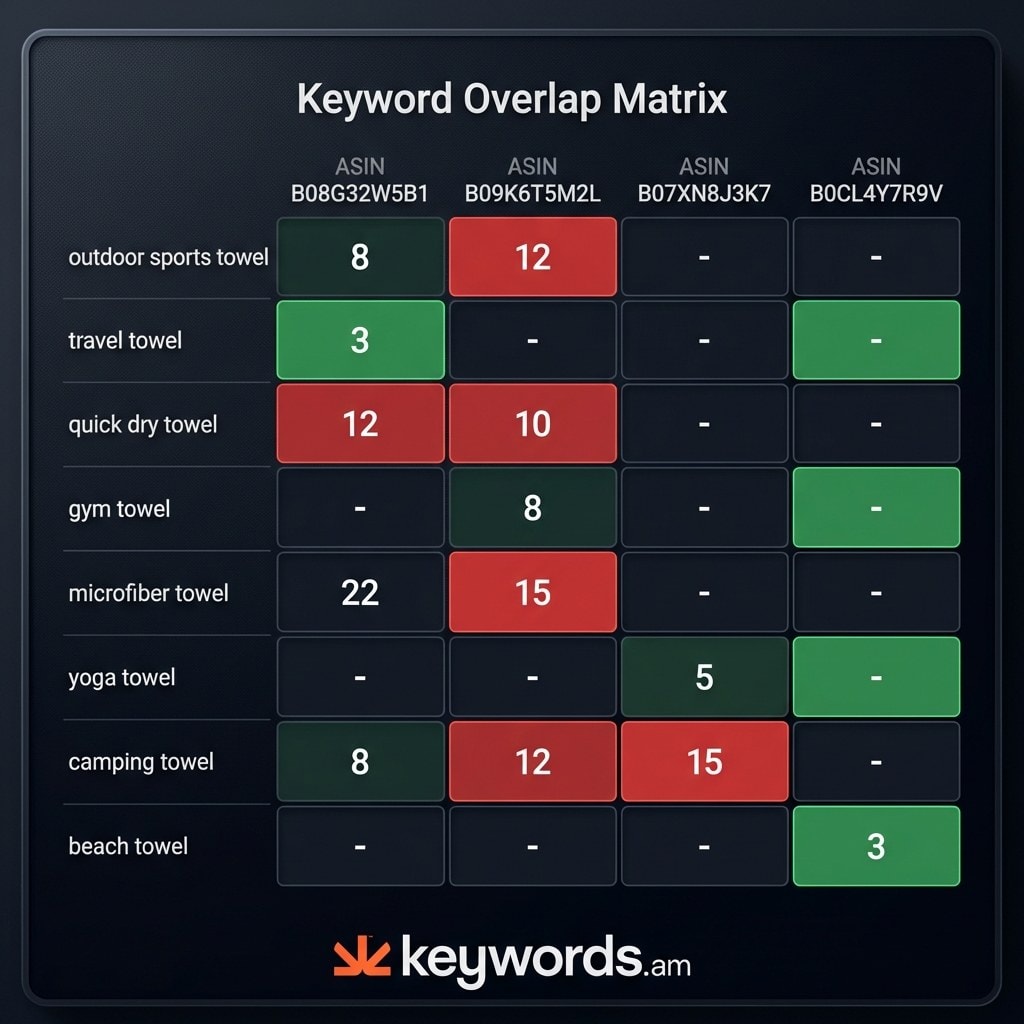
| Keyword | ASIN-1 Rank | ASIN-2 Rank | ASIN-3 Rank | Overlap Risk |
|---|---|---|---|---|
| organic vitamin c serum | #8 | #12 | - | Medium |
| vitamin c face serum | #5 | #7 | #15 | High |
| anti aging serum | #3 | - | #22 | Low |
| best vitamin c serum | #6 | #9 | #11 | High |
- Flag high-risk overlaps. Look for pairs sharing more than 40% of primary keywords where both rank between 5 and 30. If one ASIN ranks #1 and another #45, that’s usually not cannibalization, that’s one weak listing. Overlap only bites when both ASINs rank close enough to split clicks.
- Measure the velocity hit. Check whether the combined conversion rate and sales velocity of the overlapping ASINs is lower than one consolidated, well-optimized listing would produce. That comparison tells you the real cost.
Finding the overlap is half the job. The fixes are next, and they differ per type.
What are the best fixes for Amazon keyword cannibalization?
Three fixes, one per type: negative keyword routing for PPC overlap, gradual bid cuts for PPC-organic cannibalization, and keyword territory assignment across ASINs for catalog overlap. A generic approach risks solving the wrong problem.
- Fix 1: Negative keyword routing (PPC overlap). Add the keyword as an exact-match negative in your lower-priority campaigns so all traffic funnels to the best performer. If Campaign A converts at 15% on “blue widget” and Campaign B at 8%, add “blue widget” as an exact-match negative to Campaign B. Data consolidates, optimization speeds up. See the amazon negative keywords guide for the full playbook.
- Fix 2: Bid reduction (PPC-organic cannibalization). For keywords where your product ranks top 3 organically, cut PPC bids by roughly 20% every two weeks. Watch organic rank and total sales, not just PPC sales. If organic rank holds and total sales stay flat, you’ve cut waste. Use TACOS as the north-star metric.
- Fix 3: Keyword territory assignment (catalog overlap). Give each ASIN a distinct primary keyword territory based on your reverse ASIN data. Each product owns a unique keyword cluster in its title and bullet points. Generic category terms can be shared, but mostly they belong in amazon backend keywords. Product A might front-load “vitamin c serum for dark spots” while Product B leads with “vitamin c serum for wrinkles,” and both share “vitamin c serum” only in the backend.
If you have variation listings, there’s a fourth lever most sellers ignore.
How should you distribute keywords across Amazon variation listings?
Each child ASIN in a variation family gets its own backend search term field (approximately 249 bytes as of 2025, per Seller Central help), so distributing different long-tail clusters across children multiplies your total keyword coverage without cannibalization. Most sellers duplicate the same backend keywords across every child, which wastes the space entirely.
Duplicating across five color variations gives you 249 bytes of unique coverage. Distributing distinct long-tail clusters across those same five children gives you around 1,245 bytes of unique coverage (5 x 249) with zero internal competition.
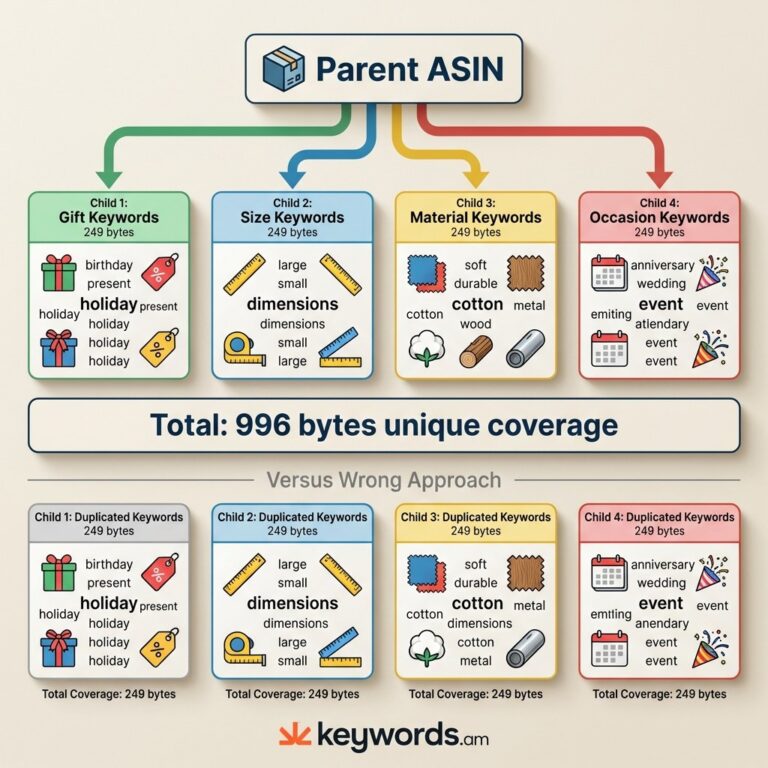
Distribution ideas that work in practice:
- Color variations: Assign long-tail keywords by use case or intent. Child 1 targets “gift for mom,” Child 2 targets size or dimension terms, Child 3 targets material or feature terms.
- Size variations: Small size targets “travel size” queries, larger size targets “family pack” queries.
- Style variations: Each style owns a demographic or occasion cluster the others don’t touch.
To check for variation cannibalization, look at Brand Analytics Search Query Performance. If multiple child ASINs show up for the same query and split clicks roughly 50/50, they’re splitting sales velocity too. Healthy distribution has each child dominating different long-tails while the parent absorbs the head term. The amazon backend keywords guide has the full allocation framework.
Frequently Asked Questions About Amazon Keyword Cannibalization
Does bidding on the same keyword in multiple Amazon PPC campaigns drive up CPC?
No. Amazon selects one ad per seller per auction, so your campaigns never bid against each other or inflate your cost per click. The real cost of PPC keyword overlap is fragmented performance data, which slows optimization. You can consolidate by adding exact-match negatives in lower-priority campaigns.
What TACOS threshold indicates PPC-organic cannibalization on Amazon?
If your TACOS exceeds roughly 20% on keywords where you already rank in the top 3 organically, your ads may be paying for clicks you’d get for free. Brands with heavy PPC-organic cannibalization often see TACOS climb to 25-35% because ads displace organic clicks rather than adding new ones. Test bid reductions in 20% steps every two weeks and watch total sales, not just PPC sales.
Can Amazon sellers detect keyword cannibalization without paid tools?
Partially. Search Term Reports and Brand Analytics help identify PPC overlap, but a reverse ASIN lookup on your own products is the fastest way to map catalog-level keyword overlap. Manual detection means downloading Search Term Reports, deduplicating, and cross-referencing with organic rank data, which gets slow past a handful of ASINs.
How do you tell if an Amazon variation strategy is causing cannibalization?
Check Brand Analytics Search Query Performance for child ASINs appearing on the same keywords. If two children split clicks roughly 50/50, they’re splitting sales velocity instead of stacking it. Healthy variation keyword distribution means each child ASIN dominates different long-tail keywords while the parent captures the head term.
Conclusion
- PPC keyword overlap is mostly a data problem, not a bidding problem. Consolidate with negatives and move on.
- PPC-to-organic cannibalization is the easiest six-figure fix in most accounts. Test 20% bid cuts every two weeks on keywords where you rank top 3 organically.
- Catalog-level overlap is the highest-severity, lowest-diagnosed issue. Reverse ASIN your own catalog before you touch a bid.
- Variation listings are keyword multipliers. Distribute unique long-tail clusters across child ASINs instead of duplicating.
- TACOS beats ACOS as the diagnostic metric. It’s the only number that tells you if ads are adding revenue or just replacing organic clicks.
The fastest way to start is to run a reverse ASIN lookup on your top 3-5 ASINs in the same category, build the overlap matrix, and flag any pair sharing over 40% of primary keywords. If you want to run that audit today, try the free Amazon keyword tool or start a Keywords.am plan to map your catalog overlap and start reclaiming the sales velocity you’re currently splitting.