
📑 Table of Contents
- Why Do Wholesale Sellers Need Amazon Keyword Research?
- How Does the Supplier Evaluation Method Work?
- How Can Wholesale Sellers Audit an Entire Supplier Catalog?
- What Can Wholesale Sellers Contribute to Shared Listings?
- Wholesale PPC Without Keyword Research Is a Budget Leak
- Frequently Asked Questions About Amazon Keyword Research Wholesale
- Conclusion
⚡ TL;DR
- Keyword research isn’t just for private label. Wholesale sellers miss revenue by ignoring keyword data and focusing entirely on the Buy Box.
- Evaluate suppliers with data. Reverse ASIN analysis reveals whether a brand’s listing actually captures search demand.
- Screen catalogs at scale. Bulk ASIN auditing filters 200-product catalogs into a shortlist of profitable opportunities in minutes.
- Contribute to shared listings. Authorized resellers can increase shared visibility by optimizing neglected backend search terms.
- Stop wasting PPC budget. Running wholesale PPC without keyword intelligence wastes spend on irrelevant auto campaigns.
Most Amazon wholesale guides dismiss keyword research in a single sentence: “Focus on the Buy Box, not SEO.” That advice leaves money on the table in three specific ways.
It causes wholesale sellers to choose suppliers blind, evaluating catalogs solely by margin rather than market demand. It leads to PPC campaigns running entirely on guesswork, draining budgets on irrelevant search terms. And it leaves listing optimization value completely untouched.
Wholesale sellers accept this because they were told amazon keyword research wholesale strategies don’t apply to their business model. They assume that since they don’t own the brand, analyzing search volumes or optimizing backend terms is someone else’s job. But buyers still need to find the listing before anyone can win the Buy Box.
This guide covers three wholesale-specific keyword research frameworks: the Supplier Evaluation Method, the Catalog Audit Method, and the Listing Contribution Method.
Why Do Wholesale Sellers Need Amazon Keyword Research?
Wholesale sellers need amazon keyword research wholesale strategies for product selection, listing contribution, and PPC targeting. These are three profit levers that Buy Box strategy alone cannot address.
The conventional wisdom repeated in Amazon seller communities goes like this: wholesale equals Buy Box plus pricing logistics, while private label equals keywords plus listing creation. This division is wrong. Relying on Buy Box mechanics alone assumes the product already gets maximum visibility. But even a highly rated product from a recognizable brand can suffer from poor organic rankings if the brand neglected basic Amazon SEO. Buying inventory for a product that nobody searches for leads to stagnant inventory and crushed margins.
Product selection provides the first use case. Before signing any wholesale agreement, keyword data reveals the truth about a product’s search demand. Consider a hypothetical supplement brand offering 50 products. Without keyword data, you choose which items to stock by looking at wholesale margins and Best Sellers Rank. With keyword data, you find the five products that have high search volume but weak listing optimization. Those five represent true wholesale opportunity: proven demand the current listing fails to capture.
Listing contribution represents the second opportunity. Authorized wholesale sellers with Brand Registry access (or brand owner collaboration) can improve shared listings. Most brand owners prioritize off-Amazon retail channels and treat their Amazon presence as an afterthought. They upload basic titles and single-sentence bullet points. Amazon allows 249 bytes of backend search terms, yet most brands use less than 50 bytes of that space according to Amazon’s backend search terms guidelines. Wholesale sellers who understand keyword strategy can fill these backend gaps and boost organic traffic for the shared listing.
PPC efficiency is the third use case. Running Sponsored Products on shared wholesale listings without proper keyword research means relying on auto campaigns that bid on every term Amazon loosely associates with the product. Wholesale PPC differs from private label PPC because you’re advertising someone else’s listing. Keyword intelligence determines which high-intent terms deserve your ad spend.
How Does the Supplier Evaluation Method Work?
The Supplier Evaluation Method uses reverse ASIN analysis to check keyword coverage, search volume, and competition before signing any wholesale agreement.
Start by picking three to five top-selling products from the supplier’s catalog and running a Reverse ASIN Lookup on each. This shows exactly what search terms drive traffic to the brand’s listing. Look for the total keyword count, keyword coverage percentage, and the specific high-volume keywords the listing ranks for versus the ones it misses.
Next, check keyword difficulty scores for the brand’s primary search terms. You want products where the existing keywords are achievable, not dominated by mega-brands with external traffic sources. Low difficulty combined with high volume means it’s easier to drive sales through targeted PPC or backend improvements. If difficulty is extremely high, advertising costs will likely eat your wholesale margins.
The final step is evaluating keyword coverage gaps. Brands with low coverage scores represent opportunity. Wholesale sellers who can help improve keyword coverage become more valuable partners, transforming from a replaceable buyer into a strategic growth contributor.
Worked Example: Screening a Supplement Brand Catalog
A hypothetical organic supplement brand sends a catalog containing 50 products. You run reverse ASIN analysis on the top 10 by revenue. The data reveals:
- 3 products have strong keyword profiles. They rank in the top five positions for high-volume terms like “organic ashwagandha powder” (45,000 monthly searches) and “vegan magnesium capsules” (32,000 monthly searches). Coverage sits above 85%. These are saturated, hard to add listing value, and you’d compete purely on price.
- 7 products have weak profiles. They target terms like “liquid zinc drops for adults” (28,000 monthly searches) but sit on page four. Coverage barely touches 20%. These seven represent clear opportunity: you can contribute listing improvements to push them up in rankings, and the products have untapped search demand.
Running reverse ASIN on individual products works for initial evaluation. But what about screening an entire catalog of 200 products?
How Can Wholesale Sellers Audit an Entire Supplier Catalog?
Bulk ASIN auditing lets wholesale sellers screen 50-200 products at once, filtering by optimization score to find listings with high demand and weak keyword coverage.
The problem with manual evaluation: checking products one by one doesn’t scale. A typical supplier might send 100 to 200 items. At five minutes per product, a 200-product catalog takes over 16 hours to evaluate. Most wholesale sellers skip this step entirely. A bulk audit condenses that work into minutes, giving a top-down view of the entire brand portfolio.
Using the ASIN Audit tool assigns optimization scores across the full catalog. Each listing receives a grade from A+ to F based on keyword coverage, title optimization, backend utilization, and content quality.
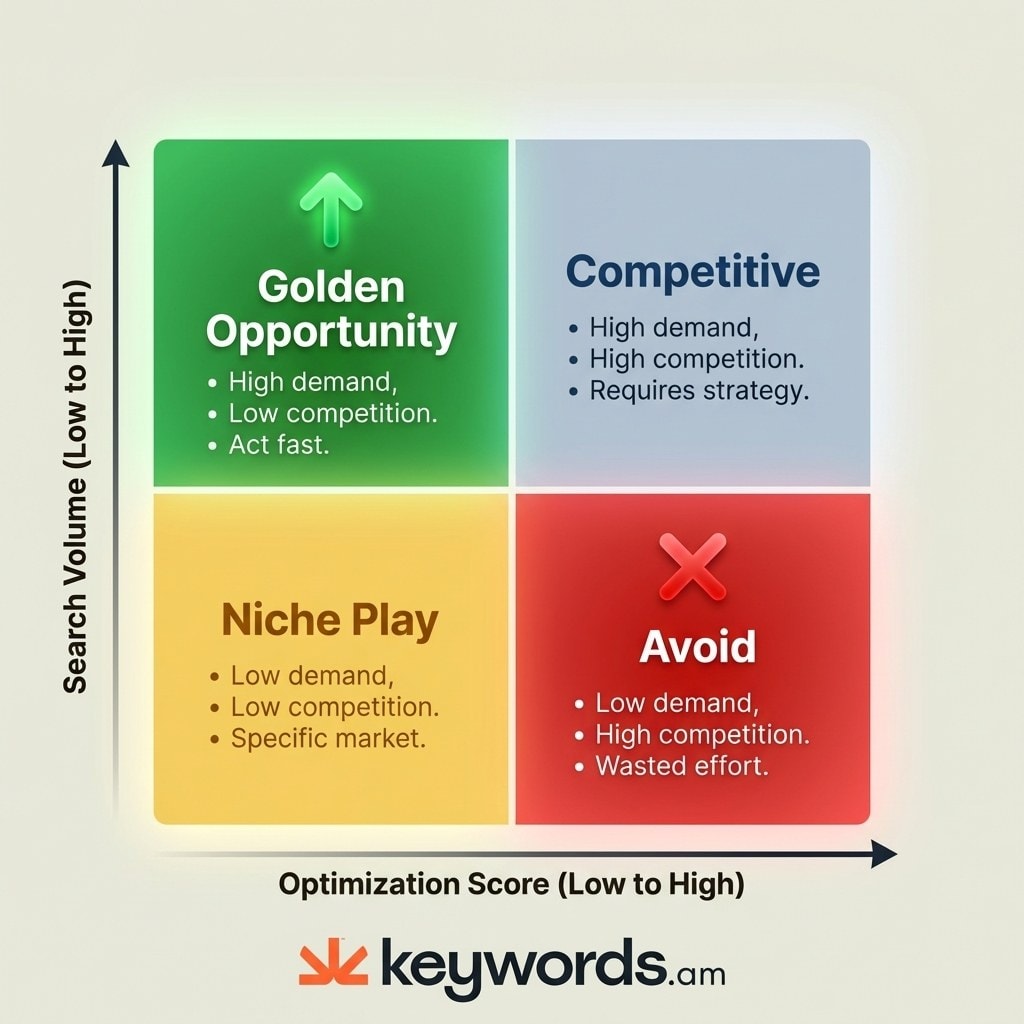
This data builds a 2×2 decision matrix for amazon keyword research wholesale product selection:
High Search Volume |
Low Search Volume |
|
|---|---|---|
Low Optimization Score |
Golden opportunity — high demand, weak listing you can improve |
Niche play — improve listing, build demand through PPC |
High Optimization Score |
Competitive — listing already optimized, harder to add value |
Avoid — low demand AND already optimized |
Focus on the “Golden opportunity” quadrant: products with strong search demand but weak listings you can improve. “Competitive” quadrant products mean price wars. “Niche play” requires aggressive advertising. “Avoid” offers no value.
Filter the catalog by sorting optimization score ascending (F to A+), then cross-reference with search volume. The products at the top of this list (low scores paired with high demand) are exactly what you want. You’re turning a 200-product catalog into a shortlist of 10-15 high-opportunity products in minutes.
What Can Wholesale Sellers Contribute to Shared Listings?
Authorized wholesale sellers can contribute backend search terms, suggest title and bullet point improvements, and collaborate with brand owners on keyword gaps that increase shared listing visibility.
First, understand what you can and cannot change. Brand Registry owners control the listing flat files. As a standard wholesale seller, you cannot unilaterally rewrite titles or swap images. But authorized sellers can submit listing contributions through Seller Central, and many brand owners welcome optimization help. This requires either Brand Registry access granted by the brand or direct collaboration with the brand owner.
Backend search terms provide the easiest win. Amazon allows 249 bytes of backend keywords per listing. Keywords.am internal analysis shows most brands use less than 20% of their backend allowance. They leave organic ranking potential completely empty. The Amazon backend keywords guide explains how to identify and fill these gaps without altering customer-facing content.
This creates a strong value proposition. Instead of asking for a deeper discount, tell the brand owner: “I can help improve your listing’s keyword coverage, which drives more organic traffic to the listing we both sell on.” This frames your business as a partnership, not a price competition. It differentiates wholesale sellers from dozens of competitors who only negotiate on margin.
Listing improvements also affect PPC metrics directly. When the organic listing ranks for more relevant keywords, ACoS naturally drops because organic sales supplement paid visibility. A well-executed listing optimization strategy ensures every ad dollar pushes the listing higher in organic ranks too.
Wholesale PPC Without Keyword Research Is a Budget Leak
Running wholesale PPC without keyword data means relying on auto campaigns that bid on irrelevant terms, inflating ACoS and wasting budget on a listing the seller doesn’t control.
According to the Jungle Scout State of the Amazon Seller report, PPC costs continue to rise year over year. The wholesale PPC trap catches sellers every year. They launch auto campaigns on shared listings, assuming Amazon’s algorithm handles targeting. Auto campaigns bid on every keyword Amazon associates with the product, including irrelevant terms, competitor brand names, and low-converting long-tail phrases.
Consider a shared listing for a vitamin C immunity supplement. An auto campaign will bid on “vitamin d softgels” and “daily multivitamin for men.” These terms don’t convert for a vitamin C product. You end up paying for clicks that generate zero revenue, bleeding your wholesale margin on a listing you don’t even own.
Avoid this by using the brand’s existing keyword profile to build targeted manual campaigns. A dedicated PPC keyword strategy for wholesale emphasizes extreme relevance. You’re optimizing spend on someone else’s listing, so precision matters more than broad discovery.
KPS (Keywords.am Priority Score) helps with wholesale PPC keyword selection. Instead of chasing the highest search volume, KPS scores keywords by conversion potential and listing impact, ensuring you bid only on phrases that drive profitable sales.
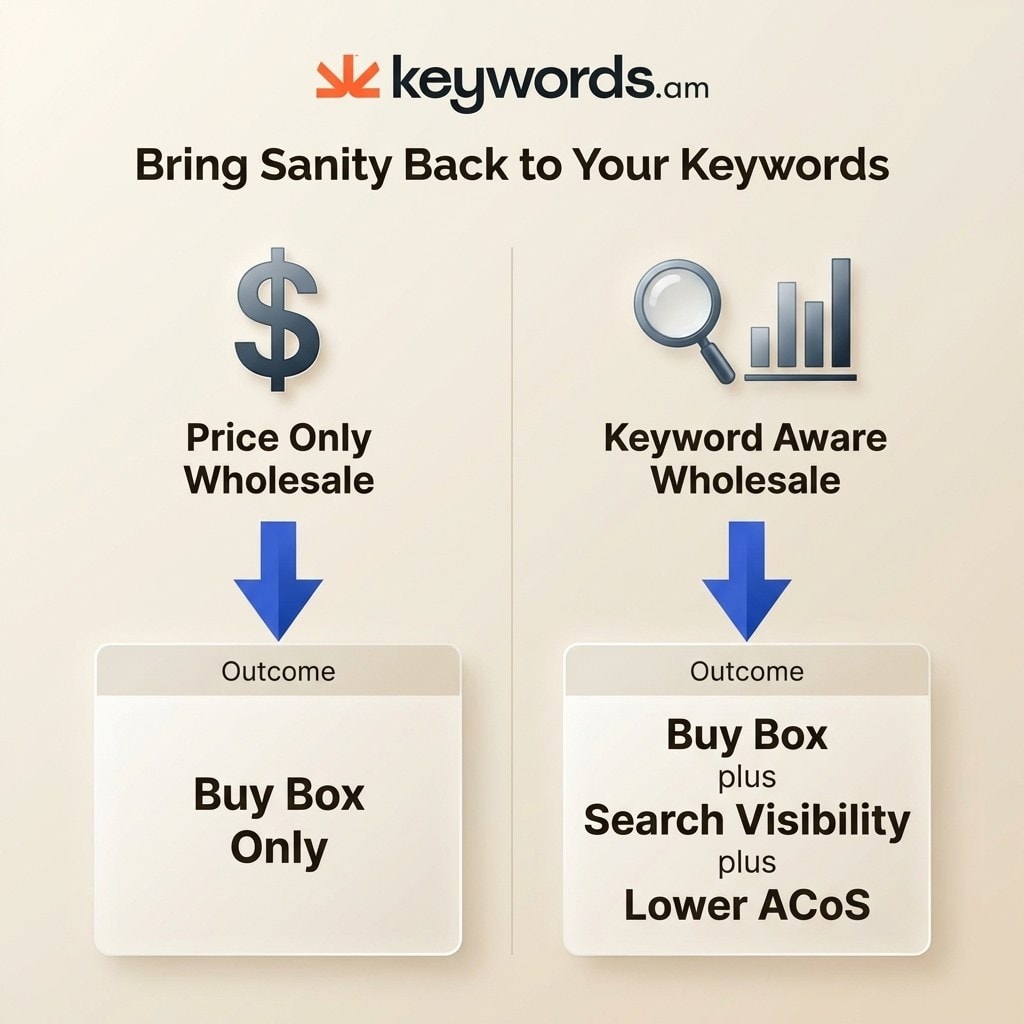
The relationship between Buy Box and keyword visibility forms the core equation. The Buy Box determines who gets the sale. But keyword ranking determines whether shoppers find the product at all. A product with 100% Buy Box ownership but zero keyword visibility still generates zero sales from search. Smart amazon keyword research wholesale sellers understand both sides of this equation.
Frequently Asked Questions About Amazon Keyword Research Wholesale
These are the most common questions wholesale sellers ask about amazon keyword research wholesale strategies and how they apply to this business model.
Conclusion
The traditional wholesale playbook needs an update. Ignoring search data means ignoring how customers actually shop on Amazon.
- Keyword research is not a private label exclusive. Wholesale sellers use it for product selection, listing contribution, and PPC targeting.
- The Supplier Evaluation Method reveals product quality and market demand before committing inventory capital.
- The Catalog Audit Method screens entire 200-product supplier catalogs in minutes instead of days.
- The Listing Contribution Method turns wholesale sellers from price competitors into valued brand partners.
Pick one supplier catalog today and run a bulk ASIN audit to identify the top five optimization opportunities. It takes minutes and permanently changes how you evaluate wholesale products. Start uncovering these margins by running your first catalog through the ASIN Audit tool.