Amazon Fundamentals
Amazon External Traffic 2026 - Brand Referral Bonus ROI Playbook
Amazon external traffic can cut acquisition costs vs PPC and earn Brand Referral Bonus credits. Learn the keyword bridge method and real ROI math.

Amazon PPC has kept climbing, and by early 2026 many mature keywords cost roughly double what they did two years ago. That’s the pressure point pushing sellers to build a proper amazon external traffic strategy instead of pouring every ad dollar into Sponsored Products.
The problem is that most sellers treat Amazon keyword research and external ads as separate jobs. They guess which Google keywords to buy, skip Amazon Attribution setup, and never calculate whether the Brand Referral Bonus actually makes the math work. This post fixes that with a keyword bridge method, an ROI formula, and a channel comparison you can act on today.
Why is Amazon external traffic the biggest growth lever in 2026?
External traffic reduces dependence on rising Amazon ad costs, earns Brand Referral Bonus credits, and feeds A10 ranking signals at the same time. It’s one of the few levers that can move both cost per acquisition and organic rank in the same campaign.
Amazon PPC has become more expensive across most competitive categories over the past two years, according to reporting from Jungle Scout and Marketplace Pulse. A keyword that returned solid margin in 2023 often no longer does at 2026 CPCs. Sellers pay more clicks for the same sale count.
At the same time, a large share of Amazon’s traffic already comes from outside the marketplace, and AI shopping surfaces like ChatGPT and Perplexity are pushing shoppers straight to product pages. Sellers who tag those clicks properly capture data their competitors ignore. External traffic also signals to Amazon that a listing is pulling new shoppers into the ecosystem, which the A10 algorithm tends to reward with better organic placement.
What is the Amazon Brand Referral Bonus and how much can sellers earn?
The Brand Referral Bonus pays brand-registered sellers a percentage of sales generated from external traffic, averaging around 10% across most categories as of 2025. Rates vary by category and Amazon can change them, so always check the current program page before modeling ROI.
Enrollment is limited to sellers with active Brand Registry. Wholesale and reseller accounts without Brand Registry don’t qualify. You can review current rules on the official Brand Referral Bonus program page.
| Category (as of 2025) | Approximate bonus rate |
|---|---|
| Device Accessories | Higher than average, up to ~45% per Amazon |
| Most standard categories | ~10% |
| Apparel | ~10% |
| Electronics | Lower single digits to ~7% |
| Grocery | Lower single digits |
Amazon uses a 14-day attribution window, meaning any purchase within 14 days of the tagged click can qualify. Credits typically land on seller statements roughly two months after the qualifying sale, since Amazon needs time to process returns before finalising payouts. Don’t kill campaigns in month one because the credits look missing; that’s the normal delay.
How do sellers set up Amazon Attribution for external traffic tracking?
Amazon Attribution is a free measurement tool that tracks external traffic performance and unlocks Brand Referral Bonus eligibility. Without it, external clicks show up as anonymous organic sessions and Amazon can’t credit the referral.
Attribution reports impressions, clicks, detail page views, add-to-carts, purchases, and total sales revenue by campaign. That’s the visibility you need to compare channels honestly.
Setting up a tag takes a few minutes:
- Open Seller Central and go to Advertising, then Attribution.
- Click Create campaign.
- Select the products you want to promote.
- Generate tags for each traffic channel (Google, Meta, email, and so on).
The tags are just URL parameters appended to a normal Amazon link. They work with Google Ads, Meta, TikTok, email platforms, influencer links, and custom domains that redirect to Amazon. Attribution also uses the same 14-day post-click window, so it captures delayed purchases inside that cycle.
Attribution tells you what happened. The harder question is which keywords to send there in the first place.
How does Amazon keyword data help choose the best external traffic keywords?
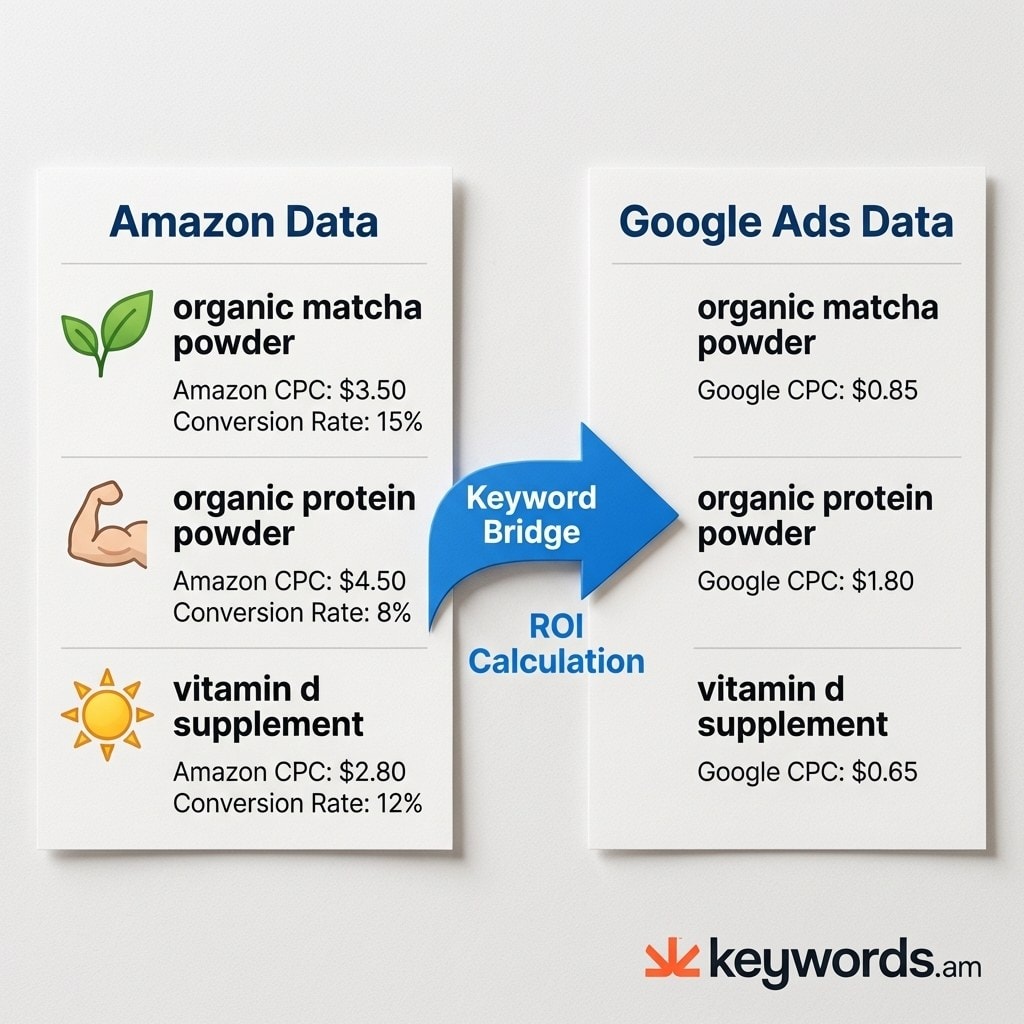
The best external keywords are ones you already know convert on Amazon but cost less on Google or Meta. That’s the keyword bridge: use Amazon conversion data to pick external targets instead of relying on Google search volume alone.
Start by pulling your Amazon Search Term Report and sorting by conversion rate. Filter for terms with high ACoS on Amazon. A term like “organic matcha powder” might convert at 15% for you on Amazon while costing $3 or more per click in Sponsored Products.
Next, cross-reference with Brand Analytics Search Query Performance data. Look for queries where your purchase share is strong but your impression share is low. That gap means your listing converts well but Amazon isn’t giving it enough real estate, exactly the situation external traffic can fix.
Then open Google Ads Keyword Planner and check the CPC for those same phrases. If Google shows a CPC materially below your Amazon CPC on a term you know converts, that’s a bridge candidate. A reverse ASIN lookup on top competitors will surface more of these overlap terms.
Finally, model the true cost per acquisition with the Brand Referral Bonus included, and make sure the listing itself is ready. The TFSD Framework covers how to align title, features, search terms, and description with incoming keyword intent so external clicks actually convert.
Where should sellers send Amazon external traffic for the best conversion rates?
Amazon Brand Stores usually convert external traffic better than product detail pages because the page carries no competing sponsored ads and reinforces the brand a shopper just clicked. Detail pages work for single-SKU campaigns but leak sales to competitor placements.
Three common destinations, with tradeoffs:
- Amazon Brand Store: Clean, branded, no competitor ads, supports Attribution.
- Product detail page: Simple, fine for one-SKU pushes, but exposes shoppers to competitor ads and “frequently bought together” widgets.
- Off-Amazon landing page then redirect: Lets you collect an email first, at the cost of a real drop-off before Amazon.
Brand Store optimization matters here. Featured products, curated subpages, and category-specific keyword targeting all help. Detail page destinations should at minimum have optimized product titles, tight bullet points, and clean A+ Content before you spend a cent on outside traffic.
Whichever destination you choose, the Attribution tag has to be appended correctly. Break the URL structure and the tracking (and the Brand Referral Bonus) disappears.
How do sellers calculate the real ROI of Amazon external traffic?
The right formula subtracts the Brand Referral Bonus from your ad cost per sale, which often flips external channels from “looks worse than PPC” to actually cheaper.
Adjusted CAC = (Ad spend / Sales from that spend) - (AOV x Bonus rate)
Worked example on a hypothetical protein powder listing:
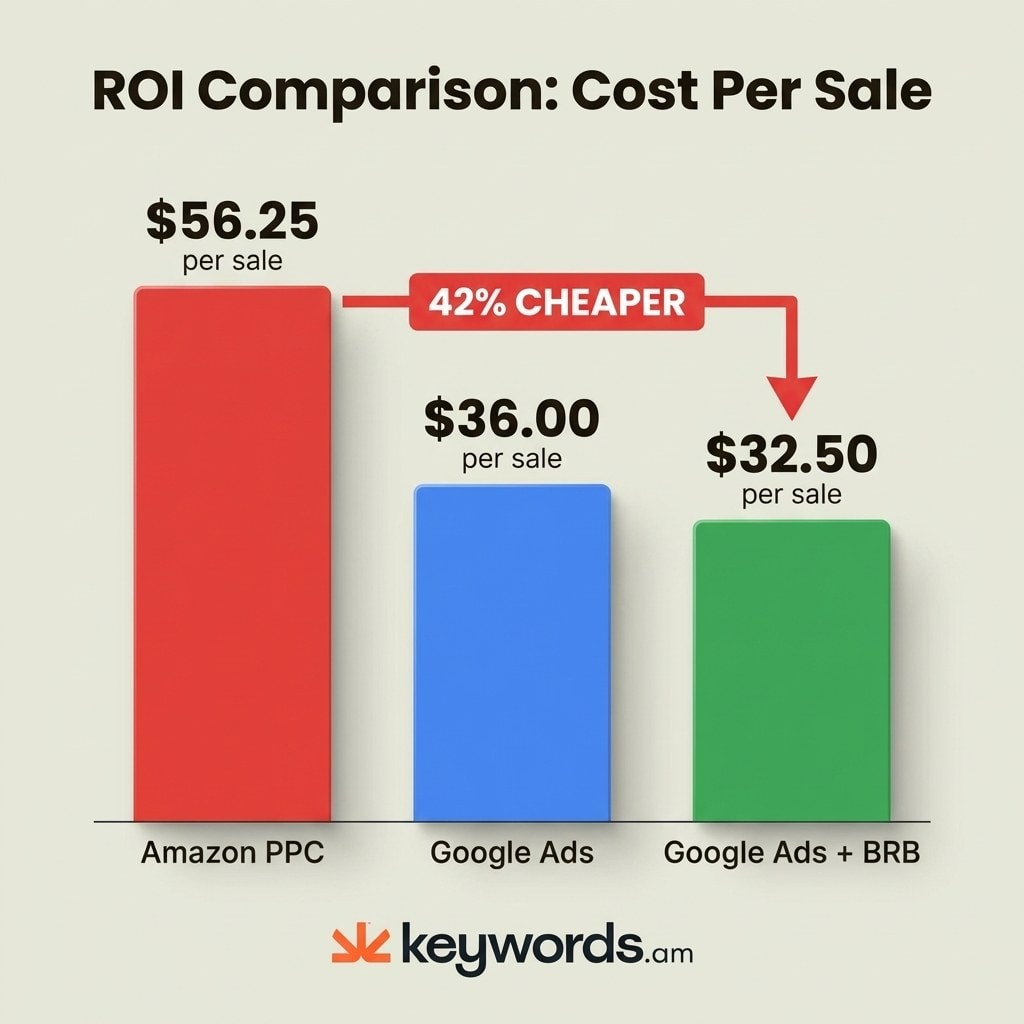
- Amazon PPC: $4.50 CPC at an 8% conversion rate = $56.25 per sale, no Brand Referral Bonus.
- Google Ads: $1.80 CPC at a 5% conversion rate = $36.00 per sale.
- Add a 10% Brand Referral Bonus on a $35 AOV = $3.50 credit per sale.
- Google Ads adjusted CAC = $36.00 - $3.50 = $32.50 per sale.
In that scenario Google Ads sits roughly 42% below Amazon PPC on adjusted CAC, even with a lower conversion rate. The numbers move with your category and margins, but the framework holds.
| Channel | Typical CPC range | Conversion to Amazon (typical) | BRB eligible | Best for |
|---|---|---|---|---|
| Google Ads | $0.50 to $3.00 | 2 to 5% | Yes | Commercial-intent search |
| Meta / TikTok | $0.30 to $2.00 | 1 to 3% | Yes | Retargeting, awareness |
| ~$0.10 effective | 15 to 22% | Yes | Launches, repeat customers | |
| Influencer | Varies | 3 to 8% | Yes (with Attribution) | Social proof, niche products |
| Amazon PPC | $0.50 to $5.00+ | 8 to 15% | No | Direct Amazon searches |
Ranges above are directional based on public benchmarks and vary heavily by category. The takeaway: different channels serve different jobs, and the Brand Referral Bonus improves all external options relative to Amazon PPC. The most profitable plays combine high-conversion Amazon keywords with a high-BRB category and a lower external CPC.
What are the most common Amazon external traffic mistakes?
Most external traffic problems trace back to a handful of avoidable errors. Fix these first before adding budget.
- Running untagged links: No Attribution tag means no reporting and no Brand Referral Bonus credit.
- Sending traffic to a raw detail page: Competitor ads on the same page can steal the sale you just paid Google for.
- Picking keywords by Google volume alone: Ignoring your Amazon Search Term Report and SQP data leads to expensive clicks that don’t convert.
- Panicking during the credit delay: Brand Referral Bonus credits typically arrive around two months later; killing campaigns at week three destroys the math.
- Only counting day-one purchases: Amazon’s 14-day post-click window captures real revenue you’ll miss if you close the loop too early.
- Ignoring listing quality: External traffic hits the same detail page as PPC, so weak conversion rate fundamentals waste every channel equally.
Frequently Asked Questions About Amazon External Traffic
Do I need Brand Registry to run external traffic?
You can drive external traffic to Amazon without Brand Registry, but you can’t earn Brand Referral Bonus credits. Brand Registry requires a registered trademark and is free to enrol in once you have one. For most brand owners, getting into Brand Registry is worth it just for the bonus alone, before counting the other benefits.
How long until Brand Referral Bonus credits appear?
Credits typically show up on seller statements roughly two months after the qualifying sale. Amazon processes returns inside the attribution window before issuing final payouts. Plan cash flow around that delay so you don’t cut profitable campaigns before the credits land.
Can I use influencer links for the Brand Referral Bonus?
Yes, as long as the influencer’s link carries your Amazon Attribution tag. That means creating the campaign in Attribution and giving the influencer your tagged URL rather than a raw Amazon link or an Amazon Associates link. Associates commissions and the Brand Referral Bonus operate on different systems.
Does external traffic help my Amazon organic ranking?
External traffic is broadly reported to be a positive signal in Amazon’s A10 ranking system because it brings new shoppers into the marketplace. The exact weighting isn’t public. Treat organic lift as a bonus on top of direct sales and Brand Referral Bonus credits rather than the main reason to run campaigns.
Should I send external traffic to a Brand Store or a product page?
Brand Stores usually win for external traffic because they show no competitor ads and reinforce brand context. Product detail pages can work for tight single-SKU pushes, especially when you want a shopper to buy one specific ASIN. If a listing sits alongside strong competitors, the Brand Store almost always converts better.
Conclusion
- Rising Amazon CPCs make external traffic a real cost lever, not a nice-to-have.
- The Brand Referral Bonus meaningfully changes adjusted CAC when you factor it into the model correctly.
- Pick external keywords using Amazon conversion data, not Google search volume in isolation.
- Amazon Brand Stores usually convert external clicks better than raw detail pages.
- Attribution tags on every link are non-negotiable; without them you’re flying blind.
Pull your Amazon Search Term Report today, sort by conversion rate, and pick five keywords with high ACoS that could be cheaper to buy on Google or Meta. Pair that shortlist with a full listing optimization pass so external clicks actually convert. If you want a faster way to surface those bridge keywords, try the free Amazon keyword tool or start a Keywords.am plan and let the data do the picking.