
📑 Table of Contents
- Why does Sponsored Brands need a different keyword strategy than Sponsored Products?
- How should keywords differ across Product Collection, Store Spotlight, and Video ads?
- How do you build an amazon sponsored brands keyword strategy from scratch?
- Branded vs non-branded campaign architecture for Sponsored Brands
- Why do negative keywords matter more for Sponsored Brands?
- How do you measure Sponsored Brands keyword performance?
- Frequently Asked Questions About Sponsored Brands Keyword Strategy
- Conclusion
⚡ TL;DR
- Manual-only targeting: Sponsored Brands has no auto campaigns — keyword research must happen before launch.
- Format-specific keywords: Product Collection, Store Spotlight, and Video ads each need tailored keyword lists.
- Product Collection: Broad category discovery terms targeting top-of-funnel shoppers.
- Store Spotlight: Branded and category browsing keywords to drive brand exploration.
- Video ads: High-intent, single-product exact match keywords to capitalize on 1.1% average CTR.
- Campaign separation: Split branded from non-branded keywords into distinct campaigns for accurate performance tracking.
- Negative keywords are critical: Higher SB CPCs make irrelevant clicks more expensive, and misplaced brand impressions hurt perception.
Sponsored Brands accounts for roughly 30% of Amazon ad spend. Most sellers target keywords the same way they do for Sponsored Products — and it shows in their ACoS.
Here’s the thing most sellers miss: Sponsored Brands is manual-targeting only. No auto campaigns exist to harvest keywords from. That single difference means standard SP keyword tactics fall apart. Sellers who copy keyword lists between ad types waste budget on mismatched shopper intent.
This guide breaks down the right amazon sponsored brands keyword strategy by individual ad format. Product Collection, Store Spotlight, and Video ads each serve a different funnel stage and need different keywords to succeed.
Why does Sponsored Brands need a different keyword strategy than Sponsored Products?
Sponsored Brands is manual-targeting only with no auto campaigns, serves brand-awareness goals, and offers three ad formats with different landing pages — all requiring distinct keyword approaches.
The absence of automatic campaigns is the biggest differentiator. Keyword research must happen before campaign launch. Sellers cannot rely on Amazon’s algorithm to discover converting search terms over time. Sponsored Products allows broad auto campaigns that slowly harvest the best-performing terms. Sponsored Brands demands upfront precision — knowing what terms shoppers use before spending a dollar.
SB lives at the top of the funnel. It’s about brand discovery, not the bottom-of-funnel “add to cart” moment that SP chases. People who click SB ads are browsing — they’re exploring a whole category, not committing to a purchase yet. That changes everything about keyword selection. Picture someone typing “men’s running shoes.” They might tap on a Sponsored Brand banner just to see what a brand offers. But that same person won’t click a regular SP ad unless they’ve already narrowed down to a specific model and size. The PPC keyword strategy that works for SP doesn’t translate here.
Then there’s the landing page problem. SB campaigns can send shoppers to a Store page, a curated product list, or a custom URL — and each option needs keywords that actually match what’s on the other side of the click. Send someone searching “waterproof camping tents” to a brand homepage full of sleeping bags? They’re gone in two seconds.
Bidding adds another layer. SB gives sellers two models: standard CPC and vCPM (cost per thousand viewable impressions). With vCPM, broad high-volume category terms make sense because you’re paying for eyeballs, not clicks. With CPC, you want tight long-tail phrases where every click has purchase intent behind it.
How should keywords differ across Product Collection, Store Spotlight, and Video ads?
The three SB formats aren’t interchangeable — they reach shoppers in completely different mental states. Product Collection catches people browsing categories, Store Spotlight pulls in folks who already know your brand, and Video ads close the deal on single-product searches.
Product Collection keywords
Product Collection campaigns work best with broad category terms and non-branded discovery searches. Picture queries like “best running shoes for flat feet” or “organic dark roast coffee” — the kind of thing someone types when they haven’t picked a brand yet. Broad and phrase match do the heavy lifting here because you’re casting a wide net. The landing page shows a curated product list or custom URL, so your keywords need to match whatever collection you’re showcasing. Selling a stainless steel cookware line? Target broad kitchenware terms and feature pots, pans, and accessories together.
Store Spotlight keywords
Store Spotlight is where branded terms and category browsing phrases shine — things like “shop Nike running” or “Sony camera accessories.” You’ll want exact and phrase match here for tighter control, since these shoppers already know (or are curious about) your brand. Every click goes straight to a Brand Store page, which means your keywords have to line up with whatever that page actually contains. Here’s something sellers often overlook: competitors are absolutely bidding on your brand name. If you don’t defend that territory, they’ll siphon off your most loyal customers. Pair these campaigns with well-built Brand Store pages to get the most from each visit.
Video ad keywords
Video ads are the sharpshooters of sponsored brands keyword targeting. They go after high-intent, single-product searches and competitor conquest terms. Stick with exact and phrase match — you need precision because every click lands on a product detail page. Got a compelling garlic press demo video? Target “stainless steel garlic press” or “easy clean garlic mincer” and nothing else. The payoff is real: Amazon’s own data puts video CTR at 1.1% versus 0.6% for static banners. That kind of engagement doesn’t come cheap, so you can’t afford to waste it on loosely matched keywords.
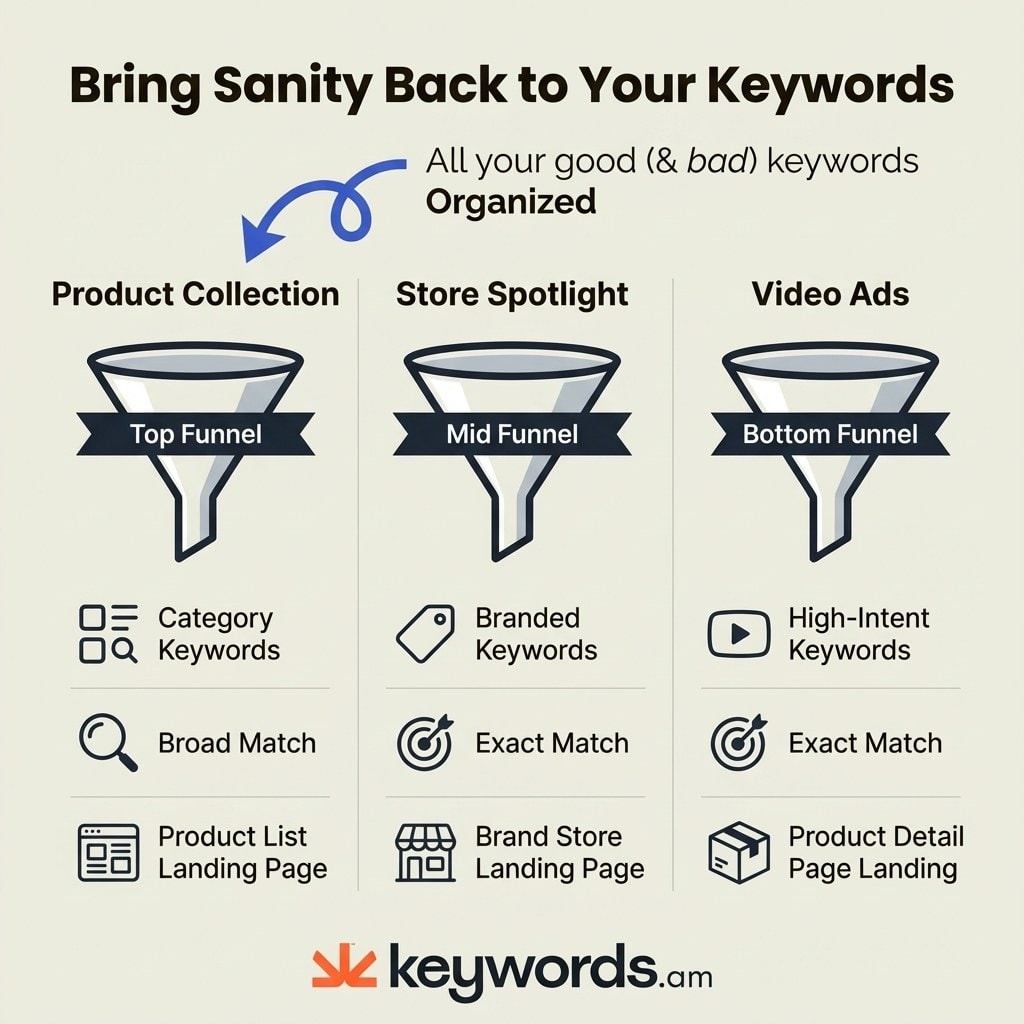
Dimension |
Product Collection |
Store Spotlight |
Video Ads |
|---|---|---|---|
Best keyword types |
Category, comparison, non-branded |
Branded, category browsing |
High-intent, competitor conquest |
Recommended match types |
Broad, phrase |
Exact, phrase |
Exact, phrase |
Landing page |
Product list / custom URL |
Brand Store pages |
Product detail page |
Funnel position |
Top (discovery) |
Mid (brand exploration) |
Bottom (purchase intent) |
Primary goal |
Category visibility |
Brand awareness + Store traffic |
Single-product conversion |
That’s the strategic layer of any amazon sponsored brands keyword strategy — matching the right keywords to the right format. But where do you actually find these keywords?
How do you build an amazon sponsored brands keyword strategy from scratch?
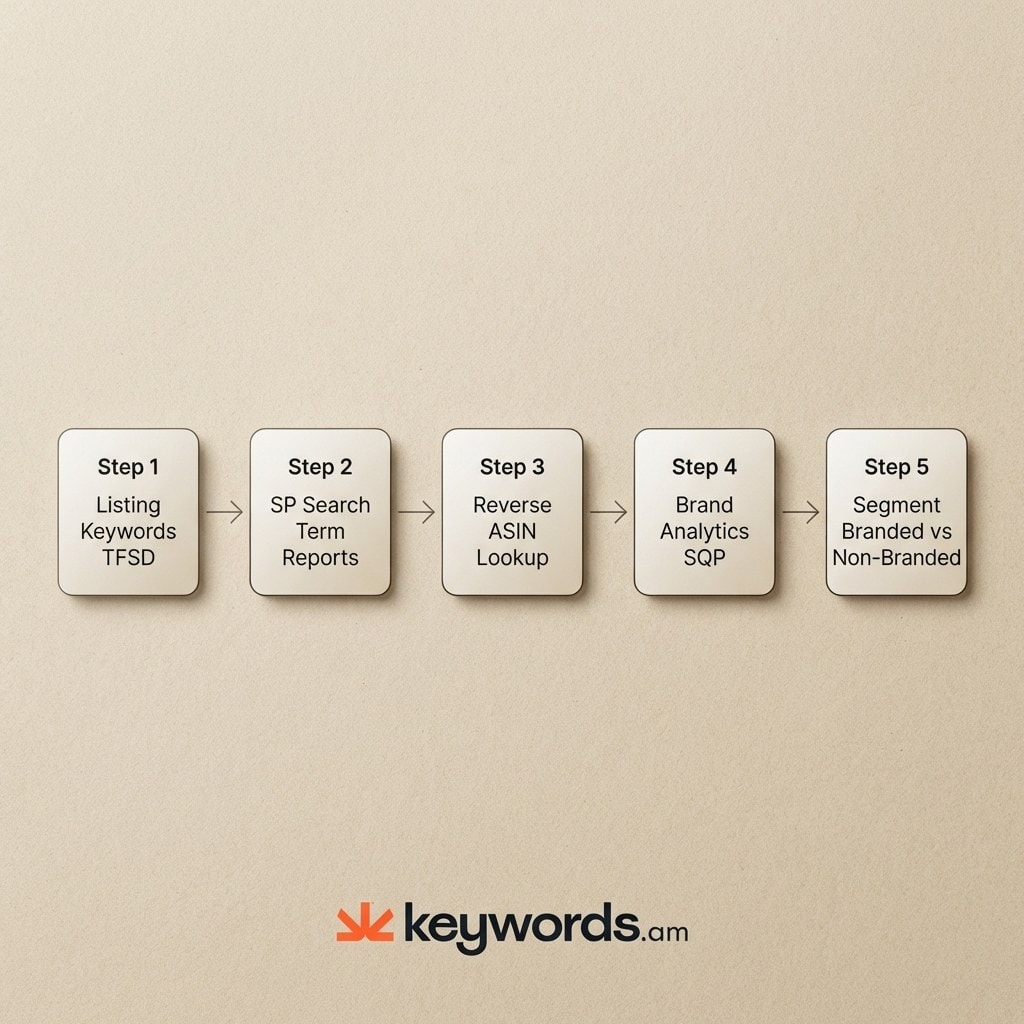
Build an SB keyword list by mining existing SP search term reports, running reverse ASIN lookups on competitors, analyzing Brand Analytics SQP data, and segmenting into branded vs non-branded groups.
-
Start with listing keywords. The TFSD framework connects what your listing targets to what your ads should bid on. If your title and bullet points focus on “vegan leather,” your SB campaigns should target those same root phrases. Start with the terms your listing already captures.
-
Mine SP Search Term Reports. Those converting SP terms you’ve been collecting? They’re gold for SB. Pull the search term report from the last 30 days, sort by orders, and you’ve got a list of phrases that actual shoppers used to find and buy your products. No guessing involved.
-
Run reverse ASIN lookups. Want to know what keywords your top competitors bid on? A reverse ASIN lookup on their best-selling ASINs tells you exactly that. Keywords.am automates this — plug in five competitor ASINs and you’ll have a list of proven phrases to test in your own campaigns. It’s one of the fastest shortcuts in competitor analysis.
-
Analyze Brand Analytics SQP. The Search Query Performance dashboard hides some real gems. Look for terms that get clicks but don’t convert well in SP — those broad phrases are often perfect for SB awareness campaigns. Someone searching a general category term probably isn’t buying right away, but if they see your brand banner? You’ve landed in their consideration set for later.
-
Segment into branded vs non-branded. These segments require separate campaigns. Amazon recommends a minimum of 25 keywords per SB campaign for sufficient impression volume. Don’t pad the list with irrelevant terms just to hit that number — focus on relevance.
Branded vs non-branded campaign architecture for Sponsored Brands
Separate branded and non-branded keywords into distinct SB campaigns with different budgets, bid strategies, and landing pages to control spend and measure performance accurately.
Here’s why this matters: branded terms convert at roughly two to three times the rate of non-branded ones. Lump them together in one campaign and your ACoS data lies to you. The blended number might look like a healthy 25%, but dig in and you’ll find branded terms cruising at 5% while non-branded terms are hemorrhaging at 80%. You can’t fix what you can’t see — and separation makes the gap obvious.
Budget allocation depends on business goals. A general starting point: 20-30% on branded defense, 70-80% on non-branded conquest and discovery. New brands need aggressive non-branded spend to acquire customers. Established brands might need heavier defensive spend to protect market share from competitors.
Landing page alignment differs by segment. Branded campaigns should point to Brand Store pages to reinforce the brand experience and cross-sell related items. Non-branded campaigns perform better pointing to Product Collection pages that showcase items relevant to the broad search term.
Defensive bidding on your own brand terms is non-negotiable. Competitors bid on your brand name to steal profitable customers. Bidding on your own brand stays cheaper than acquiring new customers from scratch. For a broader view of organizing these efforts, review proper PPC campaign structure and ongoing PPC optimization routines.
Why do negative keywords matter more for Sponsored Brands?
Negative keywords matter more in SB because higher CPCs mean wasted impressions cost more, and irrelevant brand impressions damage brand perception with shoppers.
The math hits harder in SB. Getting that top banner spot above organic results costs real money — and every irrelevant click burns through budget faster than a misplaced SP click ever would. One poorly scoped broad match keyword can chew through hundreds of dollars in a single day if nobody’s watching. That alone makes tight negative keyword management a non-optional part of any amazon sb ads strategy.
Your brand is literally on display. This is the part that catches sellers off guard. SP ads are product-focused — shoppers barely notice the seller. But SB plasters your logo, brand name, and custom headline right there in the search results. Show up on a search for “cheap dollar store body lotion” when you’re selling luxury skincare? That’s a brand image hit you can’t undo with a bid adjustment. Phrase match negatives help block entire irrelevant categories.
Stop bidding against yourself. Add your SB exact-match keywords as negative exacts in SP broad and auto campaigns. Then do the reverse. Without this, you’re literally competing against your own ads and pushing CPCs up for no reason.
Pull search term reports every week for the first month of any new campaign, then biweekly after that. Filter for terms with high spend and zero sales — those go straight into negative exacts. The full negative keywords guide walks through the formatting details.
How do you measure Sponsored Brands keyword performance?
Measure SB keyword performance using New-to-Brand percentage, impression share, top-of-search placement rate, and format-specific metrics like video completion rate alongside standard ACoS.
New to Brand percentage is the metric that separates SB from every other Amazon ad type. It tracks how many of your ad-attributed purchases came from shoppers who haven’t bought from you in the past twelve months. If your amazon sponsored brands keyword strategy is working, this number should be high. And yes — a 40% ACoS is perfectly fine when 70%+ of those customers are brand new to you.
Impression share tells a different story. It’s the percentage of available impressions your ads actually won. Seeing low numbers? Either your bids need to go up or your keyword list needs to expand. One datapoint worth noting: running SB and SP together can produce a 30% lift in impression share versus running either one alone.
Top-of-search bid multiplier is the fastest lever in SB. Bumping this up even 10-20% can significantly change how often your brand banner shows in the prime spot above organic results.
For video campaigns, watch completion rates alongside CTR. That 1.1% average CTR (versus 0.6% for static) only matters if people are actually watching your video — low completion rates signal a creative problem, not a keyword problem.
One more thing on ACoS: SB awareness campaigns and SP conversion campaigns aren’t comparable. Targeting 30-50% ACoS for brand discovery is normal. If you’re hitting 15-25% on non-branded SB terms, you’re likely being too conservative with your keyword bids.
Frequently Asked Questions About Sponsored Brands Keyword Strategy
These are the most common questions sellers ask when building their amazon sponsored brands keyword strategy.
Conclusion
The right amazon sponsored brands keyword strategy treats each ad format as a distinct channel with its own keyword requirements:
- SB is manual-only. Keyword research must happen before campaign launch, not after.
- Each format needs different keywords. Stop using one list for Product Collection, Store Spotlight, and Video.
- Separate branded from non-branded into distinct campaigns with different budgets and landing pages.
- New to Brand percentage is the key SB metric most sellers ignore.
- Negative keywords matter more because higher CPCs and visible brand impressions raise the stakes.
Take action now: Pull your top 50 converting SP search terms. Segment them by format — route high-intent terms to Video, category-level terms to Product Collection, and branded terms to Store Spotlight. That single exercise turns a generic keyword list into a format-specific strategy that lowers ACoS.
For building format-specific keyword lists from scratch, start with a reverse ASIN lookup on your top competitors. The data they’ve already paid to discover becomes your shortcut.