
📑 Table of Contents
- Why is Amazon external traffic the biggest growth lever in 2026?
- What is the Amazon Brand Referral Bonus and how much can sellers earn?
- How do sellers set up Amazon Attribution for external traffic tracking?
- How does Amazon keyword data help choose the best external traffic keywords?
- Where should sellers send Amazon external traffic for the best conversion rates?
- How do sellers calculate the real ROI of Amazon external traffic?
- What are the most common Amazon external traffic mistakes?
- Frequently Asked Questions About Amazon External Traffic
- Conclusion
⚡ TL;DR
- PPC costs breaking: Amazon PPC costs increased 50% year-over-year, making external traffic a necessary alternative.
- Brand Referral Bonus: Earn up to 10% back on sales from external traffic (up to 45% for Device Accessories).
- Attribution tracking: Amazon Attribution tracks clicks from Google Ads, Meta, and email campaigns.
- Keyword bridge method: Use Amazon Search Term Report data to choose Google Ads keywords with proven conversion rates.
- Best landing page: Amazon Brand Stores convert external visitors better than product detail pages.
- Email wins: Email marketing delivers the highest external conversion rate at 15-22%.
Amazon PPC costs rose 50% year-over-year. A keyword that cost $1.33 per click twelve months ago now demands $2.00 just to maintain position.
Sellers who drive amazon external traffic get a double benefit: lower customer acquisition costs and a ranking boost from Amazon’s A10 algorithm. Here’s the problem, though. Most sellers treat Amazon keyword strategy and external traffic as separate disciplines. They guess which Google keywords to target and ignore the conversion data Amazon already hands them for free.
This guide covers the Brand Referral Bonus program, Attribution setup, and a keyword bridge method that uses Amazon Search Term Report and SQP data to pick profitable external keywords.
Why is Amazon external traffic the biggest growth lever in 2026?
Amazon external traffic reduces seller dependence on rising PPC costs while earning Brand Referral Bonus credits and boosting organic ranking through A10 algorithm signals.
Amazon PPC costs climbed 50% year-over-year. The math is breaking for mature products. A supplement brand spending $2 per click today paid roughly $1.33 a year ago for the exact same conversion rate. Sellers pay more for identical results. But 39.9% of all Amazon traffic already comes from external sources. Your competitors are probably already tapping this traffic.
External traffic acts as a confirmed ranking signal. The Amazon A10 algorithm rewards listings that bring shoppers from outside the marketplace. Amazon wants new buyers. When a seller pays to bring a Google user to Amazon, the platform rewards that with higher organic placement. And AI shopping agents like ChatGPT Shopping and Perplexity Buy are opening entirely new channels. Shoppers now arrive from chat interfaces that recommend products directly. The economics get even better when you factor in Amazon’s Brand Referral Bonus program.
What is the Amazon Brand Referral Bonus and how much can sellers earn?
The Amazon Brand Referral Bonus gives brand-registered sellers up to 10% back on sales from external traffic, with Device Accessories earning up to 45%.
The Brand Referral Bonus program requires active Brand Registry enrollment. It’s not available for wholesale or reseller accounts. Most categories earn an average 10% bonus rate on sales generated from external links, according to the official Brand Referral Bonus program page. The exact percentage depends on the product category.
Category |
Approximate Bonus Rate |
|---|---|
Device Accessories |
Up to 45% |
Digital Music, Video |
Up to 20% |
Most categories (average) |
~10% |
Apparel |
~10% |
Electronics |
~7% |
Grocery |
~5% |
Amazon uses a 14-day attribution window for these credits. They credit any purchase within 14 days of the initial click. If a shopper clicks a Google Ad on Tuesday but waits until next Friday to buy, the seller still gets the bonus. This includes follow-up purchases made within that same window.
Sellers will experience a 2-month credit delay. Bonuses appear on statements roughly two months after the qualifying sale occurs. Don’t panic if credits don’t appear right away. Amazon takes time to process potential returns before issuing final payouts. To earn the bonus, sellers need Amazon Attribution tags on every external link.
How do sellers set up Amazon Attribution for external traffic tracking?
Amazon Attribution is a free measurement tool that tracks external traffic sources, enabling sellers to see which campaigns drive Amazon sales and qualify for Brand Referral Bonus credits.
Attribution gives clear visibility into how external campaigns perform. It logs impressions, clicks, detail page views, add-to-carts, purchases, and total sales revenue. Without it, external traffic just looks like random organic spikes.
Creating attribution tags takes a few minutes:
1. Open Seller Central and navigate to Advertising, then Attribution.
2. Click Create campaign.
3. Select the products you want to promote.
4. Generate the specific tags for your traffic channels.
These tags function as simple URL parameters. They work with Google Ads, Meta, TikTok, email platforms, and custom URLs. You place the tagged link wherever you intend to drive traffic.
The system uses a 14-day follow-up window. Attribution captures all purchases within 14 days of the click. It tracks the entire buying cycle, not just the first immediate action. Attribution tells you what happened. But the real question is: which keywords should you target externally in the first place?
How does Amazon keyword data help choose the best external traffic keywords?
Sellers can use Amazon Search Term Report conversion data and Brand Analytics SQP metrics to identify high-converting keywords that cost less on Google Ads than on Amazon PPC.
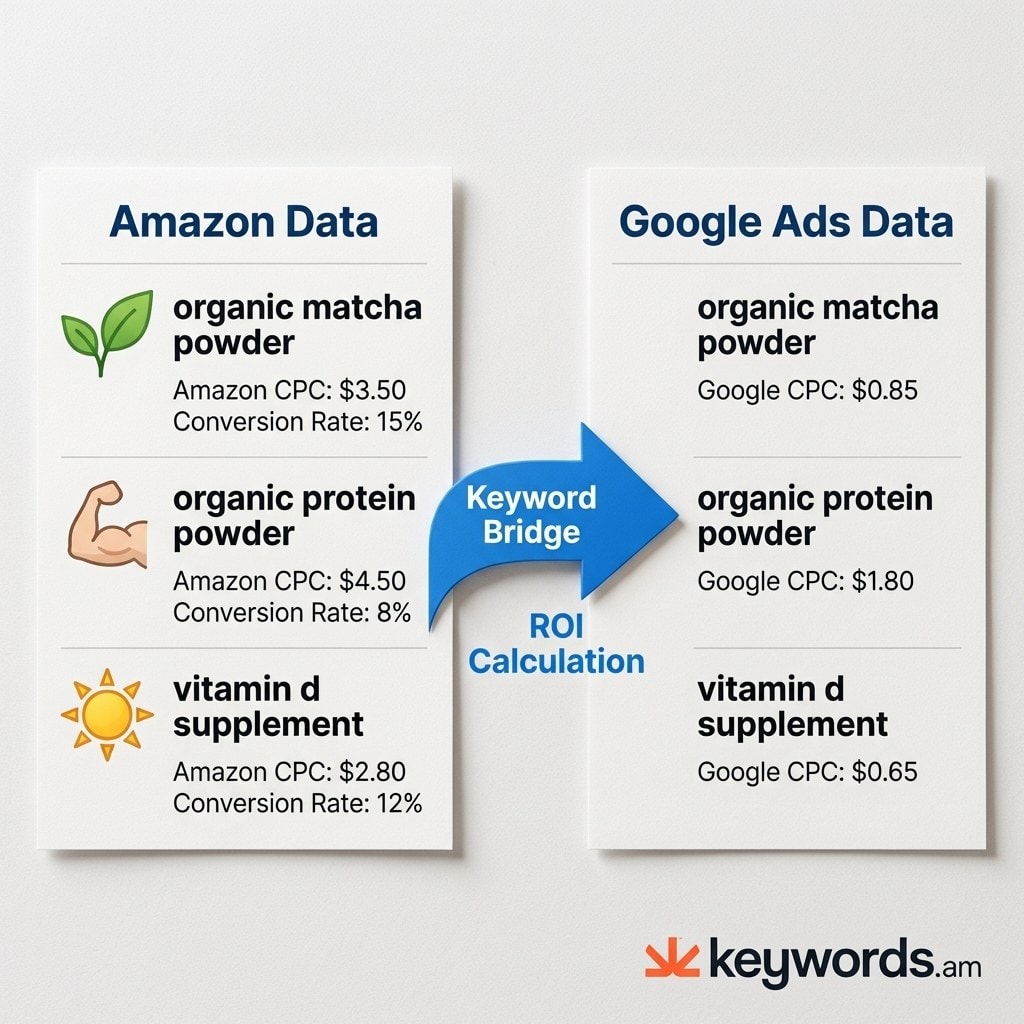
Think of it as the “keyword bridge.” It connects Amazon conversion data with Google CPC data, producing a real ROI calculation instead of guesswork. Most sellers pick Google keywords based on search volume alone. The keyword bridge relies on proven data from your existing Amazon sales history.
Start by pulling high-converting keywords from your Amazon Search Term Report. Sort by conversion rate, then filter for keywords with a high ACoS on Amazon. A keyword like “organic matcha powder” might convert at 15% but cost $3.50 per click on Amazon PPC.
Next, cross-reference this list with Brand Analytics Search Query Performance (SQP) data. Look for keywords displaying a high purchase share but a low impression share. This means your product converts well for the term, but Amazon limits your organic visibility. External traffic fills this gap.
Then check Google Ads Keyword Planner for those same keywords. Compare the Google CPC against the Amazon CPC. Understanding the differences between Amazon SEO and Google SEO matters here. You might find “organic matcha powder” costs $3.50 on Amazon but only $0.85 on Google Ads.
Finally, calculate the true cost per acquisition. You must factor in the Brand Referral Bonus. An optimized listing improves the conversion rate of this external traffic. Using the TFSD Framework ensures your title, features, search terms, and description align with the incoming keyword intent. A tightly optimized listing turns more Google clicks into Amazon buyers.
Once you know which keywords to target, the next decision is where to send the traffic.
Where should sellers send Amazon external traffic for the best conversion rates?
Amazon Brand Stores typically convert external traffic better than product detail pages because they offer a branded shopping experience and support full Attribution tracking.
Sellers generally choose between three landing page options:
* Amazon Brand Store: High conversion, no competitor ads, full tracking
* Product detail page: Good for single items, high competitor distraction
* Custom landing page: Great data collection, high drop-off rate before Amazon
The Amazon Brand Store is the best landing page for external traffic. It provides a clean, branded experience free from competitor sponsored ads. Visitors focus on your product line. Brand Stores also integrate with full Attribution tracking.
Product detail pages work decently well for highly specific single-product campaigns. But they carry a major risk. They show competitor ads, deals, and “frequently bought together” widgets. You pay for the Google click, but a competitor might steal the sale through an on-page ad.
URL format matters. Append Attribution tags correctly to the destination link. If the URL structure breaks, the tracking fails and the bonus is lost. A proper link looks like your standard Amazon URL followed by specific attribution parameters. With keywords selected and landing pages set, here is how the unit economics break down channel by channel.
How do sellers calculate the real ROI of Amazon external traffic?
The Bonus-Adjusted CAC formula subtracts Brand Referral Bonus credits from acquisition cost, often making external traffic cheaper per sale than Amazon PPC alone.
Here’s the formula that makes external traffic decisions concrete:
Adjusted CAC = Ad Spend per Sale – (AOV x Bonus Rate x Conversion Rate)
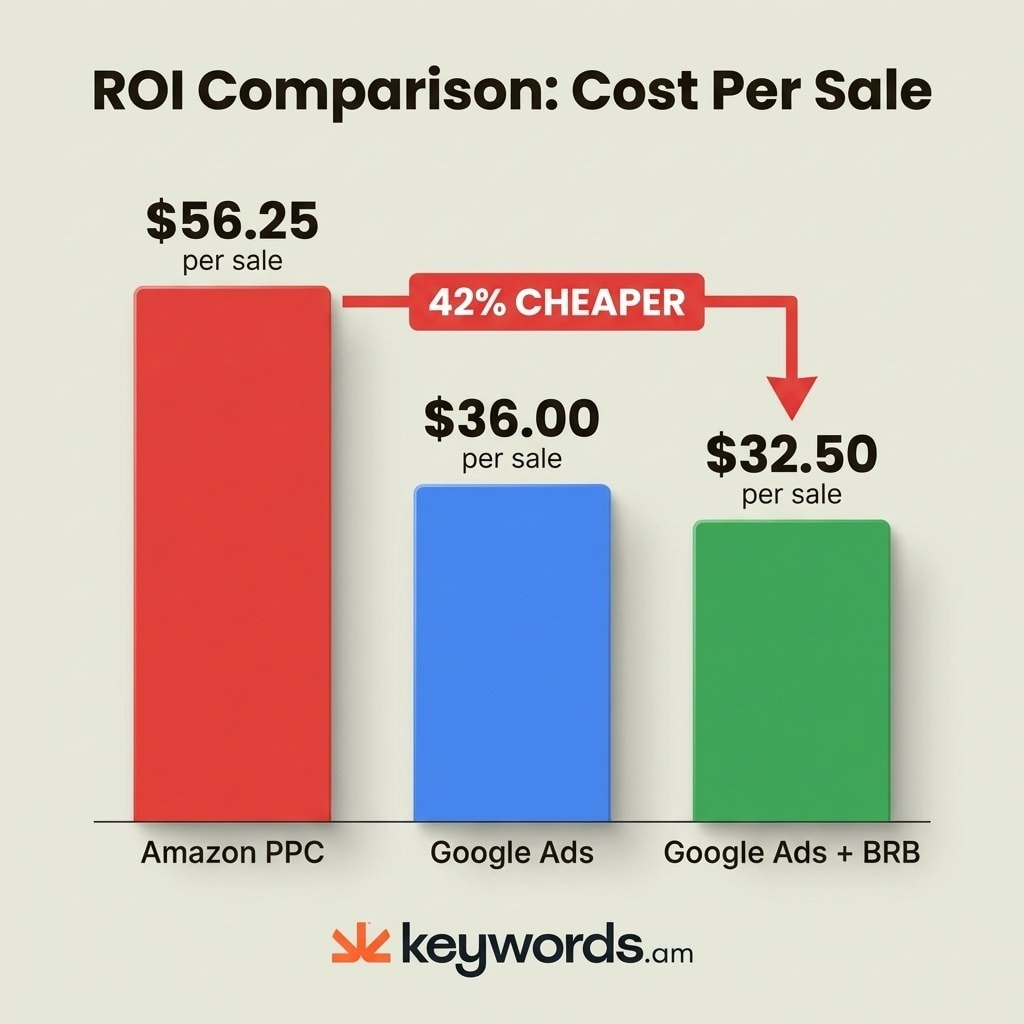
Take the keyword “organic protein powder.” It costs $4.50 per click in Amazon PPC campaigns. With an 8% conversion rate, that’s $56.25 per sale. That same keyword on Google Ads costs $1.80 per click. At a 5% conversion rate, you’re looking at $36.00 per sale.
Now apply the Brand Referral Bonus. With a 10% BRB on a $35 Average Order Value, the bonus offset equals $3.50. Your adjusted CAC becomes $36.00 minus $3.50, which equals $32.50 per sale. This Google Ads approach is 42% cheaper than relying on Amazon PPC alone.
Channel |
Typical CPC |
Conversion to Amazon |
BRB Eligible |
Best For |
|---|---|---|---|---|
Google Ads |
$0.50-$3.00 |
2-5% |
Yes |
Commercial intent keywords |
Meta/TikTok |
$0.30-$2.00 |
1-3% |
Yes |
Retargeting, awareness |
Email |
~$0.10 |
15-22% |
Yes |
Launches, repeat customers |
Influencer |
Varies |
3-8% |
Yes (with Attribution) |
Social proof, niche products |
Amazon PPC |
$0.50-$5.00+ |
8-15% |
No |
Direct Amazon searches |
Different channels serve different purposes. Google Ads captures high-intent commercial searches. Meta and TikTok work best for retargeting and broad awareness. Email marketing consistently dominates conversion rates, hitting 15-22% for established lists. Influencer marketing leans on social proof.
The savviest sellers hunt for “bonus arbitrage” keywords: high Amazon conversion rate + high-bonus category + low Google CPC. That combination yields maximum BRB profit. But even a solid strategy falls apart with common implementation mistakes.
What are the most common Amazon external traffic mistakes?
The most common external traffic mistakes are sending traffic without Attribution tags, targeting Google keywords with no Amazon conversion data, and ignoring the 2-month credit delay in ROI calculations.
Sending traffic without Attribution tags destroys the entire strategy. No bonus. Zero tracking data. Ad spend wasted blind.
Using a standard product detail page URL instead of a Brand Store link drops conversion rates. Competitor ads distract shoppers right before they buy.
Targeting Google keywords based on Google search volume alone wastes money. Don’t guess what converts. Use Amazon conversion data. That’s the entire point of the keyword bridge method.
Many sellers forget the 2-month credit delay. They run ads for 30 days, see no bonus credits, and panic. Then they kill profitable campaigns before the math has had time to work.
Ignoring the 14-day follow-up window skews attribution analysis. Some marketers only count day-one purchases. But the 14-day window captures a lot of delayed buying behavior that matters for ROI calculations.
Frequently Asked Questions About Amazon External Traffic
These are the most common questions sellers ask about driving external traffic to Amazon and the Brand Referral Bonus program.
Conclusion
- The keyword bridge method connects proven Amazon search data with cheaper Google CPCs.
- The Bonus-Adjusted CAC formula proves external traffic often beats Amazon PPC costs.
- Driving external visitors acts as a powerful ranking signal for the A10 algorithm.
- Amazon Brand Stores offer the cleanest, highest-converting landing pages for outside traffic.
Pull your Amazon Search Term Report today, sort by conversion rate, and identify 5 keywords with high ACoS that you could target on Google Ads instead.
Keywords.am helps sellers identify which keywords actually convert. Better Amazon data means better external targeting decisions. Combining keyword intelligence with a listing optimization strategy ensures external visitors land on pages built to convert. The TFSD Framework guide covers how to optimize listings so external traffic doesn’t go to waste.