
📑 Table of Contents
- What Is Amazon TACoS (and Why Does It Matter More Than ACOS)?
- How Does TACoS Compare to ACOS and ROAS?
- What Is a Good TACoS on Amazon?
- How Does the PPC-to-Organic Flywheel Lower Amazon TACoS?
- How Does Keyword Research Lower Your Amazon TACoS?
- 5 Best Strategies to Lower Your Amazon TACoS
- Frequently Asked Questions About Amazon TACoS
- Conclusion
⚡ TL;DR
- TACoS measures total ad spend against total revenue to reveal business-level profitability.
- A good TACoS target ranges from 5% to 10% for mature products, but launches require 15% to 25%.
- Cutting bids to lower ACOS often stalls organic ranking and makes your long-term TACoS worse.
- The most effective way to lower TACoS relies on finding high-intent keywords that drive organic rank.
- Matching listing copy to advertising targets improves quality scores and lowers cost per click.
- Optimizing listings through the TFSD framework should always precede aggressive advertising spend.
Amazon sellers spent over $50 billion on advertising in 2025, yet the majority still track the wrong metric when measuring ad profitability. ACOS measures campaign efficiency. TACoS measures business health. Most sellers obsess over the first and ignore the second.
This guide covers the Amazon TACoS formula, benchmarks by business stage and category, the PPC-to-organic flywheel that most guides miss, and five strategies to lower TACoS starting today. Most TACoS guides stop at the formula. TACoS is a keyword problem, not a bid problem, and that changes everything about how to lower it.
What Is Amazon TACoS (and Why Does It Matter More Than ACOS)?
Amazon TACoS (Total Advertising Cost of Sales) measures total ad spend as a percentage of total revenue, including both organic and ad-attributed sales.
The metric captures the complete relationship between advertising budgets and overall top-line growth. Instead of viewing ad spend in a vacuum, this calculation shows how dependent an entire catalog is on paid traffic. A seller might run highly efficient individual campaigns, but if overall sales volume remains low, the business still struggles to achieve meaningful profitability. Relying exclusively on campaign-level data masks these broader financial realities.
The calculation requires simple division. Divide total ad spend by total gross revenue, then multiply by 100 to find the percentage.
TACoS = (Total Ad Spend / Total Revenue) x 100
If a brand spends $2,000 on ads and generates $20,000 in total sales across both paid and organic channels, the TACoS is exactly 10%.
This distinction makes it a vastly superior metric for executive decisions compared to ACOS. ACOS only accounts for sales directly attributed to a clicked ad. A seller with a 50% ACOS might appear unprofitable at first glance. If their TACoS sits at a healthy 8%, it means their advertising is effectively fueling massive organic growth. The ads act as a loss leader that drives highly profitable organic sales velocity. To effectively navigate Amazon PPC optimization, advertisers must look past individual campaign efficiency and prioritize holistic business growth.
Many sellers fall into a common trap. They obsess over high ACOS numbers and slash their bids to improve campaign efficiency. This aggressive cutting kills conversion velocity. Without steady conversions, organic rank stalls and eventually drops. As organic sales dry up, the seller becomes dependent on paid traffic just to maintain revenue. Total profitability declines.
How Does TACoS Compare to ACOS and ROAS?
ACOS measures campaign efficiency, TACoS measures business-level ad dependency, and ROAS measures return per dollar. Each answers a different strategic question.
Sellers frequently confuse these three metrics or try to substitute one for another. Financial planners often prefer return on ad spend for broad accounting purposes. Daily operators need granular cost ratios to adjust bids effectively. Using the wrong metric leads to disastrous strategic decisions. Pausing a campaign that actually drives the majority of organic keyword ranking will destroy total catalog profitability.
A complete Amazon PPC audit requires analyzing all three numbers together. They function as a complete dashboard rather than competing ideologies.
Metric |
Formula |
What It Measures |
When to Use |
Good Range |
|---|---|---|---|---|
ACOS |
(Ad Spend / Ad Revenue) x 100 |
Campaign efficiency |
Daily bid adjustments |
15-30% |
TACoS |
(Ad Spend / Total Revenue) x 100 |
Ad dependency |
Monthly business planning |
5-15% |
ROAS |
Total Revenue / Ad Spend |
Return per dollar |
CFO-level reporting |
3x to 6x |
Analyzing ACOS and TACoS simultaneously reveals the true health of an Amazon business. Sellers can map their current performance against four distinct scenarios to diagnose deeper algorithmic issues.
Scenario |
Diagnosis |
Interpretation |
|---|---|---|
TACoS down + ACOS down |
Ideal |
Ads run efficiently while organic sales grow steadily. The flywheel is fully operational. |
TACoS down + ACOS up |
Healthy |
Organic sales heavily outpace ad growth. Ads might be expensive, but they drive massive organic volume. |
TACoS up + ACOS down |
Warning |
Total revenue is declining despite highly efficient ads. The product is losing organic market share. |
TACoS up + ACOS up |
Red Alert |
Both ad efficiency and business volume are collapsing. Immediate intervention is required. |
Use ACOS to dictate optimization inside Seller Central. Rely on TACoS to answer structural business questions. If the question involves increasing total ad budgets or launching a new product, TACoS provides the definitive operational answer.
What Is a Good TACoS on Amazon?
A good Amazon TACoS ranges from 5-10% for mature products to 15-25% for new launches, with significant variation by category and competitive intensity.
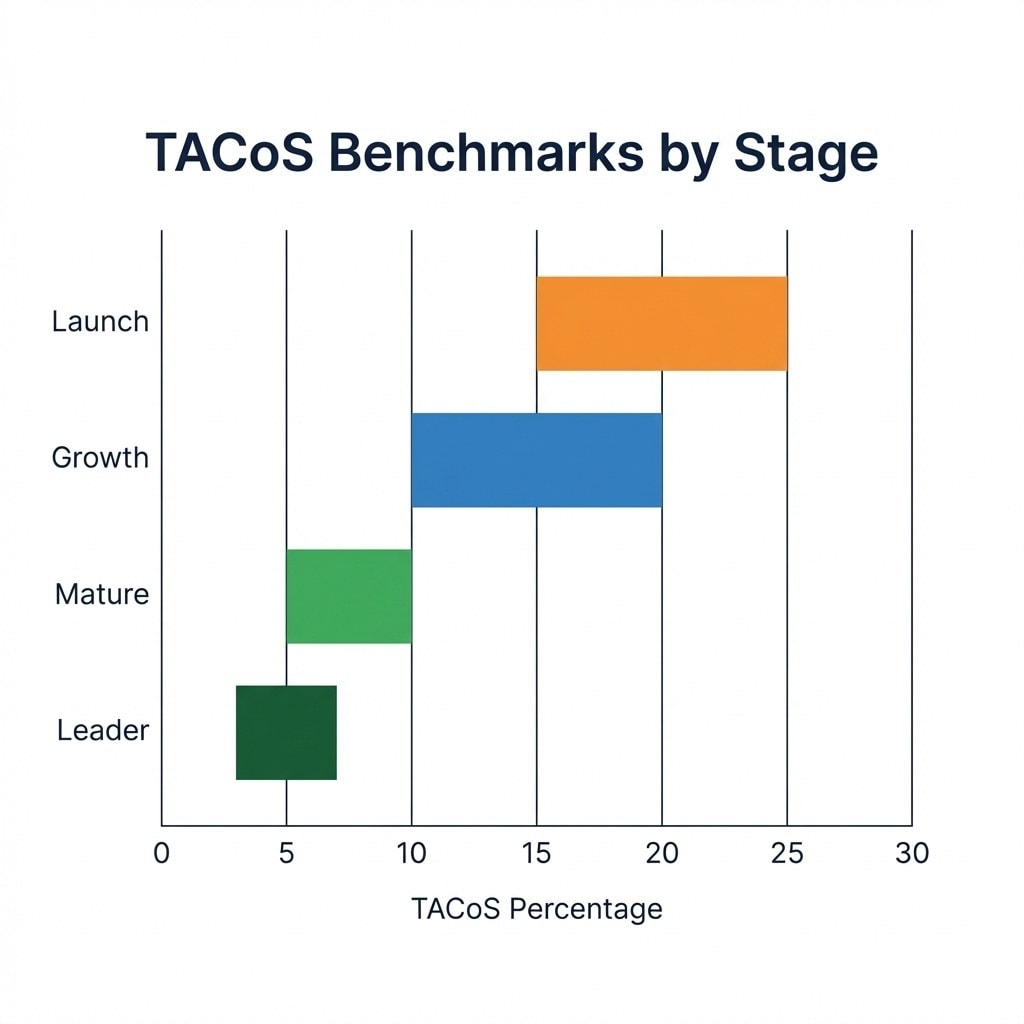
A perfect percentage does not exist in isolation. Every product lifecycle stage demands a different approach to profitability and risk. Expecting a brand new listing to match the metrics of a five-year-old category leader leads to chronic under-investment. New listings require aggressive early spending to generate the initial conversion velocity that Amazon’s algorithm demands.
Many variables dictate these ideal targets. Your baseline Amazon conversion rate heavily influences how aggressively you can spend. Products with high repeat purchase rates can sustain much higher advertising costs because the lifetime value of the customer offsets the initial acquisition expense.
Business Stage |
TACoS Range |
ACOS Range |
Context |
|---|---|---|---|
Launch (0-6 months) |
15-25% |
30-60% |
Investing heavily in rank velocity. Profitability is secondary. |
Growth (6-18 months) |
10-20% |
20-35% |
Organic sales begin building. The ratio naturally declines. |
Mature (18+ months) |
5-10% |
15-25% |
Establishing organic dominance. Ads serve a defensive purpose. |
Market Leader |
3-7% |
10-20% |
Minimal ad dependency. High margin realization. |
These benchmarks shift based on category dynamics. The average Amazon cost per click sits between $0.95 and $1.21 in 2026, but specific niches operate under different rules.
- Beauty & Supplements: Expect 12-18% regularly. The competition is fierce, and average CPCs frequently exceed $5.00. Sellers rely on subscribe-and-save programs to recoup costs.
- Electronics: Typically 8-15%. High CPCs are balanced by strong brand loyalty and higher price points.
- Home & Kitchen: Usually 8-12%. This represents a moderate competitive environment with stable conversion rates.
- Tools & Home Improvement: Often 5-10%. Lower overall ad competition and higher average selling prices keep ad dependency low.
Benchmarks provide a necessary starting point. Hitting these targets requires understanding the underlying mechanism that drives the percentages down over time.
How Does the PPC-to-Organic Flywheel Lower Amazon TACoS?
The PPC-to-organic flywheel works by using ad-driven conversions on specific keywords to lift organic rank, which increases organic sales and naturally reduces TACoS over time.
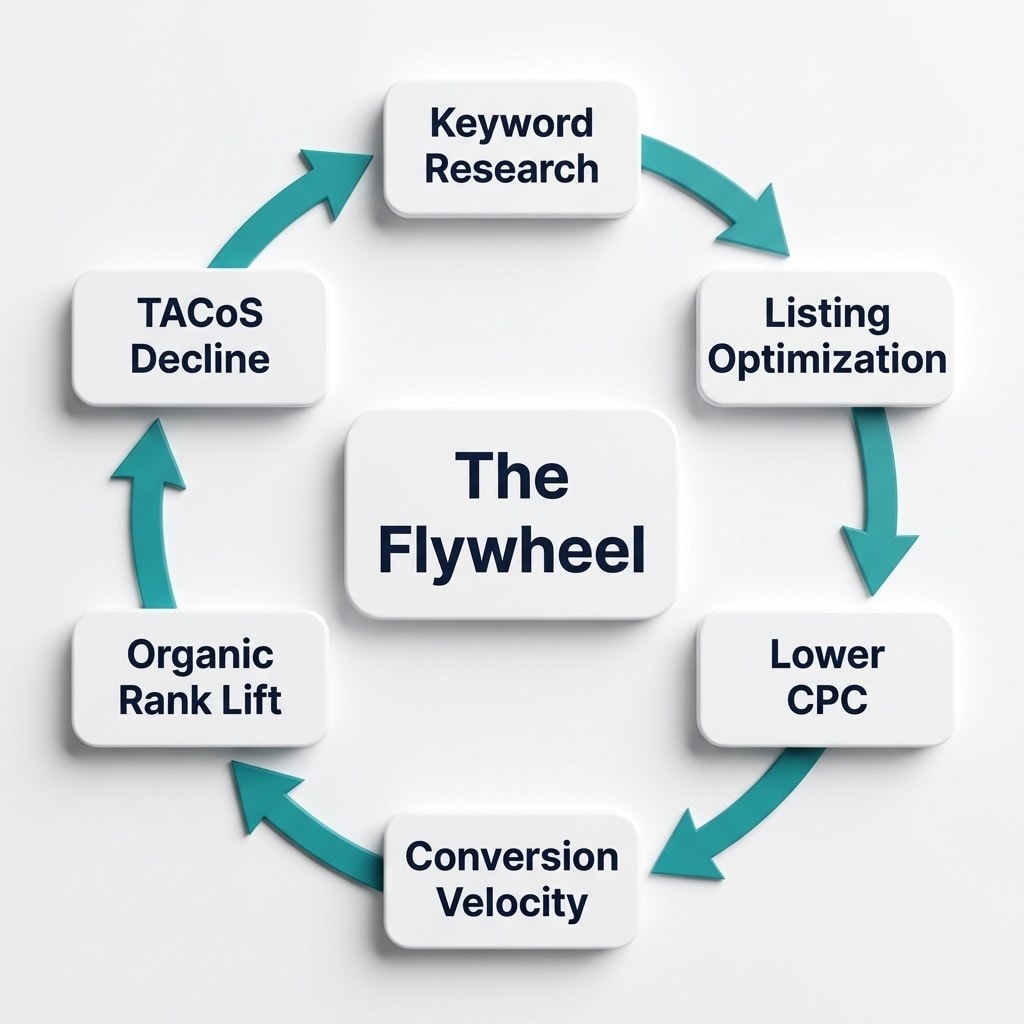
The algorithm treats every successful ad click as a signal of relevance. When a shopper searches for a term, clicks a sponsored listing, and completes a purchase, Amazon’s A10 algorithm notes that the product satisfied the search intent. The system rewards that specific listing with slightly higher organic placement for that exact keyword.
This relationship forms the core engine of Amazon profitability. The sequence operates through six distinct steps.
- Advertisers target high-intent keywords in their sponsored campaigns.
- Shoppers click the ads and convert, registering keyword-specific conversion velocity.
- The algorithm processes this velocity as a relevance signal, lifting the organic rank for that specific search term.
- Higher organic rank exposes the product to more shoppers, generating organic sales at zero advertising cost.
- As the proportion of organic sales grows relative to ad spend, the TACoS ratio naturally declines.
- The seller reinvests the newly acquired margin into new keyword targets, accelerating the entire process.
The entire system requires precise inputs. The flywheel only spins when the targeted advertising keyword closely matches the product listing content. Irrelevant keyword targeting burns through daily budgets without building any long-term rank momentum.
This exposes the biggest flaw in traditional optimization advice. Cutting bids to lower ACOS breaks the flywheel. Fewer ad clicks lead to fewer total conversions. As conversion velocity drops, organic rank stalls or reverses. The ratio worsens because the numerator shrinks slightly, but the denominator collapses. Advertisers must align their Amazon PPC keyword strategy with their organic ranking goals to ensure long-term profitability. Properly implementing the TFSD Framework guide ensures the listing content naturally supports this highly profitable advertising motion.
How Does Keyword Research Lower Your Amazon TACoS?
Better keyword research improves listing relevance, which raises ad quality scores, lowers cost per click, and accelerates the conversion-to-organic-rank flywheel that reduces TACoS.
Most sellers view cost per click as a fixed auction price. The reality is highly fluid. Amazon uses an internal quality score system to determine the final cost of an ad placement. Highly relevant listings pay less for the exact same top-of-search placement than poorly optimized competitors. The entire cost structure begins with the words written on the product detail page.
The cost reduction chain works in sequence.
- Sellers embed the right keywords strategically throughout the listing copy.
- This content matches the targeted advertising keywords perfectly, generating a high internal ad quality score.
- The elevated quality score lowers the required cost per click.
- With a lower CPC, the same daily budget buys more traffic.
- More targeted traffic yields more conversions, accelerating organic rank and driving down the business’s overall ad dependency.
Targeting massive, generic keywords routinely destroys profitability. Running ads on a broad term like “water bottle” generates thousands of clicks but terrible conversion rates. Sellers pay upwards of $3.00 per click for a miserable 2% conversion rate. Running those same ads on a highly specific phrase like “insulated water bottle 32oz BPA free” might cost only $0.80 per click while yielding a massive 8% conversion rate. High ACOS combined with zero organic rank lift guarantees rising unprofitability.
The TFSD framework approaches this problem methodically. It requires optimizing the Title, Features, Search Terms, and Description before spending a single dollar on ads. The listing optimization establishes the baseline relevance. The advertising campaigns then simply amplify that existing relevance. Sellers can read the complete TFSD Framework guide to properly map their copy. Diligent Amazon search term report analysis then identifies the exact phrases customers actually use. Combining this precise research with aggressive Amazon negative keywords implementation eliminates the wasted spend that artificially inflates the metric.
5 Best Strategies to Lower Your Amazon TACoS
The most effective TACoS reduction strategies combine listing optimization, negative keyword pruning, search term harvesting, campaign restructuring, and seasonal bid management.
Lowering overall ad dependency requires methodical execution across multiple disciplines. Sellers cannot simply tweak a few bids and expect structural business changes. The most profitable brands execute a coordinated strategy that touches both the organic copy and the advertising architecture simultaneously.
Strategy 1: Optimize listings before increasing ad spend
Fixing the foundation always precedes scaling the traffic. Pumping advertising dollars into a poorly optimized listing produces clicks but tanks conversion rates. The algorithm quickly notices the poor performance and actively penalizes the listing with higher CPCs. If a product sells an ergonomic desk chair, the copy must explicitly state the specific benefits and exact dimensions. Implement the TFSD Framework guide to ensure the Title, Features, Search Terms, and Description perfectly mirror the highest-converting customer search intents. Only increase budgets once the baseline conversion rate stabilizes above category averages.
Strategy 2: Mine the search term report weekly
The gap between what sellers think customers search and what they actually type costs thousands of dollars monthly. Mining the Amazon search term report reveals the exact phrases driving profitable sales. Sellers must extract these converting terms and immediately launch them in dedicated exact match campaigns. Conversely, they must identify terms generating clicks without sales and add them as Amazon negative keywords. This dual action starves the waste and feeds the winners. This process requires extreme discipline. A seller might discover that shoppers frequently append the word “waterproof” to their search queries. If the product is indeed waterproof, that exact term must be harvested and targeted directly.
Strategy 3: Structure campaigns by keyword intent
Mixing broad discovery keywords with highly targeted exact phrases in the same campaign creates budget chaos. Sellers must split campaigns by intent. A scattered campaign architecture guarantees wasted capital. When broad match keywords share a budget with high-performing exact match keywords, Amazon’s algorithm often funnels the money toward the broad terms because they generate faster clicks. A proper PPC campaign structure isolates variables. Use a specific Amazon Sponsored Products keyword strategy to drive direct bottom-of-funnel conversions. Deploy an Amazon Sponsored Brands keyword strategy to capture top-of-search real estate and build long-term brand awareness. Finally, utilize Amazon Sponsored Display targeting to retarget shoppers who viewed the listing but failed to purchase.
Strategy 4: Build a multi-SKU portfolio strategy
Treating an entire catalog as a single entity guarantees inefficient capital allocation. Not all products deserve the same target metrics. A brand might have a hero SKU with massive margins and high organic rank. That specific product should operate with a 5% target. A newly launched secondary product requires heavy investment and might operate at 25% for six months. Sellers must mathematically balance these extremes. Over-invest in the high-margin winners and ruthlessly cut budget on the low-margin, high-dependency tail products.
Strategy 5: Set seasonal TACoS targets
Market dynamics shift violently during peak shopping events. An Amazon seasonal keyword strategy requires flexible profitability targets. During Prime Day or Q4, average CPCs routinely increase by 20% to 40%. Conversion rates also spike simultaneously. Sellers who stick to their standard 10% target during these periods will lose all visibility to bolder competitors. Allow the metric to float higher during peak events to capture the surge in traffic, then aggressively reset the bids the moment the event concludes.
Frequently Asked Questions About Amazon TACoS
Understanding the intricacies of Amazon ad profitability requires clear answers to common seller questions.
Conclusion
- Obsessing over campaign efficiency often destroys total business profitability.
- Lowering overall ad dependency is a keyword problem, not a bidding problem.
- The most profitable sellers use targeted ad spend to build long-term organic ranking momentum.
- Aligning product listing copy with advertising targets naturally lowers the cost per click.
Audit the search term report for the top-spending campaign today. Identify five non-converting search terms and add them as negatives immediately to eliminate wasted spend. For sellers who want to optimize listings before scaling PPC spend, the Keywords.am TFSD Framework guide identifies the exact keywords to target across Title, Features, Search Terms, and Description.