Amazon Fundamentals
How Amazon BSR actually works (and the best keyword strategy to move it)
Amazon BSR updates hourly and ranks products by recent sales velocity. Learn what drives Best Seller Rank and how keyword research strategy improves it fast.

Amazon BSR updates every hour across millions of products. Most sellers treat this fluctuating number like a daily metric, panicking when rankings swing 30 percent overnight. They obsess over the raw number without understanding the calculations driving those shifts.
Others dismiss the metric entirely because the volatility makes it seem unreliable. Sustainable growth requires understanding how the algorithm processes data - not chasing shortcuts that produce temporary results.
This article breaks down how Amazon calculates Best Seller Rank, what a healthy ranking looks like across categories, and the keyword research chain that serves as the primary upstream input most optimization guides ignore.
What is Amazon BSR and how does it actually work?
Amazon BSR (Best Seller Rank) is a numerical ranking assigned to every product in its category, updated hourly based on recent and historical sales velocity.
The system assigns a rank to items within specific categories. A rank of one indicates the best-selling product in that market segment at that moment. Higher numbers indicate fewer sales relative to direct competitors. Every product receives at least one primary rank, while many carry additional rankings for niche subcategories. A kitchen gadget might rank 5,000 in the broad Home & Kitchen category while simultaneously ranking number two in the specific Garlic Presses subcategory. Both numbers matter, but they represent different competitive landscapes.
The algorithm recalculates positions on an hourly schedule - not a daily batch process. A single purchase moves the rank noticeably for low-volume products sitting deep in the catalog. This refresh rate explains why day-to-day swings of 30 to 50 percent represent normal behavior for products moving five to ten units daily. A merchant selling a handful of units might see their rank jump from 80,000 to 45,000 after two afternoon orders, then bleed back down to 80,000 if no further sales occur that evening.
Sellers find this metric on the public product detail page, below the fold in the product information section. The number also populates in Seller Central backend reports and feeds into third-party tracking tools.
A search for “amazon BSR meaning” translates directly to Best Seller Rank. Some official documents refer to it as Amazon Sales Rank instead. Both terms describe the same underlying performance measurement. Knowing the ranking exists marks the first step. Understanding how Amazon calculates that position reveals why most conventional advice fails.
How does Amazon calculate Best Seller Rank?
Amazon weights recent sales more heavily than historical sales, so a product that sold 20 units today outranks one that sold 25 units spread over the past week.
The calculation relies on strict recency weighting. Amazon assigns exponentially more weight to the last few hours of transaction data compared to sales generated last week. This creates natural volatility across the platform. A sudden spike in afternoon orders pushes the rank up immediately, even if the product experienced zero sales for the prior three days.
The system functions as a real-time relative metric without any fixed numerical scale. A product can improve its rank without securing a single new sale - if competing items experience a drop in their own volume. The ranking constantly shifts as millions of products change positions relative to one another. Sellers aren’t earning points toward a fixed goal. They’re running a never-ending race against every other merchant in their category.
Rankings scale drastically across different categories and catalog sizes. A BSR of 5,000 in Cell Phones & Accessories requires roughly 20 to 30 daily sales due to millions of competing products. A rank of 5,000 in Musical Instruments requires just three to five daily sales. Consumer traffic volume dictates the mathematical floor and ceiling of each category.
| Category | BSR Range (Top 1%) | Estimated Daily Sales | BSR Range (Top 10%) | Estimated Daily Sales |
|---|---|---|---|---|
| Electronics | 1-500 | 100-500+ | 500-5,000 | 20-100 |
| Home & Kitchen | 1-1,000 | 50-300+ | 1,000-10,000 | 10-50 |
| Beauty & Personal Care | 1-500 | 80-400+ | 500-5,000 | 15-80 |
| Sports & Outdoors | 1-500 | 40-200+ | 500-8,000 | 8-40 |
| Toys & Games | 1-300 | 50-250+ | 300-5,000 | 10-50 |
| Grocery & Gourmet | 1-500 | 30-150+ | 500-5,000 | 5-30 |
These figures represent approximate industry estimates derived from seller tool data. Amazon does not publish officialsales-to-BSR mappings.
Smart Amazon product niche validation ensures sellers compete in subcategories where they can achieve top placement. Winning a Best Seller badge in a smaller subcategory generates far more organic trust than sitting at rank 15,000 in a massive parent category. These benchmark numbers confirm that BSR measures sales performance. But there’s another ranking system sellers confuse with BSR - and mixing them up leads to bad strategy.
What is the difference between Amazon BSR and organic search rank?
BSR measures sales performance within a category. Organic search rank measures keyword relevance for specific search terms. They influence each other but track different signals.
Think of Best Seller Rank like a baseball player’s batting average - it tracks overall performance across all scenarios. Organic rank acts more like fielding position, dictating where the product shows up for a specific play. A high BSR means the product sells well overall. A high organic rank means the product appears at the top of page one when a customer types a specific phrase into the search bar.
The two systems feed into each other through a closed feedback loop. Better organic rank leads to more visibility for targeted search phrases. Higher visibility drives clicks and generates sales. Those sales improve the Best Seller Rank. Amazon notices the product converts well and boosts the organic rank further. This virtuous cycle relies on the core Amazon A10 algorithm ranking mechanics to evaluate relevance. The algorithm measures click-through rates, add-to-cart frequencies, and purchase decisions to determine which products deserve the highest organic placement.
Sellers who only monitor BSR miss critical insights at the keyword level. A sudden BSR drop might indicate a competitor outranked the listing for three profitable search terms. That specific shift wouldn’t show up in the broad sales rank metric alone. By the time the overall amazon BSR drops, the organic traffic loss has already damaged the bottom line. BSR exists as an output. The primary input driving it requires something more specific than hoping for more sales.
How does keyword research drive Amazon BSR improvement?
Keyword research drives BSR by connecting a listing to searches with high purchase intent, increasing conversion rate, which increases sales velocity - the metric BSR actually measures.
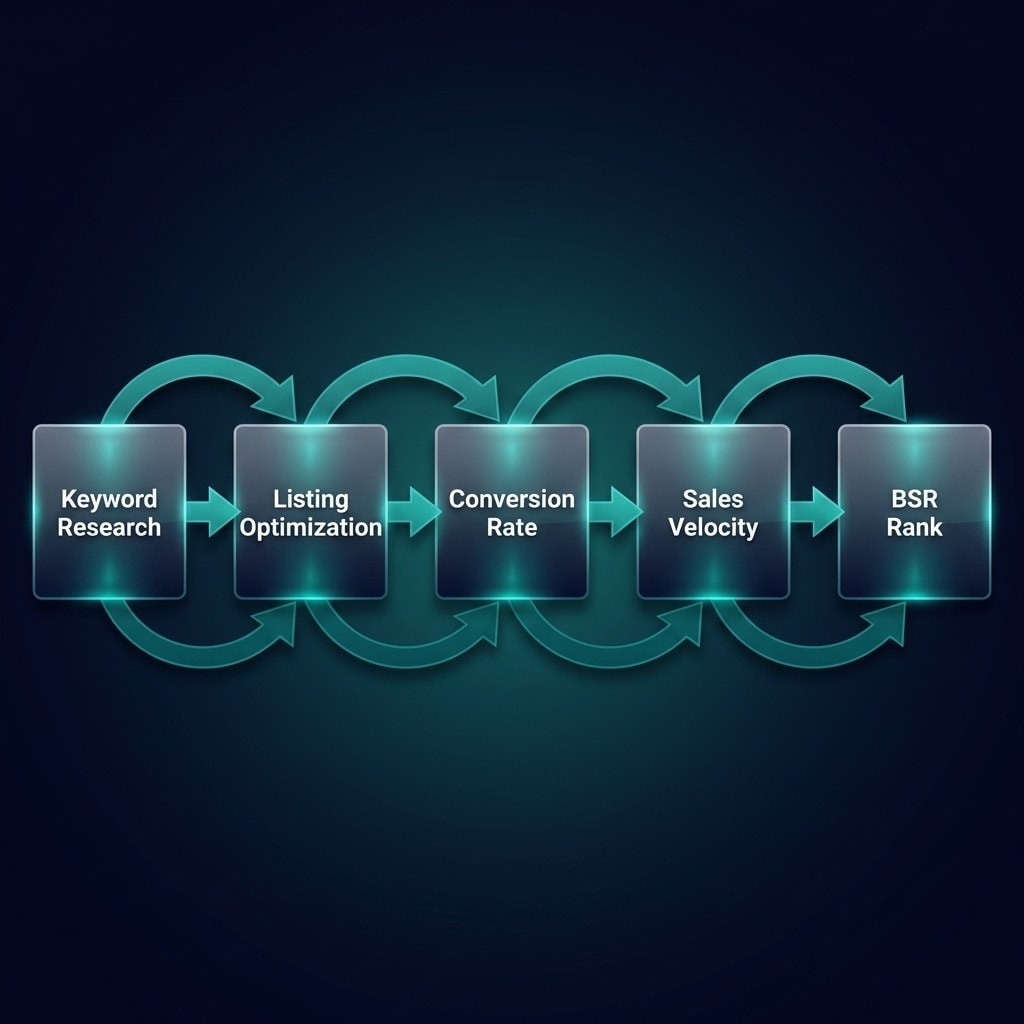
The BSR input chain moves through five sequential steps. It begins with keyword research. This transitions into structural listing optimization. Better listing copy triggers a higher conversion rate. A stronger conversion rate accelerates sales velocity. That increased velocity improves the Best Seller Rank. Sellers can’t skip steps. Attempting to force sales velocity without addressing keyword research always results in wasted effort.
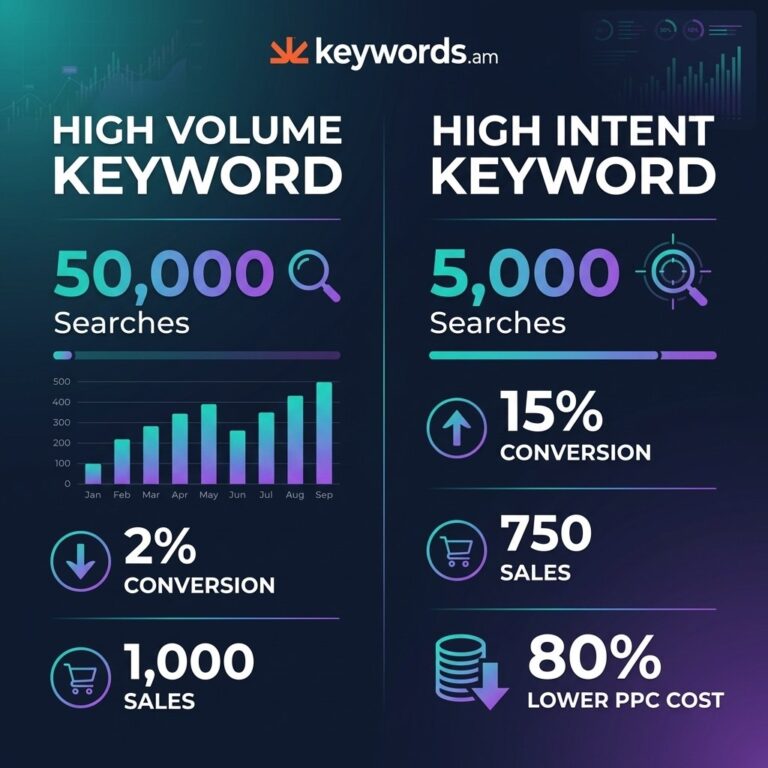
Targeting high-converting phrases beats chasing sheer search volume. A keyword generating 50,000 monthly searches with a two percent conversion rate yields 1,000 sales. A tighter keyword driving 5,000 searches with a 15 percent conversion rate brings in 750 sales - but costs 80 percent less in advertising spend with better profit margins. Shoppers searching for broad terms rarely know what they want. Identifying and targeting Amazon long-tail keywords builds a more sustainable foundation. High-intent phrases capture buyers at the end of their purchasing journey.
The TFSD Framework guide maps out structured keyword placement across Title, Features, Search Terms, and Description fields. This mapping ensures the marketplace algorithm captures the listing for the maximum number of relevant queries. The Title carries the heaviest indexing weight. Bullet features provide secondary relevance and conversion copy. The Description field catches long-tail variations and technical specifications.
Amazon keyword clustering covers the full search intent spectrum. Grouping related terminology helps a listing rank for dozens of query variations instead of relying on a single exact match phrase. If a merchant sells a garlic press, clustering ensures the listing also captures “stainless steel garlic mincer,” “professional garlic crusher,” and “heavy-duty garlic squeezer.”
Hidden Amazon backend keywords broaden the indexing net. These 249 bytes of invisible text expand Amazon keyword indexing without cluttering visible copy. This backend space works well for misspellings, colloquial terms, and alternate language translations. Higher Amazon conversion rate metrics follow naturally when a product’s relevancy matches the buyer’s exact intent. The keyword-to-BSR chain works. But most sellers skip this work and fall into traps that waste money.
What are the biggest Amazon BSR traps sellers fall into?
The five most expensive BSR traps are giveaway spikes, panic-pricing from hourly fluctuations, cross-category BSR comparisons, ignoring subcategory selection, and running PPC without optimized listing keywords.
Giveaway-driven rank manipulation wastes thousands. Most optimization guides tell sellers to run aggressive giveaways. That’s a $5,000 way to get a 48-hour BSR spike. Selling 500 units at an 80 percent discount creates an immediate rank bump that crashes once the promotion ends. The algorithm detects unnatural sales velocity from steep discount codes and normalizes the ranking shortly after. Thousands of dollars in margin gone for zero lasting improvement.
Panic-adjusting price based on hourly BSR destroys profitability. Rank shifts constantly due to recency weighting. A 30 percent swing in a single afternoon represents normal behavior for products moving five to 15 units daily. Reacting by slashing prices erodes margins without addressing the root cause. Price drops might secure one or two extra orders, but the temporary amazon BSR bump rarely justifies permanently lowered margins.
Comparing BSR across categories provides useless data. A rank of 3,000 in Grocery looks nothing like a rank of 3,000 in Electronics. Sellers must reference category benchmark tables for accurate expectations. A merchant dominating a small category might panic comparing their rank to a friend selling phone cases - two different mathematical universes.
Ignoring subcategory selection limits visibility. A product in a niche subcategory with 5,000 competitors secures a better rank than the same product in a parent category fighting 500,000 competitors. Proper positioning earns the Amazon Best Seller badge faster. That orange badge serves as a powerful conversion tool, communicating social proof to browsing shoppers.
Running PPC without listing keyword optimization burns budget. Sellers burn spend by ignoring Amazon keyword difficulty and rushing into advertising. Running an Amazon PPC optimization campaign without a solid Amazon listing optimization strategy wastes paid clicks. If the listing copy lacks optimized phrases, paid traffic doesn’t convert. Low conversion rates keep the overall rank stagnant despite heavy ad spend. The advertising algorithm punishes listings that fail to convert by raising cost-per-click rates.
Frequently Asked Questions About Amazon BSR
These are the most common questions sellers ask about Amazon BSR and sales rank optimization.
What is Amazon BSR?
Amazon BSR (Best Seller Rank) is a numerical ranking measuring a product’s sales performance relative to other products in the same category, updated hourly.
What is a good BSR on Amazon?
A “good” BSR depends on the category. In Electronics, BSR under 5,000 is strong. In Musical Instruments, BSR under 1,000 is equivalent. Use category benchmark tables to calibrate expectations.
How often does Amazon update BSR?
Amazon updates BSR hourly. A single sale can shift BSR noticeably for low-volume products, which explains day-to-day volatility.
Does BSR affect Amazon search ranking?
BSR itself doesn’t directly control search ranking. But the sales velocity that drives BSR improvement also signals relevance to Amazon’s A10 algorithm, which does influence organic rank.
How can sellers improve Amazon BSR?
Improve Amazon BSR by optimizing listing keywords for high-converting search terms, maintaining competitive pricing, and ensuring strong conversion rate through listing quality. Keyword research is the highest-leverage input.
What is the difference between BSR and organic search rank?
BSR measures sales performance. Organic search rank measures keyword relevance. They influence each other through a feedback loop: better keywords drive more conversions, which improve BSR, which signals Amazon to boost organic rank.
Does PPC advertising affect BSR?
PPC-driven sales count toward BSR. But PPC is most effective when the listing’s organic keywords are already optimized - otherwise, paid clicks don’t convert and BSR doesn’t improve despite ad spend.
Conclusion
Focusing on Best Seller Rank as a primary target leads to poor business decisions. The metric serves as a reflection of sales history, not a direct lever for growth. Chasing hourly fluctuations drains resources better invested in structural listing improvements.
- BSR is an output metric, not an input lever - nobody can optimize it directly.
- The BSR input chain flows from keywords to conversion to sales velocity before impacting rank.
- Category context matters - a rank of 5,000 means drastically different things across the marketplace.
- Keyword research serves as the highest-leverage activity for sustainable rank improvement.
Run a keyword audit on the top three listings in the catalog. Check whether the Title, Features, Search Terms, and Description cover the highest-converting search terms for the product. Start building a stronger foundation using a free Amazon keyword tool to identify the phrases driving real conversion. Let the resulting sales velocity move the amazon BSR naturally.