
📑 Table of Contents
- Why does Amazon seasonal keyword strategy matter more in 2026?
- What does a 12-month Amazon seasonal keyword calendar look like?
- How do sellers research seasonal keywords using Amazon data?
- How does the TFSD framework handle seasonal keyword placement?
- When should sellers ramp PPC spend for seasonal keywords?
- What happens to seasonal keywords after a holiday ends?
- Frequently Asked Questions About Amazon Seasonal Keyword Strategy
- Conclusion
⚡ TL;DR
- Amazon search swings 2x between June (10.63B searches) and December (20.93B searches).
- Rufus AI evaluates seasonal intent contextually, not through exact keyword matching.
- 12 monthly keyword windows exist beyond Q4 that most sellers ignore entirely.
- Brand Analytics SQP provides free first-party data to pinpoint seasonal shifts.
- Backend search terms are the safest TFSD slot for rotating seasonal keywords.
- Start PPC six weeks early with broad match, then narrow to exact match at peak.
- Post-season cleanup prevents relevance dilution and prepares the next cycle.
Amazon shoppers ran 20.93 billion searches in December 2024. Six months earlier, they ran only 10.63 billion. That near-2x swing reshapes which keywords drive sales every single month.
Most sellers swap a few keywords before Q4 and ignore the rest of the year. With Rufus AI handling 274 million daily queries and interpreting seasonal buyer intent contextually, static keyword lists are a growing liability.
This guide covers a full 12-month amazon seasonal keyword strategy calendar, a research workflow using Brand Analytics SQP, and the TFSD framework for safely layering seasonal terms without risking evergreen rank.
Why does Amazon seasonal keyword strategy matter more in 2026?
Amazon seasonal keyword strategy matters more because Rufus AI handles 274 million daily queries and interprets seasonal buyer intent contextually, making static keyword lists obsolete.
Seasonal demand is not a Q4 phenomenon. Amazon search data from Carbon6 shows shoppers executed 20.93 billion queries in December 2024 and just 10.63 billion in June. Ignoring these fluctuations leaves substantial revenue on the table.
Three hundred million customers interacted with Rufus in 2025. During Black Friday 2025, 38% of all shopping sessions involved Rufus conversations. The AI interprets seasonal intent contextually. A query like “gift for dad who golfs” gets parsed for the relationship, the hobby, and the gifting occasion. Exact-match keyword stuffing alone no longer captures this traffic.
Amazon’s COSMO knowledge graph underpins this shift. With 6.3 million nodes mapping products to use cases and seasonal contexts, Amazon search now relies on intent comprehension rather than keyword matching alone.
Over 200 million US Prime members fuel seasonal traffic surges. They spend roughly $1,170 annually compared to $570 for non-Prime shoppers. Prime-exclusive events like Prime Day and Big Deal Days create concentrated keyword windows that sellers who skip seasonal planning surrender entirely.
What does a 12-month Amazon seasonal keyword calendar look like?
A 12-month Amazon seasonal keyword calendar maps every major shopping event from January clearance through December holidays, with category-specific keyword examples and lead times for each period.
Most sellers treat Q4 as the only period requiring keyword management. But continuous micro-seasons and major shopping holidays create demand surges year-round. A structured calendar forces proactive keyword integration before advertising costs spike.
Month |
Event(s) |
Example Seasonal Keywords |
Lead Time |
|---|---|---|---|
January |
New Year’s resolutions, clearance sales |
“new year fitness equipment,” “post-holiday deals” |
4 weeks |
February |
Valentine’s Day, Super Bowl |
“valentines day gift for him,” “super bowl party supplies” |
6 weeks |
March |
Spring Shopping Event, spring cleaning |
“spring cleaning supplies,” “amazon big spring sale deals” |
5 weeks |
April |
Easter, tax season |
“easter basket gifts,” “tax organizer” |
6 weeks |
May |
Mother’s Day, Memorial Day |
“mothers day gift,” “memorial day outdoor furniture” |
6 weeks |
June |
Father’s Day, graduation |
“fathers day gift,” “graduation gift ideas” |
6 weeks |
July |
Prime Day |
“prime day deals,” “prime day electronics” |
8 weeks |
August |
Back to school |
“back to school supplies,” “dorm room essentials” |
6 weeks |
September |
Fall prep, Labor Day |
“fall home decor,” “labor day mattress sale” |
5 weeks |
October |
Prime Big Deal Days, Halloween |
“prime big deal days,” “halloween costumes” |
8 weeks |
November |
Black Friday, Cyber Monday |
“black friday deals,” “cyber monday electronics” |
8 weeks |
December |
Holiday gifting, year-end clearance |
“christmas gifts for kids,” “last minute gifts” |
6 weeks |
The summer months are a prime opportunity. Prime Day 2025 drove $24.1 billion in US online sales. Sellers who prepared keywords in May captured the bulk of that traffic.
Fall events keep growing. October’s Prime Big Deal Days generated $11 billion in 2025. Black Friday and Cyber Monday drove over $20 billion combined. Each event requires distinct keyword sets. A shopper searching “prime day deals” has different intent than one typing “christmas gifts for kids.”
How do sellers research seasonal keywords using Amazon data?
Sellers research seasonal keywords by combining Search Term Reports from auto campaigns, Brand Analytics SQP trend comparisons, Google Trends cross-referencing, and reverse ASIN analysis on seasonal competitors.
Step 1: Search Term Report harvesting
Run auto campaigns five to six weeks before a seasonal event. These campaigns capture how shoppers actually phrase seasonal queries. Analyzing the Amazon Search Term Report reveals converting phrases missed during manual brainstorming. A shopper might type “gifts for stressed out moms” instead of the generic “mothers day gift.”
Step 2: Brand Analytics SQP seasonal comparison
Brand Analytics SQP provides actual Amazon search data, not third-party estimates. Sellers can compare search query volume week-over-week or month-over-month to detect when seasonal terms spike. The dashboard offers weekly and monthly granularity with history back to December 2023. This reveals exactly when a keyword peaked the previous year.
Step 3: Google Trends cross-referencing
Google Trends pinpoints when broad seasonal interest starts rising. Shoppers often research ideas on Google before executing purchase queries on Amazon. Interest typically rises two to three weeks before Amazon search volume spikes. This acts strictly as a timing tool, not a volume source.
Step 4: Reverse ASIN on seasonal competitors
Identify competitors who rank well during seasonal peaks. Keywords.am’s Reverse ASIN tool surfaces the exact seasonal terms these competitors target, highlighting gaps in current strategies.
Grouping seasonal terms
Cluster seasonal keywords by intent to avoid cannibalization. A group targeting “stocking stuffers for men” operates differently than one targeting “luxury gifts for husband.” Proper Amazon keyword clustering keeps targeting tight and ad spend focused.
How does the TFSD framework handle seasonal keyword placement?
The TFSD framework layers seasonal keywords into Title, Features, Search Terms, and Description slots based on risk level, with backend search terms being the safest placement for temporary seasonal terms.
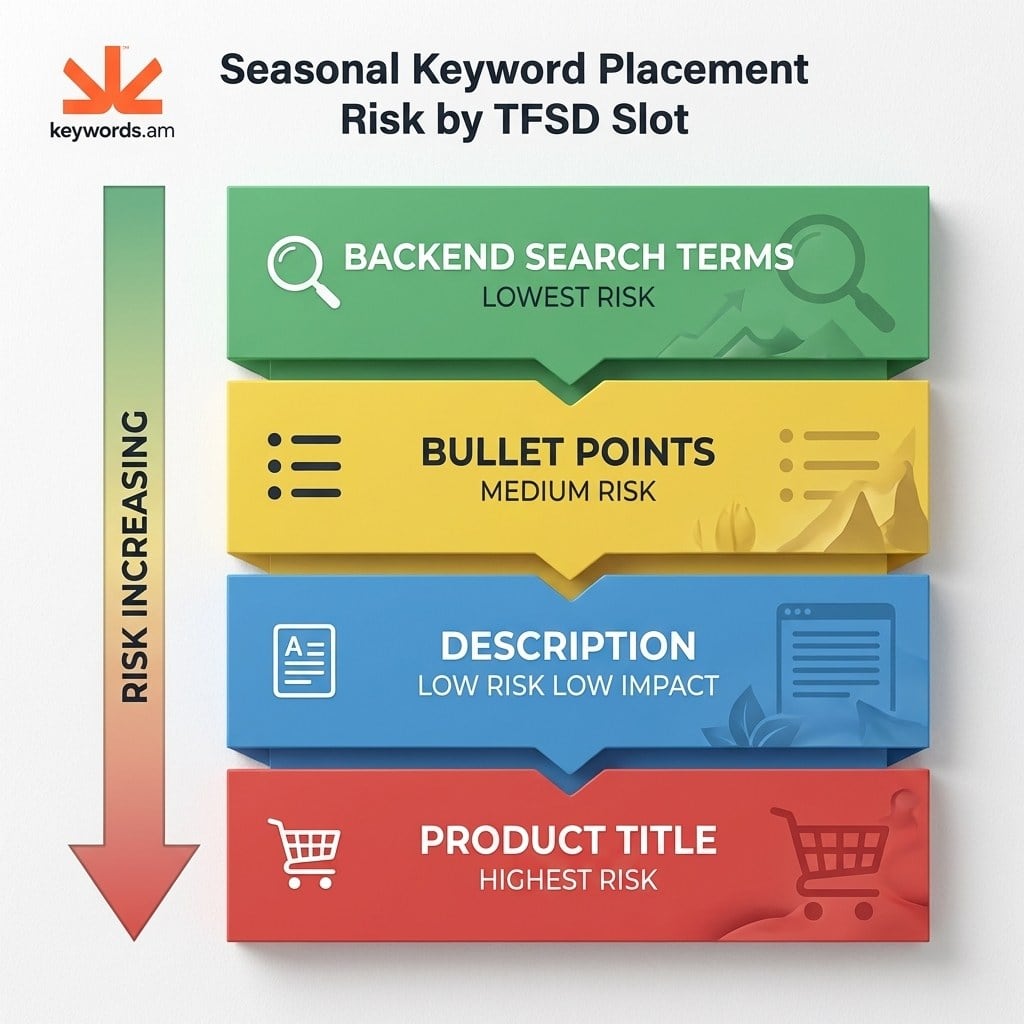
Modifying an optimized listing carries inherent danger. The Amazon A10 algorithm constantly evaluates relevance. Stuffing temporary phrases into core copy can destroy evergreen organic rank. The TFSD Framework provides a structured methodology for safe seasonal implementation.
Backend search terms (lowest risk)
The safest slot for seasonal keywords. Changes here don’t affect the visible listing or trigger re-indexing delays. Ideal for rotating terms every four to six weeks. Maximizing Amazon backend keywords captures seasonal traffic with near-zero risk to primary rankings.
Bullet points / features (medium risk)
Add a phrase like “Perfect Mother’s Day gift” to one or two bullets at most. Never rewrite the entire feature section for a temporary event. Preserve core conversion copy while adding a light seasonal touch.
Product title (highest risk)
Title changes often cause temporary rank suppression while the algorithm re-evaluates the product. Only modify titles for high-volume seasonal terms where anticipated traffic clearly justifies the risk.
Description / A+ content (low risk, low impact)
Seasonal mentions here support broad indexing but carry minimal ranking weight for competitive terms. Safe to edit, lowest direct ranking benefit.
Practical example: adding Mother’s Day keywords
- Backend: Add “mothers day gift for her” into unused backend keyword space.
- Bullet point 2: Append “Makes a thoughtful Mother’s Day gift” as the final sentence.
- Title: Do not touch unless the product already lives in the gift category year-round.
- Verify indexing: Check Amazon keyword indexing to confirm the algorithm registered the new seasonal signals.
When should sellers ramp PPC spend for seasonal keywords?
Sellers should begin ramping seasonal PPC spend six weeks before the target event, starting with broad match for discovery and narrowing to exact match as competition and CPCs rise.
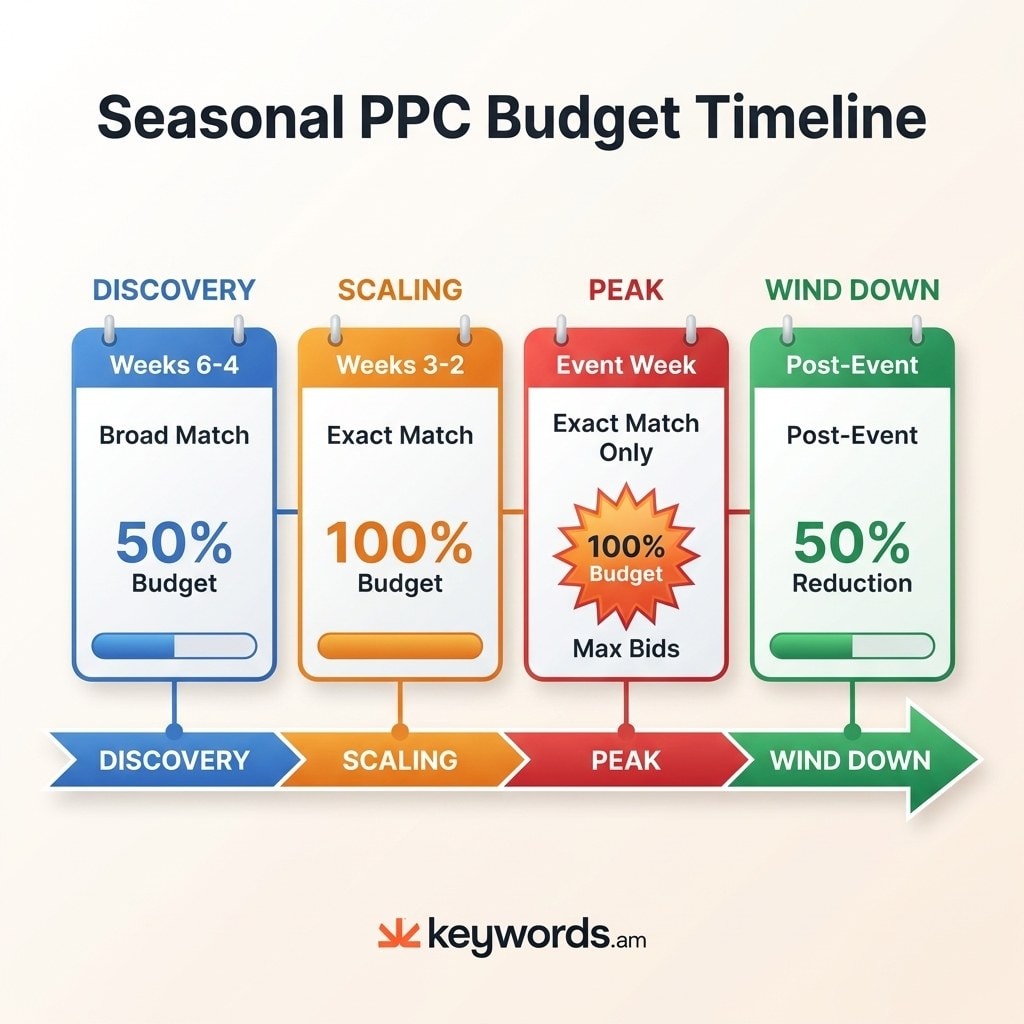
Launching campaigns the week of a holiday guarantees failure. Click costs peak during events. Without prior campaign history, ads lack the relevance scores to win premium placements.
Phase |
Timing |
Match Type |
Budget Level |
|---|---|---|---|
Discovery |
Weeks 6-4 |
Broad match + auto campaigns |
50% of target budget |
Scaling |
Weeks 3-2 |
Phrase and exact match on proven terms |
100% of target budget |
Peak Event |
Event week |
Exact match only on top performers |
Maximize bids |
Wind Down |
Post-event |
Phrase match for lingering traffic |
Reduce by 50% |
During discovery, auto campaigns surface unique Amazon long-tail keywords that bypass standard research tools. Harvest converting terms and shift them into tighter match types during scaling. This progressive refinement forms the core of a strong Amazon PPC keyword strategy.
Major events (Prime Day, BFCM, Q4 holidays) should account for roughly 40-50% of annual PPC budget. The remaining 50-60% covers year-round evergreen campaigns and minor seasonal spikes.
What happens to seasonal keywords after a holiday ends?
After a holiday ends, sellers should evaluate each seasonal keyword individually: remove terms with zero post-season traffic, keep terms that drive year-round conversions, and replace with the next season’s keywords.
The two-week evaluation window
Wait 14 days after an event before removing seasonal keywords. Shoppers hunting clearance deals or spending gift cards continue searching seasonal phrases well beyond the holiday date. A term like “gift for dad” often converts through the end of June, weeks after Father’s Day.
Post-season clearance keywords
Phrases like “after christmas sale,” “post prime day deals,” and “clearance” spike for one to two weeks after major events. Add these variations to backend keywords during the post-event window to capture discount-seeking buyers.
Data-driven keep or remove decisions
Pull SQP data or Search Term Reports and check if a seasonal keyword generated any conversions outside its primary season. If a term shows consistent off-season traffic, keep it in backend keywords year-round. The Amazon A10 algorithm rewards historical conversion stability.
Transition to the next season
Remove dead seasonal keywords that show zero lingering traffic. Replace them immediately with terms for the next upcoming event. Reference the 12-month calendar above to maintain constant momentum rather than starting from scratch every quarter.
Frequently Asked Questions About Amazon Seasonal Keyword Strategy
These are the most common questions sellers ask about building and maintaining an amazon seasonal keyword strategy.
Conclusion
Amazon seasonal demand spans all 12 months, not just Q4. The data confirms it, and sellers who plan accordingly capture revenue that competitors leave untouched.
- Backend search terms are the safest place to rotate seasonal keywords.
- Brand Analytics SQP provides free first-party data for timing seasonal shifts.
- Start PPC campaigns six weeks early, not days before the event.
- Post-season cleanup prevents relevance dilution and sets up the next cycle.
- The 12-month calendar ensures listings always point toward the next demand surge.
Open the calendar, identify the next upcoming seasonal event, and add three to five seasonal keywords to backend search terms this week. Keywords.am’s keyword research and Reverse ASIN tools help sellers pinpoint the right seasonal terms for every event on the calendar.