
📑 Table of Contents
- Why are most sellers wasting their variation keyword potential?
- How does Amazon’s algorithm handle keywords across variation families?
- How do you audit keyword coverage across a variation family?
- TFSD framework for variation keyword distribution
- Should you split variations or keep them merged?
- How do you build a PPC strategy around variation listings?
- Frequently Asked Questions About Amazon Variation Listing Strategy
- Conclusion
⚡ TL;DR
- Backend math: A 6-variation family can leverage 1,494 bytes of backend keyword space, but most sellers waste this by duplicating terms.
- Per-child indexing: Amazon indexes keywords per-child, meaning each variation has its own isolated ranking capabilities.
- Audit first: Reverse ASIN lookups on each child reveal cannibalization hotspots and untapped long-tail opportunities.
- TFSD distribution: Place broad category terms on the parent, distribute unique long-tail keywords across individual children.
- Split signal: Variation families sharing less than 20 percent of their keyword universe should be split into standalone listings.
- PPC focus: Advertise only the 1-2 top-converting children to avoid bidding against yourself.
A seller with 6 color variations of the same water bottle is theoretically sitting on 6 times 249 bytes of backend keyword space. That totals 1,494 bytes of search coverage. But if every child ASIN carries identical keywords, they use just 249 bytes across the entire family. The remaining 1,245 bytes sit empty.
Most multi-SKU sellers treat variation children as clones. They use the same title structure, the same bullet points, and the same backend terms. This creates a nightmare for sellers managing spreadsheet chaos across 10 or more SKUs. The result includes severe keyword overlap, sibling cannibalization, and hundreds of long-tail terms nobody is targeting.
A structured amazon variation listing strategy solves this problem. The process involves auditing keyword coverage across a variation family, distributing terms strategically between parent and children, and deciding when variations help or hurt search ranking. Sellers need to stop treating variations as administrative groupings and start managing them as distinct keyword real estate.
Many resources cover Seller Central setup mechanics. This guide addresses the amazon variation listing strategy layer that no one else talks about: how to research, distribute, and prioritize keywords across child ASINs.
Why are most sellers wasting their variation keyword potential?
Most sellers copy identical keywords across every child ASIN, wasting backend space and creating internal cannibalization where siblings compete for the same search terms instead of expanding total coverage.
Here’s what the clone problem looks like in practice. A seller creates one listing for a premium stainless steel water bottle with 6 color variations (Black, Navy, Forest Green, Rose Gold, Arctic White, Sunset Orange). Then they paste “stainless steel water bottle insulated BPA free” into every child’s backend. Same title. Same bullet points. Same backend terms. The assumption? More repetition strengthens the parent listing. The reality? It wastes critical indexing space.
Each child ASIN receives exactly 249 bytes of backend search terms. A 6-variation family with unique keywords per child accesses 1,494 bytes of total keyword coverage. With duplicates, the entire family uses a mere 249 bytes. The remaining allocation goes entirely unused.
Reverse ASIN analysis reveals the true cost of keyword contamination. Running a reverse ASIN search on a single child ASIN without filtering returns approximately 9,000 keywords. When applying the variation filter, only about 4,700 keywords belong to that specific child. That 4,300-keyword gap shows how search signals bleed across siblings when sellers fail to isolate them.
Meanwhile, color-specific and size-specific search terms go completely untargeted. “Rose gold water bottle”, “navy insulated bottle”, “forest green flask” — these are free long-tail terms sitting right there, but nobody’s indexing for them. A structured approach to amazon keyword cannibalization resolves overlapping signals. Once sellers identify which terms belong to which child, the internal competition stops.
But before optimizing, sellers need to understand what Amazon’s algorithm actually does with keywords across a variation family.
How does Amazon’s algorithm handle keywords across variation families?
Amazon consolidates reviews and some ranking signals across a variation family, but each child ASIN maintains its own keyword index, search rank position, and advertising eligibility independently.
Amazon selects only one child to display per search query. The algorithm evaluates relevance, sales velocity, and availability to determine the winner. Sellers don’t control which child surfaces. Searching “rose gold water bottle” should return the Rose Gold child, not the Black variation. When identical keyword targeting confuses the system, it might display a less relevant color and suppress conversion rates.
Variation families convert better than standalone listings because all children share the parent’s review count. This consolidated social proof creates a real advantage for new or lower-volume colors. A MyAmazonGuy case study documented conversion improving from 7 percent to 22 percent through variation simplification. With 95 percent of shoppers reading reviews, consolidation is a powerful lever for any amazon variation listing strategy.
Here’s the part most sellers miss: each child ASIN has its own indexed keyword set. A keyword placed in the Black bottle’s backend doesn’t index the Rose Gold child. Full stop. This per-child keyword indexing means treating the family as one entity ignores how Amazon actually crawls the catalog.
Amazon allows up to 2,000 child ASINs per parent listing. Most categories, however, cap practical variation families at 20 to 30 children before customer confusion hurts conversion rates.
Understanding per-child indexing changes everything. It means sellers need to know exactly which keywords each child currently ranks for before making adjustments.
How do you audit keyword coverage across a variation family?
Run a reverse ASIN lookup on each child ASIN individually, then build a keyword-to-variation matrix comparing coverage, gaps, and overlap across the entire family.
Start by running a reverse ASIN lookup on each child ASIN separately. Not the parent — each individual child. Use variation-level filtering to isolate keywords ranking for that specific child only. Without filtering, a reverse search returns roughly 9,000 keywords. With the filter? About 4,700. That 4,300-keyword difference is contamination from sibling ASINs, and it would’ve polluted the audit data.
Next, build a keyword-to-variation matrix. Keywords go in the rows, child ASINs in the columns. Mark which child ranks for which term. The matrix exposes three things: shared keywords all children rank for, unique terms only one child owns, and gaps where no child ranks at all.
Keyword |
Black |
Navy |
Forest Green |
Rose Gold |
Arctic White |
Sunset Orange |
|---|---|---|---|---|---|---|
stainless steel water bottle |
✓ |
✓ |
✓ |
✓ |
✓ |
✓ |
insulated water bottle BPA free |
✓ |
✓ |
✓ |
✓ |
✓ |
✓ |
rose gold water bottle |
— |
— |
— |
✓ |
— |
— |
navy insulated flask |
— |
✓ |
— |
— |
— |
— |
white water bottle for gym |
— |
— |
— |
— |
— |
— |
green hiking water bottle |
— |
— |
— |
— |
— |
— |
matte black thermos bottle |
✓ |
— |
— |
— |
— |
— |
gift water bottle for women |
— |
— |
— |
— |
— |
— |
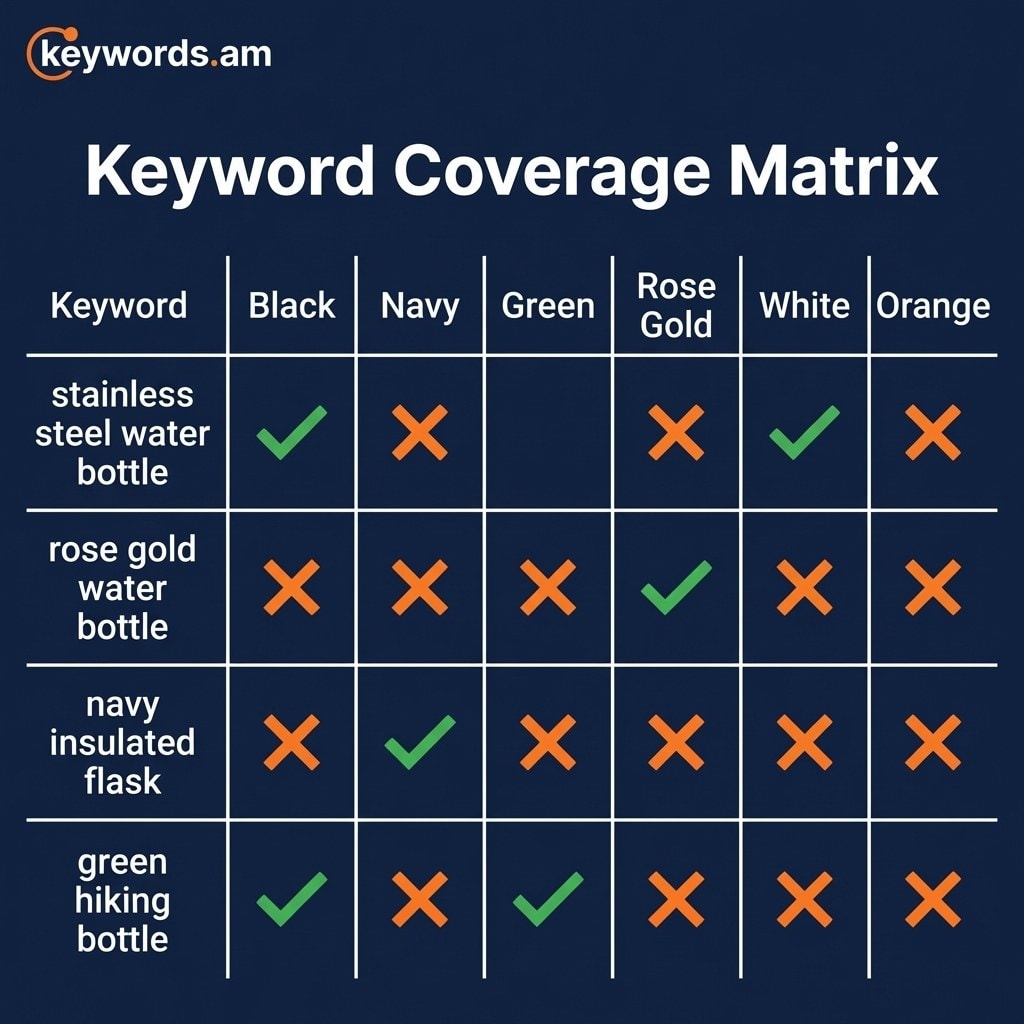
The matrix highlights cannibalization hotspots. Look for keywords where 3 or more siblings rank but none rank well (positions 30 or worse). “Stainless steel water bottle” and “insulated water bottle BPA free” are shared across all children, indicating overlapping signals. Keywords.am’s bulk ASIN audit runs this comparison across the entire family at once, grading each child’s coverage side by side.
Not all gaps require attention. Score keyword priority using the KPS feature to rank keywords by listing impact potential. Focus on terms with strong purchase intent and reasonable competition. “Gift water bottle for women” represents an uncaptured long-tail opportunity worth targeting.
The matrix reveals exactly where keywords need to go. The next step is deploying a systematic framework to distribute them between the parent and child listings.
TFSD framework for variation keyword distribution
The TFSD framework assigns broad category-defining keywords to the parent listing’s title and features, while distributing variation-specific long-tail terms across individual children’s backend search terms.
The parent listing handles broad, high-volume, category-defining keywords. Terms like “stainless steel water bottle”, “insulated water bottle”, and “BPA free water bottle” belong in the parent title and bullet points. These remain visible across all children and set the category context for the entire family. The TFSD framework guide covers parent optimization in detail.
Child listings focus on variation-specific, long-tail keywords unique to their attributes. The Rose Gold child targets “rose gold water bottle”, “pink water bottle gift”, and “rose gold gym bottle”. The Navy child owns “navy insulated flask”, “dark blue water bottle”, and “navy thermos”. Placing these terms in the right child’s backend ensures that specific searches trigger the correct variant.
Backend distribution strategy relies on utilizing the full 249 bytes per child. Instead of filling all 6 children with redundant “stainless steel water bottle insulated BPA free” text, distribute unique terms across the siblings. The parent title and features already carry the shared terms. The Swiss Army Knife for backend keywords fills only the missing bytes per child, maximizing indexing footprint across the family.
Keyword clustering organizes this process for variation families. Group keywords by variation attribute (color, size, material) and assign each cluster to the matching child. This prevents accidental overlap and keeps thematic consistency for each ASIN.
In most variation families, 1 or 2 children drive 70 to 80 percent of total sales. Audit which children perform best and invest deeper amazon variation listing strategy effort there first. If Black and Navy drive the volume, they deserve the lion’s share of keyword optimization work, not the Sunset Orange that sells three units a month.
But what happens when variations hurt more than they help? Sometimes the right strategy is to split the family apart entirely.
Should you split variations or keep them merged?
Split variations into standalone listings when children target completely different keyword universes or cannibalize each other’s rankings, and merge standalones when they share a customer base and benefit from consolidated reviews.
The decision to split depends on distinct performance signals. Break a family apart if children target different keyword universes with less than 20 percent overlap. Split underperforming siblings if 3 or more compete for the same term but none rank in the top 20. Remove a specific child if its negative reviews drag down the overall family rating.
Merging standalone listings makes sense under different conditions. Combine listings sharing 60 percent or more keyword overlap. Execute a merge when review consolidation pushes past a competitive threshold, such as combining 50 reviews per standalone into 300 combined.
Signal |
Action |
Why |
|---|---|---|
<20% keyword overlap between children |
Split into standalone listings |
Different keyword universes = different products in Amazon’s eyes |
3+ children competing for same term, none in top 20 |
Split the weakest performers |
Consolidation is splitting rank signals |
60%+ keyword overlap between standalones |
Merge into a variation family |
Review consolidation + shared traffic |
One child gets 80%+ of family sales |
Consider splitting underperformers |
Low performers dilute the family’s average metrics |
Negative reviews concentrated on one child |
Split that child out |
Protects the family’s review score |
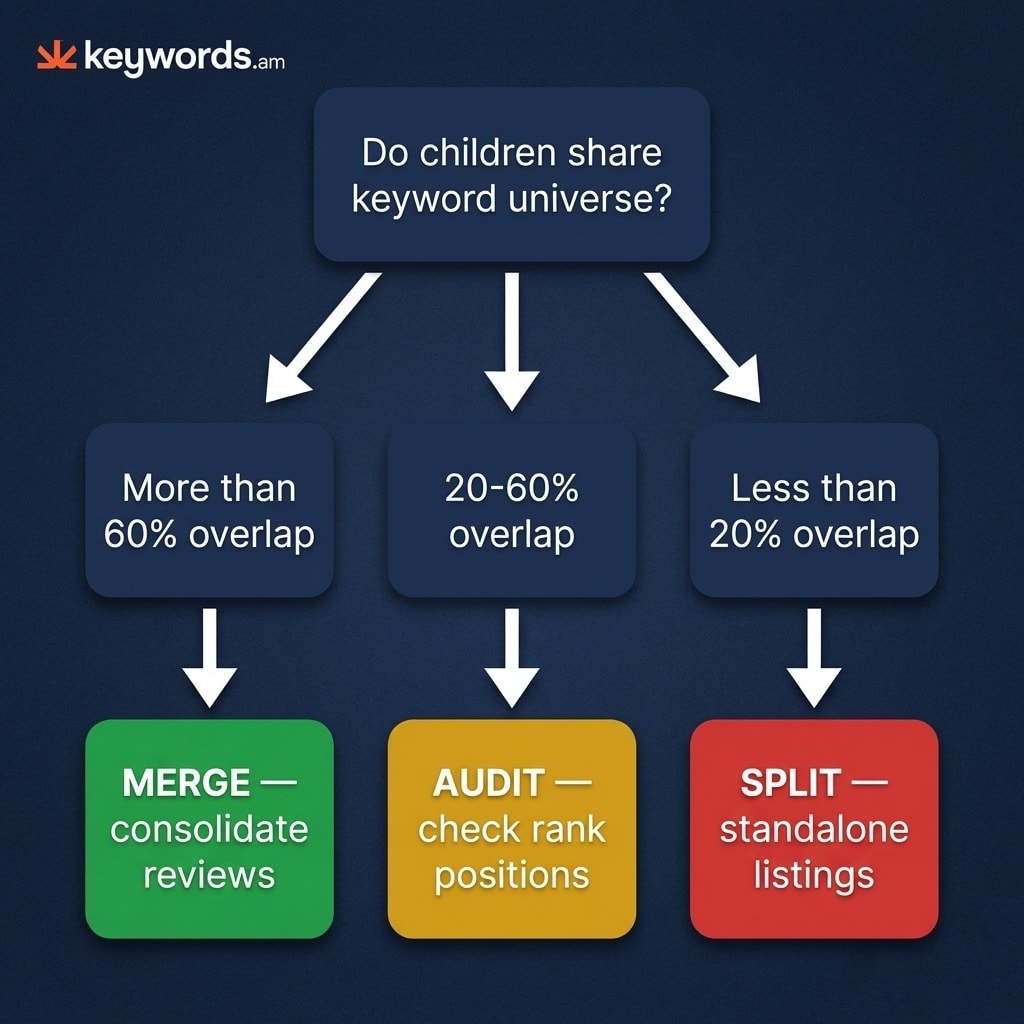
This framework directly impacts broader catalog decisions. The amazon SKU rationalization guide covers how splitting and merging affects total product footprint. Every split/merge decision should come from keyword data, not gut feelings about product aesthetics.
For the variations that stay together, a precise PPC strategy determines exactly which child receives advertising investment.
How do you build a PPC strategy around variation listings?
Advertise only the 1-2 top-converting children per variation family instead of all siblings, target variation-specific keywords per child, and use negative keywords to prevent sibling self-cannibalization in campaigns.
Budget waste occurs when sellers create Sponsored Products campaigns for every child ASIN within a variation. If all 6 water bottle children bid on “stainless steel water bottle”, they enter the same auction. The seller bids against themselves, driving up cost-per-click without gaining visibility. Amazon only shows one sponsored ad from a seller for a given keyword anyway, making the self-competition pointless.
A better amazon variation listing strategy limits advertising to the 1 or 2 top-converting children. Amazon already surfaces the best-performing child in organic results. Reinforce that algorithmic preference with targeted ad spend on those same variations. Focus the sponsored products keyword strategy on proven winners rather than spreading budget thin.
Run separate campaigns for each advertised child with variation-specific keyword targeting. The Rose Gold campaign bids on “rose gold water bottle” and “pink water bottle gift”. The Black campaign targets “matte black thermos” and “black insulated bottle”. This aligns search intent with specific PPC keyword strategy, improving click-through rates compared to generic parent listing ads.
Apply negative keywords across these campaigns. Add sibling variation attributes as negative exact matches in each child’s ad group. This prevents the Rose Gold campaign from triggering on “navy water bottle” searches. Strict negative matching forces the ad engine to respect the keyword boundaries established during organic optimization.
Use Sponsored Products product targeting to capture competitor traffic. Target a competitor’s parent ASIN to appear on all their children’s product pages simultaneously. One well-placed ad on a competitor’s variation listing can pull traffic from their entire family.
Frequently Asked Questions About Amazon Variation Listing Strategy
An effective variation strategy requires understanding exactly how Amazon processes relationships between parent and child ASINs.
Conclusion
A copy-paste approach to Amazon variation listings leaves valuable keyword real estate sitting empty. Treating each child ASIN as a unique asset unlocks ranking potential that most sellers never touch.
- Keyword indexing occurs on a per-child basis, making duplicated backend terms a waste of 249 bytes per SKU.
- Building a keyword-to-variation matrix exposes cannibalization hotspots and highlights exactly where long-tail gaps exist.
- The TFSD framework structurally separates broad parent keywords from variation-specific child terms.
- Advertising budgets should flow exclusively to the top-converting children to prevent internal bidding wars.
Here’s the 30-minute version: run a reverse ASIN lookup on each child ASIN in your best-selling variation family. Build a keyword-to-variation matrix in a spreadsheet. Identify the first 10 gap keywords and distribute them into the appropriate child’s backend search terms.
Then apply the TFSD framework to distribute what’s missing across the rest of the family. Variations can multiply search coverage — but only when each child carries keywords worth ranking for.