Listing Optimization
Best Amazon Q&A optimization strategy for rankings (most sellers miss this)
Amazon Q&A optimization feeds Rufus AI and COSMO rankings directly. Learn the proactive seeding framework that turns customer questions into keyword placements.

More than 250 million customers have used Amazon’s Rufus AI shopping assistant, and usage is up 140% year over year. When Rufus answers a shopper’s question like “is this water bottle dishwasher safe?”, it pulls from Q&A data directly. Most sellers optimize four listing fields: title, features, search terms, and description. They ignore Q&A entirely. The result? Rufus answers shopper questions using competitor Q&A instead. This article walks through a proactive framework for seeding keyword-rich questions and writing COSMO-friendly answers, turning Amazon Q&A optimization from customer service into a strategic ranking play. No other guide connects keyword research data to a question seeding strategy like this.
Does Amazon Q&A actually affect product ranking?
Amazon Q&A feeds both the COSMO knowledge graph and Rufus AI directly, making it an active ranking signal that influences search placement and AI-generated product recommendations. COSMO extracts product attributes and user intent from Q&A text to build knowledge relationships between products and search queries. This acts as Amazon’s “common sense” layer, mapping how products connect to shopper needs. Rufus AI is trained on the product catalog, customer reviews, and community Q&A. It synthesizes these sources when answering shopper questions using a retrieval-augmented generation (RAG) approach, retrieving relevant Q&A before composing answers. When COSMO was deployed to 10% of U.S. search traffic, it drove a 0.7% increase in purchases and an 8% boost in shopper engagement. Customers who use Rufus during shopping are 60% more likely to complete a purchase. Since Rufus pulls Q&A data, and Rufus users convert at a higher rate, Q&A quality directly impacts conversion metrics.
How does Amazon use Q&A data in COSMO and Rufus?
COSMO extracts product attributes from Q&A text to build knowledge graphs, while Rufus uses retrieval-augmented generation to pull Q&A content into AI-generated shopping answers. Q&A text enters COSMO’s multi-stage process: seed generation, refinement via critic classifiers, and scaling through instruction-tuned language models. This produces millions of knowledge entries across 18 product categories. The practical takeaway for sellers? COSMO reads Q&A and extracts structured product knowledge from it. Rufus employs a RAG architecture. Before answering a shopper question, Rufus retrieves relevant product data (including Q&A), then generates a response that synthesizes multiple sources. A shopper asking “is this water bottle good for hiking?” might receive an answer from Rufus that pulls a Q&A entry mentioning “BPA-free, fits in backpack side pockets, keeps water cold 24 hours.” The knowledge graph updates every 7-14 days , so Q&A changes take 1-2 weeks to propagate through COSMO. Sellers can plan update cycles accordingly. COSMO rewards clarity and context, not keyword density. Q&A answers need to be semantically rich and well-structured, not stuffed with keywords. For more on how the Amazon search algorithm processes listing data, or a deeper look at Rufus AI listing optimization, those guides cover the broader context.
The proactive Q&A seeding framework (using keyword data to find the right questions)
Proactive Q&A seeding uses Search Term Reports, SQP data, and reverse ASIN analysis to identify the 10-15 information-seeking queries most likely to surface in Rufus conversations. Here’s the five-step process:
- Pull information-seeking queries from the Search Term Report. Filter for queries containing “does”, “how”, “can”, “is”, “will”, or “what” that generated impressions but had low clicks. These indicate buyers asking questions rather than purchasing, making them ideal seed candidates. The keyword research methodology guide covers this analysis in depth.
- Cross-reference with Brand Analytics SQP data. Look for queries where the product appears but doesn’t convert well. Low purchase share despite high impression share signals an information gap that Q&A can fill. The Brand Analytics SQP guide details this analysis.
- Run reverse ASIN on the top three competitors. Identify queries they rank for that have question intent. These are the questions Rufus is already answering using competitor data. Keyword research tools like Keywords.am’s reverse ASIN feature surface these competitive gaps.
- Convert query-intent combinations into natural seed questions. For a stainless steel water bottle listing, these might include: “Does this 32oz stainless steel water bottle fit in a standard car cupholder?”, “How long does this water bottle keep drinks cold?”, or “Is this water bottle safe for kids to use at school?”
- Write keyword-optimized answers for each seeded question. The answer quality dictates COSMO’s attribute extraction (covered in the next section).
How should sellers write keyword-optimized Q&A answers for COSMO?
Structure answers with a direct attribute statement first, expand with supporting context, and include long-tail keywords naturally. This gives COSMO clear entity-attribute pairs to extract. Lead every answer with a direct entity:attribute statement. For instance: “Yes, this 32oz stainless steel water bottle is dishwasher safe (top rack only, BPA-free construction).” The first sentence is what COSMO extracts, so make it count. Expand with 2-3 supporting sentences that naturally include related long-tail keywords. “The double-wall vacuum insulation keeps water cold for 24 hours, making it ideal for hiking, gym sessions, and daily commuting.” One answer can target several long-tail queries simultaneously.
Weak answers vs. COSMO-optimized answers
| Question | Weak Answer | Strong, COSMO-Optimized Answer |
|---|---|---|
| Is this water bottle dishwasher safe? | Yes it is. | Yes, this 32oz stainless steel water bottle is dishwasher safe on the top rack. The food-grade 18/8 stainless steel and BPA-free lid are both heat resistant up to 230F. |
| How long does it keep drinks cold? | About a day. | The double-wall vacuum insulation keeps beverages cold for up to 24 hours and hot for 12 hours, perfect for all-day hydration on hikes or at the office. |
| Is it safe for kids to use? | Absolutely! | This water bottle features a spill-proof lid and durable, BPA-free materials, making it safe and easy for children to use at school or during sports activities. |
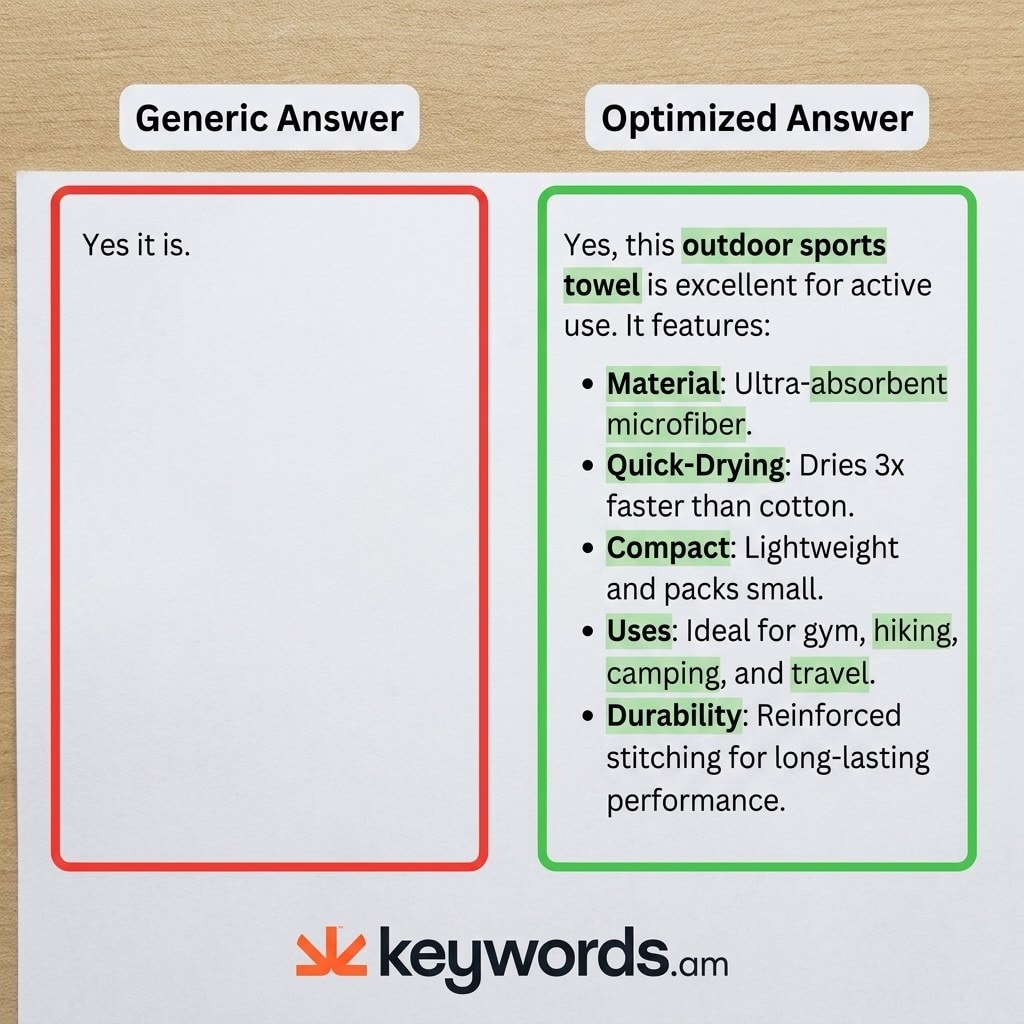
Avoid keyword stuffing. COSMO evaluates semantic coherence, not keyword density. An answer that reads unnaturally performs worse than a clean, structured response. This principle aligns with the TFSD Framework, extending optimization beyond traditional listing fields by focusing on contextual relevance.
How do you audit your existing Amazon Q&A section?
Audit existing Q&A by identifying unanswered questions, weak one-line answers, and high-value keyword gaps where competitors have Q&A coverage but the listing does not.
- Export all Q &A from the top 10 ASINs. Categorize each as “answered well,” “answered poorly” (under 20 words or generic), or “unanswered.” Unanswered questions are particularly damaging. Rufus might surface the question with no brand answer, leaving shoppers to rely on community responses.
- Map answered Q &A against the target keyword list. Identify keywords that appear in the title, bullets, or backend keywords but have zero Q&A coverage. These are “keyword gaps” where Q&A can provide coverage for conversational queries that don’t fit into structured fields. This is an extension of the broader Amazon keyword audit workflow.
- Check competitor Q &A on the top five competing ASINs. Note questions and keywords they cover that the listing does not. This competitive intelligence reveals what Rufus is already answering about the category using competitor data.
Where does Q&A fit alongside title, bullets, A+, and backend keywords?
Q&A captures conversational queries and edge-case compatibility questions that don’t fit in structured listing fields, making it the 5th pillar of listing optimization beyond TFSD. Q&A has no character limit and no indexing cap. Every answer provides additional searchable text, a stark contrast to the strict byte limits of the title (200 bytes) and backend (249 bytes).
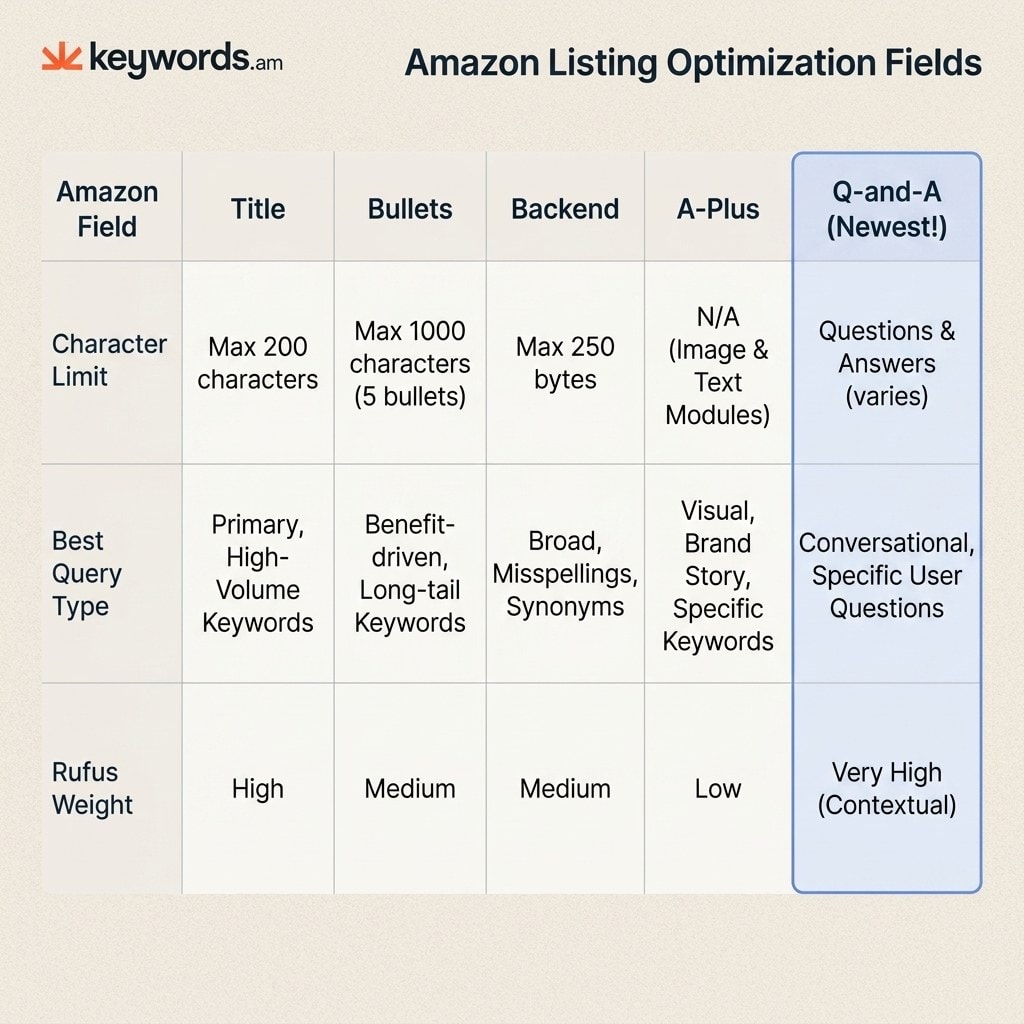
| Field | Best For | Character/Byte Limit | Rufus Weight | Example Queries Captured |
|---|---|---|---|---|
| Title | Primary keywords, brand, size | 200 bytes | High | ”stainless steel water bottle 32oz” |
| Bullets | Feature benefits, use cases | 500 bytes each | High | ”insulated water bottle for gym” |
| Backend | Synonyms, misspellings | 249 bytes | Medium | ”waterbottle”, “thermos flask” |
| A+ Content | Visual storytelling, comparison | No byte limit | Medium | Detailed feature exploration |
| Q&A | Conversational questions, compatibility, edge cases | No limit | High (Rufus primary source) | “does this fit in a honda civic cupholder” |
Q&A captures the long tail that structured fields cannot. This includes compatibility questions like “does this fit in a Honda Civic cupholder,” use-case specifics such as “is this ideal for hot yoga,” and material safety concerns like “is this food-grade stainless steel?” These question types would never fit naturally into a product title or bullet points. Rufus weighs community Q&A heavily alongside reviews when answering product-specific questions. Optimized Q&A can positively impact the Amazon conversion rate. For a deeper dive into visual listing content, the A+ content optimization guide covers that complementary field, and brand-registered sellers can also explore Amazon Posts as another discovery-focused channel alongside Q&A.
Frequently Asked Questions About Amazon Q&A Optimization
These are the most common questions sellers ask about Amazon Q&A optimization, from logistics to measurement.
Can sellers post questions on their own Amazon listings?
Amazon allows anyone with an account to ask questions on product listings, and sellers can answer as the brand through Seller Central’s “Manage Your Customer Questions” dashboard. Use a personal Amazon account (not the seller account) to seed questions. Write questions that match the information-seeking queries from keyword research. Amazon’s guidelines prohibit misleading or promotional questions, so frame them as genuine buyer concerns.
How many Q&A entries should a listing have for optimal ranking?
Aim for 15-25 answered questions per ASIN, prioritizing coverage of top keyword clusters and common purchase hesitations over raw question count. Quality matters more than quantity. Well-researched, keyword-optimized Q&A entries outperform generic one-line answers. Focus on covering the top search terms and the questions Rufus is most likely to surface.
Does Amazon Q&A affect PPC relevance and ad targeting?
Q&A text contributes to Amazon’s understanding of product relevance, which indirectly influences the queries where Sponsored Products ads can appear and their relevance scores. While Q&A is not a direct PPC input, the semantic signals it provides to COSMO help Amazon understand what queries a product is relevant for. Better Q&A coverage means improved organic and paid keyword matching.
Can Q&A content cause listing suppression?
Q&A itself does not trigger listing suppression, but answers containing prohibited claims (medical, safety, or compliance statements) can flag a listing for review. Avoid making health claims, warranty promises, or pricing guarantees in Q&A answers. Stick to factual product attributes and use cases. If a customer asks about regulatory compliance, direct them to product documentation.
How does Q&A interact with A+ content for Rufus AI?
Rufus reads both A+ content and Q&A but weighs Q&A more heavily for direct product questions because Q&A follows a question-answer format that matches shopper query patterns. A+ content excels at visual storytelling and brand narrative. Q&A excels at specific, factual product answers. They complement rather than compete. Optimize both for maximum Rufus coverage.
How long do Q&A changes take to affect rankings?
COSMO knowledge graph updates propagate every 7-14 days, so expect Amazon Q&A optimization changes to start influencing search placement and Rufus answers within 1-2 weeks. This is faster than A+ content changes, which can take longer to re-index. Track impact using the Search Term Report. Compare query-level impressions and clicks in two-week windows before and after optimization.
Conclusion
Amazon Q&A optimization is the most underutilized ranking lever available. COSMO extracts product knowledge from Q&A text, and Rufus serves this data to the 250 million+ shoppers using the AI assistant. Proactive seeding with keyword data consistently outperforms reactive answering. Writing answers in a clear, entity:attribute format gives COSMO exactly what it needs to extract. Auditing existing Q&A against the keyword list reveals gaps and opportunities that competitors are already filling. Start this week: Pull the Search Term Report, filter for information-seeking queries, and convert the top five into seed questions. For sellers identifying which keywords to target in Q&A strategy, Keywords.am’s reverse ASIN and keyword research tools surface the exact queries competitors rank for, including the conversational long-tail queries that belong in Q&A.